

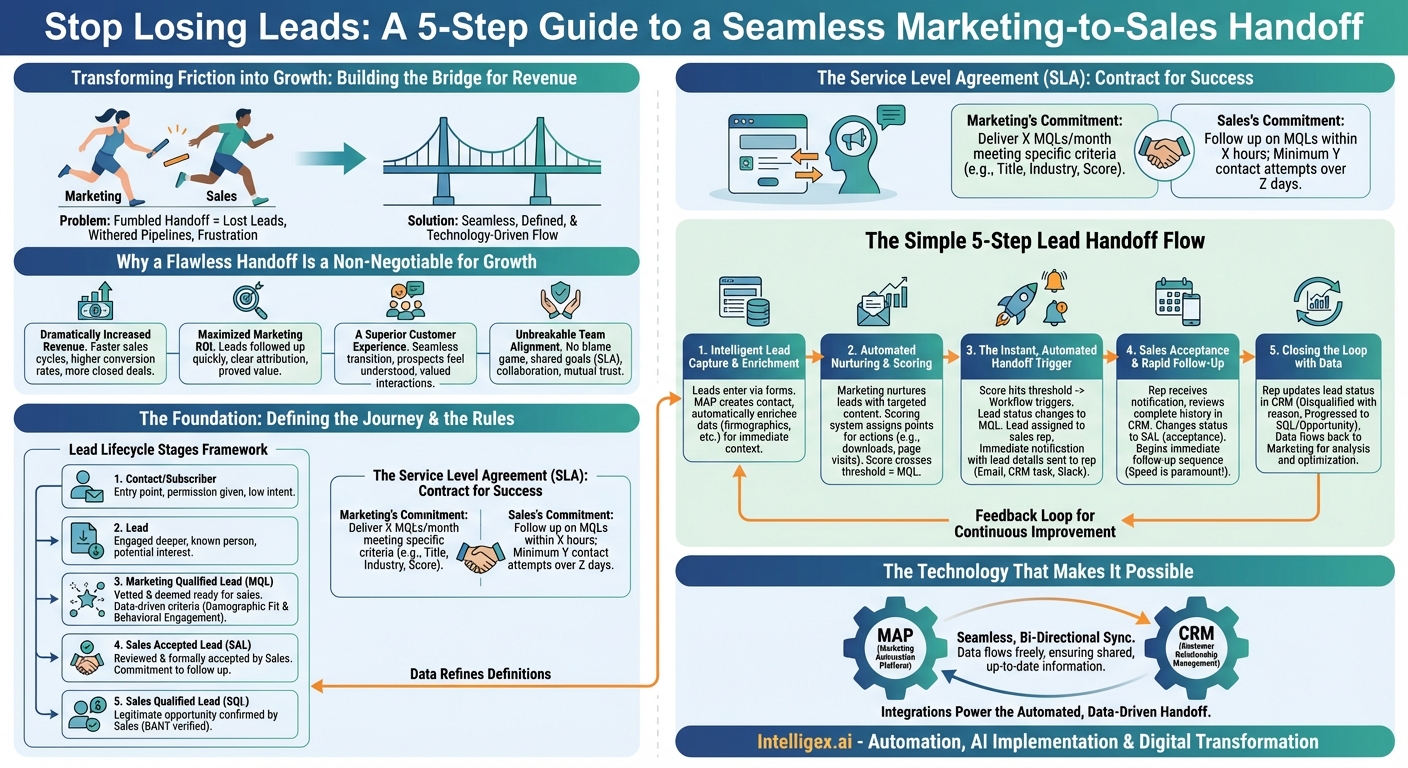
The relationship between marketing and sales departments can sometimes feel like a clumsy relay race. Marketing runs its leg of the race with gusto, generating awareness and capturing interest, only to fumble the baton pass. The sales team, waiting expectantly, either misses the handoff entirely or receives a lead so cold and unqualified it might as well have been dropped on the track. This friction point—the lead handoff—is one of the most common and costly breakdowns in the entire revenue generation process. It’s where marketing ROI goes to die, where sales pipelines wither, and where potential customers get lost in a frustrating abyss of silence or mismatched communication.
But it doesn’t have to be this way. Creating a seamless, simple, and automated flow for handing off leads from marketing to sales is not just an operational nicety; it is the fundamental bridge that connects a brilliant marketing strategy to a high-performing sales engine. By establishing clear definitions, agreed-upon rules, and a technology-driven process, you can transform the handoff from a point of friction into a powerful engine for growth, ensuring every qualified lead is treated like the valuable asset it is.
Why a Flawless Handoff Is a Non-Negotiable for Growth
Before diving into the “how,” it’s crucial to understand the “why.” The downstream effects of a well-oiled handoff process permeate the entire organization, delivering tangible benefits that go far beyond departmental harmony.
- Dramatically Increased Revenue: This is the ultimate goal. When sales receives leads that are properly qualified, informed, and timely, their conversion rates skyrocket. They spend less time chasing ghosts and more time engaging in meaningful conversations with prospects who are genuinely interested. A faster, more efficient sales cycle directly translates to more closed-won deals and a healthier bottom line.
- Maximized Marketing ROI: Marketing teams invest significant time, creativity, and budget into attracting and engaging potential customers. A broken handoff process effectively nullifies that investment. When leads are followed up on quickly and effectively, the return on every marketing dollar spent increases. You can clearly attribute revenue back to specific campaigns, proving the value of marketing’s efforts and justifying future budgets.
- A Superior Customer Experience: From the customer’s perspective, they don’t see a marketing department and a sales department; they see one company. A clunky handoff is jarring. The prospect, who just downloaded an insightful whitepaper, doesn’t want to re-explain their needs and interests to a sales rep who has no context. A smooth transition ensures the conversation continues seamlessly, making the prospect feel understood and valued from their very first interaction.
- Unbreakable Team Alignment: The infamous “blame game” between sales and marketing (“Marketing sends us junk leads!” vs. “Sales doesn’t follow up on our leads!”) evaporates when a clear process is in place. With shared definitions and mutual accountability enshrined in a Service Level Agreement (SLA), both teams operate as a single revenue unit. This fosters a culture of collaboration, trust, and shared success, which is far more productive and enjoyable for everyone involved.
The Foundation: You Can’t Hand Off What You Haven’t Defined
The single biggest reason for handoff failure is a lack of a shared vocabulary. If marketing’s definition of a “hot lead” is different from sales’s, you’re destined for conflict. The first step is to collaboratively build a framework for the lead lifecycle.
Establishing the Lead Lifecycle Stages
While the specifics can vary, most successful frameworks include these key stages:
- Contact/Subscriber: The entry point. This is anyone in your database, perhaps someone who signed up for a newsletter. They’ve given you permission to communicate but haven’t shown significant buying intent.
- Lead: A step up. This individual has engaged more deeply, perhaps by downloading a top-of-funnel content piece like an ebook or checklist. They are a known person with a potential, but unconfirmed, interest.
- Marketing Qualified Lead (MQL): This is the most critical stage in the handoff process. An MQL is a lead that marketing has vetted and deemed ready for a sales conversation based on a specific set of criteria. This isn’t a gut feeling; it’s data-driven. Qualification is typically based on a combination of:
- Demographic/Firmographic Fit: Does the lead match your Ideal Customer Profile (ICP)? This includes data like job title, industry, company size, and location.
- Behavioral Engagement: What has the lead done? Their digital body language—visiting the pricing page, watching a product demo, downloading a case study—indicates their level of interest and intent.
- Sales Accepted Lead (SAL): The official handshake. This is an MQL that the sales team has reviewed and formally accepted, committing to follow up. This step is a crucial checkpoint to ensure that sales agrees with marketing’s qualification.
- Sales Qualified Lead (SQL): After speaking with the lead, the sales rep has confirmed that there is a legitimate opportunity. They’ve likely verified budget, authority, need, and timeline (BANT) or a similar qualification framework.
The Service Level Agreement (SLA): Your Contract for Success
An SLA is a formal agreement that documents the commitments of both marketing and sales, creating mutual accountability. It removes ambiguity and sets clear expectations.
A simple SLA should define:
- Marketing’s Commitment: “The marketing team will deliver 150 MQLs per month that meet the mutually agreed-upon qualification criteria (e.g., Director-level or above, in the software industry, company size of 100+, and a lead score of 75 or higher).”
- Sales’s Commitment: “The sales team will follow up on every MQL assigned to them within 2 hours. They will make a minimum of 5 contact attempts over 10 business days before disqualifying the lead.”
This SLA becomes the rulebook that governs the entire process, providing a clear basis for measuring performance and identifying bottlenecks.
The Simple 5-Step Lead Handoff Flow
With the foundational definitions and agreements in place, you can now build a simple, automated workflow. The goal is to make the process as frictionless and hands-off as possible, relying on technology to do the heavy lifting.
Step 1: Intelligent Lead Capture and Enrichment
Leads enter your ecosystem through various channels—website forms, webinar registrations, content downloads. As soon as a lead submits a form, the process begins. This is where a Marketing Automation Platform (MAP) is essential. The MAP acts as the central brain, instantly creating a contact record. But it doesn’t stop there. Modern systems can automatically enrich this data, using just an email address to pull in valuable firmographic information like company size, industry, and revenue. This gives sales immediate context without having to ask the lead 20 questions on a form.
Step 2: Automated Nurturing and Scoring
Very few leads are ready to buy the moment they first interact with you. Pushing them to sales prematurely is a recipe for failure. Instead, marketing uses the MAP to nurture these leads with targeted email sequences and relevant content based on their interests. Simultaneously, a lead scoring system runs in the background. This system assigns points to leads based on their attributes and actions.
For example:
- Job Title “VP” or “Director”: +15 points
- Industry is “Manufacturing”: +10 points
- Visited Pricing Page: +20 points
- Downloaded a Case Study: +15 points
- Unsubscribed from Email: -50 points
A lead’s score dynamically increases as they become more engaged. Once their score crosses a predefined threshold (e.g., 75 points), they automatically become an MQL. This threshold is the data-driven trigger for the handoff.
Step 3: The Instant, Automated Handoff Trigger
The moment a lead’s score hits the MQL threshold, an automated workflow kicks into gear. This is the technical handoff, and it should be instantaneous. Manually exporting spreadsheets and emailing them to sales is a slow, error-prone process from a bygone era. The workflow should automatically:
- Change the lead’s lifecycle stage from “Lead” to “MQL” in your CRM.
- Assign the lead to a sales representative based on predefined rules (e.g., round-robin for fairness or territory-based for organization).
- Fire off an immediate notification to the assigned rep via their preferred channel—an email, a Slack message, or a task directly within their CRM. This notification should include key information and a direct link to the lead’s record.
Step 4: Sales Acceptance and Rapid Follow-Up
The notification prompts the sales rep to act. They click the link and are taken to the lead’s record in the CRM, which now contains a complete history of every marketing interaction—every page visited, email opened, and form filled out. They can see exactly why this person is considered an MQL. Satisfied that the lead is legitimate, the rep takes two crucial actions:
- They change the lead’s status to “Sales Accepted Lead” (SAL). This action signals back to the marketing team that the baton has been successfully received.
- They begin their follow-up sequence immediately, as outlined in the SLA. Research from Harvard Business Review shows that firms that tried to contact potential customers within an hour of receiving a query were nearly 7 times as likely to qualify the lead as those that tried to contact the customer even an hour later. Speed is paramount.
Step 5: Closing the Loop with Data
The handoff isn’t over until data flows back to marketing. This feedback loop is what makes the entire system intelligent and self-improving. As the sales rep works the lead, they update its status in the CRM.
- If the lead is disqualified: The rep must provide a reason (e.g., “No Budget,” “Wrong Contact,” “Unresponsive”). This data is invaluable for marketing. A high volume of “No Budget” disqualifications might mean marketing is attracting the wrong audience. A high volume of “Unresponsive” leads might mean the MQL threshold is too low.
- If the lead progresses: As the lead moves from SAL to SQL to a closed-won Opportunity, this data is also tracked. It allows marketing to see which campaigns, content, and channels are not just generating MQLs, but generating actual revenue. This allows them to double down on what works and cut what doesn’t.
The Technology That Makes It Possible
This simple flow is powered by the tight integration of two core platforms:
- Customer Relationship Management (CRM): This is the system of record for the sales team (e.g., Salesforce, HubSpot CRM). It houses all contact, account, and opportunity data.
- Marketing Automation Platform (MAP): This is the engine for the marketing team (e.g., HubSpot, Marketo, Pardot). It manages lead capture, email nurturing, and lead scoring.
The magic happens when these two systems have a seamless, bi-directional sync. Data flows freely between them, ensuring that both teams are always looking at the same, up-to-date information. This integration is the technical backbone that makes an automated, data-driven handoff a reality.
By moving away from the “over-the-wall” approach and implementing this simple, structured flow, you’re not just improving a single business process. You are building a scalable revenue machine. You are fostering a culture of collaboration, aligning your teams around the shared goal of growth, and ensuring that no lead is ever left behind. Stop fumbling the baton and start building a bridge. The finish line—and your revenue goals—are waiting.
Your Next Read:
Get a FREE
Proof of Concept
& Consultation
No Cost, No Commitment!