

In today’s connected enterprise, data doesn’t live in one place. Your customer information is in a CRM, your financial records are in an ERP, and your marketing leads are in an automation platform. The value of this data is highest when it’s connected, consistent, and available where your teams need it. But how that data moves between systems, and more importantly when, is a critical decision that directly impacts your efficiency, costs, and ability to serve your customers.
The choice between moving data in scheduled groups (batch synchronization) or instantly (real-time synchronization) isn’t just a technical detail for the IT department. It’s a strategic business decision. Choosing the wrong method can lead to costly rework, missed opportunities, and frustrated teams working with outdated information. Choosing the right one streamlines operations, empowers faster decision-making, and creates a seamless foundation for digital transformation.
Understanding the Core Difference: The “When” of Data Movement
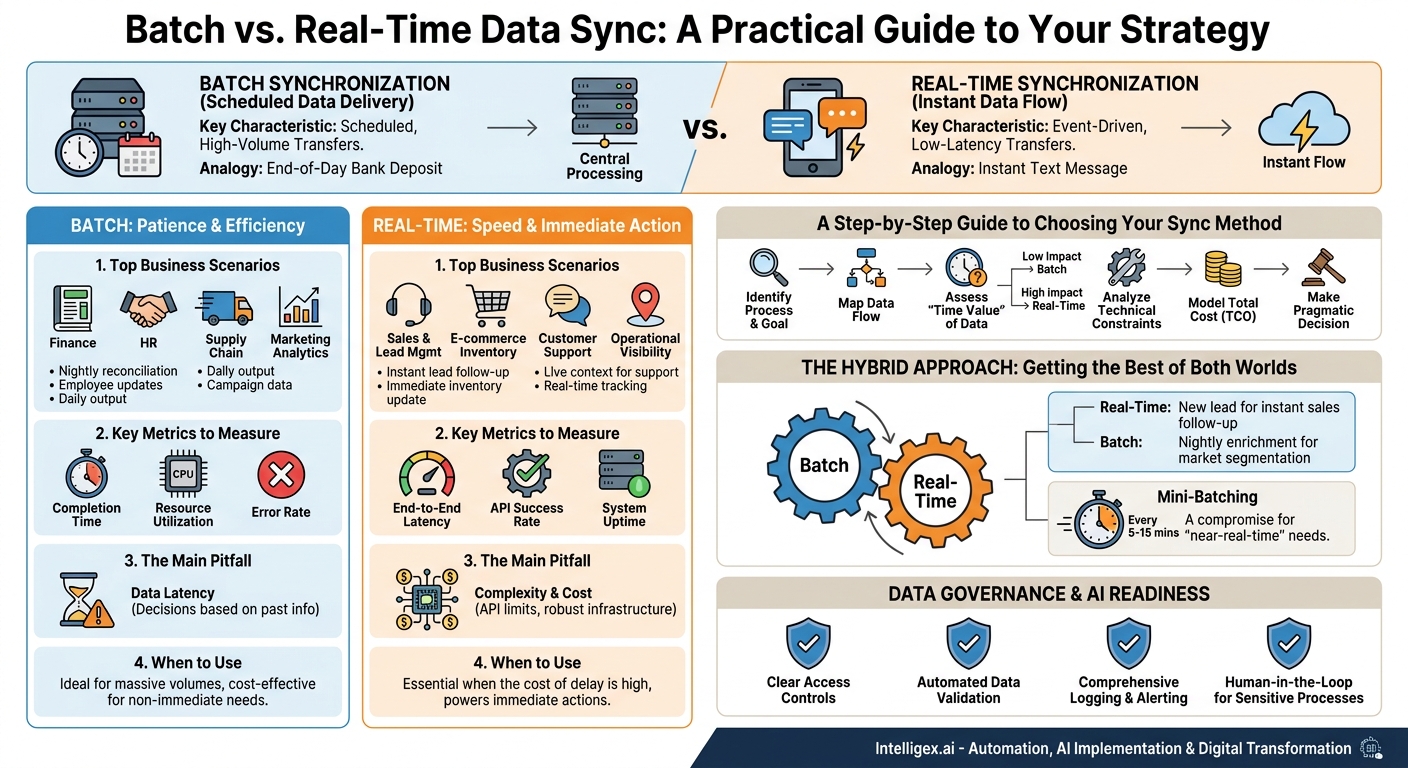
At its heart, the difference between batch and real-time synchronization is about timing and volume. Think of it like receiving mail. Batch processing is like the traditional postal service: the mail carrier collects everything for the day, sorts it at a central facility, and delivers it to you in one bundle. Real-time processing is like a text message: the information is sent and received almost instantaneously.
Batch Synchronization: Scheduled Data Delivery
In a batch process, data is collected, processed, and moved in large groups, or “batches,” on a set schedule. This schedule could be nightly, hourly, or even weekly, depending on the business need. The system waits until a specific time or a certain volume of data is accumulated before initiating the transfer.
- Key Characteristic: Scheduled, high-volume transfers.
- Analogy: End-of-day bank deposits or a nightly news summary.
Real-Time Synchronization: Instant Data Flow
Real-time synchronization, often facilitated by webhooks or APIs, moves data from one system to another the moment an event occurs. When a user fills out a “Contact Us” form on your website, a real-time process immediately creates a new lead in your CRM. There is no scheduled delay; the data transfer is part of the event itself.
- Key Characteristic: Event-driven, low-latency transfers.
- Analogy: A live stock ticker or instant messaging.
While “real-time” sounds inherently better, it’s not always the right or most cost-effective choice. The best approach depends entirely on the business context.
Batch Synchronization: When Patience is a Virtue (and a Cost Saver)
Batch processing is the workhorse of data integration. It’s reliable, efficient for large datasets, and generally less complex to build and maintain. Its primary business value lies in its ability to handle massive volumes of data in a cost-effective and resource-friendly manner, making it ideal for processes where immediacy is not a critical factor.
Top Business Scenarios for Batch Sync
- Finance and Accounting: Running nightly reconciliation between your sales platform and your accounting software like NetSuite is a perfect use case. There is no business need to reconcile every single transaction the second it happens; a daily summary is sufficient for closing the books.
- Human Resources: When a new employee is added to your core HRIS, a nightly batch job can update their profile in secondary systems like the IT service desk or the internal communications platform. Instant updates are rarely necessary.
- Supply Chain and Logistics: A manufacturing facility might send a daily batch file of its production output to the central ERP system. This provides the data needed for long-term planning without overwhelming the network with constant updates.
- Marketing Analytics: Syncing large volumes of campaign performance data from Google Ads or LinkedIn into a data warehouse for analysis is best done in a nightly batch. This allows analysts to work with a complete, consistent dataset from the previous day.
What to Measure for Batch Processes
Success isn’t about speed, but reliability and efficiency. Key metrics include:
- Batch Completion Time: How long does the entire job take to run? Is this time increasing?
- Resource Utilization: How much CPU and memory does the process consume? This helps in capacity planning and cost management.
- Error Rate Per Batch: What percentage of records failed to process? This is a crucial indicator of data quality issues at the source.
The Main Pitfall: The biggest drawback of batch is data latency. Decisions are always based on past information, which could be hours or even a day old. For operational roles that need up-to-the-minute data, this is a significant limitation.
Real-Time Synchronization: The Need for Speed
Real-time data flow is essential when the cost of delay is high. It powers immediate actions, enhances the customer experience, and provides a true, live view of your business operations. While more complex and often more expensive than batch, its value is undeniable in the right context.
Top Business Scenarios for Real-Time Sync
- Sales and Lead Management: When a potential customer requests a demo on your website, that lead should appear in your CRM (like Salesforce) instantly. A 24-hour delay means a competitor may have already called them. Real-time sync enables immediate sales follow-up when buyer intent is highest.
- E-commerce Inventory Management: If a customer buys the last blue sweater on your website, the inventory level must be updated immediately across all other channels, including your Amazon storefront and physical store POS systems, to prevent overselling.
- Customer Support: A support agent using a tool like Zendesk needs a real-time view of a customer’s recent orders and interactions. Pulling this data from the e-commerce platform on-demand as the agent opens the ticket provides them with the context to resolve the issue quickly and effectively.
- Operational Visibility: A logistics manager tracking a fleet of delivery vehicles needs real-time GPS data to optimize routes and respond to delays. A daily data dump would be useless for managing in-the-moment operations.
What to Measure for Real-Time Processes
Here, success is measured in seconds and reliability. Key metrics include:
- End-to-End Latency: The time (in milliseconds or seconds) from the moment the event occurs in the source system to when the data is available in the destination system.
- API Success Rate: The percentage of API calls that complete successfully. A high failure rate indicates systemic issues.
- System Uptime: Real-time processes are often critical. They must be monitored for availability just like any other mission-critical application.
The Main Pitfall: Real-time integrations are more complex and costly. They require careful management of API limits, robust error handling for individual transaction failures, and infrastructure that can handle unpredictable bursts of traffic.
A Step-by-Step Guide to Choosing Your Sync Method
Making the right choice requires a clear-eyed assessment of the business process, not just the technology. Follow these steps to guide your decision.
- Identify the Business Process and its Goal. Be specific. Don’t just say “sync contacts.” Define the process, like “Onboarding a New Customer,” and its goal, which is “to provide the customer with access to our platform and notify their account manager within 5 minutes of a signed contract.”
- Map the Data Flow. Identify the trigger, the source system, the destination system, and the exact data fields required. For our example, the trigger is “Contract Status = Signed” in the CRM. The source is the CRM, the destination is the user provisioning platform, and the data is the customer’s name, email, and subscription level.
- Assess the “Time Value” of the Data. This is the most critical step. Interview the people who use the data. Ask them directly: “What is the business impact if you get this data in 5 seconds versus tomorrow morning?”
- A low-impact answer (“I just need it for my weekly report”) points to batch.
- A high-impact answer (“I lose the sale if I can’t call them within 10 minutes”) demands real-time.
- Analyze Technical Constraints and Capabilities. Consult with your IT team or integration partner. Do the source and destination systems have modern, event-based APIs (like webhooks)? Or do they only support scheduled file exports? Check the API rate limits; a “chatty” real-time integration can easily exceed the number of calls allowed per hour, causing it to fail. For cloud platforms, review the official documentation (e.g., AWS documentation on service quotas).
- Model the Total Cost of Ownership (TCO). Factor in all costs. Real-time sync may involve higher subscription costs for API usage, more cloud computing resources, and more specialized development and maintenance skills. Batch sync may require less infrastructure but could have hidden costs in manual oversight or the business cost of data delays.
- Make a Pragmatic Decision. Based on the previous steps, choose the method that delivers the required business value without over-engineering. Remember, the goal is not to use the most advanced technology, but the most appropriate one.
The Hybrid Approach: Getting the Best of Both Worlds
The decision is not always a binary choice between batch and real-time. A hybrid strategy often provides the optimal balance of performance, cost, and complexity. In a hybrid model, you use real-time sync for urgent, event-driven data and batch sync for less critical, high-volume data, even within the same overall business process.
For example, a customer relationship management system might be integrated in two ways:
- Real-Time: A new lead from a web form is created in the CRM instantly to enable immediate sales follow-up.
- Batch: A nightly batch job enriches all contacts in the CRM with demographic data from a third-party provider. This data is valuable for market segmentation but is not needed in real-time.
Another common middle ground is “mini-batching.” Instead of running a large job once per day, the process runs every 5, 10, or 15 minutes. This provides more current data than a nightly batch without the complexity and cost of a true real-time, event-driven architecture. It’s an excellent compromise for scenarios where “near-real-time” is good enough.
Data Governance and AI Readiness
Your data integration strategy is the foundation of your data governance and AI initiatives. The method you choose has direct implications for data quality, security, and privacy.
Real-time processes can propagate errors just as quickly as they propagate good data. If a faulty record is entered, it can instantly cause issues in downstream systems. This requires robust, automated validation and error-handling logic to catch and isolate bad data before it spreads.
Batch processes offer a natural checkpoint. You can validate an entire dataset for quality, completeness, and consistency before loading it into the destination system. However, a single major error in a batch file can delay the entire dataset, creating a different kind of operational risk.
Regardless of the method, a safe implementation should always include the following governance checks:
- Clear Access Controls: Define and enforce who can create, modify, or manually trigger data synchronization jobs. This prevents unauthorized or accidental data transfers.
- Automated Data Validation: Implement rules to check data before it moves. For example, ensure an email address field is formatted correctly or that an order total is a positive number.
- Comprehensive Logging and Alerting: Plan for failure. Your system should log every transaction (or batch run) and automatically send alerts to the right team when a sync fails.
- Human-in-the-Loop for Sensitive Processes: When using synced data to feed an AI model or make automated decisions (e.g., credit scoring, customer segmentation), build in steps for human review to monitor for accuracy, fairness, and unexpected outcomes.
Your Next Steps: From Decision to Action
Choosing between batch and real-time synchronization is a fundamental step in building a connected and efficient organization. The decision should always be anchored in the specific business need, the value of data freshness, and a realistic assessment of your technical capabilities and budget.
Don’t try to solve everything at once. Start small and build momentum. Here is a simple action plan to get started:
- Target a Process: Identify one specific, high-value business process that is currently hampered by data silos or delays.
- Ask the Right Questions: Walk through the step-by-step guide in this post with the stakeholders of that process. Focus on quantifying the business cost of data delay.
- Bridge the Gap: Schedule a 30-minute meeting between the business owner (e.g., Head of Sales) and the IT lead or integration specialist. Use your findings as the agenda to align on the problem and potential solutions.
- Pilot and Measure: Start with a small pilot project to prove the value. Whether it’s a nightly batch sync or a single real-time workflow, measure its impact on the key metrics you identified. Success from a small, well-defined project is the best way to build the case for broader digital transformation.