

In a complex supply chain, the most critical moments are often the quietest. They happen in the instant a baton is passed from one team to another. A sales order becomes a production plan. A finished product becomes an outbound shipment. A proof of delivery becomes a paid invoice. When these handoffs are smooth, the entire operation feels effortless. But when they fail, the result is a cascade of friction, delays, and costs that reverberate from the warehouse floor to the customer’s doorstep.
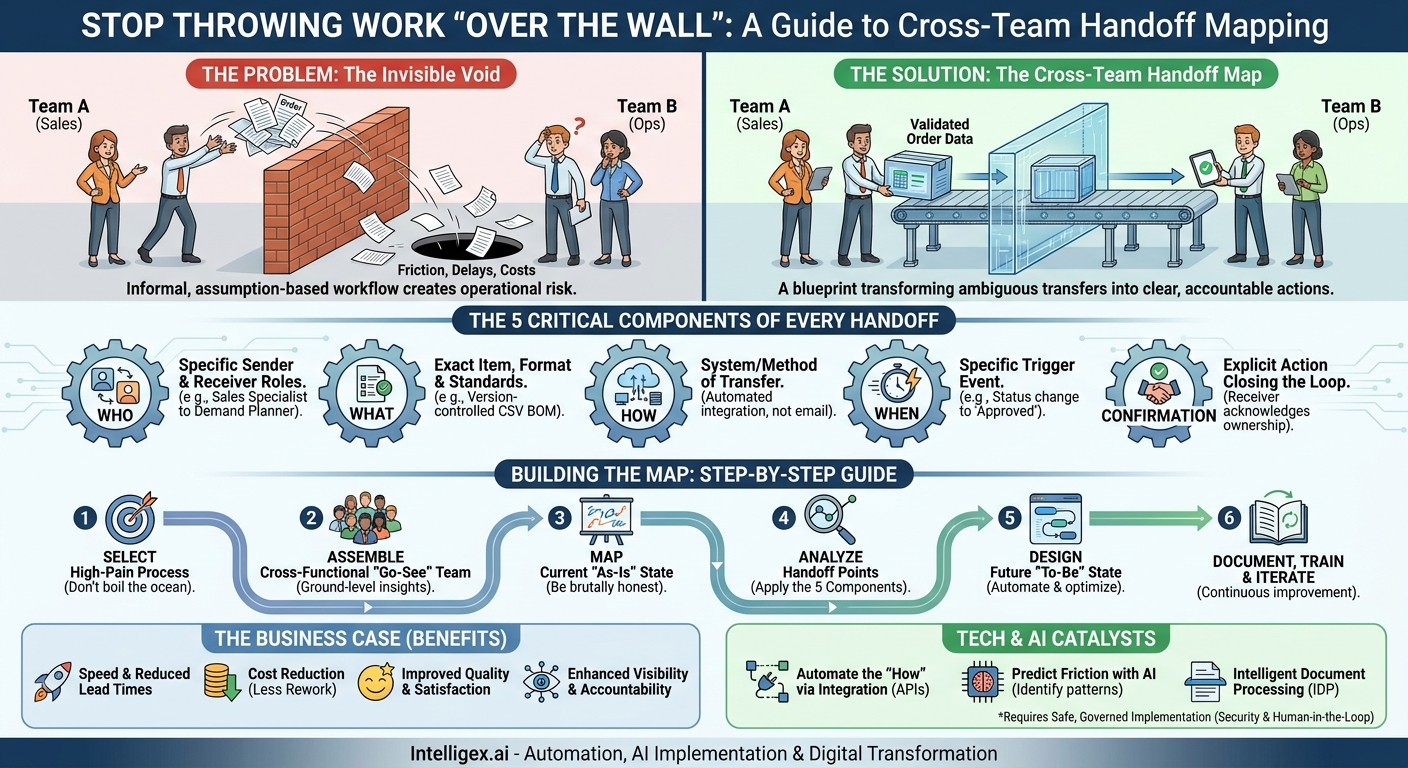
The problem is that these handoff points are often treated as invisible voids. Sales closes a deal and “throws it over the wall” to operations. Procurement orders materials without confirming the latest engineering specs. The warehouse receives a shipment with no advance notice. This informal, assumption-based workflow is a massive operational risk. The solution is to make the invisible visible with a Cross-Team Handoff Map, a detailed blueprint that transforms ambiguous transfers into clear, accountable, and efficient actions.
What is a Cross-Team Handoff Map?
A Cross-Team Handoff Map is far more than a simple flowchart. While a process diagram shows the sequence of tasks, a handoff map focuses specifically on the points of transfer, detailing the precise agreements between teams. It’s a tactical document that defines the rules of engagement for every time responsibility, data, or a physical item moves from one group to the next.
A truly effective map clarifies five critical components for every single handoff:
- Who: The specific sending and receiving roles or teams. It is not enough to say “Sales to Ops.” It should be “The Sales Operations Specialist hands off to the Demand Planner.”
- What: The exact information, document, or physical item being transferred. This includes data formats, required fields, and quality standards. For example, not just a “Bill of Materials,” but a “Version-controlled Bill of Materials in CSV format.”
- How: The system or method used for the transfer. Is it a direct update in the ERP system, an automated notification via an integration platform, or a shared file upload? The goal is to move away from unreliable channels like email.
- When: The specific trigger that initiates the handoff. This could be a status change in a system (e.g., “Order Status changed to ‘Approved'”), a time-based event, or the completion of a prior task.
- Confirmation: The explicit action the receiver takes to acknowledge they have accepted the handoff and now own the next step. This closes the loop and eliminates ambiguity about who is responsible.
Consider a practical example: the handoff from the Engineering team (who just finalized a product design) to the Procurement team (who needs to source the components). A weak process is an email with an attachment. A mapped process defines it like this:
Handoff: Final Bill of Materials (BOM) for Sourcing
- Sender: Lead Design Engineer
- Receiver: Strategic Sourcing Specialist
- What: The final, approved BOM (in the standard ERP format), including approved supplier part numbers for all Tier 1 components.
- How: Engineer changes the project status in the Product Lifecycle Management (PLM) system to “Released for Procurement.” This action automatically pushes the BOM data to the ERP.
- When: Triggered by the final design review approval.
- Confirmation: The Sourcing Specialist receives an automated task in their ERP dashboard and changes the BOM status to “Sourcing in Progress” within 24 hours, confirming receipt.
This level of detail removes guesswork, establishes clear ownership, and creates a digital paper trail that is essential for troubleshooting and process improvement.
The Business Case: Eliminating Friction and Finger-Pointing
Mapping handoffs isn’t an academic exercise; it’s a direct lever for improving core business metrics. By focusing on these critical connection points, you can drive significant value across the organization.
Speed and Reduced Lead Times
Handoffs are where momentum dies. Time is wasted chasing down missing information, clarifying ambiguous requests, or waiting for someone to notice an email in their inbox. A well-defined handoff map acts as an accelerator. The receiving team gets everything they need in the right format, through the right channel, at the right time, allowing them to begin their work immediately. This systematically shaves hours or even days off processes like order fulfillment and procurement cycles.
Cost Reduction
Sloppy handoffs create expensive mistakes. Ordering the wrong materials because of an outdated spec sheet leads to scrap and rework. Shipping to the wrong address because of a manual data entry error results in costly redelivery fees and wasted fuel. A clear handoff map with defined data standards and automated checks is one of the most effective forms of error-proofing. It reduces the costs associated with rework, expedited shipping, and excess inventory held “just in case.”
Improved Quality and Customer Satisfaction
Quality is a team sport, and handoffs are where a team can drop the ball. When the production team receives incomplete assembly instructions from engineering, or the logistics team lacks the customer’s specific delivery requirements, the final product or service suffers. By ensuring the integrity of information as it flows through the value chain, you directly impact the quality of the end product and the accuracy of the delivery, leading to higher customer satisfaction and fewer returns.
Enhanced Visibility and Accountability
When something goes wrong, a common response is a multi-team investigation to figure out what happened. A handoff map replaces this reactive scramble with proactive clarity. It serves as a single source of truth for who is responsible for what. If a deadline is missed, you can instantly see which handoff was delayed and why. This shifts the culture from one of blame to one of collective ownership and data-driven problem-solving.
Scalability
You cannot scale a business based on tribal knowledge. Relying on “asking Jane because she’s been here 10 years” is not a sustainable growth strategy. A documented handoff map is a critical tool for scaling operations. It allows you to onboard new employees faster, train teams consistently, and even replicate processes across new facilities or geographies with confidence.
Building Your First Handoff Map: A Step-by-Step Guide
The thought of mapping your entire supply chain can be overwhelming. The key is to start small with a single, high-impact process and build from there. Follow these practical steps to create your first map.
- Select a High-Pain, High-Gain Process. Don’t boil the ocean. Pick one process that is notoriously slow, error-prone, or a constant source of inter-departmental friction. Excellent candidates include “Procure-to-Pay,” “Order-to-Cash,” or the “New Product Introduction” process. Choose a process where the potential for improvement is clear.
- Assemble a Cross-Functional “Go-See” Team. You must include the people who actually perform the work, not just their managers. A successful mapping session for an order process would include a sales rep, a customer service agent, a warehouse picker, and an accounts receivable clerk. Their ground-level insights are non-negotiable. Keep the group small, ideally 5-7 people.
- Map the Current State (The “As-Is”). Get everyone in a room with a large whiteboard or virtual collaboration tool. Ask each person to walk through their piece of the process. Focus on the handoffs. Ask questions like: “What do you need to receive before you can start your work?”, “How do you receive it?”, “What do you do if it’s wrong or incomplete?”, and “Who do you hand your completed work off to?” Be brutally honest and document everything, including the workarounds, spreadsheets, and follow-up emails.
- Isolate and Analyze the Handoff Points. Look at the map you’ve created and circle every point where work moves from one person or team to another. For each of these handoffs, dissect it using the five components: Who, What, How, When, and Confirmation. This is where the pain points will become obvious (e.g., “We rely on a shared spreadsheet that anyone can edit,” or “I have to manually check my email for the shipping confirmation.”).
- Design the Future State (The “To-Be”). This is the creative part. Go through each handoff point and redesign it for efficiency and reliability. Challenge every manual step. Can an email be replaced with an automated system notification? Can manual data entry be eliminated by connecting two systems? Can a quality check be a required digital gate for the next step to begin? The goal is to design a process that is as automated, seamless, and error-proof as possible.
- Document, Train, and Iterate. Convert your whiteboard sketch into a clean, accessible document or diagram. This becomes the official playbook. But a document alone is not enough. You must train the relevant teams on the new process and, crucially, explain the “why” behind the changes. Finally, schedule a review in 30 or 60 days to see how the new process is working and make adjustments. Continuous improvement is key.
The Role of Technology and AI in Smart Handoffs
While the mapping process itself is about people and process first, technology is the catalyst that transforms a good handoff map into a great one. Modern tools can automate, accelerate, and add intelligence to your handoffs.
Automating the “How” with Integration
The most significant opportunity for improvement lies in automating the transfer of information. Manually re-keying data from a sales order in your CRM (like Salesforce) into your ERP system is slow and a major source of errors. Using integration platforms and APIs to connect these systems allows data to flow instantly and accurately. This is the foundation of a connected, digital supply chain. When systems talk to each other directly, the handoff becomes the seamless background execution of a business rule, not a manual task for an employee.
Predicting Friction with AI
This is a practical, high-value application of AI that avoids hype. Machine learning models can be trained on your historical supply chain data to identify patterns that predict future delays at specific handoff points. For example, an AI model might learn that orders with certain custom configurations, shipped to specific international locations, have a 70% chance of being delayed at the customs handoff. Armed with this insight, the system can proactively flag such an order for review by a compliance expert *before* it reaches the shipping dock, allowing them to prepare the necessary documentation in advance.
Intelligent Document Processing (IDP)
Many handoffs still rely on unstructured documents like PDF invoices, packing slips, or purchase orders received via email. IDP uses AI to “read” these documents, extract the relevant information (like invoice number, quantity, and price), and automatically enter it into your systems. This automates the incredibly tedious and error-prone task of manual data entry, freeing up your teams for higher-value work and ensuring the data passed in the handoff is accurate from the start.
A Note on Safe and Governed Implementation
Integrating technology, especially AI, into your handoffs requires a thoughtful approach to governance.
- Data Security and Access Control: As you connect systems, you must ensure that sensitive data is protected. Use role-based access controls to ensure that an employee in the warehouse can see shipping information but not the customer’s payment history. Every data transfer must adhere to your company’s security and privacy policies.
- Human-in-the-Loop Oversight: The goal of automation and AI is to augment your team, not replace their judgment. For critical decisions, such as approving a large payment or changing a production schedule, the system should flag exceptions and present them for human review. An AI might recommend a substitute part, but an engineer should make the final approval.
Measuring Success: Metrics for a Healthy Handoff
To know if your new handoff map is working, you need to measure its impact. Focus on metrics that directly reflect the efficiency and quality of the transfers themselves, as well as their effect on the overall process.
- Handoff Cycle Time: How long does it take from the moment the sender completes their task to the moment the receiver confirms receipt? This measures the “dead time” in your process. Your goal is to get this as close to zero as possible.
- First-Pass Yield: What percentage of handoffs are completed perfectly the first time, requiring no follow-up questions, corrections, or additional information? A high first-pass yield (e.g., 99%+) is a strong indicator of a clear and well-designed process.
- Error Rate by Handoff Point: Track where mistakes are happening. Are 30% of your data entry errors occurring during the logistics-to-finance handoff? This data tells you exactly where to focus your next improvement effort.
- Overall Process Lead Time: The ultimate test. Are your improved handoffs actually making the entire Order-to-Cash or Procure-to-Pay cycle faster? Seeing a reduction in these high-level metrics confirms that your targeted improvements are impacting the business as a whole.
Your Next Steps: From Whiteboard to Workflow
Improving cross-team handoffs is one of the highest-return activities you can undertake to improve your supply chain. It untangles hidden complexities, fosters a culture of shared responsibility, and builds a solid foundation for digital transformation. Use this checklist to get started:
- Have we identified the single most painful process to map first?
- Is every team that touches that process represented in our mapping session?
- Have we clearly defined the “Who, What, How, When, and Confirmation” for each handoff?
- Is our new, improved map documented and easily accessible to everyone involved?
- Do we have a simple plan to measure our success before and after the change?
The path forward doesn’t require a massive, multi-year project. It starts with a single process and a single meeting. Gather the right people, arm them with a whiteboard, and give them permission to be honest about what’s broken. That act of creating shared visibility is the first and most important step toward building a faster, more resilient, and more collaborative supply chain.
Related Posts
Get a FREE
Proof of Concept
& Consultation
No Cost, No Commitment!
