

In the high-stakes world of B2B sales, momentum is everything. A deal moves through the pipeline, building energy with each successful call, demo, and negotiation. But then, it hits a wall. The quote is delayed. The contract is stuck in legal. The data needed to make a final push is buried in a spreadsheet. This all-too-common scenario is where the sales engine sputters, and it’s almost always a symptom of friction within Sales Operations. Sales Ops is the unsung hero of a high-performing sales organization, the central nervous system that should enable, streamline, and accelerate the entire sales motion. When this system is plagued by delays, it doesn’t just frustrate your reps—it actively costs you revenue, cripples productivity, and damages the customer experience. These bottlenecks are often seen as “the cost of doing business,” but they are, in fact, solvable problems that, when addressed, can unlock immense growth potential.
The Cascade Effect: Why Sales Ops Delays are So Costly
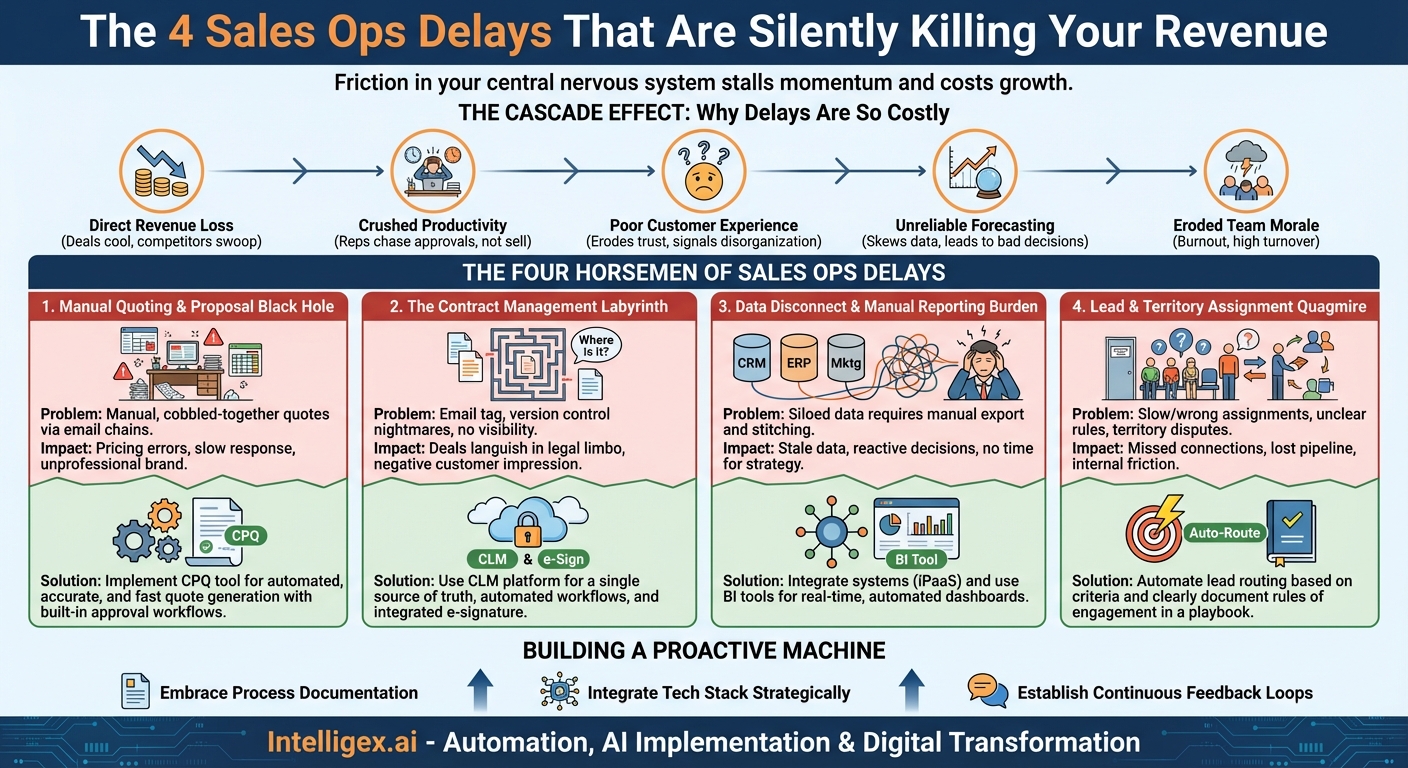
It’s easy to underestimate the true impact of an internal process delay. A two-day wait for a quote might seem minor in the context of a six-month sales cycle. However, these small delays have a powerful compounding effect that ripples across the entire organization. Understanding these costs is the first step toward building a business case for fixing them.
- Direct Revenue Loss: This is the most obvious consequence. When a deal stalls due to internal friction, it gives your champion’s internal enthusiasm time to cool. It opens the door for competitors to swoop in with a faster, smoother process. Time kills all deals, and Sales Ops delays are a primary accomplice.
- Crushed Sales Productivity: Every hour a sales rep spends chasing an internal approval, manually building a proposal, or trying to get a contract redlined is an hour they are not selling. Top-performing reps are expert communicators and relationship builders, not administrators. Forcing them to navigate a maze of clunky internal processes is a gross misallocation of your most valuable resource.
- A Poor Customer Experience: Your sales process is part of your customer experience. A prospect who has to wait a week for a simple quote or gets tangled in a confusing contracting process will rightly question your company’s ability to deliver on its promises post-sale. A slow, inefficient process signals disorganization and can erode the trust your sales team worked so hard to build.
- Unreliable Forecasting: Delays create noise in your pipeline data. A deal that should close this month gets pushed to the next quarter simply because of a paperwork jam. This skews pipeline velocity metrics, makes sales forecasts wildly inaccurate, and leads to poor strategic decisions by leadership who are operating with flawed data.
- Eroded Team Morale: Nothing burns out a high-energy sales team faster than constant internal roadblocks. When reps feel like they are fighting their own company just as hard as they are fighting the competition, morale plummets. This leads to higher turnover and a culture of frustration rather than a culture of winning.
The Four Horsemen of Sales Ops Delays
While every organization has its unique challenges, most B2B Sales Ops delays can be traced back to a few common culprits. By identifying and targeting these core issues, you can create the most significant and immediate improvements in your sales cycle velocity.
Delay #1: The Manual Quoting and Proposal Black Hole
This is often the first major bottleneck a deal encounters after a prospect expresses serious interest. The rep is ready to formalize the offer, but the process of creating the actual document is a journey fraught with peril.
The Problem: Sales reps are forced to become quote-building artisans. They piece together pricing from disparate spreadsheets, copy and paste product descriptions from outdated documents, and manually calculate discounts. They then have to email this cobbled-together quote to their manager for approval, who might then forward it to finance, creating a long and untraceable email chain. The entire process is manual, error-prone, and painfully slow.
The Impact: This manual approach leads to a host of issues. Pricing errors slip through, promising discounts the company can’t honor. Branding is inconsistent, making your company look unprofessional. Most importantly, the customer is left waiting for days, giving them ample time to explore other options. The rep, meanwhile, is stuck playing the role of a project manager instead of a seller.
The Solution: The answer lies in standardization and automation. Implementing a Configure, Price, Quote (CPQ) tool is the gold standard. A CPQ system centralizes all product and pricing information, allowing reps to quickly generate accurate, professional-looking quotes in minutes. It can automatically handle complex product bundles, subscriptions, and usage-based pricing. Furthermore, you can build automated approval workflows directly into the system. For example, any discount under 10% is auto-approved, while anything over 25% is automatically routed to the VP of Sales, creating a fast and compliant process.
Delay #2: The Contract Management Labyrinth
You’ve secured a verbal “yes.” The finish line is in sight, but now you must navigate the treacherous final mile: the contract. This stage is notorious for derailing deals and extending sales cycles by weeks, or even months.
The Problem: The process often begins with a rep searching for the “latest” Master Service Agreement (MSA) template. The document is then sent back and forth between the rep, the prospect, and your legal team via email. Version control becomes a nightmare (“Is this MSA_v4_final_FINAL.docx the right one?”). There is zero visibility into where the contract is in the approval process. Is it sitting in legal’s inbox? Is it waiting for an executive signature? Nobody knows.
The Impact: Deals languish in legal limbo. The lack of a central repository and clear workflow means documents get lost and momentum dies. This final, frustrating step can leave a lasting negative impression on a new customer, tarnishing the relationship before it even officially begins.
The Solution: A dedicated Contract Lifecycle Management (CLM) platform is essential for any B2B company of scale. A CLM system acts as a single source of truth for all contracts. It provides a library of pre-approved legal templates, tracks all changes and redlines, and manages the entire version history automatically. You can build sophisticated, automated approval chains, ensuring the contract moves seamlessly from legal to finance to the required executives without manual intervention. Integrating an e-signature tool like DocuSign or Adobe Sign is the final piece, allowing for a secure and instantaneous signing process that eliminates the need for printers and scanners.
Delay #3: The Data Disconnect and Manual Reporting Burden
In the modern sales organization, data is the fuel for growth. But for many Sales Ops teams, accessing and interpreting that data is a monumental, time-consuming task.
The Problem: Critical sales data lives in silos. CRM data is in Salesforce, marketing engagement data is in HubSpot, product usage data is in a separate database, and finance data is in the ERP. To create a meaningful report—like a weekly forecast roll-up or a quarterly business review deck—the Sales Ops team must manually export data from multiple systems, clean it up, and stitch it together in massive spreadsheets. This process can take days of a skilled analyst’s time.
The Impact: By the time the report is delivered, the data is already stale. Sales leaders are making critical decisions based on lagging indicators, not a real-time view of the business. They lack the ability to quickly drill down into performance issues or identify emerging trends. The Sales Ops team is trapped in a reactive cycle of report-building, with no time left for the strategic analysis that could actually move the needle.
The Solution: The key is integration and automation. Invest in data integration tools (like Zapier or a more robust iPaaS solution) to create a seamless flow of information between your core systems. A unified view of the customer journey becomes possible. The next step is to automate reporting by connecting your CRM or data warehouse to a Business Intelligence (BI) tool like Tableau, Power BI, or Looker. Build automated, self-service dashboards that display your key performance indicators (KPIs) in real-time. This frees up Sales Ops to focus on high-value activities like process optimization and strategic planning, while empowering sales leaders with the immediate insights they need.
Delay #4: The Lead and Territory Assignment Quagmire
The speed at which you respond to a new inbound lead is one of the single greatest predictors of your chances of winning their business. Yet, this initial handoff is frequently a source of significant and costly delays.
The Problem: A new lead arrives from the website but sits in an unassigned queue for hours, or even days. Or, when it is assigned, it’s sent to the wrong person. In other scenarios, reps argue over territory ownership or account assignments, causing leads to be passed around or simply ignored as everyone assumes it’s someone else’s responsibility. The rules of engagement are unclear, undocumented, or unenforced.
The Impact: Studies have shown that the odds of connecting with a lead decrease dramatically within the first hour. A delay of even a few hours can mean the prospect has already engaged with a more responsive competitor. This internal disorganization directly translates into lost pipeline and revenue, all while creating unnecessary friction and resentment within the sales team.
The Solution: Automation and clarity are paramount. Use your CRM’s native capabilities or a dedicated lead routing tool to implement automated assignment rules. Leads can be instantly routed based on a wide range of criteria: geography, company size, industry, product interest, or a round-robin system for equitable distribution. It’s equally important to clearly define and document your territory rules and rules of engagement. This “Sales Playbook” should be the single source of truth, eliminating ambiguity and disputes. When a new lead comes in, there should be no question about who owns it and what the expected follow-up time is.
Building a Proactive, Frictionless Sales Ops Machine
Fixing these common delays is not just about reacting to problems; it’s about building a fundamentally better operational foundation. The goal is to evolve Sales Ops from a reactive support function into a proactive strategic partner to the sales organization.
First, embrace ruthless process documentation. If a process isn’t written down, it doesn’t really exist. Create a central Sales Ops playbook that details everything from lead routing rules to the discount approval matrix. This ensures consistency, simplifies onboarding for new hires, and makes it easier to identify areas for improvement.
Second, view technology as a strategic enabler, not a silver bullet. The goal isn’t just to buy more tools, but to build an integrated tech stack where each component solves a specific problem and reduces friction. Your CRM, CPQ, CLM, and BI tools should work together in harmony to create a seamless experience for both your reps and your customers.
Finally, establish a continuous feedback loop with the sales team. Sales Ops cannot operate in a vacuum. Create formal and informal channels—like a dedicated Slack channel or regular office hours—for reps to share what’s working and what’s causing them pain. Your reps are on the front lines, and their insights are invaluable for identifying the next bottleneck before it grinds your sales engine to a halt.
Ultimately, a streamlined Sales Operations function is a powerful competitive advantage. By systematically identifying and eliminating these common delays, you do more than just speed up your sales cycle. You empower your sales team to focus on what they do best: building relationships and closing deals. You create a better experience for your customers, and you build a more predictable, scalable revenue machine for your business.
Related Posts


Category:
Get a FREE
Proof of Concept
& Consultation
No Cost, No Commitment!