

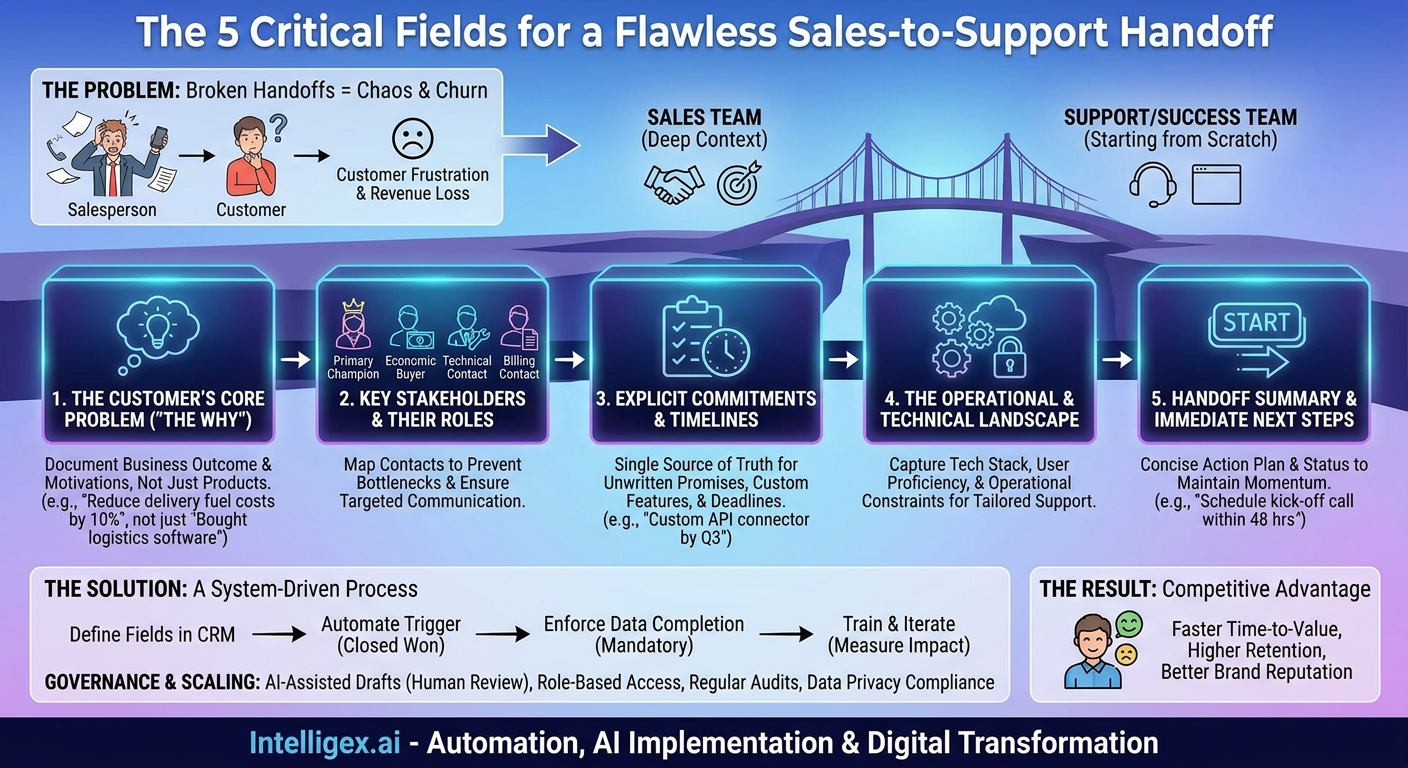
The call every customer support lead dreads begins with five simple words: “But your salesperson promised me…” What follows is a frantic scramble through old emails, a desperate search for notes in the CRM, and an apology to a frustrated new customer. This isn’t a rare occurrence; it’s a routine system failure. A broken sales-to-support handoff doesn’t just create awkward phone calls. It directly erodes revenue through customer churn, wastes expensive employee hours, and damages the brand reputation you work so hard to build.
The chaos stems from a lack of shared context. The sales team, armed with deep knowledge of the customer’s goals and pain points, closes the deal. Then, that valuable intelligence vanishes into thin air. The support or onboarding team starts from scratch, forcing the customer to repeat themselves and immediately introducing friction into the relationship. The solution isn’t more meetings or longer email threads. It’s a disciplined, system-driven process built around five critical fields of information. When these fields are consistently captured and transferred, the handoff transforms from a moment of risk into a source of competitive advantage.
Field 1: The Customer’s Core Problem (The “Why”)
The most common mistake in a handoff is documenting what the customer bought, not why they bought it. A note that says “Sold them the Enterprise Analytics Suite” is nearly useless to a support specialist. It provides no context for their motivations, their definition of success, or the business problem they are trying to solve. The “Why” is the single most important piece of information for building a long-term, successful customer relationship.
This field should capture the customer’s goal in their own words. It translates a product or service into a tangible business outcome. Instead of focusing on features, it focuses on the value the customer expects to receive. This allows the post-sales teams to frame their guidance, troubleshooting, and proactive check-ins around what truly matters to the client.
Practical Examples
- Instead of: “Customer bought our logistics optimization software.”
- Write This: “Their primary goal is to reduce last-mile delivery fuel costs by at least 10% within six months. They are currently struggling with inefficient routing across their 200-vehicle fleet.”
- Instead of: “Sold them a 50-seat license for our HR platform.”
- Write This: “They need to decrease the time it takes to onboard a new employee from five days to one day. Their current manual process is causing errors and delaying new hire productivity.”
Business Value
Capturing the “Why” delivers immediate returns in quality and speed. Support agents can solve tickets faster because they understand the user’s intent. Customer success managers can have more strategic conversations, moving from “How is the tool working?” to “Are we on track to reduce your fuel costs?” This alignment ensures the customer achieves their desired outcome, which is the leading indicator of retention and expansion.
Field 2: Key Stakeholders and Their Roles
A new customer account is not a single entity; it’s a collection of individuals with different responsibilities and communication preferences. When the support team only has one name, every issue, whether it’s a technical bug, a billing question, or a feature request, goes to that single point of contact. This creates a bottleneck and frustrates the customer, who has to act as an internal router for your company.
Mapping out the key stakeholders during the sales process is crucial for efficient post-sale communication. At a minimum, you need to identify the individuals responsible for different functions. This simple act of organization prevents miscommunication and ensures the right message gets to the right person, fast.
Essential Stakeholder Checklist
- Primary Champion: The main day-to-day contact and project lead. They are responsible for the implementation and adoption of your solution.
- Economic Buyer: The person who holds the budget and signed the contract. They care about ROI and overall business impact. They should be contacted for renewals and strategic reviews, not for routine support tickets.
- Technical Contact(s): The IT administrator, developer, or technical user responsible for a system’s backend, integrations, or security. They are the go-to for technical troubleshooting.
- Billing Contact: The individual in the finance or accounts payable department who needs to receive and process invoices. Sending invoices to the Primary Champion is a common and easily avoidable mistake.
Business Value
Clarity around roles provides immense operational leverage. It drastically reduces the time wasted finding the right person, leading to faster resolutions and a more professional customer experience. It also enables targeted communication. Your marketing team can send product updates to the Primary Champion, your finance team can communicate seamlessly with the Billing Contact, and your engineers can work directly with their Technical Contact, improving visibility and efficiency for everyone.
Field 3: Explicit Commitments and Timelines
This field is your single source of truth for managing customer expectations. It is where any promise made during the sales cycle that falls outside of your standard product offering or service level agreement (SLA) must be documented. Unwritten promises are the root cause of countless customer escalations and painful “he said, she said” arguments.
This isn’t about policing your sales team; it’s about enabling your delivery teams to succeed. If a salesperson agreed to a specific feature delivery date, a custom integration, or a non-standard payment schedule, the rest of the company needs to know. Documenting these commitments creates accountability and ensures the entire organization is aligned on what was sold. The entry should be specific, dated, and, if possible, linked to an internal project ticket or responsible party.
What to Document Here
- Custom Features: “Promised a custom dashboard widget for tracking production line efficiency. Engineering ticket #PROJ-451 is tracking this, with an estimated delivery by end of Q3.”
- Integration Work: “Agreed to build a custom API connector to their legacy Oracle ERP. Kick-off call with our professional services team is the immediate next step.”
- Non-Standard Terms: “Approved a 90-day net payment term for the first invoice due to their internal budget cycle. Finance has been notified.”
- Data Migration: “Sales committed to migrating 10,000 contact records from their old system free of charge. A success manager needs to scope the project.”
Business Value
The value here is pure risk mitigation. By making commitments explicit, you prevent misaligned expectations that lead to dissatisfaction and churn. It improves cross-functional visibility, ensuring that Engineering, Finance, and Support are aware of any special obligations. This transparency builds trust with the customer, as they see your company operating as a unified team to deliver on its promises.
Field 4: The Operational and Technical Landscape
Providing support without understanding the customer’s environment is like a doctor prescribing medicine without asking about symptoms. Generic advice is often irrelevant and frustrating. To provide truly effective support and guidance, your team needs context about the customer’s world: their technology, their processes, and the technical aptitude of their users.
This information is almost always uncovered during the sales discovery process. The key is to capture it systematically so it can be used by the post-sales teams. This data helps the support team troubleshoot more effectively and allows the success team to provide proactive, relevant advice. It prevents the customer from having to re-explain their setup every time they interact with someone new at your company.
Key Contextual Information
- Core Technology Stack: What CRM, ERP, or other major software do they use? (e.g., “They use Salesforce as their CRM and Marketo for marketing automation.”)
- Technical Proficiency: Are the primary users highly technical, or will they need extra guidance and simplified instructions? (e.g., “The marketing team is self-sufficient, but the sales users will need step-by-step guides.”)
- Operational Constraints: Are there any internal processes, security requirements, or change freezes that could impact implementation or adoption? (e.g., “All new software must go through a formal security review, which can take up to 4 weeks.”)
Business Value
Contextual data accelerates the customer’s time-to-value. When an onboarding specialist knows the customer’s tech stack, they can prioritize the most important integrations first. When a support agent knows the users are not technical, they can avoid jargon and provide clearer instructions, reducing back-and-forth communication. This level of tailored service is a powerful differentiator that increases customer satisfaction and product adoption.
Field 5: Handoff Summary and Immediate Next Steps
The final field acts as the bridge between the sales and post-sales worlds. While the other four fields provide essential background information, this one is purely about action and momentum. It’s a concise summary from the account executive that answers two questions: “What is the status of this new customer?” and “What needs to happen right now?”
This field should be brief, clear, and actionable. It ensures that the baton is passed cleanly, with no ambiguity about who owns the next step. It also serves as a quick-glance summary for anyone new to the account, providing an immediate understanding of the relationship’s health and trajectory. It’s the “read this first” section that prevents a new customer from falling through the cracks.
Example Handoff Summary
“The customer is very excited to get started and has a hard deadline to go live before their annual conference in six weeks. The Primary Champion, Sarah Jones, is our key advocate. The immediate next step is for the assigned Onboarding Specialist to schedule the project kick-off call within 48 hours. A potential risk is that their lead engineer is on vacation for the next week, so we should be prepared for a slight delay on the technical integration front.”
Business Value
This field is all about speed and accountability. It creates a clear trigger for the post-sales team, ensuring no time is lost after the deal is signed. By clearly defining the next action and owner, it eliminates confusion and keeps the customer’s momentum high. Highlighting potential risks also allows the team to be proactive, managing challenges before they become full-blown problems. This smooth transition sets a positive tone for the entire customer lifecycle.
Putting It All Together: A 4-Step Implementation Plan
Knowing what information to collect is only half the battle. Building a reliable handoff process requires embedding these five fields into your daily operations. This isn’t about adding bureaucracy; it’s about creating a system that makes the right thing the easy thing to do. Here is a practical, step-by-step approach to get started.
- Define and Centralize Your Fields. The first step is to get agreement from Sales, Support, Customer Success, and Operations on the exact definition of each field. Then, build them directly into your CRM (like Salesforce, HubSpot, or Zendesk). Give them clear, unambiguous names like “Customer’s Core Problem” or “Handoff Next Action.” This ensures everyone is working from the same playbook.
- Automate the Handoff Trigger. The handoff should not rely on someone remembering to send an email. Create a workflow automation rule in your CRM. When a deal’s stage is updated to “Closed Won,” the system should automatically trigger a notification to the assigned support or onboarding lead and create the initial account record populated with the sales data.
- Enforce Data Completion. To ensure consistency, make these five fields mandatory for a deal to be closed. Use your CRM’s validation rules to prevent a sales rep from moving an opportunity to the final stage until the handoff information is complete. This may cause some initial friction, but it quickly builds the habit of capturing crucial information before the deal is done.
- Train, Measure, and Iterate. Train your sales team not just on what to fill in, but why it matters to the customer and the rest of the company. Show them how their input directly impacts retention and reduces escalations. Then, measure the impact. Track metrics like “Time to First Meaningful Customer Interaction,” “Onboarding CSAT Scores,” and “Number of Escalations in the First 90 Days.” Use this data to refine your process over time.
Governance and Automation: Scaling the Process Safely
As your organization grows, manual data entry can become a bottleneck. This is where thoughtful automation and clear governance become critical. The goal is to enhance the quality and consistency of your handoff data without creating new risks.
Automation can help populate some of these fields. For instance, conversation intelligence tools can analyze sales call transcripts to suggest text for the “Customer’s Core Problem” and “Explicit Commitments” fields. This can save time, but it should not replace human oversight. An AI-generated summary should always be reviewed and edited by the account executive, who holds the ultimate context. The AI provides a first draft, not the final word.
From a governance perspective, it is vital to establish clear rules around this data.
- Access Control: Use role-based permissions in your CRM. While the data should be visible to all client-facing teams, only the sales team should be able to edit the initial handoff fields. The support team can then add their own notes in separate, dedicated fields as the relationship progresses.
- Data Integrity: Regularly audit the quality of the handoff information. Are the fields being filled out thoughtfully, or are reps just putting in placeholder text to close the deal? Spot-check new accounts and provide feedback.
- Privacy: Ensure that any customer information captured is handled in accordance with your company’s data privacy policies and regulations like GDPR or CCPA. Documenting stakeholder information is crucial, but it must be done securely.
A well-governed, semi-automated process delivers scalability. It ensures that every new customer, whether it’s your tenth or your ten-thousandth, receives the same high-quality, context-aware experience from day one.
Your Next Steps to a Chaos-Free Handoff
Transforming your sales-to-support handoff won’t happen overnight, but you can start making progress this week. The path to a smooth, scalable, and customer-centric process begins with a single, focused conversation. Don’t try to boil the ocean. Instead, take these two simple actions:
- Schedule a 30-minute meeting with the leaders of your Sales and Support teams. Use the five fields outlined here as your agenda. Ask a simple question: “How well do we capture and transfer this information today?”
- Audit your last five closed deals. Open them in your CRM and see how many of the five key questions you can answer. The gaps you find are your starting point for building a better system.
By focusing on these foundational pillars of information, you can eliminate the guesswork, reduce the friction, and stop the chaotic scrambles. You can begin building a handoff process that doesn’t just prevent problems, but actively creates the foundation for a long and profitable customer relationship.
Your Next Read:
Get a FREE
Proof of Concept
& Consultation
No Cost, No Commitment!
