

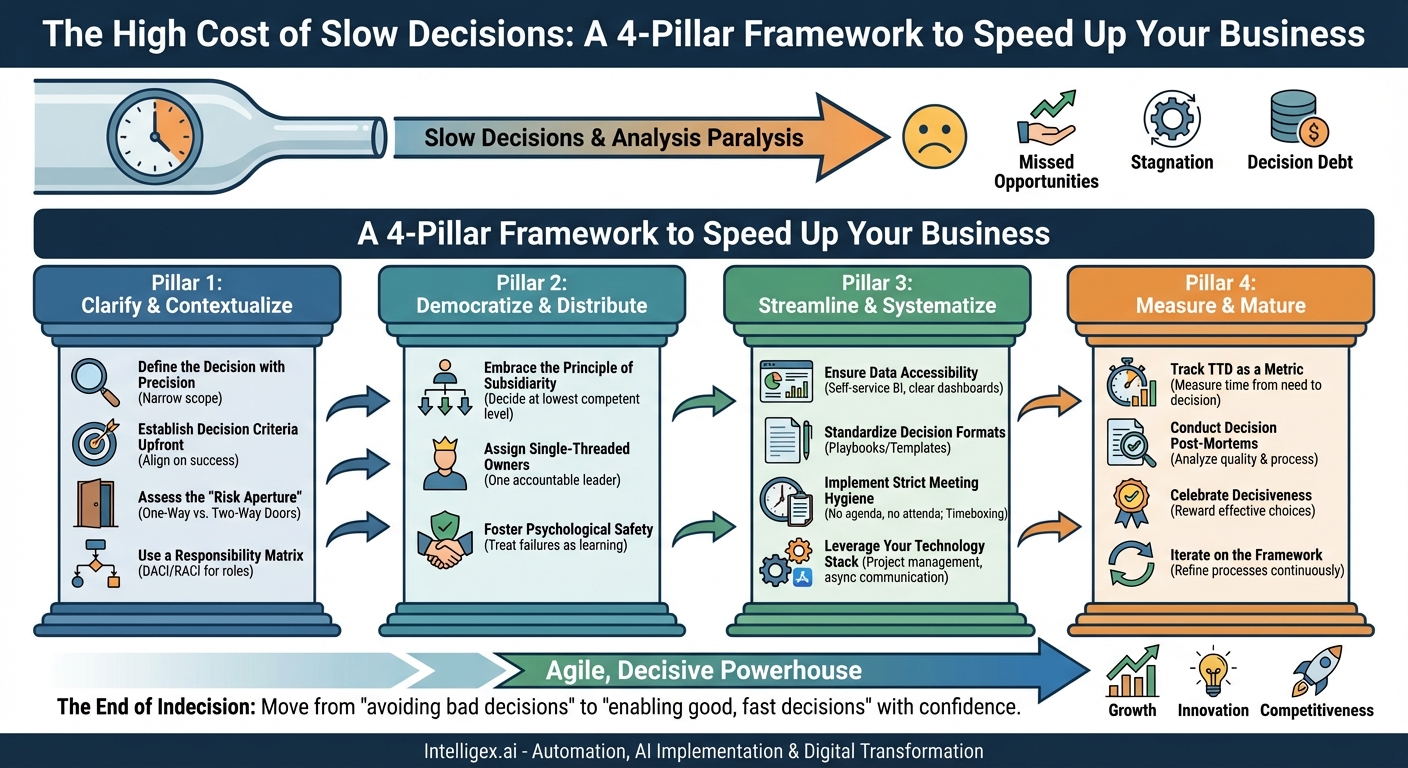
In today’s hyper-competitive business landscape, speed is more than a virtue; it’s a survival mechanism. Markets shift, customer expectations evolve, and new competitors emerge with breathtaking velocity. In this environment, the ability to make high-quality decisions quickly is not just an advantage—it’s the primary driver of agility and resilience. Yet, many organizations find themselves mired in “analysis paralysis,” where endless meetings, convoluted approval chains, and a pervasive fear of making the wrong call grind progress to a halt. The time it takes to move from identifying a problem to committing to a course of action, known as Time-to-Decision (TTD), has become a critical, yet often unmeasured, business metric. Reducing TTD isn’t about promoting recklessness; it’s about building a robust system that enables fast, intelligent, and confident choices. This is where a dedicated Time-to-Decision Reduction Framework becomes indispensable.
Understanding the True Cost of Slow Decisions
Before diving into a framework, it’s crucial to appreciate the insidious damage caused by a high TTD. The costs aren’t always visible on a balance sheet, but their impact is profound and far-reaching. When decisions languish, opportunities are lost. That window to capture a new market segment closes. The chance to address a customer complaint before it goes viral vanishes. The momentum of a high-performing team dissipates as they wait for a green light that never seems to come.
Beyond missed opportunities, slow decision-making breeds a culture of stagnation and disengagement. Employees become frustrated when their initiatives are stuck in bureaucratic limbo. They learn that proactivity is punished with waiting, so they stop bringing new ideas forward. This “decision debt” accumulates, creating a drag on the entire organization, making it less responsive, less innovative, and ultimately, less competitive. The goal, therefore, is to create an organizational operating system that optimizes for decisiveness without sacrificing diligence.
The Four Pillars of the Time-to-Decision Reduction Framework
A successful framework for reducing TTD is not a single tool or a rigid policy. It’s a holistic approach built on four interconnected pillars: Clarify & Contextualize, Democratize & Distribute, Streamline & Systematize, and Measure & Mature. By focusing on these four areas, organizations can systematically dismantle the barriers to rapid, effective decision-making.
Pillar 1: Clarify & Contextualize
The single biggest cause of delayed decisions is a lack of clarity. If stakeholders don’t understand the problem, the stakes, or what a “good” outcome looks like, they will default to delay. This pillar is about front-loading the work to ensure every decision-making process starts on a firm foundation.
Key Actions:
- Define the Decision with Precision: Vague questions lead to vague answers. Instead of asking, “What should we do about our website?” frame it as, “Should we invest in a website redesign in Q3 to increase lead conversion by 15%, with a budget of X?” A well-defined question immediately narrows the scope and focuses the discussion.
- Establish Decision Criteria Upfront: Before any options are debated, the team must agree on the criteria for success. Are we optimizing for cost, speed to market, customer satisfaction, or technical scalability? Forcing this alignment early prevents the goalposts from moving mid-discussion.
- Assess the “Risk Aperture”: Not all decisions are created equal. Amazon popularised the concept of “one-way” vs. “two-way” doors. A two-way door decision is reversible; if you make a mistake, you can easily go back. These decisions should be made quickly by small teams or individuals. A one-way door decision is highly consequential and difficult or impossible to reverse (e.g., launching a major new product line, acquiring another company). These require more deliberate analysis. Categorizing decisions correctly is essential to allocating the right amount of time and resources.
- Use a Responsibility Matrix: Tools like DACI (Driver, Approver, Contributor, Informed) or RACI (Responsible, Accountable, Consulted, Informed) are invaluable. They eliminate ambiguity about who has the final say, who needs to provide input, and who simply needs to be kept in the loop. The most important role to clarify is the single, ultimate “Approver.”
Pillar 2: Democratize & Distribute
The traditional, hierarchical model where every significant decision flows to the top is a bottleneck by design. A modern, agile organization empowers its people. This pillar is about pushing decision-making authority down and out to the edges of the organization, where information is most current and context is richest.
Key Actions:
- Embrace the Principle of Subsidiarity: This principle dictates that a decision should be made at the lowest possible or least centralized competent level. A frontline customer service team lead is better equipped to decide on a specific customer issue than a VP of Operations who is three levels removed. Trust your teams.
- Assign Single-Threaded Owners: For any important initiative, assign a single person who is unequivocally responsible for its success. This “single-threaded owner” is empowered to drive the decision-making process, gather the necessary resources, and see the outcome through. This model, also championed by Amazon, prevents the diffusion of responsibility that plagues committee-led projects.
- Foster Psychological Safety: People will only make decisions if they feel safe to do so. If the culture punishes every failure, employees will become risk-averse and escalate even minor choices. Leaders must cultivate an environment where well-intentioned, well-informed decisions that don’t pan out are treated as learning opportunities, not career-limiting mistakes.
Pillar 3: Streamline & Systematize
Even with clear context and empowered owners, the actual process of making a decision can be bogged down by inefficient workflows and poor information access. This pillar focuses on the operational mechanics—the “how”—of decision-making.
Key Actions:
- Ensure Data Accessibility: Decisions are only as good as the data they’re based on. Organizations must invest in self-service business intelligence (BI) tools, clear dashboards, and a data culture that makes it easy for decision-makers to get the information they need without waiting for a report from another department.
- Standardize Decision Formats: For recurring decision types, create a template or “playbook.” A marketing team’s decision on a campaign budget could have a standard one-page template that includes the objective, target audience, key metrics, proposed budget, and expected ROI. This ensures all the necessary information is presented consistently and completely, reducing back-and-forth.
- Implement Strict Meeting Hygiene: Meetings are often where decisions go to die. Enforce a “no agenda, no attenda” policy. Agendas should clearly state the decision that needs to be made. Use timeboxing to keep discussions focused and assign a facilitator to ensure the meeting stays on track and ends with a clear outcome: a decision made, a decision deferred with a clear owner and next steps, or a decision escalated.
- Leverage Your Technology Stack: Use project management tools (like Asana or Jira) to track the progress of a decision. Use communication channels (like Slack or Teams) for quick, asynchronous input to avoid scheduling yet another meeting. The right tools can create a clear, auditable trail for the decision-making process.
Pillar 4: Measure & Mature
You cannot improve what you do not measure. To truly shrink TTD, you must treat it as a key performance indicator. This pillar is about creating a feedback loop for continuous improvement of the decision-making process itself.
Key Actions:
- Track TTD as a Metric: For key decision types, start tracking the time from when the need for a decision is formally identified to when the final call is made. This data will reveal bottlenecks in your process. Is it getting stuck waiting for data? Or waiting for a specific executive’s approval?
- Conduct Decision Post-Mortems: After a decision has been implemented and its outcome is known, conduct a retrospective. This isn’t about blame. The goal is to analyze both the quality of the decision and the process used to make it. Ask questions like: Did we have the right people in the room? Did we have the right data? What could we have done to make this decision 20% faster?
- Celebrate Decisiveness: Acknowledge and reward individuals and teams who demonstrate effective and efficient decision-making. Highlight stories of how a quick, well-reasoned decision led to a positive outcome. This reinforces the desired cultural shift away from indecision.
- Iterate on the Framework: The framework itself is not a static document. It’s a living system. Use the insights from your metrics and post-mortems to refine your processes, update your playbooks, and provide better training to your teams.
The End of Indecision
Reducing Time-to-Decision is a profound cultural and operational shift. It requires moving from a mindset of “avoiding bad decisions” to one of “enabling good, fast decisions.” It’s about trusting your people, providing them with clarity, and equipping them with the processes and data to act with confidence. By implementing a framework built on the pillars of Clarifying, Democratizing, Streamlining, and Measuring, you can transform your organization from a sluggish bureaucracy into an agile, decisive powerhouse. The race is already on; the organizations that can think and act the fastest will be the ones that not only survive but thrive in the years to come.
Your Next Read:
Category:
Get a FREE
Proof of Concept
& Consultation
No Cost, No Commitment!