

The word “automation” is everywhere. It’s a buzzword in boardrooms, a promise on software websites, and a source of both excitement and anxiety for professionals across every industry. But for all the discussion, automation remains one of the most misunderstood concepts in the modern workplace. It’s often painted in broad, dramatic strokes—either as a utopian solution to all our productivity woes or a dystopian harbinger of mass unemployment. The truth, as is often the case, is far more nuanced, practical, and accessible.
The gap between perception and reality is filled with myths. These myths aren’t just harmless misunderstandings; they can prevent businesses from adopting powerful tools, cause employees to fear for their careers unnecessarily, and lead to misguided implementation strategies. To truly harness the power of automation, we must first dismantle the fictions that surround it. This post will tackle some of the most common automation myths and replace them with the practical reality of how this technology is reshaping our world for the better.
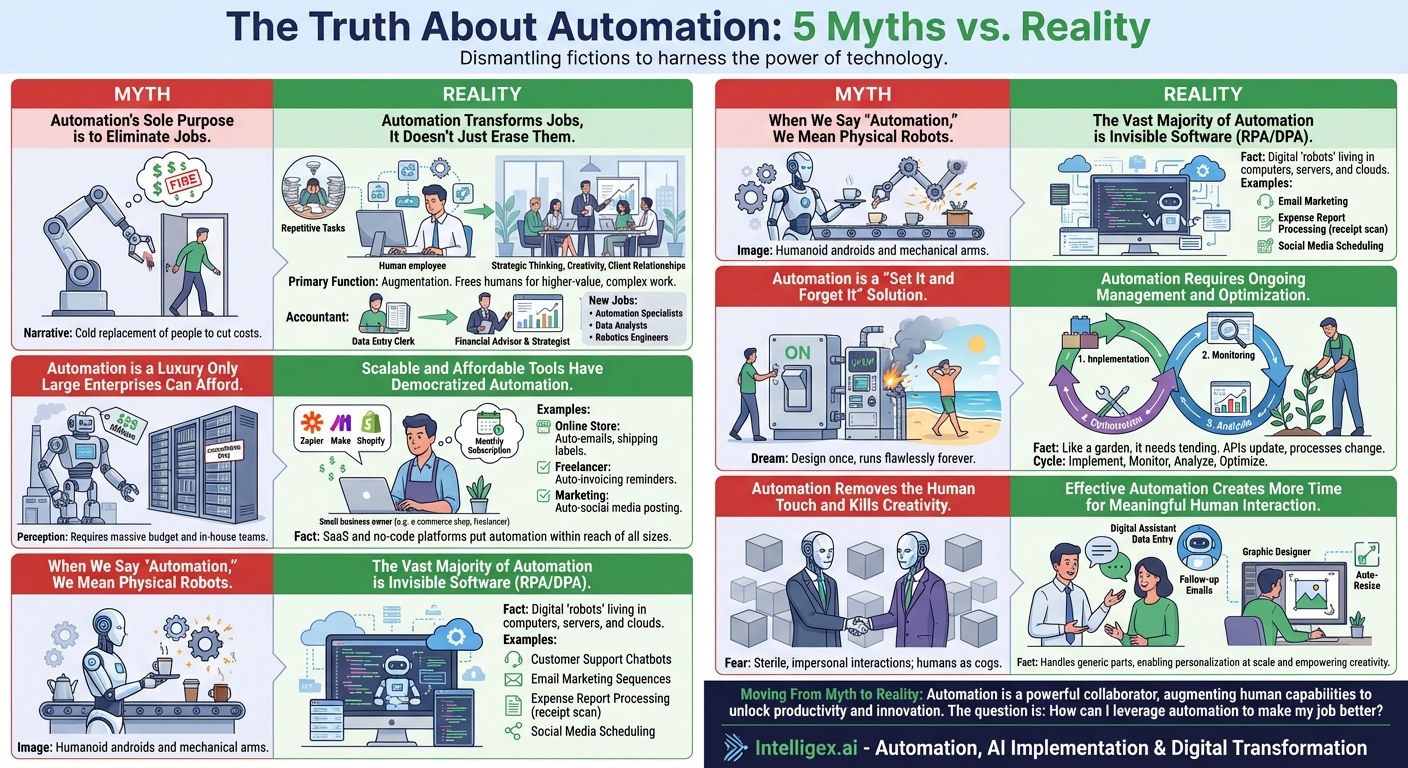
Myth #1: Automation’s Sole Purpose is to Eliminate Jobs
This is, without a doubt, the most pervasive and fear-inducing myth of them all. The narrative is simple and scary: a company brings in a new system or robot, and a human employee is shown the door. The mental image is one of a cold, calculated replacement of people with machines, driven purely by a desire to cut costs. While some roles focused entirely on repetitive, mechanical tasks have been and will be phased out, this view misses the bigger picture entirely.
The Reality: Automation Transforms Jobs, It Doesn’t Just Erase Them
The primary function of modern automation is not replacement, but augmentation. It’s about taking over the tasks that humans are not particularly good at or don’t enjoy—the repetitive, the tedious, the soul-crushing data entry, the endless copy-pasting, and the manual report generation. By delegating these tasks to software, automation frees up human employees to focus on what they do best: strategic thinking, creative problem-solving, building client relationships, and complex decision-making.
Consider the role of an accountant. Twenty years ago, a significant portion of their time was spent manually entering numbers into ledgers and reconciling accounts. The introduction of accounting software automated much of that work. Did accountants become obsolete? Far from it. Their role evolved. Instead of being data entry clerks, they became financial advisors, strategists, and analysts, using the readily available data to provide higher-value insights to their clients. Automation didn’t eliminate the accountant; it elevated them.
Furthermore, the automation industry itself creates entirely new categories of jobs. We now have roles like:
- Automation Specialists: Professionals who design, implement, and manage automated workflows.
- Data Analysts: Experts who interpret the vast amounts of data generated by automated systems to find business insights.
- Robotics Engineers and Technicians: People needed to build, maintain, and improve the physical and software robots.
Myth #2: Automation is a Luxury Only Large Enterprises Can Afford
Another common misconception is that automation is synonymous with massive, multi-million dollar factory robots or sprawling, custom-coded enterprise resource planning (ERP) systems. The image is one of a team of expensive consultants, a long implementation timeline, and a price tag that would make a small business owner’s head spin. This might have been true a decade or two ago, but the technology landscape has changed dramatically.
The Reality: Scalable and Affordable Tools Have Democratized Automation
The rise of Software-as-a-Service (SaaS) and no-code/low-code platforms has put powerful automation tools within reach of businesses of all sizes, from a solo freelancer to a mid-sized e-commerce shop. You no longer need a massive budget or an in-house development team to start automating.
Tools like Zapier, Make (formerly Integromat), and Microsoft Power Automate allow anyone to connect the apps they already use and create automated workflows with simple, visual interfaces. For example:
- A small online store can automatically send a personalized thank-you email, add the customer to a specific mailing list, and create a shipping label the moment a new order comes in through Shopify.
- A freelance consultant can automate their invoicing process, sending reminders for late payments without lifting a finger.
- A marketing team can automatically post their latest blog article to all their social media channels simultaneously.
These aren’t six-figure projects; they are often accomplished with affordable monthly subscriptions. The focus has shifted from massive, monolithic systems to agile, targeted automations that solve specific problems, delivering a high return on investment very quickly.
Myth #3: When We Say “Automation,” We Mean Physical Robots
Thanks to decades of science fiction, the word “automation” often conjures images of humanoid robots on an assembly line or futuristic androids serving coffee. While physical robots are certainly a part of the automation world, especially in manufacturing and logistics, they represent only a tiny fraction of what automation actually is.
The Reality: The Vast Majority of Automation is Invisible Software
Most of the automation that impacts our daily work lives is software-based and completely invisible. This is often referred to as Robotic Process Automation (RPA) or Digital Process Automation (DPA). It’s not about physical arms and gears; it’s about scripts and code that mimic human actions on a computer.
Think about these common examples of software automation:
- Customer Support Chatbots: These bots can answer common questions 24/7, freeing up human agents to handle more complex or sensitive customer issues.
- Email Marketing Sequences: When you sign up for a newsletter and receive a series of welcome emails over the next few days, that’s automation at work.
- Expense Report Processing: Software that can scan a receipt, extract the relevant data (vendor, date, amount), and automatically populate an expense report for approval is a form of RPA.
- Social Media Scheduling: Tools that allow you to plan and schedule a week’s worth of content in one sitting are a simple but powerful form of marketing automation.
These digital “robots” live inside our computers, servers, and cloud platforms, silently working in the background to make processes faster, more efficient, and less prone to human error.
Myth #4: Automation is a “Set It and Forget It” Solution
There’s a tempting dream that you can design the perfect automated workflow, switch it on, and then walk away forever as it runs flawlessly in the background. This “set it and forget it” mentality is not only unrealistic but also dangerous. It can lead to broken processes, frustrated customers, and missed opportunities.
The Reality: Automation Requires Ongoing Management and Optimization
An automated system is more like a garden than a statue. It needs to be tended to. Workflows are often built by connecting multiple different applications via their APIs (Application Programming Interfaces). If one of those applications updates its API, the automation can break. If your business process changes, the automation needs to be updated to reflect that change.
Think of your automations as digital employees. You wouldn’t hire someone and then never check in on their performance or give them updated instructions. Your automated systems deserve the same level of oversight.
Effective automation involves a cycle of:
- Implementation: Building and launching the initial workflow.
- Monitoring: Keeping an eye on the system to ensure it’s running as expected and catching any errors.
- Analysis: Reviewing the performance of the automation. Is it saving as much time as you expected? Is there a bottleneck?
- Optimization: Refining and improving the workflow based on analysis to make it even more efficient or effective.
Myth #5: Automation Removes the Human Touch and Kills Creativity
This myth stems from the fear that by automating interactions, we make them sterile, impersonal, and robotic—in the worst sense of the word. The concern is that customers will feel like they’re just another number in a system, and employees will be reduced to cogs in a machine, with no room for creative expression or genuine connection.
The Reality: Effective Automation Creates More Time for Meaningful Human Interaction
When implemented thoughtfully, automation does the opposite. It handles the generic, repetitive parts of a process, which allows humans to spend more time on the high-value, personalized parts. It enables personalization at scale, something that would be impossible to do manually.
For instance, a salesperson can use automation to handle lead data entry and initial follow-up emails. This frees them from hours of administrative work, giving them more time to research their top prospects, understand their specific needs, and have deeper, more meaningful conversations. The automation handles the logistics, while the human builds the relationship.
Similarly, automation can empower creativity. When a graphic designer doesn’t have to spend hours manually resizing the same image for ten different social media platforms—a task that can be easily automated—they have more time and mental energy to focus on the core creative concept. Automation doesn’t replace the creative spark; it clears away the administrative underbrush so that the spark can ignite.
Moving From Myth to Reality
The journey to understanding automation is one of moving from fear to empowerment. It’s about recognizing that this technology is not an adversary but a powerful tool—a collaborator that can make our work more meaningful, our businesses more efficient, and our professional lives more fulfilling. The reality is that automation is accessible, scalable, and primarily focused on augmenting human capabilities, not replacing them.
By shedding these common myths, we can begin to see automation for what it truly is: a set of tools that, when wielded with strategy and care, can unlock unprecedented levels of productivity and innovation. The question is no longer “Will automation change my job?” but rather, “How can I leverage automation to make my job better?”
Your Next Read:
Get a FREE
Proof of Concept
& Consultation
No Cost, No Commitment!