

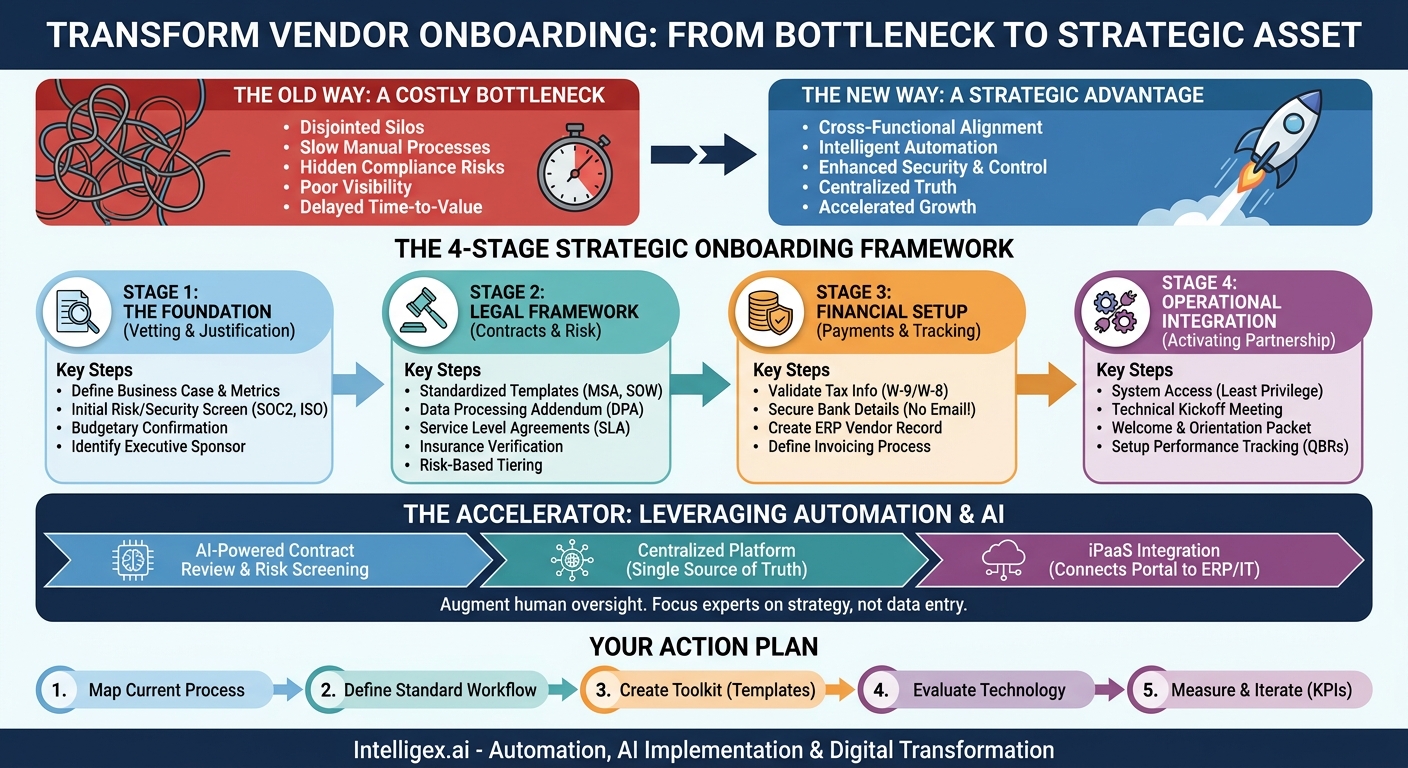
Vendor onboarding is often seen as a bureaucratic necessity, a series of administrative hurdles to clear before the real work can begin. But this perspective misses a critical opportunity. A slow, fragmented, and opaque onboarding process doesn’t just cause frustration; it actively erodes value. It delays projects, introduces security risks, creates payment errors, and strains the new partnership before it even starts. In contrast, a streamlined, intelligent, and cross-functional onboarding system is a powerful competitive advantage. It accelerates time-to-value, reduces operational costs, and builds a foundation for scalable, high-quality vendor relationships.
Treating vendor onboarding as a strategic function, rather than a clerical task, transforms it from a cost center into a value driver. It ensures that every new partner, whether a critical software provider or a niche creative agency, is integrated into your business efficiently, securely, and in full alignment with your financial and operational goals. This guide breaks down the essential steps across Legal, Finance, and Operations, providing a practical blueprint for building a process that delivers speed, visibility, and control.
Why a Disjointed Process Costs You More Than You Think
Before diving into the “how,” it’s essential to understand the “why.” When departments work in silos, the consequences ripple across the organization. A business team might verbally agree to terms with a new marketing analytics vendor, only to have the project stall for six weeks waiting for a legal review. Finance might be unable to pay an invoice because the operations team never submitted the proper tax forms, leading to late fees and a damaged relationship. These aren’t isolated incidents; they are symptoms of a broken process.
The hidden costs accumulate quickly:
- Delayed Projects: Every day a vendor is stuck in onboarding is a day you’re not getting the value you’re paying for. For a sales team waiting on a new CRM integration, this means lost revenue opportunities.
- Wasted Labor: Employees spend hours chasing down documents, seeking approvals, and re-entering the same vendor information into multiple disconnected systems (e.g., procurement, accounting, and IT).
- Compliance and Security Risks: Without a standardized process, critical checks can be missed. A vendor might be granted system access before a security review is complete, or a contract might be signed without the necessary data privacy clauses, exposing the company to significant liability.
- Poor Visibility: When there is no central source of truth, it becomes nearly impossible for leadership to get a clear picture of vendor spend, performance, or overall risk exposure.
A well-designed onboarding workflow addresses these issues head-on. It establishes a clear, predictable path for every new vendor, providing visibility to all stakeholders and ensuring that critical legal, financial, and operational requirements are met in the correct sequence.
Stage 1: The Foundation – Vetting and Business Justification
Proper onboarding begins before a contract is even drafted. The first stage is about ensuring a vendor is the right fit and that there is a clear business case for the engagement. Rushing this step often leads to signing deals with partners who can’t meet security standards or whose services don’t truly align with business needs.
The requesting team, whether it’s Marketing, IT, or Supply Chain, should lead this phase with support from other functions. The goal is to answer fundamental questions before dedicating significant legal and financial resources.
Key Steps in Initial Vetting:
- Define the Need and Business Case: The sponsoring team must articulate precisely what problem the vendor solves and what business value is expected. This should include success metrics. For example, a new logistics provider should have a target for “reducing average shipping time by X%” or “lowering cost-per-delivery by Y%.”
- Initial Risk and Security Screening: Before deep-diving into contract negotiations, perform a preliminary risk assessment. This is especially critical for any vendor that will handle sensitive company or customer data. Does the vendor have standard security certifications like SOC 2 or ISO 27001? A simple security questionnaire at this stage can filter out unqualified vendors early.
- Budgetary Confirmation: The sponsoring team must confirm with Finance that the expenditure is within budget. This simple check prevents wasted time negotiating a contract for a service that can’t be funded.
- Identify the Executive Sponsor: Every vendor relationship should have a designated internal owner. This person is ultimately responsible for the vendor’s performance and the value delivered from the engagement.
Getting this stage right ensures that only qualified, strategically aligned, and properly funded vendors enter the formal onboarding pipeline. It’s a filter that saves everyone time and focuses resources where they matter most.
Stage 2: The Legal Framework – Contracts and Risk Mitigation
Once a vendor has been vetted and approved in principle, the process moves to the Legal department. This stage is often perceived as a bottleneck, but it doesn’t have to be. The legal team’s role is to protect the company, not to obstruct business. A clear, standardized, and transparent process helps them do this efficiently.
The primary output of this stage is a fully executed contract that clearly defines the scope of work, payment terms, data handling requirements, and liabilities. Using standardized templates and playbooks can dramatically accelerate this process.
A Practical Legal Review Checklist:
- Master Service Agreement (MSA): Is there an MSA in place? If not, will the vendor sign your company’s standard paper or are you reviewing theirs? Having a strong, pre-approved template is a massive accelerator.
- Statement of Work (SOW) or Order Form: Does the document clearly define the deliverables, timelines, and costs? It must be specific enough to prevent scope creep and future disputes.
- Data Processing Addendum (DPA): If the vendor will process personal or sensitive data, a DPA is non-negotiable. This is a legal requirement under regulations like GDPR and CCPA.
- Service Level Agreement (SLA): For technology and other service providers, an SLA defines performance expectations, such as uptime guarantees and support response times. It should also specify remedies or penalties if these levels are not met.
- Insurance Verification: Confirm the vendor carries adequate insurance coverage (e.g., General Liability, Cyber, Errors & Omissions) and collect a Certificate of Insurance (COI).
To avoid becoming a bottleneck, legal teams can implement a risk-based review process. A low-cost, low-risk engagement (like a one-off purchase of stock photos) shouldn’t require the same level of scrutiny as a multi-year contract for a core enterprise software platform. Tiering vendors by risk allows legal resources to focus on the highest-impact agreements.
Stage 3: Financial Setup – Enabling Payments and Tracking
With a signed contract in hand, the vendor must be set up correctly in the company’s financial systems. This is the Finance and Accounts Payable (AP) team’s domain. Errors at this stage lead directly to payment delays, which can quickly sour a new vendor relationship and damage your company’s reputation.
The goal is to collect and validate all necessary information to ensure timely, accurate, and compliant payments. A self-service vendor portal is an excellent tool here, as it allows vendors to securely enter their own information, reducing manual data entry and errors for your team.
The Core Financial Onboarding Steps:
- Collect and Validate Tax Information: For U.S.-based vendors, this means collecting a signed W-9 form. For international vendors, it’s typically a W-8BEN or W-8BEN-E. This information is required for tax reporting purposes. Verifying the details against the IRS database can prevent future compliance issues. For more information on these forms, visit the official IRS forms and publications page.
- Securely Obtain Banking Details: Establish a secure, multi-factor process for collecting bank account information for ACH or wire transfers. Email is not a secure method for this. A vendor portal or a secure form solution is highly recommended to prevent fraud.
- Create the Vendor Record: The vendor must be created in your accounting or ERP system. This record should link back to the signed contract and include key information like payment terms (e.g., Net 30, Net 60), default expense categories, and assigned internal cost centers.
- Communicate the Invoicing Process: Clearly instruct the vendor on how to submit invoices. Should they be emailed to a specific AP address? Uploaded to a portal? What information is required on the invoice (e.g., PO number, contact name) to ensure it gets processed without delay?
What to measure: Key metrics for this stage include First-Time Payment Accuracy Rate and Time to Set Up Vendor for Payment. A high accuracy rate and a short setup time indicate a healthy financial onboarding process.
Stage 4: Operational Integration – Activating the Partnership
The final stage is where the vendor is connected to the teams and systems they will be working with. This is where Operations, IT, and the sponsoring business unit collaborate to ensure the vendor can start delivering value as quickly as possible. The handoffs must be seamless.
For a new software vendor, this might involve IT provisioning licenses and coordinating a technical integration. For a consulting firm, it could mean scheduling kickoff meetings and granting access to project management tools. For a new parts supplier, it means setting them up in the inventory management system and communicating logistics requirements.
Key Integration Activities:
- System Access and Provisioning: IT grants the necessary, and minimal, level of access to systems, applications, and data. This follows the principle of least privilege to maintain security.
- Technical Kickoff: For any technical implementation, schedule a kickoff meeting between your internal technical team and the vendor’s team to align on timelines, requirements, and points of contact.
- Welcome and Orientation: The sponsoring team should provide the vendor with a welcome packet. This can include key internal contacts, communication guidelines, and an overview of the project goals.
- Performance Tracking Setup: The internal owner should establish the mechanism for tracking the vendor’s performance against the goals and SLAs defined in the contract. This could be a recurring meeting, a shared dashboard, or a formal Quarterly Business Review (QBR) process.
This stage is complete only when the vendor is fully enabled and the internal team is equipped to manage the relationship and measure its performance effectively.
Leveraging Automation and Centralized Platforms
Managing this entire cross-functional process manually using emails and spreadsheets is not scalable. It’s prone to error, lacks visibility, and becomes exponentially more difficult as the number of vendors grows. This is where technology plays a transformative role.
A centralized vendor management or procurement platform can serve as the single source of truth, orchestrating the workflow across departments. When the sponsoring team initiates a request, the platform can automatically route it to Legal for contract review, then to Finance for financial setup, and finally to IT for provisioning.
Intelligent automation can further streamline these steps. For example:
- AI-powered contract review can analyze a vendor’s proposed agreement against your standard terms, flagging non-standard clauses for faster legal review. It doesn’t replace a lawyer, but it helps them focus on the highest-risk items first.
- Automated risk screening can check vendors against sanction lists and adverse media databases, providing an initial risk score to inform the vetting process.
- Integration Platform as a Service (iPaaS) can connect your vendor portal to your ERP and other systems, eliminating manual data entry and ensuring information is consistent everywhere.
The goal of this technology is not to eliminate human oversight but to augment it. By automating repetitive, low-value tasks, you free up your legal, finance, and operations experts to focus on strategic activities like negotiating better terms, analyzing vendor performance, and mitigating complex risks.
A Note on Security and Governance
When you automate processes and integrate systems, especially when using AI, robust governance is paramount. Any vendor that touches sensitive data requires rigorous security diligence. Frameworks like SOC 2 provide a level of assurance about a vendor’s security posture. You can learn more about these professional standards from the governing body, the AICPA. Always ensure that vendor access to your systems is role-based and limited to only what is necessary. When using AI tools for tasks like risk assessment, maintain a human-in-the-loop approach. An AI can flag a potential risk, but a human expert should always make the final judgment call.
Your Action Plan for a World-Class Onboarding Process
Transforming your vendor onboarding from a chaotic series of tasks into a streamlined, strategic function is an achievable goal. It requires a commitment to cross-functional collaboration and a clear plan of action.
Here are your next steps:
- Map Your Current Process: Get stakeholders from Legal, Finance, Ops, and a key business unit (like Marketing or IT) in a room. Whiteboard your current “as-is” process from initial request to first payment. Identify the bottlenecks, redundant steps, and points of friction.
- Define a Standardized “To-Be” Workflow: Design a single, unified process that applies to all vendors. Define clear roles and responsibilities for each stage (Vetting, Legal, Finance, Ops). Create risk-based tiers to allow for a faster path for low-risk vendors.
- Create Your Toolkit: Develop standardized templates and checklists. This includes your master service agreement, a standard security questionnaire, and a vendor setup form. Centralize these documents so everyone is using the latest version.
- Evaluate Technology Solutions: Explore how a centralized platform, whether a dedicated vendor management system or an integration platform, can automate your new workflow, provide visibility, and serve as a single source of truth for all vendor data.
- Measure, Iterate, and Improve: Define your key performance indicators (KPIs), such as Average Time to Onboard and Vendor Compliance Rate. Track these metrics to measure the impact of your changes and identify areas for further improvement.
By investing in a robust vendor onboarding process, you are investing in the speed, agility, and security of your entire organization. You turn an administrative burden into a strategic asset that enables growth and protects your business from unnecessary risk.
Your Next Read:
Category:
Get a FREE
Proof of Concept
& Consultation
No Cost, No Commitment!