

Your content strategy is brilliant. Your writers are crafting compelling narratives. Your subject matter experts are providing invaluable insights. The pieces are all there for a high-performing content engine. Yet, time and again, you find yourself staring at a calendar, watching deadlines fly by as a perfectly good piece of content languishes in operational limbo. This frustrating gap between a “finished” draft and a “published” post is where many content programs falter. This is the domain of Content Operations (ContentOps), the system of people, processes, and technology that turns a great idea into a live asset. And it’s often in the final, seemingly simple stages—review, formatting, and uploading—that the most significant and costly delays occur. These “last mile” problems can derail your entire content calendar, diminish team morale, and prevent your hard work from ever reaching its intended audience.
Think of it like running a marathon. The strategy, research, and writing are the grueling first 25 miles of training and execution. The final mile—the operational tasks of getting it over the finish line—should be a victory lap. Instead, for many teams, it’s an unexpected uphill climb filled with unforeseen obstacles. Why is this? These final stages are a convergence point for multiple stakeholders: writers, editors, SEO specialists, designers, legal teams, and marketing managers. They require a blend of creative judgment and technical precision, and they are frequently underestimated and under-resourced. A “quick review” turns into a week-long debate. A “simple format” becomes a multi-hour battle with a clunky CMS. A “scheduled upload” gets bumped for the third time. Individually, these are minor hiccups. Cumulatively, they create a system of friction that grinds your content velocity to a halt.
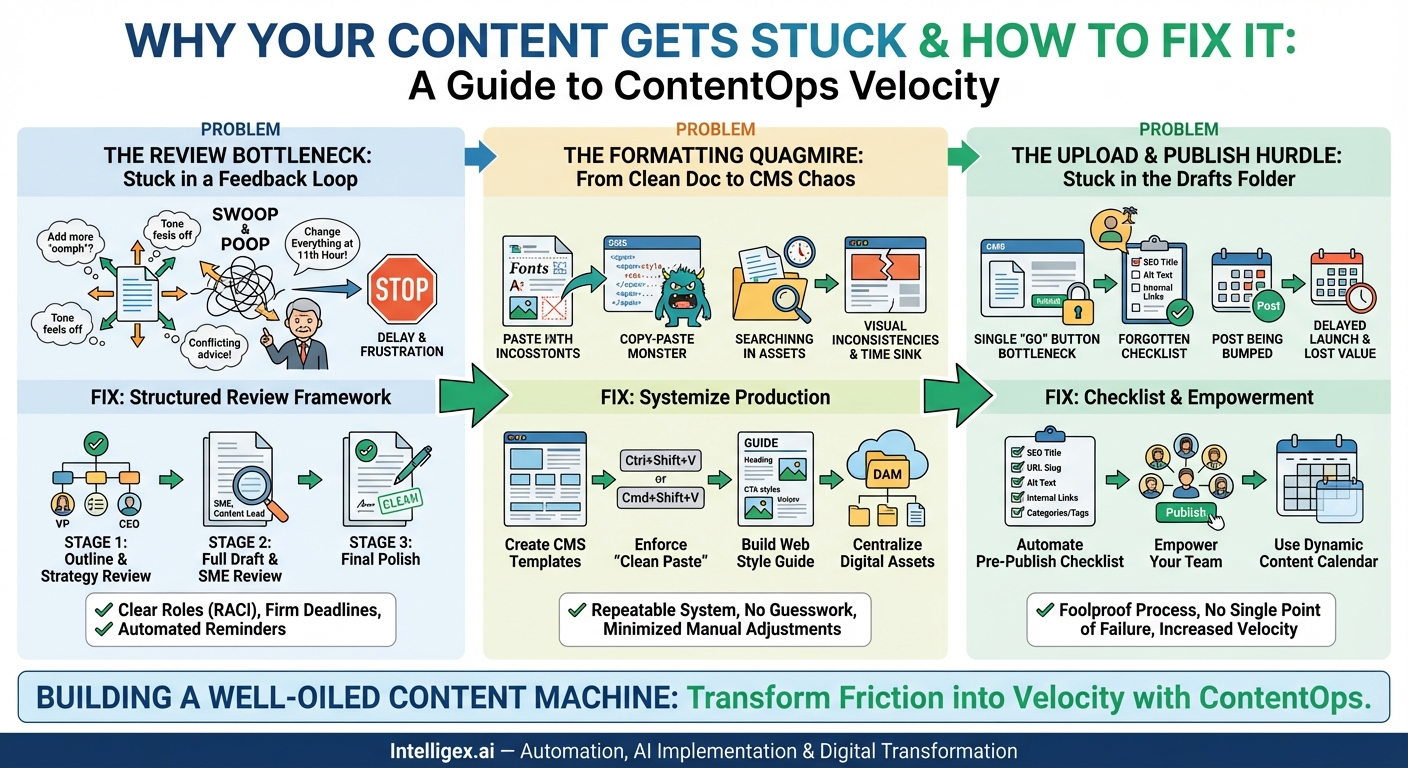
The Review Bottleneck: Stuck in a Feedback Loop
The single most common delay in any content pipeline is the review cycle. Content gets passed around like a hot potato, collecting conflicting feedback, vague suggestions, and endless revisions until the original message is diluted and the deadline is a distant memory. This “review vortex” is a notorious productivity killer, but it can be untangled by understanding its root causes.
Common Causes of Review Delays
- Vague, Unactionable Feedback: Comments like “This isn’t working for me,” “Can we add more ‘oomph’?” or “The tone feels off” are frustratingly useless. They express a feeling without providing a concrete direction for improvement, forcing the writer to guess what the reviewer truly wants.
- Too Many Cooks in the Kitchen: When a draft is sent to a dozen people simultaneously, you’re inviting chaos. A sales leader provides feedback on grammar while the legal team questions the core marketing message. This results in conflicting advice and sends the content team on a wild goose chase trying to appease everyone.
- Undefined Review Stages: Without a clear, sequential process, reviews become a free-for-all. People provide feedback at the wrong time (e.g., making strategic suggestions on a final, proofread version) or don’t review at all, assuming someone else has it covered.
- The “Swoop and Poop”: This classic scenario involves a senior stakeholder who has been uninvolved in the entire process. They appear at the 11th hour, glance at the nearly-finished piece, and drop a major, strategy-altering comment that sends it back to the drawing board. This not only causes massive delays but is also incredibly demoralizing for the team.
How to Fix It: A Structured Review Framework
Overcoming the review bottleneck isn’t about moving faster; it’s about moving smarter. The key is to implement a structured, transparent, and sequential process that brings the right people in at the right time to give the right kind of feedback.
Your goal is to shift from a model of chaotic consensus-building to one of structured, stage-gated approvals.
- Stage 1: The Outline & Strategy Review. Before a single paragraph of the full draft is written, the outline, core argument, and key takeaways should be reviewed by the primary stakeholders. This is the time for the VP of Product, the Head of Sales, or the CEO to weigh in on the strategic direction. Gaining buy-in at this early stage prevents the dreaded “swoop and poop” later on.
- Stage 2: The Full Draft & SME Review. Once the draft is written, the review circle should shrink dramatically. This stage is for the subject matter expert (SME) to check for technical accuracy, the content lead to ensure it aligns with the brand voice and goals, and perhaps one other key stakeholder to validate the overall narrative. Feedback here should focus on substance, clarity, and accuracy.
- Stage 3: The Final Polish. This is the last stop. This review is solely for copyediting and proofreading. The only people who should be in this stage are the editor or proofreader. The time for strategic input or substantive changes is long past. The focus here is exclusively on grammar, spelling, punctuation, and adherence to the style guide.
To support this framework, create simple review checklists for each stage and use a RACI (Responsible, Accountable, Consulted, Informed) chart to clarify roles. Set firm deadlines for feedback—not “ASAP,” but “Feedback due by 4 PM Friday.” Project management tools can automate these reminders, ensuring accountability without constant manual follow-up.
The Formatting Quagmire: From Clean Doc to CMS Chaos
The content has been approved. Everyone loves it. Now comes the seemingly simple task of moving it from a Google Doc or Word file into your Content Management System (CMS). This is where the formatting quagmire begins. What looked pristine in the document becomes a jumble of inconsistent fonts, broken layouts, and poorly sized images on the website. Hours are wasted wrestling with clunky visual editors and cleaning up messy code.
Common Causes of Formatting Delays
- The Copy-Paste Monster: The number one culprit. Pasting formatted text directly from a word processor into a CMS’s WYSIWYG editor imports a mountain of junk HTML styling (e.g.,
<span style="font-weight: 400;">). This overrides your website’s carefully crafted CSS, leading to visual inconsistencies and a frustrating cleanup process. - Lack of Standardized Templates: When every new blog post is built from scratch within the CMS, you introduce opportunities for error and inconsistency. One author might use H2s for subheadings, while another uses H3s and bolded text. CTAs are placed in different locations, and image styles vary wildly.
- The Asset Scavenger Hunt: The writer has finished the text, but now someone has to spend an hour hunting down the correct featured image, resizing it, compressing it, and finding the embed code for a related video. This “asset wrangling” is a hidden time sink that rarely gets factored into production timelines.
- Technical Skill Gaps: The person tasked with uploading the content may not be a CMS power user. They might struggle to implement specific layouts, add custom HTML snippets for things like tables or callout boxes, or troubleshoot minor display issues, turning a 20-minute task into a two-hour ordeal.
How to Fix It: Systemize Your Production
The solution to formatting chaos is to industrialize the process. You need to build a repeatable, template-driven system that removes guesswork and minimizes manual adjustments.
- Create and Mandate CMS Templates: Work with your developers to build pre-styled templates for your primary content types (e.g., standard blog post, listicle, case study, landing page). These templates should have pre-defined styles for all headings, lists, blockquotes, and image containers. The publisher’s job is simply to pour the content into the correct fields.
- Enforce a “Clean Paste” Workflow: Train your team to always paste content as plain text (using Ctrl+Shift+V on Windows or Cmd+Shift+V on Mac). This strips away all the messy formatting from the source document. From there, they can apply the clean, pre-defined styles from your CMS template.
- Build a Web Content Style Guide: This is a companion to your brand style guide, but it’s specifically for digital content. It should define pixel dimensions for different image types (featured image, in-body image), how to format captions, when to use H2 vs. H3, the proper styling for blockquotes, and the brand’s primary and secondary CTA button styles.
- Centralize Digital Assets: Use a Digital Asset Management (DAM) platform or even a highly organized cloud storage system (like a dedicated Google Drive or Dropbox folder). Store all final, approved, and web-optimized images, videos, and graphics here. Naming conventions are crucial (e.g., `YYYY-MM-DD_[Blog-Post-Slug]_[Image-Description].jpg`). This eliminates the scavenger hunt and ensures everyone is using the correct assets.
The Upload & Publish Hurdle: Stuck in the Drafts Folder
The final hurdle is often the most baffling. The content is written, approved, and perfectly formatted. It is sitting in the CMS, ready to go live. And there it sits. And sits. A piece of content that is 99% complete provides 0% of the value. This final-stage delay is often a symptom of a process that lacks a clear owner or a standardized final checklist.
Common Causes of Publishing Delays
- The “Go” Button Bottleneck: In many organizations, only one or two people have the permissions or authority to hit the “Publish” button. If that person is busy, in meetings, or on vacation, the entire content pipeline grinds to a halt.
- Pre-Publish Checklist Paralysis: The final upload is more than just text and images. It involves a host of critical but often-forgotten details: optimizing the URL slug, writing a compelling meta description, adding alt text to images, selecting the right tags and categories, adding internal links, and ensuring tracking codes are in place. When this is done as an ad-hoc afterthought, it’s easy to miss steps or delay the launch.
- Calendar and Scheduling Conflicts: The piece is ready, but the content calendar is a rigid, inflexible document. A last-minute product launch or PR announcement suddenly takes priority, and your evergreen blog post gets bumped indefinitely with no clear reschedule date.
How to Fix It: Checklist and Empowerment
Streamlining the final publish step is about making the process foolproof and removing single points of failure.
- Automate with a Pre-Publish Checklist: Build a mandatory checklist directly into your project management task for publishing. Before a post can be marked as “complete,” the publisher must check off every item:
- SEO Title & Meta Description Added
- URL Slug Optimized
- Featured Image Assigned (with Alt Text)
- All In-Body Images Have Alt Text
- Categories & Tags Assigned
- 3-5 Internal Links Added
- Author & Publish Date Set
- UTM Parameters Added to External Links
- Empower Your Team: A single “publisher” is a bottleneck. Train multiple members of the content team on the full publishing process, including the pre-publish checklist. Grant them the necessary CMS permissions to schedule and publish content. Trust and empowerment, backed by a strong process, are key to increasing velocity.
- Use a Dynamic Content Calendar: Your calendar should be a living tool integrated with your project management system. When a piece is ready to be scheduled, it should be visible to all stakeholders. This transparency helps in negotiating priorities and ensures that bumped content is immediately and officially rescheduled, not lost in limbo.
Building a Well-Oiled Content Machine
The persistent delays in the review, formatting, and upload stages are rarely due to a lack of effort. They are symptoms of broken or non-existent processes. By dissecting these bottlenecks and implementing structured, system-based solutions, you can transform your content workflow from a source of friction and frustration into a well-oiled machine. This isn’t about micromanagement; it’s about creating a clear, predictable path for content to travel from idea to publication. Investing in a robust ContentOps framework reclaims countless hours, boosts team morale, and, most importantly, ensures that the valuable content you work so hard to create actually gets in front of the audience you want to reach, on time, every time.
Your Next Read:
Category:
Get a FREE
Proof of Concept
& Consultation
No Cost, No Commitment!
