

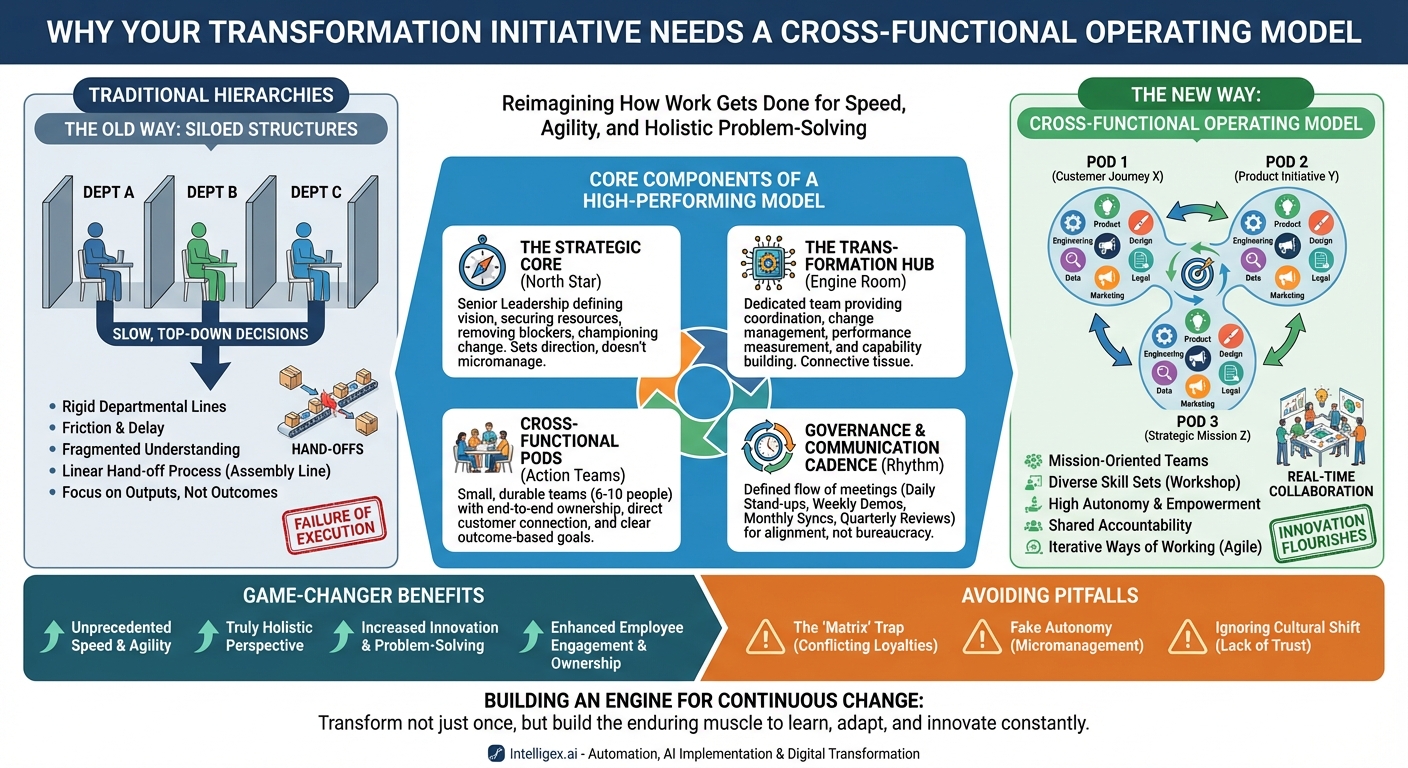
In today’s volatile business landscape, the word “transformation” is ubiquitous. Companies are constantly seeking to reinvent themselves—digitally, culturally, and operationally—to stay competitive. Yet, a staggering number of these ambitious initiatives fall short of their goals. The reason is often not a lack of vision or investment, but a failure of execution rooted in outdated, siloed organizational structures. Traditional hierarchies, with their rigid departmental lines and slow, top-down decision-making processes, are fundamentally ill-equipped to handle the dynamic, complex nature of modern transformation. They create friction, delay, and a fragmented understanding of the very problems they are trying to solve.
Enter the cross-functional operating model. This is not merely about putting people from different departments into the same meeting room; it’s a fundamental reimagining of how work gets done. It is a purpose-built system designed for speed, agility, and holistic problem-solving. For a transformation team, adopting this model isn’t just a best practice—it’s a prerequisite for success. It shifts the focus from departmental outputs to shared, customer-centric outcomes, creating an environment where innovation can truly flourish.
What Exactly is a Cross-Functional Operating Model?
At its core, a cross-functional operating model is a structured framework that brings together individuals with diverse skills and perspectives from across the organization to work collaboratively on a specific mission. Instead of a linear, hand-off-based process (e.g., business develops a requirement, hands it to IT, who builds it and hands it to marketing), this model creates small, autonomous teams—often called “pods,” “squads,” or “crews”—that own a problem or an initiative from end to end.
Think of the difference between an assembly line and a dedicated workshop. On an assembly line, each worker performs a single, specialized task in isolation. In a workshop, a team of artisans—a woodworker, a metalworker, a finisher—all work together on the same piece, contributing their unique skills in real-time to create a cohesive final product. The cross-functional operating model is the organizational equivalent of that workshop.
This model is defined by several key characteristics:
- Mission-Oriented Teams: Teams are organized around customer journeys, products, or strategic initiatives, not functional departments.
- Diverse Skill Sets: Each team contains all the necessary skills to deliver on its mission, such as product management, engineering, design, data analysis, marketing, and legal.
- High Autonomy: Teams are empowered to make decisions about how they work and how to best achieve their objectives, within a set of clear guardrails.
- Shared Accountability: The entire team is collectively responsible for the outcome, breaking down the “it’s not my job” mentality.
- Iterative Ways of Working: Teams typically adopt agile methodologies, working in short cycles (sprints) to deliver value, learn from feedback, and adapt their approach quickly.
The Core Components of a High-Performing Model
Implementing a successful cross-functional model requires more than just rearranging reporting lines. It involves creating a supportive ecosystem with clearly defined components that work in concert. While the specifics can be tailored, most effective models include the following elements.
1. The Strategic Core (The “North Star”)
This is the senior leadership group responsible for defining the transformation’s overall vision, objectives, and strategic priorities. Their role isn’t to micromanage the teams but to act as the guiding force. Their primary responsibilities include:
- Setting the Vision: Clearly articulating the “why” behind the transformation and defining what success looks like.
- Securing Resources: Allocating the necessary budget, technology, and talent to the initiative.
- Removing Systemic Blockers: Addressing major organizational impediments that individual teams cannot solve on their own (e.g., legacy IT policies, rigid HR processes).
- Championing the Change: Continuously communicating the importance of the transformation and celebrating successes to maintain momentum.
2. The Transformation Hub (The “Engine Room”)
While the cross-functional pods are autonomous, they don’t operate in a vacuum. The Transformation Hub (or Transformation Management Office) serves as a central coordinating and enabling function. It’s the connective tissue of the operating model. This small, dedicated team provides support and ensures alignment across the various pods. Key functions include:
- Program Management: Tracking overall progress against milestones and managing interdependencies between teams.
- Change Management & Communication: Developing and executing a plan to help the broader organization understand and adapt to the changes.
- Performance Measurement: Establishing and tracking key performance indicators (KPIs) and Objectives and Key Results (OKRs) for the transformation.
- Capability Building: Providing training and coaching on new ways of working, such as agile methodologies, design thinking, and data-driven decision-making.
3. Cross-Functional Pods (The “Action Teams”)
These are the heart and soul of the operating model. Pods are small, durable teams (typically 6-10 people) dedicated to a specific outcome. A pod tasked with improving the customer onboarding experience, for example, might include a product owner, a UX/UI designer, two software engineers, a data analyst, and a marketing specialist. Their strength lies in their composition and mandate:
- End-to-End Ownership: They are empowered to research, design, build, test, and launch solutions for their specific domain.
- Direct Customer Connection: They engage directly with end-users to gather feedback and rapidly iterate on their solutions.
- Clear, Measurable Goals: Their success is tied to business outcomes (e.g., “increase user activation by 15%”), not just task completion.
4. Governance and Communication Cadence (The “Rhythm”)
Autonomy without alignment leads to chaos. A well-defined cadence of meetings and communication channels ensures that information flows freely and teams remain aligned with the strategic vision. This isn’t about adding more meetings; it’s about having the right meetings with a clear purpose.
- Daily Stand-ups: Pod-level meetings to sync on daily progress and blockers.
- Weekly Demos & Reviews: Pods showcase their work to stakeholders, gather feedback, and plan for the next cycle.
- Bi-weekly/Monthly Syncs: Representatives from different pods and the Transformation Hub meet to discuss cross-pod dependencies and share learnings.
- Quarterly Business Reviews: Pods and leadership review progress against OKRs, reflect on achievements, and adjust strategic priorities for the next quarter.
Why This Model is a Game-Changer for Transformation
Adopting a cross-functional operating model delivers profound benefits that directly address the common failure points of large-scale change initiatives.
1. Unprecedented Speed and Agility: By co-locating all necessary skills within a single team, the model eliminates the time-consuming hand-offs and approval queues that plague traditional structures. Decisions are made faster by the people closest to the information, allowing teams to pivot quickly based on new data or customer feedback.
2. A Truly Holistic Perspective: Silos create blind spots. When marketing, technology, and operations work separately, no one owns the complete customer experience. A cross-functional team, by its very nature, is forced to consider the entire value stream. This leads to more coherent, user-centric solutions rather than disjointed, department-optimized features.
3. Increased Innovation and Problem-Solving: When you bring together diverse minds—an engineer who thinks in systems, a designer who thinks in user flows, and a data scientist who thinks in patterns—the creative friction generates better ideas. The team’s psychological safety and shared goal encourage experimentation and learning from failure, which are essential ingredients for innovation.
4. Enhanced Employee Engagement and Ownership: Giving teams real autonomy and a clear line of sight to the impact of their work is a powerful motivator. Team members feel a stronger sense of purpose and ownership when they are responsible for an outcome, not just a task. This model fosters a culture of accountability and continuous improvement from the ground up.
Avoiding the Pitfalls: Making the Model Work in Practice
Transitioning to a cross-functional model is a significant change in itself and comes with its own set of challenges. Awareness of these common pitfalls is the first step to avoiding them.
The “Matrix” Trap: A common mistake is creating “cross-functional” teams where members still report primarily to their functional managers for direction and performance reviews. This creates conflicting loyalties and priorities. To be effective, the pod’s mission must be the team member’s primary focus, and performance evaluations should heavily weigh their contribution to the pod’s success.
Fake Autonomy: Leadership may say they are empowering teams, but then continue to dictate solutions and second-guess every decision. True autonomy requires leaders to shift their role from directing to coaching—setting clear goals and constraints, then trusting the team to figure out the “how.”
Ignoring the Cultural Shift: You cannot simply drop a new structure on top of an old culture. A cross-functional model requires a culture of collaboration, transparency, and psychological safety. This involves actively training people in new communication skills, conflict resolution, and feedback techniques. It’s a change in mindset, not just a change in the org chart.
Conclusion: Building an Engine for Continuous Change
A cross-functional operating model is more than just a management fad; it is a strategic response to the demands of a rapidly changing world. For teams tasked with driving organizational transformation, it provides the structure, speed, and focus required to navigate complexity and deliver meaningful results. By breaking down silos, empowering teams, and aligning everyone around a shared mission, this model transforms the very way an organization learns, adapts, and innovates.
The journey to implement this model is not easy. It requires unwavering leadership commitment, a willingness to challenge long-held assumptions, and a deep investment in people. However, the reward is an organization that is not only capable of executing a single transformation but has built the enduring muscle for continuous change—making it more resilient, more customer-focused, and ultimately, more successful in the long run.
Your Next Read:
Category:
Get a FREE
Proof of Concept
& Consultation
No Cost, No Commitment!