

The business is growing. Orders are pouring in, the client roster is expanding, and the team is buzzing with activity. This is the moment every founder dreams of. Yet, instead of feeling triumphant, you’re feeling the strain. Deadlines are getting tight, communication is fraying, and your best employees look permanently overwhelmed. The instinctive, almost reflexive, response is simple: “We need more people.” It’s a logical conclusion. More work requires more hands. But what if the problem isn’t a shortage of hands, but a bottleneck in the flow of information between them? What if hiring more people is like adding more cars to a traffic jam instead of building a new highway?
Before you draft that next job description, take a step back and look at the underlying mechanics of your operations. Often, the chaos and inefficiency that feel like a staffing issue are actually symptoms of a deeper, more structural problem: disconnected systems. Your business runs on a collection of powerful software—a CRM for sales, an ERP for operations, an accounting platform for finance, a marketing automation tool, and a dozen other specialized apps. When these systems don’t talk to each other, you create invisible, digital walls that your team must manually climb over dozens, or even hundreds, of time a day. This is where system integration—the process of connecting disparate software applications so they can share data automatically—becomes not just a technical solution, but a strategic imperative. Adding headcount is a linear solution; system integration is an exponential one. Here are the critical signs that your business needs the latter, not the former.
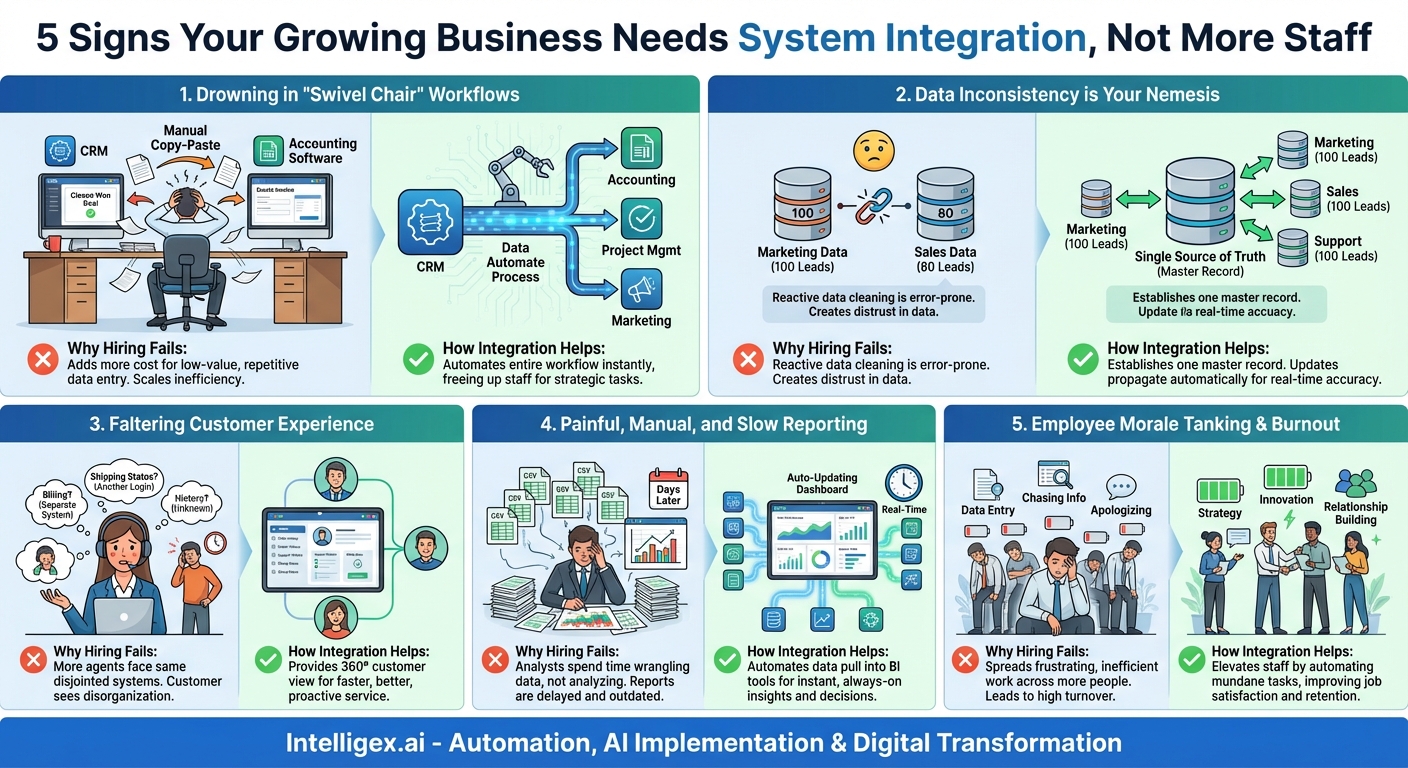
1. Your Team is Drowning in “Swivel Chair” Workflows
Picture your top sales representative. They’ve just closed a major deal in your CRM. What happens next? They swivel their chair to another monitor (or tab), open up the accounting software, and manually create a new customer and an initial invoice. Then, they swivel again to the project management tool to set up the new client project, copying and pasting details from the CRM. Finally, they might manually add the new contact to your marketing email list. This “swivel chair integration,” where a human acts as the bridge between two non-communicating systems, is a massive red flag.
Why More Headcount Fails: Hiring another person to do this work doesn’t solve the problem; it just adds another swivel chair to the office. You’re paying a salary, benefits, and overhead for a smart, capable human to perform a task that a machine could do instantly and without error. Furthermore, as you scale, this manual workload grows exponentially. Doubling your sales doesn’t just mean one person is busier; it means you might need two or three people dedicated solely to this low-value, repetitive data entry. The cost scales, but the efficiency plummets.
How Integration Helps: An integrated system automates this entire workflow. When a deal is marked “Closed-Won” in the CRM, an integration can automatically:
- Create the customer and invoice in the accounting system.
- Provision a new project in your project management tool, pulling in key contacts and deal notes.
* Add the contact to a “New Customer” email sequence in your marketing platform.
This frees your team from mind-numbing copy-paste tasks, allowing them to focus on what they were hired for: selling, managing projects, and building customer relationships.
2. Data Inconsistency is Your Constant Nemesis
Does your marketing team have a different customer address on file than your finance team? Does your sales team’s reporting show 50 new leads this week, while your marketing platform shows 75? When data lives in isolated silos, it inevitably drifts apart. A customer updates their phone number with a support agent, but that information never makes it back to the CRM. A sales rep misspells a company name when creating an invoice. These small discrepancies seem minor in isolation, but they snowball into a massive problem: you can no longer trust your own data.
Why More Headcount Fails: Throwing people at a data integrity problem is a losing battle. You can hire data validation clerks, but they are still human. They will make mistakes, take time off, and introduce their own inconsistencies. Moreover, you are creating a reactive, after-the-fact process. You’re paying people to clean up a mess that your disconnected systems are continuously creating. This leads to delayed reporting, poor business decisions based on flawed information, and endless inter-departmental arguments over which spreadsheet is the “correct” one.
How Integration Helps: System integration establishes a “Single Source of Truth” (SSOT). You designate one system—often the CRM for customer data—as the master record. When a piece of information is updated in the master system, the integration automatically propagates that change to all other connected systems. A customer updates their address in your customer portal? It’s instantly updated in your CRM, billing software, and shipping platform. This ensures that everyone across the organization is working from the same, accurate, real-time information, transforming data from a liability into a reliable strategic asset.
3. The Customer Experience is Starting to Falter
A long-term customer calls your support line with a billing question. The support agent has to put them on hold while they log into a separate accounting system to view their invoice history. The customer then asks about the status of a recent order, requiring another hold while the agent logs into the shipping platform. They don’t have a holistic view of the customer’s journey, history, or value. From the customer’s perspective, this is frustrating and makes your company seem disorganized. They feel like they’re interacting with separate, disjointed departments, not one cohesive brand.
Why More Headcount Fails: Hiring more support agents might reduce call wait times, but it won’t fix the clunky, disjointed experience once the call is connected. Each new agent will still have to navigate the same labyrinth of disconnected systems, putting customers on hold and fumbling for information. You can invest heavily in training, but you can’t train away a fundamental lack of access to unified information. The core problem—a fragmented customer view—remains untouched.
How Integration Helps: By integrating your support desk software with your CRM, billing system, and ERP, you can provide your agents with a 360-degree view of the customer on a single screen. When a call or ticket comes in, the agent can immediately see the customer’s entire history: past purchases, recent support interactions, outstanding invoices, and shipping statuses. They can answer questions faster, resolve issues more effectively, and even identify opportunities for upselling. This transforms customer support from a reactive cost center into a proactive, value-adding part of the business.
4. Reporting and Analytics are Painful, Manual, and Slow
Your leadership team asks for a report on customer acquisition cost (CAC) versus lifetime value (LTV) for the last quarter. To produce this, your analyst needs to export a CSV from your ad platforms (Google Ads, LinkedIn), another from your CRM (to see which leads converted), and a third from your accounting software (to get actual revenue data). They then spend the next two days in a spreadsheet nightmare, cleaning data, matching records using VLOOKUP, and manually building charts. By the time the report is ready, the data is already a week old, and the opportunity for timely action has passed.
Why More Headcount Fails: Hiring a dedicated data analyst simply means you’re paying someone full-time to perform this manual, soul-crushing export-and-merge routine. While they might get faster at it, the process itself remains fundamentally broken. It’s slow, prone to human error, and not scalable. As you add more data sources, the complexity of this manual reporting explodes, and your expensive analyst spends 90% of their time wrangling data instead of analyzing it for strategic insights.
How Integration Helps: Integration platforms can automatically pull data from all your disparate systems into a centralized data warehouse or business intelligence (BI) tool. Your marketing spend, sales conversions, and revenue data are all connected and updated in real-time. Dashboards that once took days to create are now always on and always accurate. Your leadership team can self-serve the information they need, and your analyst can finally focus on high-value work: finding trends, building predictive models, and answering strategic questions that drive the business forward.
5. Employee Morale is Tanking and Burnout is High
Your best employees didn’t join your company to spend their days on tedious, repetitive tasks. They joined to solve interesting problems, build relationships, and make an impact. When their daily reality consists of manual data entry, chasing down information from other departments, and apologizing to customers for system-related delays, it leads to frustration, disengagement, and eventually, burnout. You start losing your A-players not to competitors, but to sheer exhaustion from fighting your own internal processes.
Why More Headcount Fails: This is perhaps the most insidious trap. You see your team is overworked, so you hire more people to “lighten the load.” But you’re not lightening the load; you’re just spreading the same frustrating, inefficient work across more people. The new hires quickly become just as jaded as the veterans, and the cycle of burnout and turnover continues. This is incredibly costly, not just in recruitment fees, but in lost institutional knowledge and a damaged company culture.
How Integration Helps: Automation isn’t about replacing people; it’s about elevating them. By integrating systems and automating the mundane, you empower your employees to work at the top of their skill set. Salespeople can spend more time selling, marketers can focus on strategy, and operations teams can proactively optimize processes instead of just putting out fires. This leads to higher job satisfaction, better employee retention, and a culture of innovation, as your team is freed up to think about how to improve the business, not just how to survive the day.
If these signs resonate with you, it’s time to shift your perspective. The growing pains you’re experiencing are a signal. They’re telling you that the collection of individual tools that got you here won’t get you to the next level. Before you approve the budget for another desk chair, invest in a thorough analysis of your workflows. Map out where information gets stuck, where manual effort is highest, and where data is most fragmented. The solution you need may not be found on a job board, but in the powerful, invisible connections of a well-integrated technology stack. It’s an investment not just in software, but in a scalable, efficient, and resilient foundation for future growth.
Your Next Read:
Get a FREE
Proof of Concept
& Consultation
No Cost, No Commitment!