

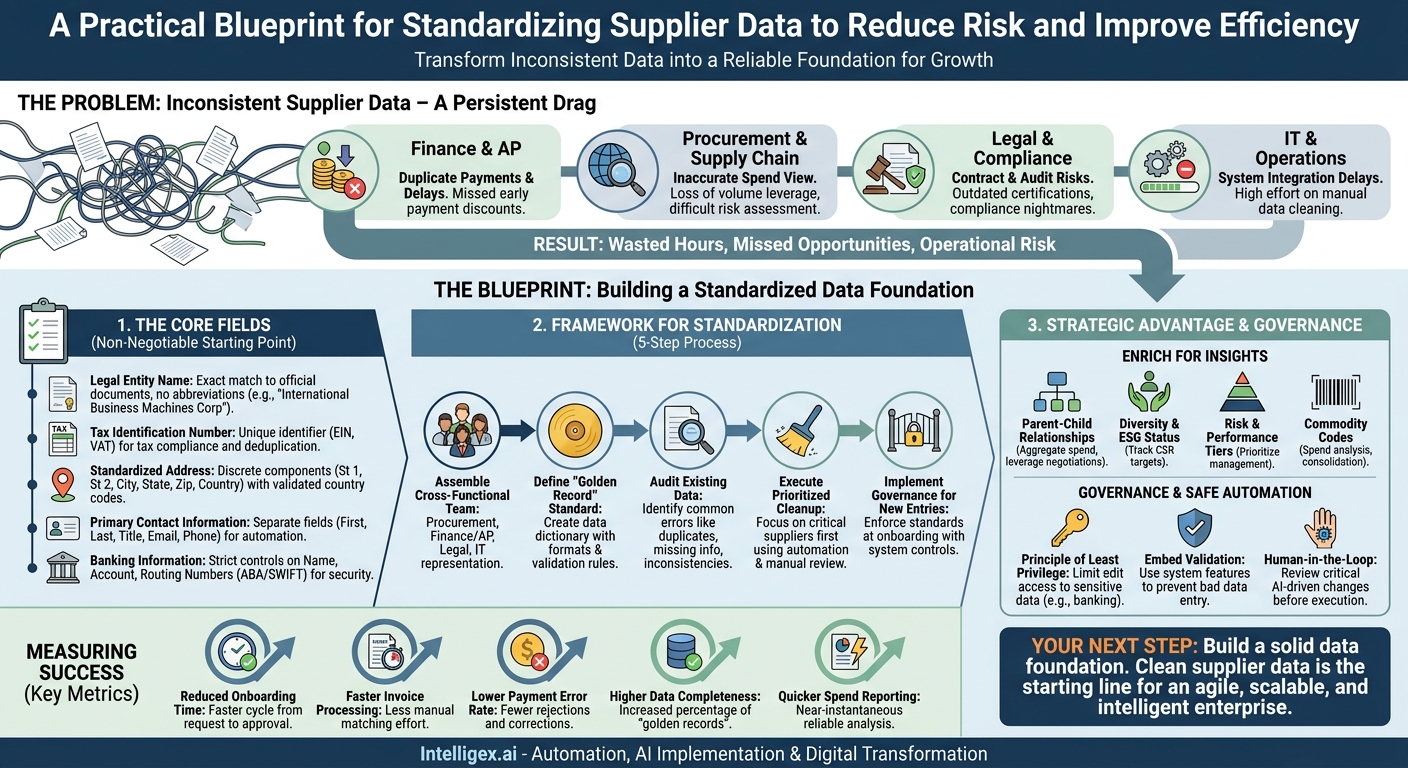
Inconsistent supplier data is more than a messy spreadsheet. It is a quiet but persistent drag on your entire operation. It creates friction in your accounts payable process, obscures risk in your supply chain, and slows down strategic decision-making. Every time an invoice is delayed because of a mismatched address, or a compliance report is held up by a missing tax ID, your business pays a price in wasted hours, missed opportunities, and operational risk. Before you can leverage advanced analytics or AI to optimize your supply chain, you must first build a reliable data foundation.
Standardizing supplier information is not a one-time cleanup project. It is a fundamental business discipline that unlocks speed, improves cost control, and provides the visibility needed to scale effectively. Getting it right early prevents small data inconsistencies from compounding into major systemic problems down the road. This guide provides a practical blueprint for identifying which data fields to prioritize and how to establish a standard that sticks.
Why Standardizing Supplier Data Isn’t Just an IT Task
The consequences of poor supplier data are felt across the organization, making it a shared business responsibility. When data is fragmented and inconsistent, every department that interacts with suppliers feels the impact, often without realizing the root cause.
Consider these common scenarios:
- Finance & Accounts Payable: A supplier named “Global Tech” in one system and “Global Technologies, LLC” in another can lead to duplicate payments or, more often, payment delays. These delays can damage supplier relationships and cause you to miss out on early payment discounts, directly impacting your bottom line.
- Procurement & Supply Chain: Without a unique, standardized identifier for each supplier, you cannot get an accurate view of your total spend. You might be negotiating with three different divisions of the same parent company without realizing it, losing significant volume-based leverage. Furthermore, assessing supplier risk becomes nearly impossible when you can’t reliably link performance data or compliance certifications to a single, authoritative entity.
- Legal & Compliance: Is the legal entity name on your contract the same one you are paying? Are their compliance certifications (like ISO 27001 or SOC 2) up to date? Inconsistent data makes contract management a nightmare and creates significant audit and compliance risks.
- IT & Operations: When integrating new systems, like an ERP or a procurement platform, inconsistent supplier data is a primary cause of project delays and budget overruns. The IT team is forced to spend countless hours on complex data mapping and manual cleanup efforts instead of focusing on value-added activities.
By treating supplier data as a strategic asset, you shift the focus from reactive cleanup to proactive governance. This creates a single source of truth that empowers every team with reliable, actionable information, reducing friction and enabling more intelligent business processes.
The Core Fields: Your Non-Negotiable Starting Point
You do not need to standardize every piece of supplier information at once. The key is to start with a core set of fields that provide the most immediate business value. Focus on getting these right first, as they form the bedrock of your supplier master record. For each field, define a clear, unambiguous format and make it mandatory during the onboarding process.
A Checklist for Your Core Supplier Data
-
Legal Entity Name: This is the official name the supplier uses for contracts and tax purposes. It must be an exact match to their legal documentation. Avoid using abbreviations, DBAs (“doing business as”), or informal names.
Example: Standardize on “International Business Machines Corporation” instead of “IBM” or “IBM Corp.”
-
Tax Identification Number: This includes a federal Employer Identification Number (EIN) in the U.S., a VAT number in Europe, or the equivalent in other regions. This field is critical for tax compliance and is one of the best ways to prevent duplicate entries, as it is a unique identifier.
Example: Require the 9-digit EIN for all U.S.-based suppliers, and cross-reference it with their W-9 form. For information on U.S. tax forms, the Internal Revenue Service provides official guidance.
-
Standardized Address (Physical & Remittance): Addresses are a common source of error. Standardize them by breaking them into discrete components: Street Line 1, Street Line 2, City, State/Province, Postal Code, and Country. Use standardized abbreviations (e.g., “St” for Street, “CA” for California) and validate country codes against a known standard like ISO 3166.
Example: Instead of a free-text field, use structured fields that guide user input and enforce consistency.
-
Primary Contact Information: Store contact details in separate fields: First Name, Last Name, Job Title, Email Address, and Phone Number. This prevents important information from being buried in a generic “notes” field and makes it easier to automate communications or integrate with a CRM.
Example: Mandate a valid email format check upon entry to reduce bounced communications.
-
Banking Information: This data is highly sensitive and requires strict controls. Standardize the format for Bank Name, Account Number, and Routing Number (such as ABA in the U.S. or SWIFT/BIC for international payments). Ensure this information can only be viewed and edited by authorized personnel in the Accounts Payable department.
Beyond the Basics: Fields for Strategic Advantage
Once you have a solid foundation with the core fields, you can expand your data model to include information that supports more strategic objectives like risk management, diversity initiatives, and performance analysis. These fields turn your supplier database from a simple payment ledger into a powerful business intelligence tool.
Enriching Your Data for Deeper Insights
Parent-Child Relationships: Many of your suppliers may be subsidiaries of larger parent corporations. By mapping these relationships, you can aggregate your total spend with a single corporate entity. This gives your procurement team immense leverage during negotiations and provides a more accurate picture of supplier concentration risk. Services from companies like Dun & Bradstreet can help provide this corporate linkage data.
Diversity & ESG Status: Many organizations have goals to increase spend with diverse suppliers (e.g., women-owned, minority-owned, or veteran-owned businesses). Capturing and certifying this status allows you to track progress against corporate social responsibility (CSR) and Environmental, Social, and Governance (ESG) targets. This requires a defined process for collecting and validating certifications.
Risk & Performance Tiers: Not all suppliers are created equal. Categorize them based on their strategic importance, risk profile, and performance history. A simple tiering system (e.g., Tier 1: Strategic Partner, Tier 2: Preferred Supplier, Tier 3: Transactional Vendor) can help you prioritize relationship management efforts and tailor risk monitoring activities. This data can be a simple dropdown field updated based on periodic business reviews.
Commodity Codes: Classify suppliers by the goods or services they provide using a standardized coding system like the United Nations Standard Products and Services Code (UNSPSC). This enables sophisticated spend analysis, helping you identify opportunities for category consolidation and cost savings.
A Practical Framework for Standardization
Standardizing supplier data requires a structured approach that combines clear definitions, a methodical cleanup process, and ongoing governance. Without a plan, even the best intentions can result in a project that stalls after the initial audit.
Follow these five steps to create a sustainable data standard:
- Assemble a Cross-Functional Team: Your data standardization effort cannot live in a single department. Form a small “tiger team” with representatives from Procurement (who onboard suppliers), Finance/AP (who pay them), Legal (who contract with them), and IT (who manage the systems). This ensures the final standard meets everyone’s needs and fosters buy-in across the business.
- Define Your “Golden Record” Standard: With your team, create a simple data dictionary. For each of the core fields identified earlier, document the required format, data type, and validation rules. For example, will phone numbers include the country code? Will state names be two-letter abbreviations or spelled out? This document becomes your single source of truth for what “good” data looks like.
- Audit Your Existing Data: Before you can fix the problem, you need to understand its scope. Run queries against your current supplier database to identify common issues: duplicate entries based on name or tax ID, records with missing addresses or contact information, and fields with inconsistent formatting (e.g., “USA,” “U.S.A.,” “United States”).
- Execute a Prioritized Cleanup: Do not try to boil the ocean. Start by cleaning up your most critical suppliers, perhaps the top 100 by annual spend or those in a key strategic category. Use a combination of methods: automated scripts for simple formatting changes, third-party data enrichment services for validation, and manual review for complex duplicates. Document all changes and the rationale behind them.
- Implement Governance for New Entries: This is the most critical step for long-term success. Update your supplier onboarding process to enforce the new data standards from day one. Use system-level controls like mandatory fields, dropdown lists, and format masks in your ERP or procurement software. Ensure that no new supplier can be added to the system until their data meets the defined “golden record” standard.
Measuring Success: How to Know It’s Working
The impact of standardized supplier data should be tangible and measurable. Tracking key performance indicators (KPIs) will not only demonstrate the value of your efforts but also help you identify areas for continuous improvement. Focus on metrics that directly reflect improvements in efficiency, cost, and risk management.
Key Metrics to Track
- Time to Onboard a New Supplier: Measure the average time from when a new supplier request is submitted to when they are fully approved and ready for transactions in your system. As data collection becomes more structured, this cycle time should decrease significantly.
- Invoice Processing Time: Track the average time from invoice receipt to payment approval. Clean data reduces the manual effort required to match invoices to purchase orders and supplier records, leading to faster processing.
- Rate of Payment Errors: Monitor the percentage of payments that are rejected, delayed, or require manual correction due to incorrect supplier information (e.g., wrong bank account or address). A successful standardization project will drive this number down.
- Percentage of Complete Supplier Records: Regularly audit your supplier master file and measure the percentage of records that meet your “golden record” standard. Aim for this number to consistently increase over time.
- Time to Generate Spend Reports: How long does it take your analytics team to produce a reliable report on spend by category or by parent company? With standardized data, this process should shift from a multi-day data-wrangling exercise to a near-instantaneous query.
Data Governance and Safe Automation
As you begin to rely on this clean data for automation and AI-driven insights, establishing strong governance becomes paramount. Good data hygiene is not just about format; it is also about security, privacy, and control. A careless approach can introduce new risks, even with perfectly standardized data.
First, implement the principle of least privilege. Not everyone needs the ability to edit every field. Personnel in Accounts Payable should be the only ones with rights to modify highly sensitive banking information. Procurement teams may have rights to update contact information or performance tiers, but not the legal entity name or tax ID after initial validation.
Second, embed validation at the point of entry. Use the features in your business systems, like those from SAP or Oracle, to enforce your data dictionary rules. This prevents bad data from entering the ecosystem in the first place, reducing the need for future cleanup projects.
Finally, when using automation or AI tools to enrich or correct data, always incorporate a human-in-the-loop review process for critical changes. For example, if an AI tool suggests merging two potential duplicate supplier records, that action should be flagged for review by a data steward before it is executed. This ensures that automation acts as an accelerator for your team, not an unchecked source of potential errors.
Your Next Steps: Building a Foundation for Growth
Starting the journey to standardized supplier data can feel daunting, but progress begins with a few deliberate steps. Instead of launching a massive, company-wide initiative, focus on building momentum through a small, successful pilot. This approach allows you to demonstrate value quickly and refine your process before a broader rollout.
Here is your immediate action plan:
- Identify a Business Champion: Find a leader in Finance or Procurement who feels the pain of poor data and can advocate for the resources needed to fix it.
- Scope a Pilot Project: Choose one critical supplier category or your top 25 strategic suppliers. Your goal is to get this small subset of data perfectly aligned with your new standard.
- Define Your “Core Four”: Start with the absolute essentials. Agree on a non-negotiable standard for just four fields: Legal Entity Name, Tax ID, Physical Address, and Primary Contact Email.
By taking these focused first steps, you build the solid data foundation necessary for a more agile, scalable, and intelligent enterprise. Clean supplier data is not the end goal; it is the starting line.
Your Next Read:
Category:
Get a FREE
Proof of Concept
& Consultation
No Cost, No Commitment!
