

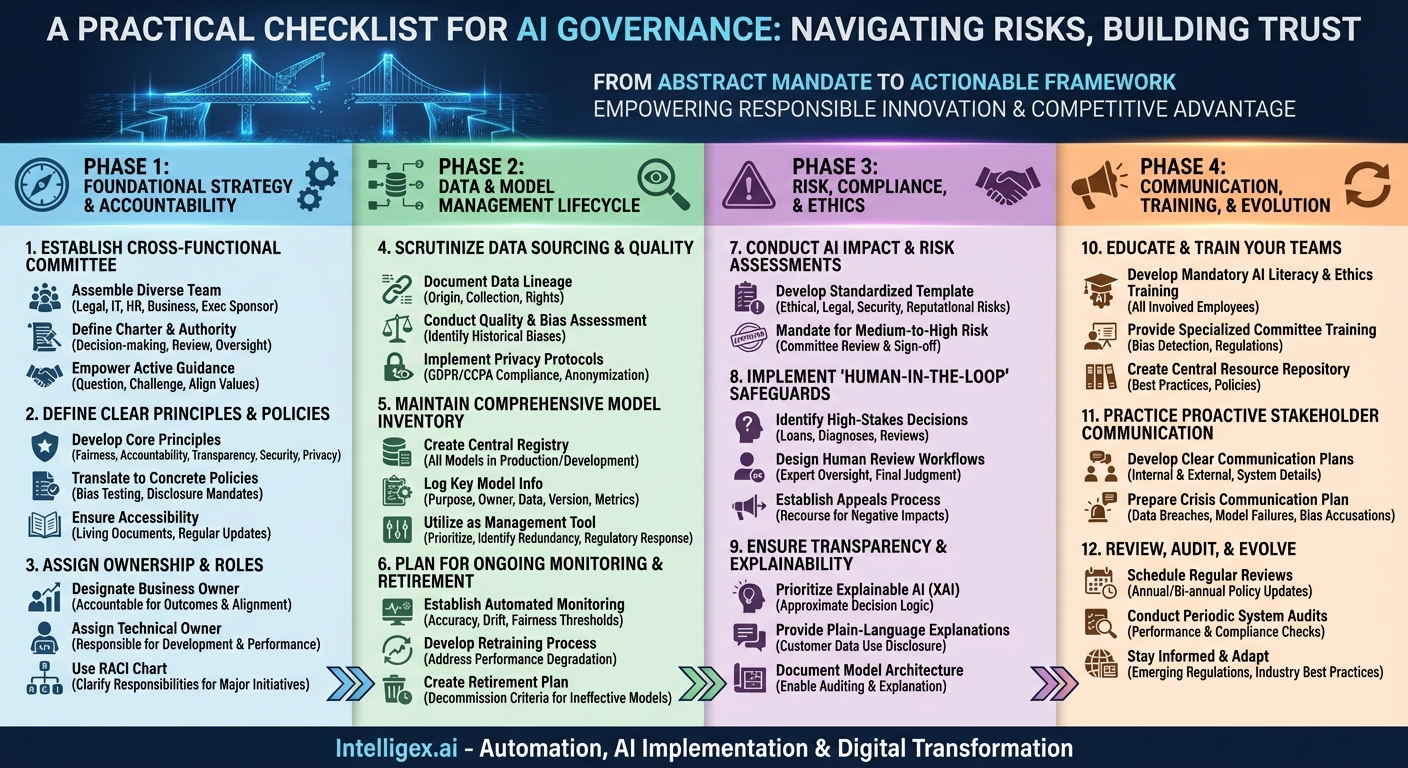
Artificial intelligence is no longer a futuristic concept discussed in boardrooms; it’s a practical tool being deployed across departments, from marketing and sales to operations and human resources. This rapid integration brings immense potential for efficiency, innovation, and competitive advantage. However, it also introduces a new and complex landscape of risks. Without a structured framework for oversight, businesses can stumble into significant ethical, legal, and reputational pitfalls, including biased decision-making, data privacy violations, and a general lack of accountability. This is where AI governance comes in. It is not a barrier to innovation but a crucial enabler, providing the guardrails necessary to build, deploy, and manage AI systems responsibly and effectively. It’s the difference between harnessing a powerful tool and being controlled by it.
For business teams on the front lines of AI implementation, governance can feel like an abstract, top-down mandate. The key is to translate high-level principles into a practical, actionable checklist. This guide is designed for exactly that purpose—to empower business leaders, project managers, and their teams to navigate the complexities of AI with confidence. By systematically addressing these key areas, you can ensure your AI initiatives are not only powerful but also principled, compliant, and trustworthy.
Phase 1: Foundational Strategy & Accountability
Before a single line of code is written or a third-party tool is procured, a strong foundation of strategy and accountability must be laid. This initial phase is about defining the rules of the road and ensuring everyone knows who is responsible for what. Skipping this step is like building a skyscraper without a blueprint or a foreman.
1. Establish a Cross-Functional AI Governance Committee
AI is not just an IT or data science issue; it touches every facet of the organization. Your governance body must reflect this reality. A common mistake is to relegate AI oversight solely to the technical teams. This creates a dangerous blind spot to business, legal, and ethical implications.
Action Items:
- Assemble a committee with representatives from key departments: Legal, Compliance, IT/Data Science, Human Resources, a relevant business line (e.g., Marketing, Finance), and an executive sponsor.
- Clearly define the committee’s charter, including its decision-making authority, meeting cadence, and responsibilities. These responsibilities should cover policy approval, high-risk project review, and incident response oversight.
- Empower this group to be more than a rubber stamp. They should actively question, challenge, and guide AI projects to ensure alignment with company values and policies.
2. Define Clear Principles and Policies
Your company’s values shouldn’t be left at the door when you start using AI. Governance begins by codifying these values into clear, understandable AI principles. These principles act as a north star for every AI-related decision.
Action Items:
- Develop a set of core AI principles. These often include commitments to fairness, accountability, transparency, security, and privacy.
- Translate these high-level principles into concrete policies. For example, a “fairness” principle should be supported by a policy that mandates bias testing for any AI model used in hiring or customer segmentation. A “transparency” principle could lead to a policy requiring clear disclosure to customers when they are interacting with an AI chatbot.
- Make these documents easily accessible to all employees involved in AI projects. They should be living documents, reviewed and updated regularly as technology and regulations evolve.
3. Assign Ownership and Roles
A policy without an owner is just a suggestion. For governance to be effective, accountability must be crystal clear. Every AI system, from its inception to its retirement, needs designated owners who are responsible for its performance and adherence to governance standards.
Action Items:
- For each AI project, assign a Business Owner who is accountable for the system’s outcomes and its alignment with business goals.
- Assign a Technical Owner (often a data scientist or engineer) responsible for the model’s development, performance, and maintenance.
- Use a RACI (Responsible, Accountable, Consulted, Informed) chart for major AI initiatives to clarify roles and prevent confusion, especially when an issue arises.
Phase 2: Data & Model Management Lifecycle
The heart of any AI system is its data and the model built from it. Robust governance requires rigorous management of this entire lifecycle, from data acquisition to model retirement. A failure at any point in this chain can compromise the entire system.
4. Scrutinize Data Sourcing and Quality
The old adage “garbage in, garbage out” is amplified a thousand-fold with AI. Biased, incomplete, or poor-quality data is the primary cause of underperforming and discriminatory AI systems. Data governance is the bedrock of AI governance.
Action Items:
- Document the lineage of all training data. Where did it come from? How was it collected? Do we have the legal and ethical rights to use it for this purpose?
- Conduct a thorough data quality and bias assessment. Look for historical biases in the data that could lead to unfair outcomes (e.g., gender or racial bias in historical hiring data).
- Implement data privacy protocols from the start. Ensure all data used complies with regulations like GDPR and CCPA, and that personally identifiable information (PII) is handled appropriately, often through anonymization or pseudonymization techniques.
5. Maintain a Comprehensive Model Inventory
As AI use grows, it’s easy to lose track of all the models operating across the business. This “shadow AI” presents a significant risk. A central model inventory provides the visibility necessary for effective oversight.
Action Items:
- Create a registry of every AI model in production or development.
- For each model, log key information: its purpose, the business owner, the data it was trained on, its version, its performance metrics, and any known limitations or risks.
- This inventory is not just for tracking; it’s a critical management tool for prioritizing updates, identifying redundant systems, and responding to regulatory inquiries.
6. Plan for Ongoing Monitoring and Retirement
An AI model is not a “set it and forget it” asset. Its performance can degrade over time as real-world data patterns shift—a phenomenon known as model drift. A model that was accurate last quarter might be unreliable today.
Action Items:
- Establish automated monitoring for key model metrics, including accuracy, data drift, and fairness. Set thresholds for these metrics that trigger alerts for human review.
- Develop a clear process for retraining and redeploying models when performance degrades.
- Create a model retirement plan. No model lasts forever. Define the criteria for decommissioning a model when it is no longer effective, compliant, or relevant to business needs.
Phase 3: Risk, Compliance, and Ethics
This phase focuses on proactively identifying and mitigating the potential harms of AI. It involves looking beyond model accuracy to consider the real-world impact on individuals, the business, and society. This is where governance proves its value in protecting the company’s brand and bottom line.
7. Conduct AI Impact and Risk Assessments
Before deploying any AI system, especially one that affects customers or employees in significant ways, you must understand its potential impact. A formal assessment forces teams to think through the consequences and build in safeguards.
Action Items:
- Develop a standardized AI Impact Assessment template. This should prompt teams to consider potential risks across various domains: ethical (e.g., fairness, autonomy), legal (e.g., discrimination, privacy), security (e.g., adversarial attacks), and reputational.
- Mandate the completion of this assessment for all medium-to-high-risk AI projects before they can be approved for deployment. The AI Governance Committee should review and sign off on these assessments.
8. Implement “Human-in-the-Loop” Safeguards
Full automation is not always the right answer. For high-stakes decisions—such as loan applications, medical diagnoses, or employee performance reviews—relying solely on an AI’s output is a recipe for disaster. A human expert should be involved to provide oversight, context, and a final judgment call.
Action Items:
- Identify and classify high-stakes decision points where AI is used.
- Design workflows that require human review and approval for these decisions. The AI can provide a recommendation or analysis, but the final decision rests with a qualified person.
- Establish a clear appeals process for individuals who are negatively impacted by an AI-driven decision. This provides a crucial mechanism for recourse and error correction.
9. Ensure Transparency and Explainability
If you can’t explain how your AI system reached a decision, you can’t trust it. This “black box” problem is a major obstacle to adoption and a huge liability. Stakeholders—from internal auditors to regulators to customers—are increasingly demanding to know the “why” behind AI-driven outcomes.
Action Items:
- Prioritize the use of explainable AI (XAI) techniques, especially for models influencing critical decisions. While some complex models are inherently less transparent, tools and methods exist to approximate their decision-making logic.
- For customer-facing AI, provide clear, plain-language explanations of how their data is used and how decisions affecting them are made.
- Ensure that technical teams thoroughly document their model architecture, features, and decision-making processes so that they can be audited and explained later.
Phase 4: Communication, Training, and Evolution
Finally, governance is a human endeavor. It relies on a well-informed workforce and a culture of responsibility. A perfect policy document is useless if no one knows it exists or understands how to apply it.
10. Educate and Train Your Teams
Your employees are your first line of defense in responsible AI. They need to be equipped with the knowledge to identify potential issues and understand their role within the governance framework.
Action Items:
- Develop mandatory AI literacy and ethics training for all employees involved in the design, development, or deployment of AI systems.
- Provide specialized training for members of the AI Governance Committee on topics like bias detection, regulatory landscapes, and risk assessment.
- Create a central repository of resources, best practices, and policy documents that is easily accessible to everyone.
11. Practice Proactive Stakeholder Communication
Be transparent about your use of AI with all relevant stakeholders, including employees, customers, investors, and regulators. Building trust externally starts with fostering a culture of openness internally.
Action Items:
- Develop clear internal and external communication plans for new AI deployments. Explain what the system does, what data it uses, and what safeguards are in place.
- Prepare a crisis communication plan for potential AI-related incidents, such as a data breach, a major model failure, or an accusation of bias.
12. Review, Audit, and Evolve
AI governance is not a one-time project; it’s a continuous process of improvement. The technology, regulations, and societal expectations around AI are changing at a dizzying pace. Your governance framework must be agile enough to keep up.
Action Items:
- Schedule regular (e.g., annual or bi-annual) reviews of your AI principles, policies, and procedures.
- Conduct periodic audits of your AI systems to ensure they are performing as expected and remain in compliance with your governance framework.
- Stay informed about emerging AI regulations and industry best practices, and be prepared to adapt your framework accordingly.
Implementing AI is a journey, not a destination. By embedding this governance checklist into your workflow, you transform risk into an opportunity—an opportunity to build innovative AI solutions that are not only powerful and profitable but also responsible, fair, and worthy of trust. This is how you win with AI in the long run.
Your Next Read:
Category:
Get a FREE
Proof of Concept
& Consultation
No Cost, No Commitment!
