

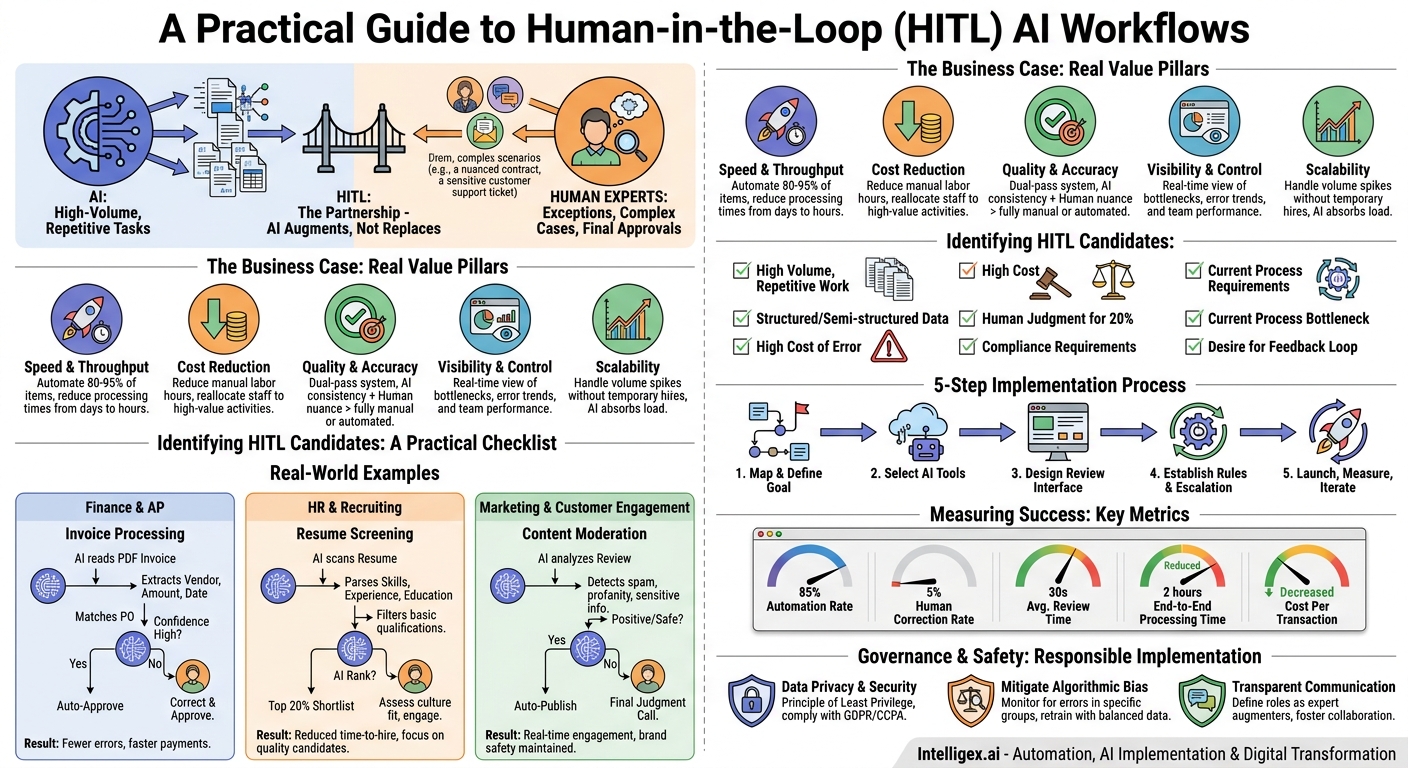
Everyone is exploring AI to make their business faster and more efficient. But the idea of “full automation” can be daunting. What if the AI makes a costly mistake? What about tasks that require nuance, judgment, or a final compliance check? For many critical business processes, taking humans completely out of the equation is not just risky, it’s impractical. This is where a Human-in-the-Loop (HITL) approach provides a powerful, pragmatic solution.
An HITL system isn’t about replacing people. It’s about augmenting them. It creates a partnership where AI handles the high-volume, repetitive work, and human experts handle the exceptions, the complex cases, and the final approvals. Think of it as giving your best people a team of tireless digital assistants who sort, classify, and prepare work, freeing them to focus on what they do best: think critically and make strategic decisions.
The Business Case: When Does HITL Create Real Value?
Implementing any new system requires a clear business case. HITL is not just a technological curiosity; it’s a model that drives tangible improvements across key performance indicators. By strategically combining machine speed with human intelligence, you create a workflow that is greater than the sum of its parts.
The value proposition breaks down into five core areas:
- Speed and Throughput: An AI can process thousands of documents, emails, or transactions in the time it takes a person to process a few. An HITL system lets you clear 80-95% of items automatically, leaving only a small, manageable queue for your team. This dramatically reduces end-to-end processing times for everything from customer support tickets to accounts payable invoices.
- Cost Reduction: By automating the bulk of a task, you significantly reduce the manual labor hours required. This doesn’t necessarily mean reducing headcount. Instead, it allows you to reallocate your team’s valuable time from tedious, low-value data entry to higher-value activities like analysis, customer engagement, or process improvement.
- Quality and Accuracy: Humans make mistakes, especially when performing repetitive tasks. AI provides a consistent baseline for quality. When the AI is uncertain, it flags the item for a human, who can make a more nuanced decision. This dual-pass system often results in higher overall accuracy than either a fully manual or a fully automated process. Better yet, the corrections made by humans can be used to retrain the AI, creating a continuous improvement cycle.
- Visibility and Control: Manual processes can be black boxes. Where is that invoice? Who approved that request? An HITL workflow centralizes exception handling into a single queue. This gives managers a real-time dashboard of bottlenecks, error trends, and team performance, providing a level of process visibility that was previously impossible.
- Scalability: Your business has peaks and troughs. An HITL system allows you to handle sudden spikes in volume (like a marketing campaign launch or end-of-quarter financial close) without needing to hire and train temporary staff. The AI absorbs the extra load, and the human review workload increases only marginally.
Identifying HITL Candidates: A Practical Checklist
Not every workflow is a good fit for a Human-in-the-Loop model. The best candidates share a common set of characteristics. Use this checklist to evaluate processes within your own operations, finance, marketing, or HR teams to find the low-hanging fruit.
Your process is a strong candidate for HITL if you can answer “yes” to several of these questions:
- Is there a high volume of repetitive work? The process involves handling hundreds or thousands of similar items, like invoices, resumes, support tickets, or customer reviews.
- Does the task involve structured or semi-structured data? The AI needs predictable patterns to learn from, such as data extraction from forms, classification of emails, or flagging keywords in text.
- Is the cost of an error high? For tasks like financial approvals, medical coding, or legal contract review, a mistake can have serious consequences. HITL provides a crucial safety net.
- Is human judgment needed for a small subset of cases? The “80/20 rule” often applies. If 80% of the decisions are straightforward but 20% require context, empathy, or complex reasoning, the process is a perfect fit.
- Are there compliance or regulatory requirements? Many industries require a human to sign off on certain decisions for legal or regulatory reasons. HITL builds this requirement directly into the workflow.
- Is the current manual process a known bottleneck? If a team is constantly behind on processing a specific type of task, it’s a clear signal that automation assistance is needed.
- Do you want to create a feedback loop to improve automation over time? The corrections made by your team are valuable training data. An HITL system is the best way to capture this data and continuously make your AI models smarter.
Real-World Examples: HITL Across Departments
Theory is useful, but concrete examples show how HITL works in practice. Here is how different business units are leveraging this model to transform their core processes.
Finance and Accounts Payable
The Challenge: A mid-sized company processes over 5,000 vendor invoices per month. The AP team manually enters data from each PDF invoice into their ERP system, a slow and error-prone process that leads to late payment fees and frustrated vendors.
The HITL Solution:
- An AI model with Optical Character Recognition (OCR) reads each incoming invoice and automatically extracts key fields: vendor name, invoice number, date, line items, and total amount.
- The AI matches the invoice to a purchase order in the system.
- If the data is extracted with high confidence (e.g., above 95%) and matches the PO perfectly, the invoice is automatically approved for payment.
- If the AI’s confidence is low, the amount exceeds a pre-set threshold (e.g., $5,000), or there is no matching PO, the invoice and the extracted data are routed to an AP specialist’s review queue.
- The specialist sees the original invoice and the AI’s proposed data side-by-side, quickly making any necessary corrections before approving.
The Value: The AP team now spends their time managing exceptions, not on data entry. Processing time drops from days to hours, and early payment discounts are captured more frequently.
Human Resources and Recruiting
The Challenge: A popular job posting attracts over 1,000 applications. Recruiters spend dozens of hours sifting through resumes to find the small number of candidates who meet the basic qualifications.
The HITL Solution:
- An AI model scans every resume, parsing for key information like years of experience, specific skills (e.g., “Python,” “PMP Certified”), and education level.
- The system automatically filters out applications that clearly do not meet the minimum requirements defined in the job description.
- It then scores and ranks the remaining candidates, presenting a “top 20%” shortlist to the recruiter.
- The recruiter focuses their time on this pre-vetted list, using their expertise to assess culture fit, career progression, and other nuances the AI cannot.
The Value: Time-to-hire is significantly reduced. Recruiters can handle more open requisitions and spend more quality time engaging with the most promising candidates.
Marketing and Customer Engagement
The Challenge: A large e-commerce brand wants to display user-generated product reviews on its website but must filter out spam, inappropriate language, and mentions of competitors.
The HITL Solution:
- A natural language processing (NLP) model analyzes every submitted review in real-time.
- Reviews that are clearly positive and contain no flagged terms are automatically published.
- Reviews containing profanity, spam links, or potentially sensitive information are sent to a human moderator’s queue.
- The moderator makes the final judgment call, protecting the brand’s reputation while ensuring legitimate negative feedback isn’t unfairly censored.
The Value: Customer engagement increases through real-time reviews, while brand safety is maintained without requiring a massive team of full-time moderators.
A 5-Step Process for Implementing Your First HITL Workflow
Getting started with Human-in-the-Loop doesn’t require a massive, multi-year transformation project. By starting with a single, well-defined process, you can build momentum and demonstrate value quickly. Follow these five steps to launch your first HITL workflow.
- Map the Process and Define the Goal: Before you introduce any technology, you must understand the current state. Document the existing manual workflow step-by-step. Identify the exact decision points, inputs, and outputs. Clearly define what you want to achieve. Is the goal to reduce processing time by 50%? Or is it to improve accuracy to 99.5%? A clear success metric is essential.
- Select the Right AI Model and Tools: Based on your goal, choose the appropriate type of AI. For document processing, you’ll need an OCR and data extraction model. For email routing, you’ll need a text classification model. You can leverage pre-built services from cloud providers like Amazon Web Services or use more specialized platforms designed for specific tasks.
- Design the Human Review Interface: This is one of the most critical steps. The interface for your human experts must be simple, fast, and intuitive. It should present the AI’s suggestion, the confidence score, and the original source data all in one view. The goal is to make the review and correction process take seconds, not minutes.
- Establish Clear Rules and Escalation Paths: Define the business logic for the workflow. What triggers a human review? A confidence score below 90%? A transaction amount above $1,000? A specific keyword? Also, define what happens after the review. Who handles complex escalations? What are the service-level agreements (SLAs) for completing reviews?
- Launch, Measure, and Iterate: Start with a pilot group. Monitor performance from day one using the metrics you defined in the first step. Track the automation rate, human correction rate, and average review time. Use the corrections made by your team as a valuable dataset to periodically retrain and improve the underlying AI model.
Measuring Success: Key Metrics for HITL Systems
To justify the investment and prove the value of your HITL system, you need to track the right metrics. These go beyond simple activity tracking and focus on the business impact of the new workflow.
- Automation Rate: The percentage of items processed entirely by the AI without human intervention. This is your primary measure of efficiency. An initial goal might be 70%, with a target of 90% or higher as the model improves.
- Human Correction Rate: Of the items reviewed by a human, what percentage required a correction? A high rate might indicate the AI model needs more training, while a very low rate might suggest your review rules are too conservative.
- Average Review Time: How long does it take a person, on average, to review one flagged item? This measures the efficiency of your review interface and process. The goal is to keep this as low as possible.
- End-to-End Processing Time: The total time from when an item enters the workflow to when a final decision is made. This is a crucial customer-facing or vendor-facing metric that directly reflects the speed improvements.
- Cost Per Transaction: Calculate the blended cost (machine processing cost + human review cost) for each item. As your automation rate increases, this cost should steadily decrease compared to the fully manual baseline.
Governance and Safety: Implementing HITL Responsibly
As you integrate AI into critical business processes, especially those involving sensitive customer or employee data, responsible implementation is non-negotiable. An HITL framework inherently provides a layer of oversight, but it’s important to be intentional about governance from the start.
First, address data privacy and security. The AI model and the human reviewers should only have access to the data they absolutely need to perform their function (the Principle of Least Privilege). Ensure all data is handled according to regulations like GDPR or CCPA and that your review environment has strong access controls.
Second, use human review as a tool to actively monitor for and mitigate algorithmic bias. If you notice the AI is consistently making errors for a particular demographic, document type, or region, it’s a sign that the training data may be biased. The HITL process makes these patterns visible, allowing you to intervene, retrain the model with more balanced data, and ensure fair outcomes.
Finally, be transparent with your team. Clearly communicate that the goal of the system is to augment their skills, not replace them. Define their roles as expert reviewers and subject matter experts whose feedback is crucial for improving the system. This fosters a culture of collaboration rather than one of fear or resistance.
Your Next Steps: From Idea to Action
The Human-in-the-Loop model offers a balanced and practical path to leveraging AI in your business. It delivers the speed and scale of automation while retaining the judgment, accountability, and nuance that only a human can provide.
The journey starts with a single step. Don’t try to boil the ocean. Instead, use the checklist in this post to identify one or two candidate processes that are causing friction in your organization. Map the workflow, define your goals, and begin the conversation about how a partnership between your people and intelligent automation can unlock the next level of efficiency and quality for your business.
Your Next Read:
Category:
Get a FREE
Proof of Concept
& Consultation
No Cost, No Commitment!
