

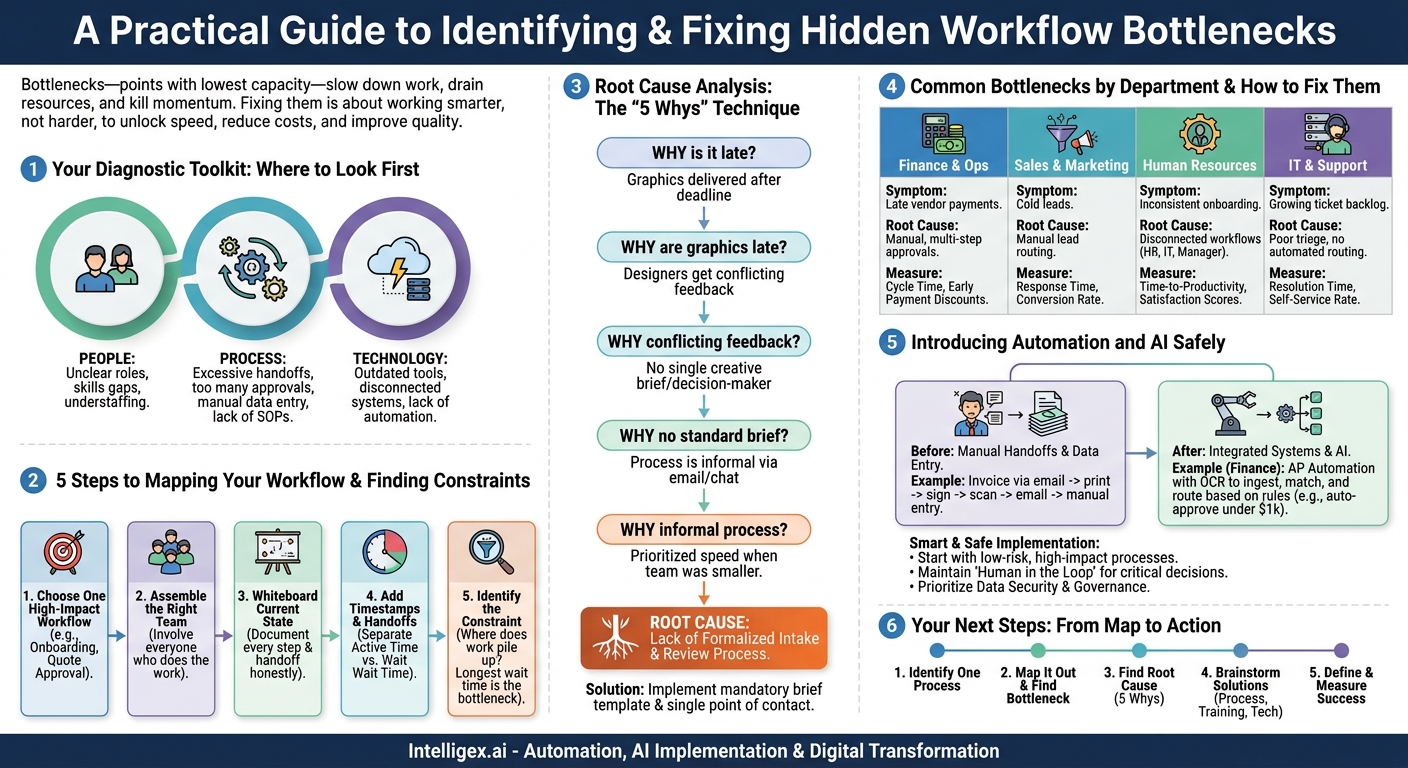
Work gets stuck. It’s a universal business problem. A critical report is delayed waiting for data from another department. A sales quote sits in a manager’s inbox, holding up a deal. A new employee waits days for system access, unable to start their job. These delays, often called bottlenecks, feel like isolated frustrations, but they are symptoms of deeper issues in your workflows. They quietly drain resources, kill momentum, and frustrate your best people.
The common reaction is to blame a person or a team, or to throw more resources at the problem. But the real culprit is almost always the process itself. A bottleneck is simply the point in a workflow with the lowest capacity. All work is forced to slow down to match the pace of that single constraint. Finding and fixing these constraints isn’t about working harder; it’s about working smarter. By systematically identifying the root causes of these delays, you can unlock significant improvements in speed, reduce operational costs, and improve the quality of your output.
The High Cost of Hidden Friction
Workflow bottlenecks are more than just an inconvenience. They create tangible and intangible costs that ripple across the organization, impacting everything from your balance sheet to your company culture. Understanding these costs is the first step toward justifying the effort needed to fix them.
Financial Costs: The most direct impact is on your bottom line. When a process stalls, you are paying for wasted time. An operations team waiting for an approval is still on the clock. A delayed project can trigger penalty clauses with a client or mean missing a window of market opportunity. In supply chain, a paperwork bottleneck can lead to demurrage fees for containers sitting at a port. In finance, slow invoice processing can mean missing out on early payment discounts offered by vendors. These small, hidden costs add up to a significant financial drain.
Quality Degradation: When a bottleneck finally clears, the downstream teams are often forced to rush to make up for lost time. This rush is a breeding ground for errors. Marketing copy is published with typos. Code is deployed without thorough testing. Financial reports are submitted with inaccuracies. This leads to rework, which is expensive, and can damage customer trust and brand reputation. The pressure to “just get it done” compromises the quality that sets your business apart.
Decreased Visibility and Control: A classic sign of a bottleneck is a lack of visibility. When a task is handed off into a black box, like an overloaded legal review queue or a complex manual approval chain, nobody has a clear answer to the question, “What is the status of this?” This forces managers into a cycle of chasing updates through emails and meetings, which is itself a waste of valuable time. Without a clear view of the process, you cannot manage it effectively, predict timelines, or make data-driven decisions.
Employee Morale and Burnout: Perhaps the most underestimated cost is the human one. Constantly waiting for others, or being the person everyone is constantly chasing, is stressful and demoralizing. Employees become frustrated when they are blocked from doing their jobs by forces outside their control. This can lead to disengagement, burnout, and higher employee turnover. A culture of blame often develops, where departments point fingers at each other instead of collaborating to fix the underlying system.
Your Diagnostic Toolkit: Where to Look First
Before you can fix a bottleneck, you have to find it. The root cause of a delay is rarely obvious. It’s often buried in the handoffs between people, processes, and the technology that supports them. To begin your diagnosis, you can use a simple framework to categorize potential problem areas. Think of this as your initial checklist for investigation.
- People: This category isn’t about blaming individuals. It’s about the human elements of the workflow. Are roles and responsibilities crystal clear? Does everyone know who owns the next step? Is there a skills gap where specific tasks can only be done by one or two overburdened experts? Are your teams properly resourced, or is a key function chronically understaffed, creating a permanent capacity issue?
- Process: This is where the most common and fixable bottlenecks hide. Look for signs of process inefficiency. Are there excessive handoffs, where work passes through too many hands? Are there too many approval layers for low-risk decisions? Do you rely on manual, error-prone steps like re-typing data from a PDF into a spreadsheet? A lack of Standard Operating Procedures (SOPs) is a major red flag, as it forces people to reinvent the wheel every time.
- Technology: Your tools are meant to accelerate work, not slow it down. Is your team fighting with slow, outdated software? Are your key systems disconnected, forcing manual data transfer between your CRM, ERP, and financial software? A common technology bottleneck is the absence of automation for repetitive, rule-based tasks that consume hours of human effort every week.
By starting with these three categories, you can structure your investigation and avoid jumping to conclusions. The problem you think is a “people problem” (a slow team) might actually be a “process problem” (too many approvals) enabled by a “technology problem” (no automated workflow tool).
A Step-by-Step Guide to Mapping Your Workflow
To truly understand where work gets stuck, you must make the invisible visible. A workflow mapping exercise is the most effective way to do this. It’s a collaborative effort to document a process exactly as it happens today, not as it’s described in an outdated manual. This visual map will immediately highlight the delays and friction points.
- Choose One High-Impact Workflow. Don’t try to map your entire business at once. Start with a single process that is causing known pain or is critical to your business goals. Good candidates include customer onboarding, sales quote approval, vendor payment processing, or resolving high-priority support tickets. Pick one and focus all your energy there first.
- Assemble the Right Team. The map will only be accurate if you involve the people who actually perform the work every day. A manager’s perception of a process is often very different from the reality on the ground. Invite representatives from every stage of the workflow, from the person who initiates the request to the person who completes the final step.
- Whiteboard the Current State. Get your team in a room (physical or virtual) with a large whiteboard. Start at the very beginning of the process (the trigger) and ask, “What happens first?” Document that step. Then ask, “What happens next?” Continue this until you reach the final outcome. For each step, note who is responsible and what tools or systems they use. Be brutally honest and capture every detail, including the workarounds and exceptions.
- Add Timestamps and Handoffs. Go back through your map and estimate two types of time for each step: active time (the time someone is actively working on the task) and wait time (the time the task spends sitting in a queue, an inbox, or waiting for a handoff). You will often find that the total wait time far exceeds the total active time. Clearly mark every point where work is handed off from one person or team to another, as these are prime locations for bottlenecks.
- Identify the Constraint. Now, stand back and look at your map. Where does work pile up? Which step has the longest wait time? Where do the most questions and follow-up emails occur? The step that governs the overall speed of the entire process is your primary bottleneck. The entire workflow can only move as fast as this single step. This is your target for improvement.
Root Cause Analysis: Asking “Why?” Five Times
Identifying a bottleneck is a great start, but it’s not enough. You need to understand the root cause behind it. A powerful yet simple technique for this is the “5 Whys.” By repeatedly asking “why” a problem is occurring, you can peel back the layers of symptoms to find the foundational issue that needs to be solved. Trying to fix a symptom will only provide temporary relief, while fixing the root cause can solve the problem permanently.
Let’s walk through a real-world example for a marketing team.
The Problem: Our new campaign content is consistently published late. (This is the bottleneck identified in the workflow map).
- 1. Why is it late? Because the final graphics from the design team are often delivered after the deadline.
- 2. Why are the graphics late? Because designers receive last-minute, conflicting feedback from multiple stakeholders in marketing and sales.
- 3. Why do they receive conflicting feedback? Because there isn’t a single, consolidated creative brief and one person assigned as the final decision-maker for feedback.
- 4. Why isn’t there a standard brief and a clear approver? Because we’ve never formalized the content request and review process; it happens over email and chat.
- 5. Why haven’t we formalized the process? Because we prioritized speed and informal collaboration when the team was smaller, and we never updated the process as the team and complexity grew.
The Root Cause: The lack of a formalized and standardized intake and review process. Notice how this changes the solution. The initial symptom might suggest “we need to hire more designers.” But the root cause analysis shows the real solution is to implement a clear process, such as creating a mandatory creative brief template and designating a single point of contact for approvals. This is a far more effective and scalable fix.
Common Bottlenecks by Department (And How to Spot Them)
While every business is unique, bottlenecks often appear in similar patterns across different functions. Here are some common symptoms, potential root causes, and key metrics to watch in several key departments.
Finance and Operations
Symptom: Vendor invoices are frequently paid late, leading to strained relationships and missed early-payment discounts.
Potential Root Cause: A manual, multi-step approval process that relies on email chains or physical document sign-offs. An invoice can get stuck waiting for a manager who is traveling or simply has an overflowing inbox.
What to Measure: Invoice Processing Cycle Time (from receipt to payment), Percentage of Early Payment Discounts Captured, Number of Invoices Processed Per Full-Time Employee.
Sales and Marketing
Symptom: High-quality leads from the website go cold before a sales representative can contact them.
Potential Root Cause: Manual lead routing. A marketing team member might have to manually export leads from a webform tool, clean the data in a spreadsheet, and then manually import it into the CRM like Salesforce for assignment. This delay can take hours or even days.
What to Measure: Lead Response Time (time from submission to first contact), Lead-to-Opportunity Conversion Rate.
Human Resources
Symptom: New hires have a frustrating and inconsistent onboarding experience, feeling unproductive for their first week.
Potential Root Cause: Lack of a coordinated, automated workflow. HR, IT, and the hiring manager all have separate task lists that are not connected. IT can’t provision a laptop until HR confirms the hire, and the manager can’t schedule training until the laptop is ready.
What to Measure: Time-to-Productivity for New Hires, New Hire Satisfaction Scores, Onboarding Task Completion Rate.
IT and Support
Symptom: The backlog of internal support tickets is constantly growing, and employees complain about long resolution times for simple requests.
Potential Root Cause: A poor triage system where every ticket, from a password reset to a server failure, enters the same general queue. There is no automated way to route simple, repeatable requests to a specific team or provide self-service answers from a knowledge base.
What to Measure: Average Resolution Time, First Response Time, Ticket Backlog Growth Rate, Self-Service Resolution Rate.
Introducing Automation and AI Safely
Once you have identified the root cause of a bottleneck, you can explore solutions. Often, the most powerful solutions involve integrating your systems and automating manual work. This is where modern platforms and targeted AI can deliver transformative value, not as a magical cure-all, but as a precise tool to fix a specific, well-understood problem.
Let’s revisit our departmental examples. Instead of just creating a better manual process, we can use technology to build a better system:
- For Finance: Implement an Accounts Payable (AP) automation tool. It can ingest invoices via email, use optical character recognition (OCR) to extract the data, match it against a purchase order, and automatically route it for approval based on pre-set rules (e.g., invoices under $1,000 are auto-approved, over $10,000 go to the CFO). This removes the manual data entry and email chasing entirely.
- For Sales: Use a simple integration platform to connect your website form directly to your CRM. The moment a potential customer clicks “submit,” a lead is instantly created and assigned to the correct sales rep based on territory or industry, triggering an immediate notification for follow-up.
- For HR: A modern HRIS or workflow automation platform can orchestrate the entire onboarding process. When HR marks a candidate as “hired,” it can automatically trigger a sequence of tasks: create a support ticket for IT to provision hardware and accounts, add the employee to the payroll system, and assign a checklist of onboarding tasks to the hiring manager.
A Note on Smart and Safe Implementation
Bringing automation and AI into your workflows requires a thoughtful approach. The goal is to enhance human capabilities, not replace critical judgment.
First, start with low-risk, high-impact processes. Automating invoice routing is a much safer starting point than automating customer contract negotiations. Build momentum and trust with smaller wins.
Second, always maintain a “human in the loop” for critical decision points. AI can be used to summarize a complex support ticket or flag an unusual clause in a contract, but the final decision to close the ticket or approve the contract should rest with a person.
Finally, prioritize data security and governance. Any automated system should operate on the principle of least privilege, meaning it only has access to the specific data and systems it absolutely needs to perform its function. For enterprise solutions, leveraging robust platforms like those on AWS can provide a secure and scalable foundation. Ensure all data handling complies with privacy regulations like GDPR or CCPA.
Your Next Steps: From Map to Action
Understanding your bottlenecks is enlightening, but taking action is what creates value. The path from discovery to resolution is a structured process of continuous improvement, not a one-time project. Here is a simple plan to get started.
- Identify One Process. Don’t get overwhelmed. Choose the single workflow where delays cause the most pain or financial loss for your business right now. Get a quick win here, and you will build the momentum needed to tackle more.
- Map It Out. Schedule the workflow mapping session with the right team. Make the current state visible to everyone and pinpoint the primary bottleneck where work consistently slows down.
- Find the Root Cause. Use the “5 Whys” technique to dig beneath the surface of the bottleneck. Make sure you are solving the real problem, not just a symptom.
- Brainstorm Solutions. Only now should you consider solutions. Evaluate them in this order: first, can you fix this with a simple process change? Second, does the team need better training or clearer documentation? Third, is this the right time to invest in technology for integration or automation?
- Define and Measure Success. How will you know if your changes worked? Define a clear, measurable goal before you implement anything. For example, “We will reduce the average lead response time from 48 hours to 4 hours within the next quarter.” Track this metric to prove the value of your efforts and guide your next steps.
By treating your workflows as systems that can be analyzed and improved, you shift your organization’s mindset from one of reactive problem-solving to proactive, continuous improvement. The result is a more resilient, efficient, and scalable business, ready to meet the challenges of tomorrow.
Your Next Read:
Category:
Get a FREE
Proof of Concept
& Consultation
No Cost, No Commitment!