

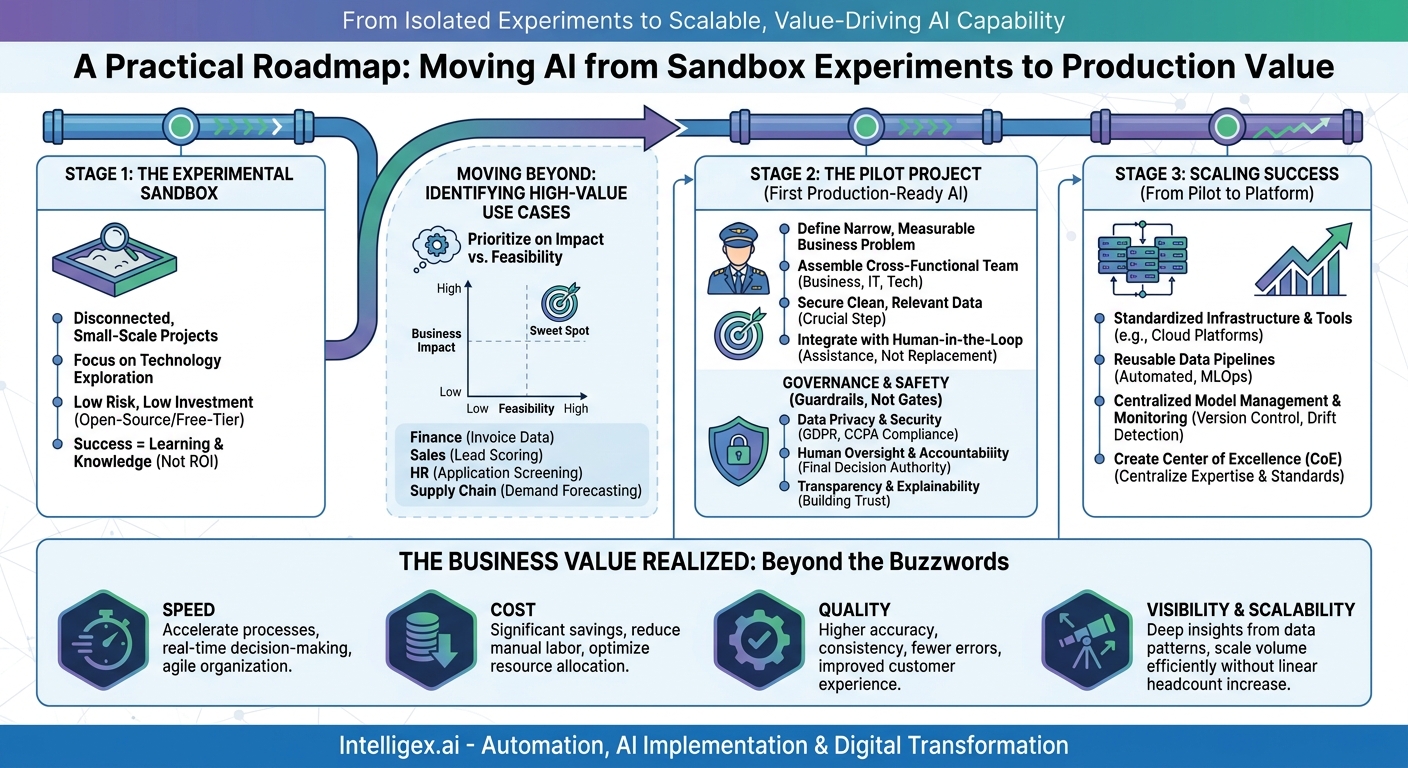
Most organizations today are touching artificial intelligence in some capacity. You might have a marketing team experimenting with generative AI for social media posts or an IT department building a proof-of-concept chatbot. These experiments are valuable, but they are just the first step. The real business transformation happens when AI moves out of the sandbox and into production, becoming a core part of how your business operates. This is the journey from isolated experiments to a mature, scalable AI capability that delivers tangible value.
Moving along this maturity curve is not just about adopting new technology. It is a strategic shift that impacts people, processes, and your bottom line. It requires a clear-eyed approach that prioritizes real-world problems over technological hype. This guide provides a practical roadmap to navigate this journey, outlining the key stages, common pitfalls, and actionable steps to help you turn AI potential into production reality.
Stage 1: The Experimental Sandbox
Every AI journey begins with experimentation. This initial stage is defined by small-scale, often isolated projects driven by curiosity and the desire to understand what is possible. It is a phase of learning and discovery, and its primary output is knowledge, not immediate return on investment.
In the sandbox, teams are testing the waters. A finance analyst might use a Python library to build a simple forecasting model on historical sales data. A customer service team might test a third-party chatbot on a small subset of internal FAQs. These activities are crucial for building foundational skills and demystifying the technology within the organization.
What This Stage Looks Like
- Projects are disconnected: Different departments run their own small tests without a central strategy.
- Focus is on technology: The goal is often to see if a particular AI tool or technique works.
- Low risk, low investment: These projects typically use open-source tools, free-tier cloud services, or small software subscriptions.
- Success is about learning: The project is a success if the team learns about the technology’s capabilities and limitations, even if the tool itself is not deployed.
Common Pitfalls to Avoid
While this stage is about exploration, it can easily become a dead end. Avoid treating AI as a “magic box” without a clear purpose. Even a small experiment should have a hypothesis. For example, “We believe we can use a language model to categorize customer feedback more accurately than manual tagging.” This frames the experiment around a potential business outcome. Also, resist the urge to tackle your most complex, mission-critical problem first. Start with something manageable to build confidence and momentum.
Moving Beyond the Sandbox: Identifying High-Value Use Cases
The most critical leap in AI maturity is moving from “playing with technology” to “solving business problems.” This requires a systematic approach to identifying and prioritizing opportunities where AI can deliver the most significant impact. Stop asking, “What can we do with AI?” and start asking, “What are our biggest business challenges, and could AI help solve them?”
A simple but effective way to prioritize is to evaluate potential use cases on two axes: business impact and feasibility. High-impact problems are those that directly affect key metrics like revenue, cost, or customer satisfaction. Feasibility depends on factors like data availability and quality, technical complexity, and the clarity of the problem definition.
Examples of High-Impact, High-Feasibility Use Cases by Department
- Finance & Operations: Automating the extraction of data from invoices and receipts. This is a well-understood problem with clear ROI in time saved and error reduction. The data (invoices) is available, and the technology is mature.
- Sales & Marketing: Implementing lead scoring to prioritize sales outreach. By analyzing historical data from your CRM, like Salesforce, an AI model can predict which leads are most likely to convert, helping your team focus its efforts.
- Human Resources: Screening high-volume job applications for basic qualifications. For roles that receive thousands of applicants, an AI tool can quickly surface the candidates who meet the core requirements, freeing up recruiters to focus on interviews and engagement.
- Supply Chain: Improving demand forecasting. While highly complex forecasting is a difficult problem, starting with a model that analyzes past sales data to predict near-term demand for your top-selling products is often a manageable and valuable first step.
The goal is to find the sweet spot: a project with a clear, measurable business benefit that is not overly complex to implement. Your first real AI project should be a demonstrable win that builds credibility and secures buy-in for future initiatives.
Stage 2: The Pilot Project, Your First Production-Ready AI
A pilot project is fundamentally different from an experiment. It is a production-intent system, built to solve a specific business problem for a limited set of users or a slice of a business process. It is your first real test of deploying, managing, and deriving value from an AI system in a live environment. The pilot’s success is not measured by learning alone, but by its impact on a predefined business metric.
This is where the rubber meets the road. It requires a more formal process, a dedicated team, and a clear focus on a measurable outcome. Rushing this stage or treating it like just another experiment is a common reason why AI initiatives fail to gain traction.
A Step-by-Step Guide to a Successful Pilot
- Define a Narrow, Measurable Problem: Be ruthlessly specific. Instead of “improve customer service,” aim for “reduce the average response time for Tier 1 support tickets by 15%.” Instead of “optimize inventory,” focus on “reduce stockouts for our top 50 SKUs by 10%.” This specificity makes success easy to define and measure.
- Assemble a Cross-Functional Team: Your pilot team needs more than just a data scientist. You need a business owner who deeply understands the problem and will champion the solution, an IT or operations expert who knows the existing systems and data, and a technical lead who can build or integrate the AI solution.
- Secure Clean, Relevant Data: This is often the most challenging step. The success of most AI models is entirely dependent on the quality and availability of data. You must identify where the necessary data lives, ensure you have permission to use it, and invest time in cleaning and preparing it for the model. Garbage in, garbage out is the immutable law of AI.
- Choose the Right Technology (Build vs. Buy): Do not over-engineer. For many business problems, a pre-built AI service from a cloud provider or a specialized software vendor is faster and more cost-effective than building a custom model from scratch. Only consider building a custom model if your problem is highly unique and you have the in-house talent to support it.
- Integrate with a Human in the Loop: For your first pilot, the AI should assist, not replace, a human. The output of the model (e.g., a recommended sales lead, a flagged invoice, a suggested inventory order) should be reviewed and approved by an employee. This builds trust, provides a crucial safety net, and generates valuable feedback for improving the model.
- Measure and Communicate Relentlessly: Track the metric you defined in step one. Compare the performance of the new AI-assisted process against the old baseline. Share the results, both positive and negative, with stakeholders. This transparency is key to building trust and securing support for scaling up.
Governance and Safety: Building Guardrails, Not Gates
As soon as you begin planning your first pilot, you must also begin planning for AI governance. Approached correctly, governance is not a bureaucratic hurdle that slows you down. It is a set of guardrails that enables you to move faster and more safely. Ignoring it exposes your organization to significant risks, including data breaches, biased outcomes, and regulatory penalties.
Effective governance is about asking and answering a few simple but critical questions before a model goes into production.
Core Pillars of Safe AI Implementation
Data Privacy and Security: Understand exactly what data your model uses. If it includes Personally Identifiable Information (PII) or other sensitive customer or employee data, you must ensure your processes comply with regulations like GDPR and CCPA. Be clear about where the data is stored, who has access, and how it is protected both at rest and in transit.
Human Oversight and Accountability: For any decision that has a significant impact on an individual (e.g., a hiring decision, a credit application, a medical diagnosis), a human must be the final authority. AI can provide recommendations and insights, but the ultimate accountability must rest with a person. Your process must have a clear point for human review and intervention.
Transparency and Explainability: Users and stakeholders should know when they are interacting with an AI. Where possible, you should be able to provide a basic explanation for why the AI made a particular recommendation. This is not always technically feasible for complex models, but it is a crucial principle for building trust, especially with your employees who will be using these tools.
Pre-Deployment Safety Checklist
Before any AI model handles live data or influences a live business process, your team should be able to answer “yes” to these questions:
- Have we inventoried all sensitive data types the model will process?
- Is there a clear, documented human review step for high-stakes decisions?
- Do we have a monitoring plan to detect performance degradation or unexpected model behavior?
- Are access permissions for the data, model, and infrastructure restricted to essential personnel?
- Have we informed relevant stakeholders (including legal and compliance) about this new process?
Stage 3: Scaling Success, From Pilot to Platform
Your pilot project was a success. You proved that AI can solve a real business problem and deliver measurable value. Now, the challenge is to replicate that success across the organization without starting from scratch every time. This is the transition from running ad-hoc AI projects to building a strategic AI capability.
Scaling requires a shift in thinking. Instead of building one-off solutions, you start building a reusable platform, a set of standardized tools, processes, and expertise that empowers teams across the company to build and deploy AI solutions efficiently and safely.
Key Components of a Scalable AI Strategy
Standardized Infrastructure and Tools: To avoid chaos, it is wise to standardize on a primary set of tools. This often means choosing a preferred cloud platform for machine learning, such as Amazon SageMaker or Google’s Vertex AI. This provides a common environment for data storage, model training, and deployment, reducing complexity and improving collaboration.
Reusable Data Pipelines: The work you did to clean and prepare data for your pilot should not be a one-time effort. A scalable strategy involves building automated, reusable data pipelines that can reliably feed clean data to multiple models. This is a core component of MLOps (Machine Learning Operations).
Centralized Model Management and Monitoring: As you deploy more models, you need a central system to track their versions, monitor their performance in production, and trigger alerts when they start to drift or produce inaccurate results. A model that works perfectly today may degrade over time as business conditions change, and you need to be able to detect and fix this proactively.
Creating a Center of Excellence (CoE): A CoE can take many forms, but its purpose is to centralize AI expertise and best practices. This group can help other business units identify use cases, provide technical guidance, and ensure that all projects adhere to the organization’s governance standards. It acts as an accelerator, not a gatekeeper.
The Business Value Realized: Beyond the Buzzwords
Ultimately, the goal of maturing your AI adoption is not about technology, but about driving business outcomes. When AI is successfully moved from the sandbox to a scaled platform, it unlocks value across four key dimensions.
Speed: AI accelerates the pace of business. It can automate manual processes that take hours or days, reducing them to seconds. It enables faster decision-making by analyzing data in real time, such as identifying a fraudulent transaction as it happens. This translates to a more agile and responsive organization.
Cost: Mature AI implementation leads to significant cost savings. It reduces the need for manual labor in repetitive tasks like data entry and document processing. It optimizes resource allocation, for example, by ensuring you have the right amount of inventory in the right place at the right time, minimizing both waste and missed sales.
Quality: For rule-based, repetitive tasks, AI can perform with a higher degree of accuracy and consistency than humans. This can mean fewer errors in financial reporting, higher quality control on a manufacturing line, or a more consistent and personalized experience for your customers.
Visibility and Scalability: AI gives you the ability to see patterns and gain insights from vast amounts of data that would be impossible for a human to analyze. This leads to better forecasts and a deeper understanding of your business. Furthermore, AI-powered processes can scale to handle massive increases in volume without a corresponding increase in headcount, allowing your business to grow more efficiently.
Your Next Steps on the AI Maturity Journey
Moving from AI experiments to production value is a deliberate journey, not an overnight transformation. Whether you are just starting in the sandbox or working to scale your first successful pilot, the key is to take intentional, focused steps forward.
Here is a simple action plan to guide your next move:
- Assess Your Current State: Be honest about where you are today. Are you still running disconnected experiments? Have you completed a successful pilot? Understanding your current level of maturity is the first step to planning the road ahead.
- Identify One High-Impact, Low-Complexity Pilot: If you have not done so already, convene a small group of business and technology leaders. Brainstorm potential use cases and identify one that offers a clear business win and is technically achievable in the next 3 to 6 months.
- Form Your Pilot Team: Do not relegate this to a side project for the IT department. Assign a dedicated business owner who feels the pain of the problem you are trying to solve and empower them with the technical resources to succeed.
- Start the Governance Conversation Now: Do not wait until you have a problem. Begin drafting a simple set of principles for the responsible use of AI in your organization. Involve legal, compliance, and HR early. This proactive approach will enable you to move faster and with greater confidence as you scale.
By focusing on real business problems, building a foundation of trust and safety, and scaling what works, you can move your organization beyond the hype and harness AI to create lasting, measurable value.
Your Next Read:
Category:
Get a FREE
Proof of Concept
& Consultation
No Cost, No Commitment!