

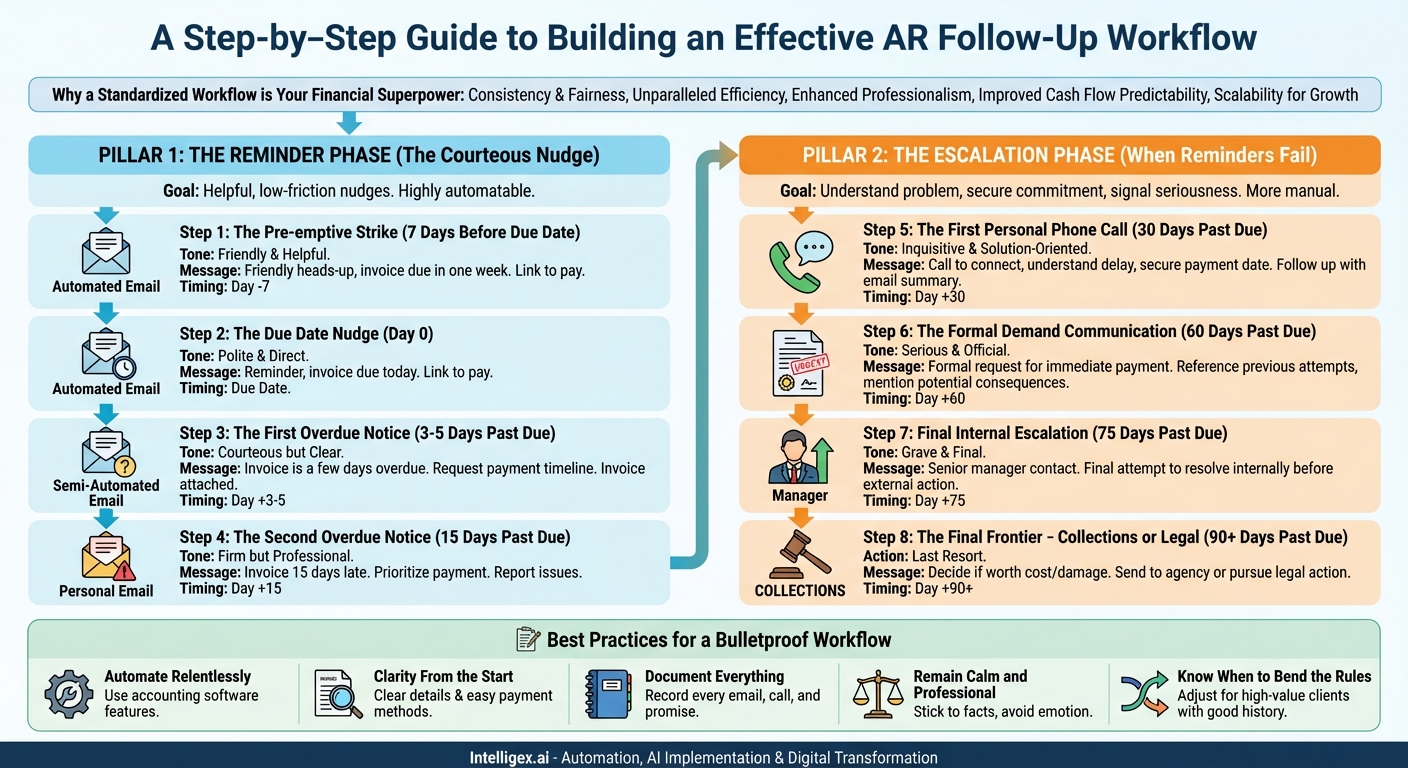
Cash flow is the lifeblood of any business. You can have the best product, the most innovative service, and a team of superstars, but if cash isn’t flowing in, the engine will eventually seize. At the heart of this crucial flow is Accounts Receivable (AR), and one of the biggest challenges businesses face is managing overdue invoices. It’s a delicate dance: you need to be firm enough to collect what you’re owed but gentle enough to maintain positive customer relationships. Simply winging it—sending a sporadic email here, making a random call there—is a recipe for stress, wasted time, and, ultimately, lost revenue. The solution isn’t to be more aggressive; it’s to be more systematic. This is where a well-defined AR follow-up workflow, built on the twin pillars of reminders and escalations, transforms chaos into a predictable and effective process.
Why a Standardized Workflow is Your Financial Superpower
Before diving into the nuts and bolts of a workflow, it’s essential to understand why it’s so transformative. Adopting a structured approach to AR follow-up isn’t just about creating a to-do list; it’s a fundamental shift in how you manage your company’s finances and customer interactions. The benefits are profound and far-reaching.
- Consistency and Fairness: A standardized workflow ensures every customer receives the same level of communication at the same intervals. This eliminates the risk of unconscious bias and ensures fairness. It also sets clear expectations; your clients learn that you have a professional process for payments, which often encourages them to pay more promptly in the future.
- Unparalleled Efficiency: How much time do you or your team spend each week thinking about who to contact, what to say, and when to say it? A workflow removes this guesswork. It provides a clear roadmap, allowing your team to execute tasks efficiently instead of constantly strategizing. This frees up valuable time for more strategic activities.
- Enhanced Professionalism: An ad-hoc collection process can often feel reactive and, at times, emotional. A structured workflow, with its pre-defined templates and timelines, demonstrates that your company is organized, serious, and professional in all its dealings, including financial ones. This builds trust and respect.
- Improved Cash Flow Predictability: When you have a system, you can start gathering data. You’ll learn the average number of days it takes to collect payments, which communication steps are most effective, and which clients are consistently late. This data allows you to forecast cash flow with greater accuracy, making financial planning and decision-making much more reliable.
- Scalability for Growth: A manual, memory-based follow-up system might work when you have 20 clients. It will shatter when you have 200. A documented workflow is scalable. As your business grows, you can onboard new team members or implement automation tools with a clear, established process already in place.
–
–
–
–
The Anatomy of an Effective AR Workflow
A robust AR workflow can be broken down into two distinct but connected phases: the Reminder Phase and the Escalation Phase. The first is about providing helpful, low-friction nudges. The second is a more formal, structured process for when those nudges don’t produce results. The goal is to resolve as many issues as possible in the first phase while having a clear and confident plan for the second.
Pillar 1: The Reminder Phase (The Courteous Nudge)
The Reminder Phase is built on the assumption that most late payments are due to oversight, not malice. Your customer is busy, the invoice got buried in their inbox, or it’s sitting on the wrong person’s desk. The goal here is to be helpful and make it incredibly easy for them to pay you. This phase is often highly automatable using modern accounting software.
Step 1: The Pre-emptive Strike (7 Days Before Due Date)
The best follow-up is one you never have to make. A gentle reminder before the due date can prevent many late payments. This is a purely customer-service-oriented communication.
- Channel: Automated Email
- Tone: Friendly and helpful.
- Message: “Hi [Client Name], this is just a friendly heads-up that invoice #[Invoice Number] for [Amount] is due in one week, on [Due Date]. You can view and pay the invoice here: [Link to Payment Portal]. Thanks for your business!”
Step 2: The Due Date Nudge (Day 0)
On the day the payment is due, another simple, automated reminder can catch those who intended to pay but forgot.
- Channel: Automated Email
- Tone: Polite and direct.
- Message: “Hi [Client Name], just a reminder that invoice #[Invoice Number] for [Amount] is due today. If you’ve already made the payment, please disregard this message. You can make a payment here: [Link to Payment Portal].”
Step 3: The First Overdue Notice (3-5 Days Past Due)
This is the first official “past due” communication. It’s still crucial to maintain a helpful and non-accusatory tone. Assume it’s a simple mistake.
- Channel: Automated or Semi-Automated Email
- Tone: Courteous but clear.
- Message: “Hi [Client Name], we’re just following up on invoice #[Invoice Number] for [Amount], which was due on [Due Date]. Our records show it is now a few days overdue. Could you please let us know when we can expect payment? A copy of the invoice is attached for your convenience.”
Step 4: The Second Overdue Notice (15 Days Past Due)
At this point, the invoice is more than two weeks late. The tone can become slightly more firm, but still professional. The focus shifts from “did you forget?” to “this requires your attention.”
- Channel: Email (potentially from a specific person, not a generic “accounts” address)
- Tone: Firm but professional.
- Message: “Hi [Client Name], I’m writing to follow up on invoice #[Invoice Number] for [Amount]. It is now 15 days past due. Please prioritize this payment at your earliest convenience. If there’s an issue with the invoice or you’re experiencing a problem with payment, please let us know immediately so we can assist. You can pay online here: [Link to Payment Portal].”
–
–
Pillar 2: The Escalation Phase (When Reminders Fail)
If you’ve completed the Reminder Phase and the invoice remains unpaid, it’s time to transition to the Escalation Phase. This phase requires more manual intervention and a shift in communication. The assumption now is that this is no longer a simple oversight. The goal is to understand the problem, secure a firm payment commitment, and signal that the matter is becoming more serious.
Step 5: The First Personal Phone Call (30 Days Past Due)
Emails are easy to ignore; a phone call is not. This is often the most effective step in the entire workflow. It’s a chance to connect with a human, understand the reason for the delay, and agree on a solution.
- Channel: Phone Call
- Tone: Inquisitive and solution-oriented, not confrontational.
- Script Outline:
- Introduce yourself and the reason for your call: “Hi [Contact Name], this is [Your Name] from [Your Company]. I’m calling about invoice #[Invoice Number], which is now 30 days past due.”
- Confirm they received the invoice: “I just want to confirm you received the invoice and that everything was satisfactory with our service/product?”
- Listen: This is the most important part. Let them explain. Is there an issue with their cash flow? Did the invoice go to the wrong person? Is there a dispute?
- Secure a commitment: “I understand. Can we agree on a payment date? Can you commit to paying by [specific date]?”
- Follow up: Immediately after the call, send an email summarizing the conversation and the agreed-upon payment date. “Hi [Contact Name], thanks for taking the time to speak with me. As discussed, you will be processing payment for invoice #[Invoice Number] on [Date]. We appreciate your attention to this.”
Step 6: The Formal Demand Communication (60 Days Past Due)
If the phone call commitment is missed or you can’t reach anyone, the communication must become more formal. The language should clearly state that the account is seriously delinquent and that further action may be required.
- Channel: Email and/or Physical Letter
- Tone: Serious and official.
- Message: “Subject: URGENT: Overdue Account for [Your Company] – Invoice #[Invoice Number]”. The body should reference previous attempts to contact them, state the number of days the invoice is past due, and mention your company’s payment terms. It should clearly state that this is a formal request for immediate payment to avoid further action. You might also mention that services could be suspended (if applicable and stated in your contract).
Step 7: Final Internal Escalation (75 Days Past Due)
Before moving to external options, one last internal step can be effective. Have a senior member of your team (a manager, director, or even a C-level executive) reach out. A message from a different, more senior person signals the high priority of the issue.
- Channel: Email or Phone Call from a Senior Manager
- Tone: Grave and final.
- Message: “I am the [Job Title] at [Your Company], and your account has been escalated to my attention due to a severely overdue balance… This is our final attempt to resolve this matter internally before we are forced to consider external collection options.”
Step 8: The Final Frontier – Collections or Legal Action (90+ Days Past Due)
This is the last resort. If an invoice is over 90 days past due and the client is unresponsive, you must decide if the amount owed is worth the cost and potential relationship damage of sending it to a collections agency or pursuing legal action. A good workflow is designed to prevent you from ever reaching this step. However, having it as a defined final step shows you are prepared to see the process through to its conclusion.
Best Practices for a Bulletproof Workflow
Creating the timeline is only half the battle. Executing it effectively requires embedding best practices into your process.
- Automate Relentlessly: The entire Reminder Phase can and should be automated. Use the features in your accounting software (like QuickBooks Online, Xero, or FreshBooks) to set up automatic email reminders. This saves countless hours and ensures no invoice slips through the cracks.
- Clarity From the Start: Ensure your initial invoices are crystal clear. Include the invoice number, due date, amount due, and a clear description of services rendered. Most importantly, provide obvious and easy ways to pay.
- Document Everything: Keep a meticulous record of every touchpoint. Log every email sent, every phone call made (with notes on who you spoke to and what was said), and every payment promise. This documentation is invaluable if a dispute arises or you need to escalate to collections.
- Remain Calm and Professional: It can be frustrating to chase money you are owed, but letting emotion enter the conversation is counterproductive. Stick to the facts of the workflow. You are not a bill collector harassing someone; you are a professional partner following a standard business process.
- Know When to Bend the Rules: While consistency is key, a workflow shouldn’t be a rigid prison. For a high-value, long-term client who has an unblemished payment history and is one week late, you might skip an automated reminder in favor of a personal, friendly check-in. The workflow is your guide, not your master.
By implementing a structured reminder and escalation workflow, you transform your AR process from a reactive, stressful scramble into a proactive, predictable system. You protect your company’s most vital resource—cash flow—while treating your customers with fairness and professionalism. It’s a strategic investment of time that pays dividends in financial stability, operational efficiency, and peace of mind.
Your Next Read:
Get a FREE
Proof of Concept
& Consultation
No Cost, No Commitment!