

In the complex ecosystem of a modern business, work doesn’t happen in a vacuum. It flows, or sometimes trickles, from one department to another, a long chain of dependencies where a delay in one link can cause a catastrophic failure down the line. We’ve all felt the frustration. The marketing team launches a major campaign, only to find the landing page isn’t ready because of a backlog in the IT department. A sales executive closes a landmark deal, but the contract languishes in the legal queue for days, jeopardizing the client relationship. A new hire sits idle for a week, waiting for a laptop, access credentials, and a desk, creating a poor first impression and wasting valuable time. These aren’t isolated incidents; they are symptoms of a deeper, more systemic problem: a lack of shared understanding and accountability for how work moves between teams.
The traditional response is often a game of “not my ticket,” where departments operate as black boxes. A task is thrown over the proverbial wall, and what happens next is a mystery. When deadlines are missed, the finger-pointing begins. Sales blames Legal, Marketing blames IT, and everyone blames the process, or lack thereof. This reactive, siloed approach breeds inefficiency, erodes morale, and ultimately impacts the customer experience. But what if there was a way to turn this chaotic web of handoffs into a transparent, predictable, and accountable system? There is, and it’s called a Workflow Service Level Agreement (SLA) Map.
The Anatomy of a Cross-Departmental Breakdown
Before diving into the solution, it’s crucial to understand the anatomy of the problem. Without a shared framework for time and responsibility, several dysfunctions become the norm:
- Invisible Bottlenecks: When a process slows down, it’s often impossible to pinpoint the exact cause. Is the legal team understaffed? Is the IT security review protocol overly complex? Is the finance department waiting on incomplete information? Without a map, you’re navigating blind, and problems remain hidden until they become crises.
- Unrealistic Expectations: A marketing manager might assume a new webpage can be deployed in 24 hours, not realizing the multi-step process involving security scans, QA testing, and content staging that IT must follow. This mismatch in expectations leads to constant friction and a sense of being let down by other teams.
- Lack of Prioritization: Every department believes their request is the most urgent. For a team like IT or Design, which services the entire organization, this creates a chaotic influx of “high-priority” tickets. Without a clear system, they are forced to guess which tasks are truly most critical to the business, often leading to the wrong things getting done first.
- Erosion of Trust: Over time, these repeated failures and frustrations lead to a breakdown in inter-departmental trust. Teams begin to see each other as obstacles rather than partners, hoarding information and building taller walls around their silos to protect their own interests.
Introducing the Workflow SLA Map: Your Blueprint for Clarity
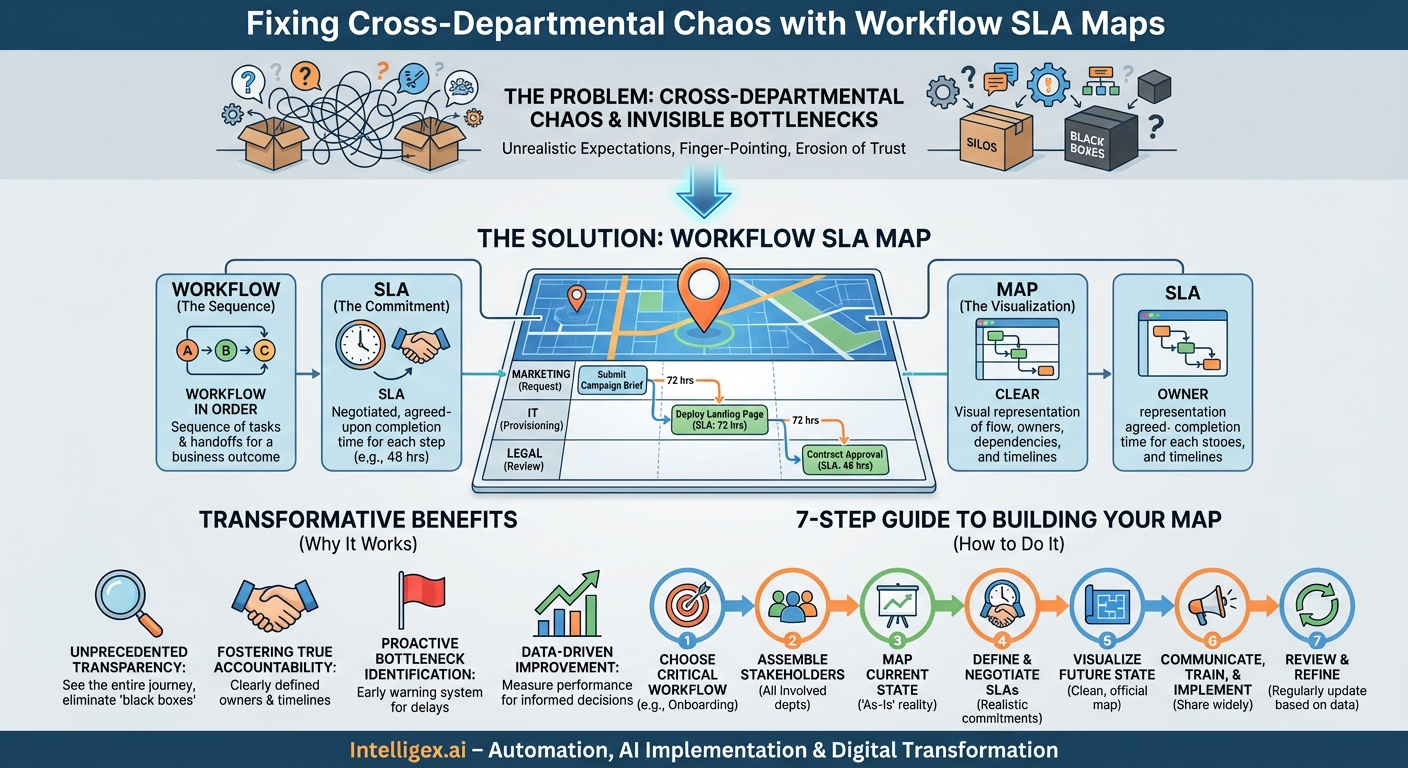
A Workflow SLA Map is a powerful visual tool that goes far beyond a simple flowchart. It’s a comprehensive, multi-layered document that outlines a specific cross-functional process, detailing every step, the department responsible for it, and, most importantly, the agreed-upon time it should take. Think of it as a GPS for your internal processes, showing not just the route but also the expected travel time for each leg of the journey.
Let’s break down the name:
- Workflow: This is the sequence of tasks and handoffs required to complete a specific business outcome, like onboarding a new employee or launching a new product feature.
- SLA (Service Level Agreement): This is the critical component. For each step in the workflow, there is a negotiated and agreed-upon commitment for completion time. It’s not a guess or a hope; it’s a formal promise. For example, “IT will provision a new laptop and software within 48 hours of receiving the approved request from HR.”
- Map: The visual representation brings it all to life. It clearly shows the flow, the owners, the dependencies, and the timelines in a way that a dense document never could. This visual clarity is what makes it accessible and powerful for everyone in the organization, from front-line staff to the C-suite.
By mapping these elements together, you transform an abstract process into a tangible, measurable, and manageable system. The ambiguity disappears, replaced by a shared source of truth that every department can see and align with.
The Transformative Benefits of Mapping Your Workflows
Implementing Workflow SLA Maps is more than a process improvement exercise; it’s a cultural shift towards transparency and collaboration. The benefits ripple across the entire organization.
Unprecedented Transparency and Clarity
The single greatest benefit is the radical transparency it creates. Suddenly, everyone can see the entire journey of a work item. The marketing team understands why the IT deployment takes three days. The sales team sees that the legal review is just one of seven steps in contract execution. This shared context eliminates misunderstandings and builds empathy between teams. It stops the “black box” problem, as everyone can now see inside the processes of their colleagues.
Fostering True Accountability
With clearly defined owners and timelines for each step, accountability becomes inherent to the process. There’s no more room for “I thought someone else was handling that.” The map clearly states who is responsible for what and by when. This isn’t about creating a culture of blame; it’s about empowering teams with ownership. When people know what is expected of them and see how their contribution impacts the overall timeline, they are more motivated to meet their commitments.
Proactive Bottleneck Identification
A Workflow SLA Map acts as an early warning system. When a particular stage in the process consistently exceeds its SLA, it’s immediately visible to everyone. This red flag isn’t an accusation; it’s a data point. It allows managers to ask constructive questions: Does this team need more resources? Is their process inefficient? Are they receiving incomplete information from the previous step? You can address these bottlenecks proactively with data, rather than waiting for a major failure to expose the weakness.
Data-Driven Process Improvement
You can’t improve what you can’t measure. The SLAs on your map provide a baseline for performance. By tracking actual completion times against the agreed-upon SLAs, you can gather invaluable data on your operational efficiency. This allows you to move beyond anecdotal evidence and make informed decisions. You might discover that investing in a new software for the legal team could cut contract review time in half, providing a clear ROI for the expense.
How to Build Your First Workflow SLA Map: A Step-by-Step Guide
Creating your first map can seem daunting, but by following a structured approach, you can build a powerful tool for your organization. Start with one high-impact, frequently problematic process to prove the concept.
Step 1: Choose a Critical Cross-Functional Workflow
Don’t try to boil the ocean. Select a single workflow that is a known source of pain and involves multiple departments. Excellent candidates include:
- New employee onboarding
- Sales contract execution
- Marketing campaign launch
- Customer support ticket escalation
- New product feature development and release
Step 2: Assemble the Stakeholders
Get representatives from every single department involved in the chosen workflow into a room (or a virtual meeting). This is non-negotiable. You need input from the people who actually do the work. For employee onboarding, this would include HR, the hiring manager, IT, and Facilities at a minimum.
Step 3: Map the Current State (The “As-Is”)
Using a whiteboard or a digital collaboration tool, walk through the process exactly as it happens today. Ask questions like, “What happens next?” “Who does that?” “How do they know they need to do it?” “What do they need from the previous step to begin?” Focus on documenting reality, not the ideal process. Identify every task, every handoff, and every decision point.
Step 4: Define and Negotiate the SLAs
This is the most critical and often the most challenging step. Go back through your “as-is” map, and for each step, ask the owner, “Realistically, what is a reasonable amount of time to complete this task, assuming you have everything you need?” This is a negotiation. IT might want 72 hours to provision a laptop, while HR wants it in 24. They need to discuss the constraints and agree on a realistic SLA that both parties can commit to. The result should be a firm but achievable timeline for each stage.
Step 5: Visualize the Future State Map
Now, create the clean, official Workflow SLA Map. This is the visual blueprint that will become your new source of truth. Use clear swimlanes to denote which department owns which tasks. Use connectors to show the flow of work. Most importantly, display the SLA for each task prominently. Color-coding can be used to indicate the status of tasks in a live version of the map (e.g., green for on-track, yellow for at risk, red for overdue).
Step 6: Communicate, Train, and Implement
A map that no one uses is worthless. Share the finalized map widely. Hold a brief training session to ensure everyone understands how to read it and what their responsibilities are. Integrate it into your project management tools if possible. It must be seen as the official playbook for that workflow.
Step 7: Review and Refine
The map is a living document. Set a recurring meeting (perhaps quarterly) to review the performance of the workflow against the map. Are SLAs being met? Have any new bottlenecks emerged? Has the process itself changed? Use this time to refine the map based on real-world data and feedback, ensuring it remains accurate and effective.
From Chaos to Collaboration
Implementing a Workflow SLA Map is about more than just drawing diagrams. It’s about initiating a fundamental shift from a culture of silos and blame to one of shared ownership, transparency, and continuous improvement. It replaces assumptions with agreements and ambiguity with clarity. By visualizing the intricate dance of work as it moves across your organization, you empower every team member to see their critical role in the larger picture.
The journey begins with a single map. Choose a process that’s causing pain, bring the right people together, and commit to creating a shared understanding. The initial effort will pay dividends in the form of reduced friction, faster execution, improved morale, and a business that operates not as a collection of disconnected parts, but as a single, coordinated engine driving towards a common goal.
Your Next Read:
Get a FREE
Proof of Concept
& Consultation
No Cost, No Commitment!