

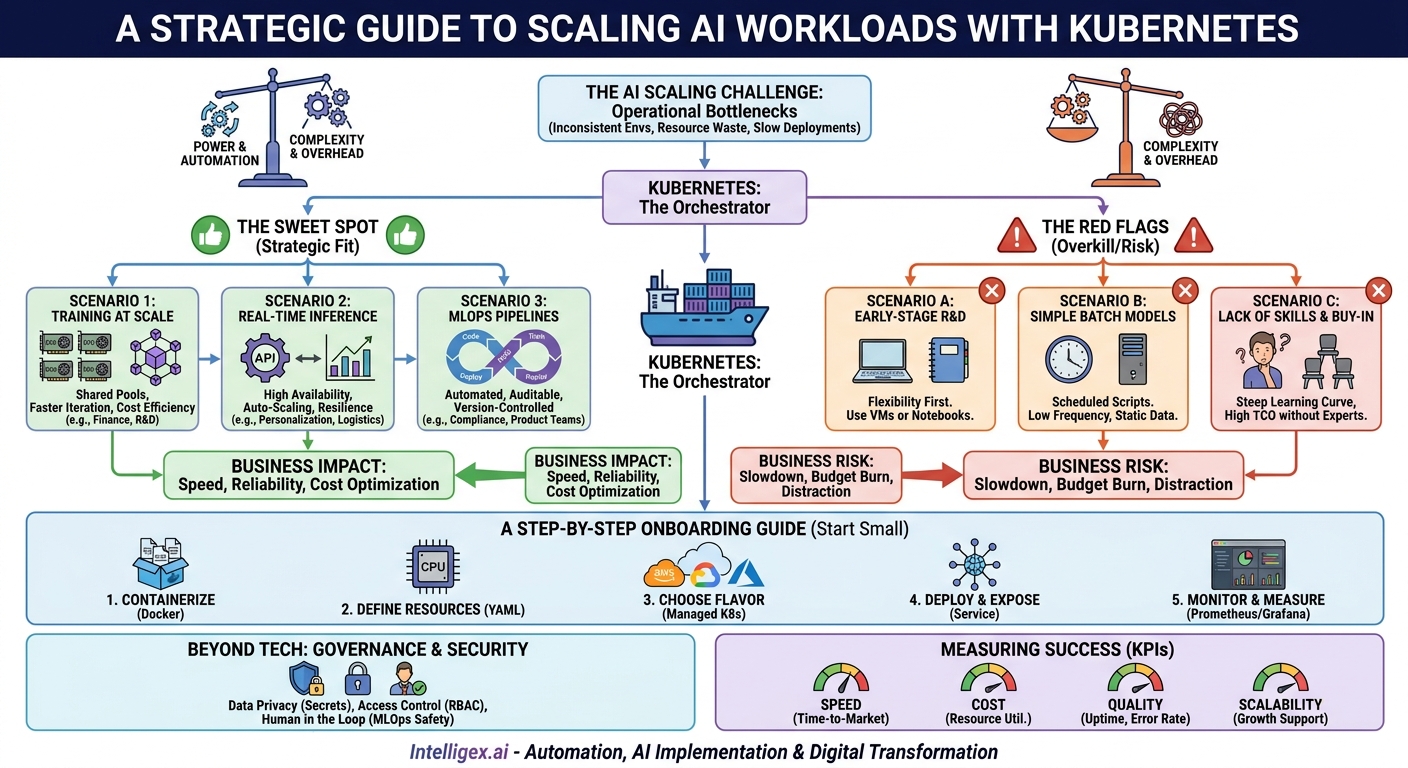
Artificial intelligence is no longer a futuristic concept; it’s a practical tool driving real business outcomes, from optimizing supply chains to personalizing customer experiences. But as AI models become more complex and integral to operations, the underlying infrastructure often struggles to keep up. Data science teams spend more time managing servers than building models, and deployments become fragile, expensive, and slow. This is the operational bottleneck that Kubernetes was designed to solve. It’s a powerful platform for automating the deployment, scaling, and management of applications.
However, power comes with complexity. Adopting Kubernetes for your data and AI workloads is a significant decision, not a simple upgrade. It offers tremendous advantages in the right context but can become a costly, resource-draining distraction if implemented for the wrong reasons. The key is to distinguish between a genuine need for industrial-scale orchestration and a problem that a simpler solution could solve. This guide will help you understand where Kubernetes provides a clear return on investment for your AI initiatives and where it’s simply overkill.
Kubernetes and AI: What Problem Are We Actually Solving?
At its core, Kubernetes is an open-source container orchestration system. Think of it as an expert logistics manager for your software. Instead of manually deploying an application on a server, you package it into a self-contained unit called a container. You then tell Kubernetes what resources your application needs (CPU, memory, GPUs) and how many copies you want running. Kubernetes handles the rest: it finds the right servers, runs the containers, manages network communication, and automatically restarts them if they fail.
For AI and machine learning, this solves several persistent problems:
- Environment Inconsistency: A model trained on a data scientist’s laptop often fails in production because of subtle differences in software libraries or configurations. Containers solve this by packaging the model and all its dependencies together, ensuring it runs identically everywhere.
- Resource Management Hell: High-end GPUs are expensive and often sit idle. Kubernetes can manage a shared pool of these resources, allocating them to training jobs as needed and releasing them afterward. This drastically improves utilization and reduces cloud costs.
- Complex Deployment Choreography: A modern AI application isn’t just one model. It’s a pipeline of data processing, feature engineering, model training, validation, and serving. Kubernetes provides a framework to define and automate this entire workflow, making it repeatable and reliable.
The business value isn’t the technology itself, but the operational efficiency it unlocks. By abstracting away the underlying hardware, you empower your technical teams to focus on creating value, not managing infrastructure. Success isn’t measured by the number of containers you’re running, but by the reduction in time it takes to get a valuable AI feature into the hands of your customers or internal users.
The Sweet Spot: When Kubernetes Supercharges Your AI Initiatives
Kubernetes isn’t a universal solution, but for certain classes of problems, it provides a powerful competitive advantage. If your organization is facing challenges in scaling, speed, or reliability, it might be time to consider orchestration. These scenarios are where Kubernetes truly shines.
Scenario 1: Model Training at Scale
When you move beyond simple models, training becomes a major computational challenge. A deep learning model for image recognition or natural language processing can require multiple GPUs running for days or even weeks. Doing this on a single machine is impractical. Kubernetes, often paired with tools like Kubeflow, allows you to distribute a training job across a cluster of machines. It handles the complex task of scheduling, data distribution, and fault tolerance.
Business Impact:
- Finance: Sees a direct reduction in cloud compute costs through better GPU utilization. Instead of dedicating expensive hardware to individual projects, you create a shared pool that serves the entire organization.
- R&D: Data science teams can run more experiments in parallel, dramatically shortening the research and development cycle. Faster iteration leads to better, more accurate models.
Scenario 2: Deploying and Scaling Real-Time Inference Services
Once a model is trained, it needs to be deployed as an “inference service” an API that can make predictions in real time. For a marketing team’s personalization engine or a logistics team’s route optimization tool, this service needs to be highly available and scalable. Kubernetes excels here. It can automatically scale the number of model replicas up or down based on incoming traffic, ensuring fast response times during peak demand (like a Black Friday sale) and saving costs during quiet periods.
Business Impact:
- Operations: Achieves high availability and resilience with less manual effort. If a server fails, Kubernetes automatically moves the model service to a healthy one.
- Sales & Marketing: Can confidently launch campaigns that rely on AI-powered features, knowing the backend infrastructure can handle the traffic spike without crashing.
Scenario 3: Building Repeatable MLOps Pipelines
MLOps (Machine Learning Operations) is the practice of bringing software development discipline to machine learning. The goal is to create a reliable, automated, and auditable process for taking a model from experiment to production. Kubernetes is the ideal foundation for an MLOps platform. It allows you to define the entire ML lifecycle, from data ingestion and preparation to model training, validation, deployment, and monitoring, as a version-controlled pipeline.
Business Impact:
- IT & Compliance: Gains a fully auditable trail of how and when models were trained and deployed, which is critical for governance and regulatory requirements.
- Product Teams: Can release new and improved models faster and with greater confidence, treating AI as a standard part of the software development lifecycle.
Here is a quick checklist to help you decide if you’ve hit the sweet spot for Kubernetes:
- Are you running multiple AI projects that need to share expensive hardware (like GPUs)?
- Do you need to deploy models as highly available, scalable APIs for other applications to use?
- Is your process for deploying models manual, slow, and prone to errors?
- Is regulatory compliance and auditability a key concern for your AI applications?
If you answered “yes” to two or more of these, Kubernetes is likely a strong fit.
A Step-by-Step Guide: Onboarding Your First AI Workload
Adopting Kubernetes can feel daunting. The key is to start with a small, well-defined project to build skills and demonstrate value. Avoid a “big bang” approach where you try to migrate everything at once. This five-step process provides a high-level roadmap for getting your first AI model running on Kubernetes.
- Containerize Your Model Application: The first step is to package your model and its inference code into a container image using a tool like Docker. This involves creating a `Dockerfile` that specifies the base operating system, required libraries (like TensorFlow or PyTorch), and your model files. This container becomes the universal, portable unit of your application.
- Define Your Resource Needs: Create a Kubernetes “Deployment” configuration file (written in YAML). In this file, you declare exactly what your container needs to run. Be specific. How much CPU? How much memory? Does it require a GPU? This declaration is a contract that tells Kubernetes how to schedule and run your application effectively.
- Choose Your Kubernetes Flavor: You don’t have to build a Kubernetes cluster from scratch. Major cloud providers offer managed services like Amazon EKS, Google GKE, and Azure AKS. These services handle the complexity of managing the underlying cluster, allowing your team to focus on the applications. For most businesses, a managed service is the most practical and cost-effective choice.
- Deploy and Expose Your Model: With your configuration file ready, you can use the Kubernetes command-line tool (`kubectl`) to deploy your application to the cluster. Next, you’ll create a “Service” configuration. This gives your model a stable network address and exposes it as an API that other applications can call, either internally within the cluster or externally to the internet.
- Monitor and Measure: Deployment is just the beginning. Use monitoring tools (like Prometheus and Grafana, which are standard in the Kubernetes ecosystem) to track your model’s performance. Watch its latency, error rate, and resource consumption. This data is crucial for optimizing performance, managing costs, and proving the value of the initiative.
The Red Flags: When Kubernetes is Complete Overkill
The biggest mistake a company can make is adopting a powerful technology just because it’s popular. Kubernetes has a steep learning curve and significant operational overhead. Implementing it before you’re ready can slow you down and burn through your budget with little to show for it.
Scenario 1: Early-Stage Experimentation and Research
When a data scientist is exploring a new dataset or prototyping a model in a Jupyter notebook, their primary need is flexibility, not scalability. Forcing them to containerize every experiment and write YAML files creates friction and stifles creativity. In this phase, simple tools like a powerful virtual machine in the cloud or a dedicated data science platform are far more productive.
Scenario 2: Simple, Static, Batch-Processing Models
Imagine your HR team needs a model that predicts employee attrition. It’s retrained once a quarter using a static dataset and produces a simple report. This model doesn’t need to run 24/7 or handle thousands of requests per second. Running this as a scheduled script on a single virtual machine is perfectly adequate, simple to manage, and far cheaper than maintaining a Kubernetes cluster for it.
Scenario 3: You Lack the In-House Skills and C-Suite Buy-In
Kubernetes is not a “set it and forget it” solution. It requires a dedicated team (or at least a few dedicated engineers) with specialized skills in cloud-native technologies, networking, and security. If you try to force this responsibility onto an already overloaded IT team without proper training or executive support, the project is likely to fail. The Total Cost of Ownership (TCO) must include salaries for skilled engineers, training, and potentially consulting fees, which can easily outweigh the infrastructure savings for smaller-scale projects.
Before you commit, ask yourself honestly: Is the operational complexity we are experiencing today a bigger business problem than the cost and effort of adopting and maintaining a Kubernetes platform?
Beyond the Tech: Managing Data, Security, and Governance
Deploying AI models on any platform introduces governance challenges, and Kubernetes is no exception. While it provides powerful tools for automation, it doesn’t automatically make your AI safe or compliant. A thoughtful approach to security and governance is essential from day one.
Data Privacy and Security: When you containerize an application, you must also consider how it handles sensitive data. Kubernetes provides mechanisms like “Secrets” for managing API keys and database credentials securely, rather than hardcoding them into a container image. Network Policies can be used to create firewalls within the cluster, ensuring that a customer-facing model, for example, cannot directly access a sensitive internal HR database.
Access Control (RBAC): Who gets to deploy a new model into production? Who can access the underlying data? Kubernetes has a robust Role-Based Access Control (RBAC) system that allows you to define granular permissions. You can create roles such as “Data Scientist” (who can deploy models to a staging environment) and “ML Engineer” (who has permission to promote models to production). This prevents unauthorized changes and creates a clear chain of command.
The Human in the Loop: Automation is powerful, but it’s not a substitute for human judgment. For high-impact AI systems, such as those used for medical diagnoses, financial lending, or hiring, your process must include a human review step. Kubernetes can automate the deployment of a model, but the decision to put that model in front of customers should be a deliberate business decision based on rigorous testing and ethical review. The goal of MLOps is to make deployments easy and safe, not to remove human oversight.
Measuring Success: KPIs That Matter to the Business
The success of a Kubernetes adoption for AI should be measured in business terms, not technical ones. Your executive team doesn’t care about the number of pods running; they care about speed, cost, and quality. Here are the key performance indicators (KPIs) to track:
- Speed (Time-to-Market): The most important metric is often “model lead time.” This is the total time from a data scientist having a trained model to that model being live in production, serving users. Kubernetes and MLOps pipelines should drastically reduce this from weeks or months to days or even hours.
- Cost (Resource Efficiency): Track your cloud bill, paying close attention to compute costs. Measure the utilization rate of your expensive GPU nodes. Before Kubernetes, they might have been at 10-20% average utilization. A well-managed cluster can often push this above 60-70%, representing a direct and significant cost saving.
- Quality (Reliability and Performance): Monitor the health of your deployed models. Key metrics include API uptime (is the service available?), error rate (how many requests are failing?), and model latency (how long does a prediction take?). These directly impact the user experience and the trustworthiness of your AI systems.
- Scalability (Business Enablement): While harder to quantify, measure the platform’s ability to support business growth. Can it handle the traffic from a new product launch without falling over? Does it allow multiple teams to work in parallel without interfering with each other? This demonstrates the platform’s value as a strategic enabler, not just a cost center.
Your Next Steps: Building a Practical Roadmap
Moving forward with Kubernetes for your AI workloads requires a measured and strategic approach. It’s a journey, not a single project. Use these steps to build your roadmap and ensure you’re adopting this powerful technology for the right reasons.
- Assess Your Current Maturity: First, honestly evaluate your organization’s pain points. Are your data scientists genuinely blocked by infrastructure bottlenecks? Are deployments slow and unreliable? Or are you just starting your AI journey? Your starting point determines the right path forward. Don’t invest in a complex platform to solve a problem you don’t have yet.
- Start Small with a High-Value Project: Identify a single, well-understood AI workload that fits the “sweet spot” criteria. A good candidate is an existing model that is difficult to scale or a new project that requires a scalable, reliable API. Success on a pilot project will build momentum and provide valuable lessons. For tools to help, projects like Kubeflow provide a machine learning toolkit specifically for Kubernetes.
- Invest in Skills, Not Just Software: The primary barrier to Kubernetes adoption is the skills gap. Plan for training your existing team, hiring experienced talent, or engaging a partner to help you build your initial platform. This investment in people is just as critical as the investment in technology. A great resource is the official documentation from cloud providers, such as the guides for Amazon Elastic Kubernetes Service (EKS).
- Evaluate Managed Services First: Before you consider building and managing your own Kubernetes cluster, thoroughly evaluate the managed offerings from major cloud providers. The operational savings in maintenance, security patching, and upgrades almost always outweigh the marginal cost difference, especially for organizations that are not in the business of managing infrastructure.
By focusing on clear business problems, starting small, and investing in the right skills, you can harness the power of Kubernetes to build a scalable, efficient, and reliable foundation for your company’s AI-driven future.
Your Next Read:
Category:
Get a FREE
Proof of Concept
& Consultation
No Cost, No Commitment!
