

In today’s fast-paced business landscape, terms like automation, artificial intelligence (AI), and system integration are everywhere. They’re hailed as the keys to efficiency, innovation, and growth. Yet, for many, they remain a confusing jumble of buzzwords. They are often used interchangeably, leading to misconceptions about what they do, how they differ, and, most importantly, how they can truly benefit an organization. The reality is that these three concepts, while related, are fundamentally distinct. Understanding their unique roles is the first step toward building a smarter, more connected, and more efficient business. This guide will demystify each concept, break down their core functions with simple examples, and illustrate how they come together to form a powerful trio that can revolutionize the way you work.
The Workhorse: Demystifying Automation
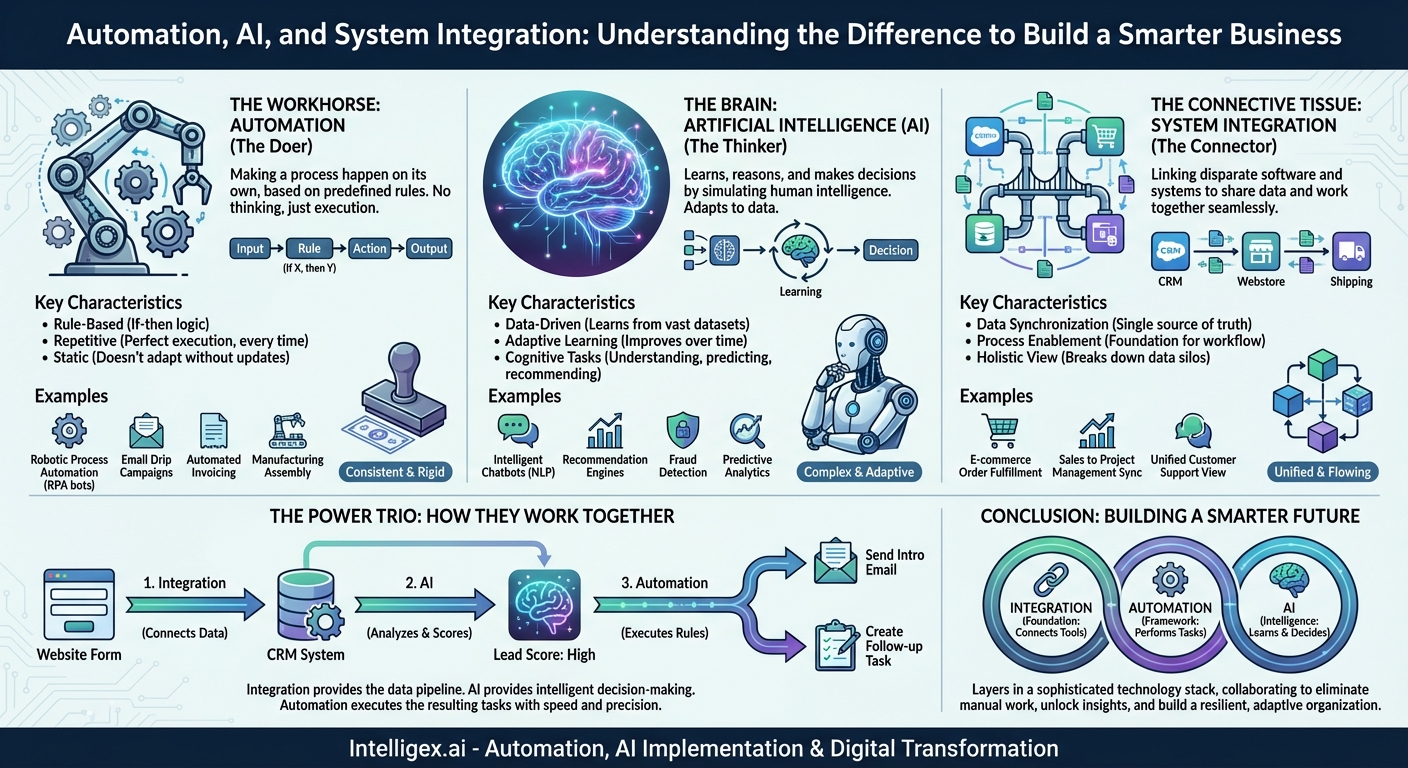
At its core, automation is about making a process happen on its own, without human intervention, based on a predefined set of rules. Think of it as the ultimate to-do list follower. You give it a specific, repetitive task with clear instructions, and it executes that task perfectly every single time. It’s the digital equivalent of a factory assembly line robot that performs the same weld on every car that passes. It doesn’t think, it doesn’t learn, and it doesn’t improvise. It simply does.
The primary driver behind automation is efficiency. It’s designed to take over the mundane, time-consuming, and error-prone tasks that bog down human employees. This frees up your team to focus on more strategic, creative, and high-value work that requires a human touch.
Key Characteristics of Automation:
- Rule-Based: Automation operates on a simple “if this, then that” logic. For example, if a new user signs up for a newsletter, then automatically send them a welcome email.
- Repetitive: It excels at tasks that need to be done over and over again in the exact same way, such as daily data entry or monthly report generation.
- Static: An automated process doesn’t adapt on its own. If the underlying business rule changes, a human must go in and update the automation’s programming.
Automation in the Real World
You encounter automation every day, often without realizing it. Here are some common examples in a business context:
- Robotic Process Automation (RPA): This involves using software “bots” to mimic human actions on a computer. An RPA bot can be programmed to log into an application, copy data from a spreadsheet, and paste it into a CRM system. It’s a perfect solution for legacy systems that don’t have modern APIs to connect with each other.
- Email Marketing Campaigns: When you set up a “drip campaign” that sends a sequence of emails to a new subscriber over several weeks, that’s automation. The system follows the rules you set without you needing to press “send” each time.
- Automated Invoicing: A system that automatically generates and sends an invoice to a client as soon as a project is marked as complete in your project management tool.
- Manufacturing: Physical robots on an assembly line performing tasks like painting, screwing on parts, or packaging products.
The main limitation of automation is its rigidity. It can’t handle exceptions or make judgments. If an automated invoicing system encounters an invoice with an unusual format it wasn’t programmed to read, it will fail. It needs human intervention to solve the problem. In short, automation is about doing, not thinking.
The Brain: Unpacking Artificial Intelligence (AI)
If automation is the workhorse that follows instructions, Artificial Intelligence (AI) is the brain that can learn, reason, and make decisions. AI is a broad field of computer science dedicated to creating machines that can simulate human intelligence. Unlike automation, which is programmed to execute a specific task, AI is trained on vast amounts of data to recognize patterns, make predictions, and adapt to new information.
Where automation is about consistency and repetition, AI is about complexity and variability. It can handle tasks that don’t have a simple, fixed set of rules. Think of a spam filter. A simple automated rule might be “If an email contains the phrase ‘buy now,’ move it to spam.” But spammers quickly adapt. An AI-powered spam filter, however, learns from millions of emails. It analyzes patterns in wording, sender reputation, and email structure to make an intelligent judgment about whether an email is spam, even if it’s a type it has never seen before.
Key Characteristics of AI:
- Data-Driven: AI systems learn from data. The more data they are exposed to, the more accurate and sophisticated their decision-making becomes.
- Adaptive Learning: Through a subset of AI called Machine Learning (ML), systems can improve their performance over time without being explicitly reprogrammed.
- Cognitive Tasks: AI can perform tasks that traditionally require human cognition, such as understanding natural language, recognizing images, or making strategic recommendations.
AI in the Real World
AI’s ability to “think” opens up a world of possibilities far beyond what simple automation can achieve:
- Intelligent Customer Service Chatbots: While a basic automated chatbot can only respond to specific keywords, an AI-powered chatbot uses Natural Language Processing (NLP) to understand the intent and sentiment behind a customer’s query. It can hold a more natural conversation and solve complex, non-scripted problems.
- Recommendation Engines: When Netflix suggests a movie or Amazon recommends a product, that’s AI at work. It analyzes your past behavior and compares it to millions of other users to predict what you’ll enjoy next.
- Fraud Detection: Banks use AI to analyze thousands of transactions per second, identifying subtle patterns of behavior that indicate fraudulent activity. This is far more effective than a human trying to follow a checklist of “suspicious” activities.
- Predictive Analytics: Businesses use AI to forecast future sales trends, predict customer churn, or identify which sales leads are most likely to convert, allowing them to allocate resources more effectively.
AI’s power lies in its ability to manage ambiguity and make informed decisions based on patterns and probability. However, it’s often more complex and resource-intensive to implement than simple automation, requiring significant data sets for training and specialized expertise to build and maintain.
The Connective Tissue: Understanding System Integration
Now that we’ve defined the “doer” (Automation) and the “thinker” (AI), we need to introduce the vital third component: the “connector.” System integration is the process of linking different, often disparate, software applications and IT systems so they can share data and work together seamlessly. It’s the digital plumbing that allows information to flow freely throughout your organization.
In most businesses, different departments use different software. The sales team has a CRM, the marketing team has an email platform, the finance team has an accounting system, and the warehouse has an inventory management system. Without integration, these systems are isolated “data silos.” Getting information from one to another often requires manual work, like exporting a CSV file from one system and uploading it to another—a slow, tedious, and error-prone process.
System integration builds the bridges between these software islands. It ensures that when something happens in one system, the relevant information is automatically and instantly available in all other connected systems.
Key Characteristics of System Integration:
- Data Synchronization: It ensures that all connected systems have the same, up-to-date information, creating a “single source of truth.”
- Process Enablement: Integration is often the foundational layer that makes sophisticated automation possible. You can’t automate a cross-departmental workflow if the departments’ systems can’t talk to each other.
- Holistic View: By breaking down data silos, integration provides a complete, 360-degree view of your business operations and customer interactions.
System Integration in the Real World
Integration is the unsung hero working behind the scenes to make modern business possible:
- E-commerce Order Fulfillment: When you buy a product online, a system integration connects the e-commerce platform (like Shopify) to the inventory system. It instantly deducts the item from stock, preventing it from being oversold. It then connects to the shipping provider’s system (like FedEx) to generate a tracking number.
- Sales to Project Management: An integration can be set up so that when a salesperson marks a deal as “won” in their CRM (like Salesforce), it automatically creates a new project in the team’s project management tool (like Asana) and populates it with all the relevant client details.
- Unified Customer Support: Integrating your customer support ticketing system with your CRM allows a support agent to see a customer’s entire purchase history and past interactions while they are on a call, leading to faster and more personalized service.
Without system integration, both automation and AI are severely limited. Automation can only operate within the confines of a single application, and AI can’t make intelligent decisions without access to a complete and unified dataset.
The Power Trio: How They Work Together
The true transformative power emerges when automation, AI, and system integration are used not in isolation, but in concert. They are not competitors; they are collaborators, each playing a distinct but essential role in creating a sophisticated, intelligent, and efficient digital ecosystem.
Let’s walk through a complete business scenario to see the power trio in action:
Scenario: A lead from a marketing campaign becomes a new customer.
- System Integration (The Connector): A potential customer fills out a “contact us” form on your website. An integration between your website and your CRM instantly creates a new lead record in the CRM, populated with the information from the form. The marketing and sales systems are now in sync.
- Artificial Intelligence (The Thinker): An AI-powered lead scoring model within your CRM analyzes the new lead. It looks at the person’s job title, company size, and the web pages they visited before filling out the form. It compares this data against historical data from thousands of previous leads and determines this is a “high-quality” lead with a 90% probability of converting. The AI then assigns the lead to the sales representative best equipped to handle this type of client.
- Automation (The Doer): Once the AI assigns the lead, a rule-based automation kicks in. It automatically sends an introductory email to the lead from that sales rep’s account and simultaneously creates a task in the rep’s calendar to follow up with a phone call in 24 hours.
In this example, system integration provided the data pipeline. AI provided the intelligent decision-making. And automation executed the resulting tasks with speed and precision. This seamless workflow would be impossible with just one of these technologies alone.
Conclusion: Building a Smarter Future
Understanding the difference between these three pillars is crucial for any leader looking to modernize their operations. To put it in the simplest terms:
- System Integration connects your tools and allows data to flow between them.
- Automation uses that connected data to perform repetitive, rule-based tasks.
- Artificial Intelligence analyzes that data to learn, make predictions, and drive intelligent decisions.
They are not interchangeable concepts, but layers in a sophisticated technology stack. System integration is the foundation, automation is the framework, and AI is the intelligence that brings it all to life. By strategically combining these powerful forces, businesses can not only eliminate manual work and reduce errors but also unlock new insights, deliver superior customer experiences, and build a truly resilient and adaptive organization ready for the future.
Your Next Read:
Category:
Get a FREE
Proof of Concept
& Consultation
No Cost, No Commitment!