

Every business feels it. The project that stalls for days waiting on a single approval. The sales team that can’t get accurate pricing information quickly. The month-end close that drags on for weeks. These are more than just daily frustrations; they are workflow bottlenecks, and they act like sludge in your operational engine. They increase costs, delay revenue, burn out your best people, and ultimately hinder your ability to scale.
The common mistake is to treat the symptom. We buy a new tool or reshuffle a team, hoping for a quick fix. But the bottleneck often returns because the underlying issue was never addressed. To truly solve the problem, you must move beyond the surface-level pain and map the root cause. This isn’t about a complex, six-month analysis. It’s about asking the right questions, systematically, to find the true source of the delay.
Symptoms vs. The Sickness: Recognizing a True Bottleneck
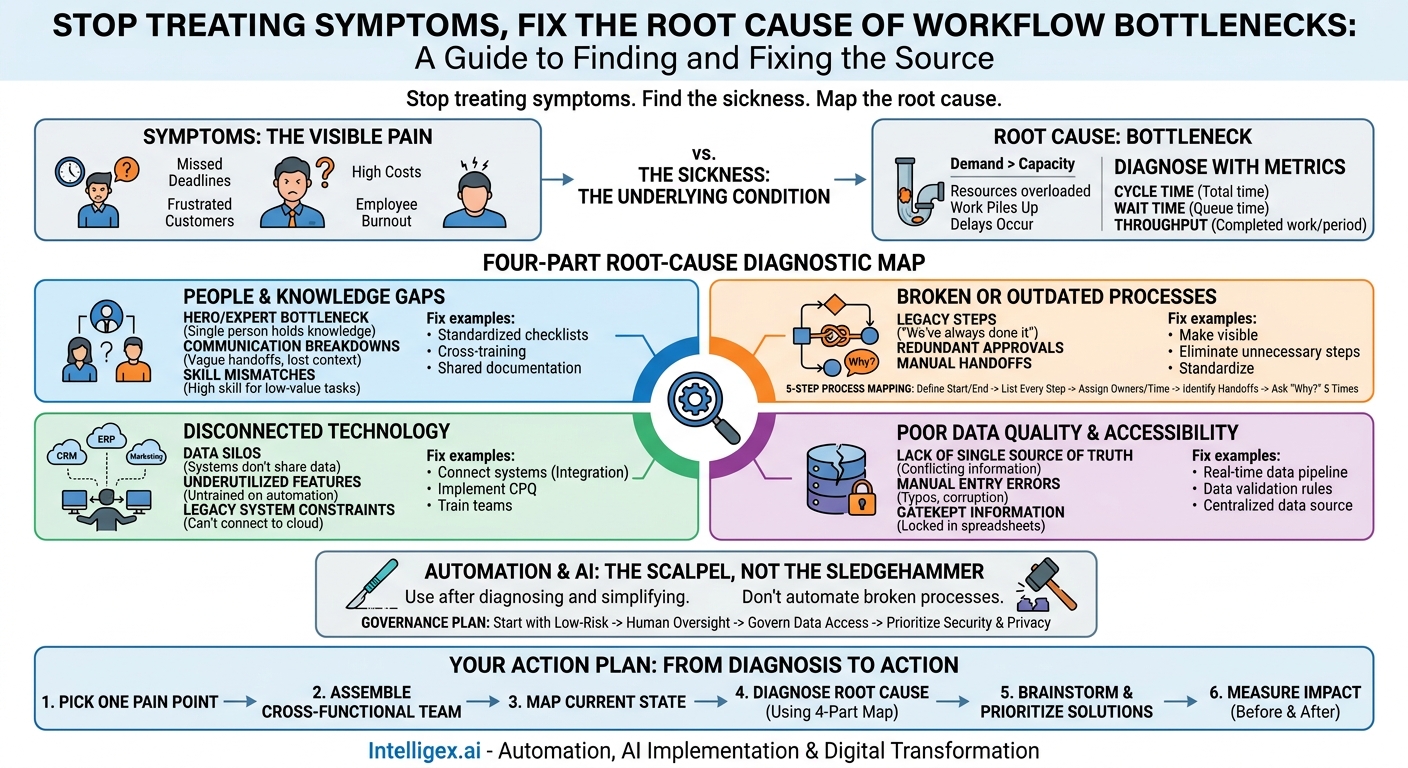
Before you can fix a problem, you have to define it correctly. A missed deadline is a symptom. A frustrated customer is a symptom. The real sickness is the underlying condition causing these outcomes. A bottleneck occurs when the demand for a resource, person, or process step exceeds its capacity, causing work to pile up and wait.
Think of it like this:
- Symptom: The marketing team complains that legal review for new ad copy takes over a week, causing campaigns to be delayed.
- Possible Sicknesses: Legal has no standardized intake process, so requests arrive in emails, chats, and hallway conversations. There might be a single lawyer responsible for all marketing reviews (a people bottleneck), or the review process itself might involve unnecessary, sequential steps (a process bottleneck).
- Symptom: The finance team spends the first 10 days of every month manually reconciling expense reports.
- Possible Sicknesses: The company uses three different systems for corporate cards, expense submissions, and accounting, none of which talk to each other (a technology bottleneck). Or, the data from employee submissions is often incomplete or inaccurate, requiring constant follow-up (a data bottleneck).
To start your diagnosis, you need to measure where the work is slowing down. You don’t need a complex business intelligence platform to begin. Start by tracking a few key metrics for a single, problematic workflow:
- Cycle Time: The total time from the start of a process to its completion. (e.g., from “customer order received” to “order shipped”).
- Wait Time: The amount of time a task spends sitting in a queue, waiting for the next action. This is often where the biggest bottlenecks hide.
- Throughput: The number of work items completed in a specific period (e.g., number of invoices processed per week). A drop in throughput is a clear warning sign.
Your Diagnostic Toolkit: A Four-Part Root-Cause Map
Once you’ve identified a workflow with a significant wait time or a painfully long cycle time, you can start digging for the root cause. Nearly every operational bottleneck can be traced back to one or more of four fundamental areas. Think of these as the four key locations on your diagnostic map.
- People: The skills, knowledge, and structure of your teams.
- Process: The sequence of steps taken to get work done.
- Technology: The tools, software, and systems used to execute the process.
- Data: The information required to make decisions and complete tasks.
By systematically examining each of these areas, you can move past the symptoms and pinpoint the specific, solvable problem that is holding your business back.
Root Cause 1: People and Knowledge Gaps
Often, the friction in a workflow has nothing to do with software or formal procedures. It comes down to human factors. These bottlenecks are subtle but incredibly common, stemming from how knowledge is stored, how teams communicate, and whether the right people are doing the right work.
Common Issues to Look For:
- The Hero or Expert Bottleneck: A single person holds all the critical knowledge or is the only one authorized to approve a certain step. The entire process grinds to a halt when they are busy, on vacation, or leave the company. This is a huge scalability risk.
- Communication Breakdowns: Work is handed off between teams with a vague email or a message in a chat channel. Key context is lost, forcing the receiving team to spend time chasing down information before they can even begin their part of the task.
- Skill Mismatches: Highly skilled employees are stuck doing low-value, repetitive administrative tasks, while junior employees may lack the training to use available tools effectively, creating rework and errors.
Example in Practice: HR Onboarding
A company’s time-to-productivity for new hires is lagging. The symptom is that new employees wait days for laptop access and system logins. The IT team is blamed for being slow. But upon investigation, the root cause is a knowledge and communication gap. The hiring manager sends an email to HR, who then forwards it to IT, but key details like required software licenses are often missing. IT has to circle back to the manager, who is busy and slow to respond. The process isn’t documented, and each department works in its own silo.
How to Fix It: The solution isn’t a new IT ticketing system. It’s creating a standardized onboarding checklist shared between the manager, HR, and IT. It’s cross-training a backup on the IT team to handle setup requests. It’s about creating a clear, shared process that doesn’t rely on one person remembering to forward an email.
Root Cause 2: Broken or Outdated Processes
“Because we’ve always done it this way” is one of the most expensive phrases in business. Processes that were designed years ago for a smaller, simpler company often break down under the weight of growth. These bottlenecks are embedded in the very fabric of how work gets done.
A Simple 5-Step Process to Map Your Workflow:
To find the kinks in your process, you have to make it visible. Grab a whiteboard or open a simple flowchart tool and walk through these steps with the people who actually do the work.
- Define the Start and End: What event triggers this workflow? What does a successful outcome look like? For example, “A new lead is created in our CRM” (start) and “The lead is qualified and assigned to a sales rep” (end).
- List Every Single Step: Document every action and decision point in between. No step is too small. Include “wait for approval,” “email Team B,” and “manually update spreadsheet.”
- Assign Owners and Estimate Time: Who is responsible for each step? How long does the action itself take (touch time) and how long does it typically wait before being worked on (wait time)?
- Identify the Handoffs: Pay close attention to any point where the work moves from one person or team to another. This is where miscommunication and delays thrive.
- Ask “Why?” Five Times: For each step, especially the delays and approvals, ask why it exists. Is this approval still necessary? Why does this need to be a manual review? Challenging the legacy steps often reveals redundancies that can be eliminated entirely.
This exercise quickly illuminates problems like redundant approvals where three different managers sign off on the same low-risk item, or manual steps like printing a PDF just to sign it, scan it, and email it back.
Root Cause 3: Disconnected or Underutilized Technology
Technology should be an accelerator, but it can easily become an anchor. A common bottleneck is not the absence of technology, but the friction between the tools you already have. This is often called “swivel chair integration,” where an employee has to physically turn from one system to another, copying and pasting data all day long.
Common Issues to Look For:
- Data Silos: Your CRM, ERP, and marketing automation platforms are all powerful on their own, but if they don’t share data, you create immense manual work. For instance, the sales team in Salesforce has no visibility into the marketing engagement history from another platform.
- Underutilized Features: You may be paying for a powerful software suite with built-in automation features, but your team was never trained on them and continues to do the work manually.
- Legacy System Constraints: An old, on-premise accounting system can’t connect to your modern cloud-based tools, forcing your finance team into a painful cycle of manual data exports and imports every month.
Example in Practice: Sales Quoting
A sales team struggles to get quotes to customers quickly. The symptom is missed revenue and frustrated reps. The root cause is a technology bottleneck. Reps have to pull customer data from the CRM, look up pricing and inventory from three different spreadsheets maintained by the operations team, and then manually build the quote in a Word document. Each step is a potential point of error and delay.
How to Fix It: The solution is to connect these systems. An integration between the inventory system and the CRM could provide reps with real-time stock levels. A proper Configure, Price, Quote (CPQ) tool could automate the entire process, pulling from a single source of truth for pricing and generating a professional quote in minutes, not hours.
Root Cause 4: Poor Data Quality and Accessibility
No process can run efficiently on bad fuel. If your data is inaccurate, incomplete, or inaccessible, every subsequent step in the workflow suffers. Decisions are delayed pending data validation, and work has to be redone when errors are discovered downstream. This creates a vicious cycle of mistrust and inefficiency.
Common Issues to Look For:
- Lack of a Single Source of Truth: Your sales team has one address for a customer, and your finance team has another. Which one is correct? The time spent reconciling these differences is pure waste.
- Manual Data Entry Errors: Every time a human manually types information from one place to another, there is a risk of typos, transpositions, and other errors that corrupt your data at the source.
*Gatekept Information: Critical data is locked away in a departmental spreadsheet on someone’s hard drive. To get a simple report, other teams must submit a request and wait for the “data owner” to have time to pull it for them.
Example in Practice: Supply Chain Forecasting
A CPG company frequently experiences stockouts of its most popular products, leading to lost sales and unhappy retailers. The symptom is poor inventory management. The root cause is a data bottleneck. The forecasting team builds its models using sales data that is a week old. The warehouse inventory system only updates once every 24 hours. The team is making critical, multi-million dollar decisions based on stale, incomplete information.
How to Fix It: The focus should be on creating a real-time data pipeline. Integrating the point-of-sale system, warehouse management system, and forecasting software provides an up-to-the-minute view of reality. Implementing data validation rules at the point of entry ensures that the information flowing into the system is accurate from the start.
A Note on Automation and AI: The Scalpel, Not the Sledgehammer
After diagnosing a bottleneck, it’s tempting to jump straight to a high-tech solution like AI or robotic process automation (RPA). These tools can be incredibly powerful for eliminating manual work and speeding up processes, but they are most effective when applied to the right problem. Automating a broken or redundant process only helps you make the same mistakes faster and at a greater scale.
First, use the diagnostic map to simplify and standardize your process. Eliminate the unnecessary steps. Clean up your data. Only then should you apply automation to the remaining manual, repetitive, and rule-based tasks.
When you do introduce automation, especially solutions involving AI, proceed with a clear governance plan:
- Start with low-risk, high-impact processes. Automating invoice data entry is a much safer starting point than automating customer credit approvals.
- Maintain human oversight. For sensitive or complex decisions, use a “human-in-the-loop” model. The AI can analyze the data and make a recommendation, but a person makes the final approval.
- Govern your data access. Ensure any automation tool only has permission to access the specific data it needs to perform its function (the principle of least privilege).
- Prioritize security and privacy. Be certain you understand how the tool processes and stores any sensitive customer, employee, or financial information.
Your Next Steps: From Diagnosis to Action
Identifying the root cause of a workflow bottleneck is the most critical step toward building a more efficient, scalable, and resilient operation. It transforms you from being reactive, constantly fighting fires, to being proactive, strengthening your business from the inside out. Don’t let the scope of the challenge intimidate you. Start small and build momentum.
A Simple Action Plan:
- Pick One Pain Point: Choose a single, well-understood bottleneck that has a clear business impact. Don’t try to fix everything at once.
- Assemble a Cross-Functional Team: Get a representative from each department involved in that workflow in the same room. The people doing the work know where the real problems are.
- Map the Current State: Use the 5-step process mapping exercise to make the workflow visible to everyone. Focus on being honest, not perfect.
- Diagnose the Root Cause: Use the four-part map (People, Process, Technology, Data) to categorize the core problem. Is it a single expert holding all the knowledge? A missing integration? A manual approval loop?
- Brainstorm and Prioritize Solutions: Focus on simple, practical improvements. Can you eliminate one approval step? Can you create one shared checklist? Can you implement one simple data validation rule?
- Measure the Impact: Before you make the change, benchmark your current cycle time, error rate, or throughput. Measure it again afterward to demonstrate the value of your improvement and build the case for the next one.
By repeating this simple, focused process, you can systematically remove friction from your operations, freeing your team to focus on high-value work that drives growth and delights customers.
Your Next Read:
Category:
Get a FREE
Proof of Concept
& Consultation
No Cost, No Commitment!