

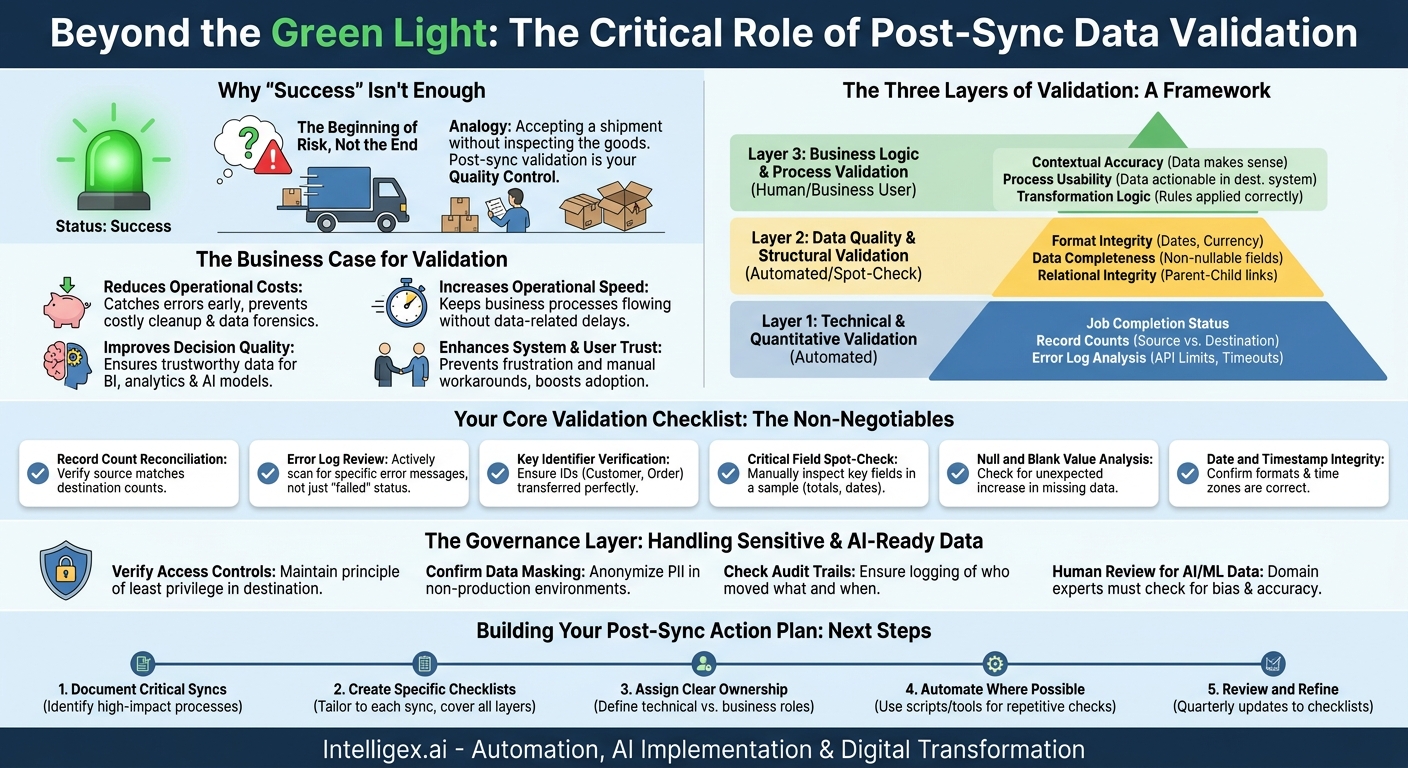
The synchronization job finishes, and the status indicator glows a reassuring green: “Success.” For many teams, this marks the end of the process. But in reality, it is the beginning of the most critical phase: validation. A technically successful data transfer means nothing if the data itself is unusable, incorrect, or incomplete. Without a structured validation process, you risk corrupting downstream workflows, eroding user trust, and making business-critical decisions based on flawed information.
Failing to validate a data sync is like accepting a shipment of raw materials without checking the packing slip or inspecting the goods. The delivery truck arrived, but is the cargo what you ordered? Is it the right quantity? Is it damaged? In the world of digital operations, post-sync validation is your quality control. It is the essential bridge between a technical task and a reliable business outcome, directly impacting operational speed, cost control, and data quality.
Why “Success” Isn’t Enough: The Business Case for Post-Sync Validation
A successful API call or a completed database query only confirms that a connection was made and data packets moved from point A to point B. It says nothing about the meaning or integrity of that data. The true cost of a “successful” but unvalidated sync often appears days or weeks later, causing problems that are significantly harder and more expensive to fix. A rigorous validation discipline provides tangible business value across several key areas.
Reduces Operational Costs: Catching an error immediately after a sync is a simple fix. Catching it after it has triggered a thousand incorrect invoices, shipped products to the wrong addresses, or skewed a quarterly financial report requires a costly, time-consuming data forensics and cleanup project. Proactive validation prevents these downstream financial and reputational costs.
Improves Decision Quality: Business intelligence dashboards, analytics platforms, and AI models are only as good as the data they consume. When a sync introduces errors, such as incorrect currency formats or mismatched customer IDs, the resulting insights become untrustworthy. Validation ensures that the data fueling your strategic decisions is accurate, consistent, and reliable.
Increases Operational Speed: A broken data flow brings business processes to a halt. A sales team cannot act on new leads that are missing contact information. A supply chain manager cannot process orders if product codes are corrupted. By confirming data is correct and usable immediately after a sync, you ensure that operational teams can proceed with their work without delay or confusion.
Enhances System and User Trust: When users in a destination system (like a CRM or ERP) repeatedly encounter bad data, they lose faith in the tool. This leads to the creation of shadow spreadsheets and manual workarounds, defeating the purpose of an integrated system. Consistent validation builds trust and encourages user adoption.
The Three Layers of Validation: A Framework for Thoroughness
To avoid being overwhelmed, it helps to structure your validation efforts into three distinct layers. Each layer builds on the previous one, moving from a purely technical check to a comprehensive business process verification. This approach ensures you cover all bases, from the machine level to the end-user experience.
Layer 1: Technical and Quantitative Validation
This is the first line of defense and the most straightforward layer. It answers the fundamental question: Did the mechanics of the sync work as expected? This is often automated and monitored by IT or the integration team.
- Job Completion Status: Did the sync process run to completion without critical failures?
- Record Counts: Does the number of records extracted from the source system match the number of records loaded into the destination system? Account for any intentional filtering.
- Error Log Analysis: Are there any errors or warnings in the logs? Look for issues like API rate limiting, authentication failures, timeouts, or records that were rejected by the destination system’s validation rules.
Layer 2: Data Quality and Structural Validation
This layer moves beyond pure numbers to inspect the data itself. It answers the question: Is the data structured correctly and internally consistent? This often requires a mix of automated rules and manual spot-checks.
- Format Integrity: Are dates in the correct format (e.g., YYYY-MM-DD)? Are currency symbols and decimal places correct? Have special characters or different language character sets been preserved?
- Data Completeness: Are fields that should never be empty (non-nullable fields) populated? For example, every customer record must have a unique ID.
- Relational Integrity: If you are syncing related data (like customers and their orders), have the relationships been maintained? Do the foreign keys in the order table correctly reference the primary keys in the customer table?
Layer 3: Business Logic and Process Validation
This is the most crucial and often overlooked layer. It answers the ultimate question: Does this data make sense and can we use it to do our jobs? This validation must involve the business users who depend on the data.
- Contextual Accuracy: Is a new sales order assigned to an active sales representative? Does a product’s inventory level make sense, or is it a negative number?
- Process Usability: Can a user in the destination system perform a key action with the synced data? For example, can the finance team generate an invoice from a newly synced sales order in the ERP?
- Transformation Logic: If data was transformed during the sync (e.g., converting currencies, concatenating fields, applying business rules), was the transformation applied correctly?
Your Core Validation Checklist: The Non-Negotiables
While every synchronization process is unique, a core set of checks applies to nearly every scenario. Use this checklist as a starting point for creating your own specific validation plan. It focuses on the most common points of failure and provides a solid foundation for data integrity.
- Record Count Reconciliation: Verify that the number of records created, updated, or deleted in the source matches the counts in the destination. Document any expected discrepancies.
- Error Log Review: Actively scan logs for specific error messages, not just for a “failed” status. A sync can “succeed” while still logging thousands of individual record-level rejections.
- Key Identifier Verification: Check that unique identifiers (like Customer ID, Order Number, Employee ID) have been transferred perfectly. An error here can orphan records or corrupt relationships.
- Critical Field Spot-Check: Manually inspect a small, representative sample of records. Look at the most important fields, such as financial totals, contact information, status fields, and key dates.
- Null and Blank Value Analysis: Check for an unexpected increase in null or blank values in required fields. A mapping error could be causing a source field to be dropped during the transfer.
- Date and Timestamp Integrity: Confirm that date formats are correct and that time zones have been handled as expected, especially when syncing between systems in different regions.
Deep Dive: Validating Common Business Scenarios
Applying validation principles to real-world scenarios makes their value clear. Here is how different departments can approach post-sync validation for their critical processes.
Scenario: Sales & Marketing (CRM to Marketing Automation)
A seamless flow of data between a CRM like Salesforce and a marketing automation platform is vital for lead nurturing and campaign analysis.
- What to Validate: A new lead created from a “Contact Us” form in the marketing tool should appear in the CRM assigned to the correct regional queue. Crucially, if a contact unsubscribes in a marketing email, their “Email Opt-Out” status must be synced back to the CRM immediately to ensure compliance.
- Business Impact of Failure: A delay in syncing new leads means slower sales follow-up and lost opportunities. Failing to sync unsubscribes risks violating anti-spam laws (like CAN-SPAM or GDPR) and damaging brand reputation.
- Metric to Watch: Lead Response Time. An effective sync keeps this metric low.
Scenario: Finance & Operations (ERP to Warehouse Management System)
When a sales order is confirmed in the Enterprise Resource Planning (ERP) system, the data must flow perfectly to the Warehouse Management System (WMS) to kick off fulfillment.
- What to Validate: A new sales order in the ERP must create a corresponding, accurate pick list in the WMS with the correct SKUs, quantities, and shipping address. After the order is shipped, the inventory reduction in the WMS must sync back to the ERP to maintain an accurate, system-wide inventory count.
- Business Impact of Failure: Incorrect SKUs or quantities lead to shipping errors, customer dissatisfaction, and costly returns. Failure to sync inventory updates back to the ERP can lead to stockouts or selling products that are not actually available.
- Metric to Watch: Order Accuracy Rate. This is a direct measure of the sync’s operational quality.
A Step-by-Step Guide to Effective Spot-Checking
Manual spot-checking is an indispensable part of validation, especially for confirming business logic. It empowers business users to verify data without needing deep technical knowledge. Follow this simple process to make your spot-checks effective and repeatable.
- Select Representative Records: In the source system, choose a small sample (3-5 records) that represents different conditions. For instance, select one brand new customer, one recently updated customer, and one customer with a complex order history.
- Document Key Source Attributes: For each selected record, note the values of its most critical fields in a simple spreadsheet or text document. Include the unique ID (e.g., Customer Number), name, email, status, and a key financial figure like “Total Order Value.”
- Locate Records in the Destination: Using the unique ID, find the exact same records in the destination system. If you cannot find a record, you have already discovered a major sync failure.
- Perform a Side-by-Side Comparison: Place the source and destination data side-by-side. Compare each of the critical fields you documented. Pay close attention to fields that undergo transformation. For example, was the `FirstName` and `LastName` from the source correctly concatenated into a `FullName` field in the destination?
- Test a Downstream Action: This is the ultimate test. Take one of the synced records and try to use it in a key business process in the destination system. For example, can you add the newly synced customer to a marketing campaign? Can you generate a shipping label using their address? If the downstream action fails, the sync was not truly successful.
The Governance Layer: Handling Sensitive and AI-Ready Data
When synchronization involves personally identifiable information (PII), financial data, or information destined for an AI model, the stakes are higher. Validation must extend beyond data accuracy to include security and governance. This is not just a best practice; it is often a legal and ethical requirement.
Verify Access Controls: Data that was restricted to the finance department in the source ERP should not suddenly become visible to the entire sales team when synced to the destination CRM. Validate that the permissions and role-based access controls in the destination system are correctly applied to the synced data, maintaining the principle of least privilege.
Confirm Data Masking and Anonymization: For syncs into development, testing, or analytics environments, sensitive data should be masked, tokenized, or anonymized. Your validation should include checks to ensure that no live PII (like social security numbers or credit card details) has leaked into non-production systems.
Check Audit Trails: A robust synchronization process includes comprehensive logging. For compliance and security purposes, you must be able to answer: What data was moved? Who or what process moved it? When was it moved? Validate that these audit trails are being generated and are accessible.
Human Review for AI/ML Data: If you are syncing data to be used as a training set for a machine learning model, automated validation is not enough. A biased or corrupted dataset can lead to a flawed and untrustworthy AI. Implement a human-in-the-loop process where a domain expert reviews a statistical sample of the synced data to check for contextual accuracy, fairness, and relevance before it is fed to the model.
Building Your Post-Sync Action Plan: Next Steps
Moving from a reactive to a proactive validation culture does not happen overnight. It requires a deliberate and structured approach. The goal is to make validation a standard, non-negotiable step in every data integration project. Here is how you can get started.
- Document Your Critical Syncs: Identify the 3-5 most important data synchronization processes in your organization. These are the ones where an error would cause the most significant business disruption.
- Create a Specific Checklist for Each: For each critical sync, work with the relevant business stakeholders to create a tailored validation checklist that covers all three layers: technical, data quality, and business logic.
- Assign Clear Ownership: Define who is responsible for validation. Is it the IT team, the business analyst, or the end-user department? Often, it is a shared responsibility. The technical team validates Layer 1, while the business owner validates Layers 2 and 3.
- Automate Where Possible: Identify the most repetitive and rule-based checks from your list (like record counts and format checks) and work with your integration team to automate them. This can be done with scripts or monitoring tools like Amazon CloudWatch, freeing up human validators to focus on business logic.
- Review and Refine: Your business and systems are not static. Schedule a quarterly review of your validation checklists and processes to ensure they are still relevant and effective, especially after a major software update or a change in business processes.
By treating post-sync validation with the seriousness it deserves, you transform your data integration efforts from a risky technical necessity into a reliable engine for business growth and operational excellence.
Your Next Read:
Get a FREE
Proof of Concept
& Consultation
No Cost, No Commitment!