

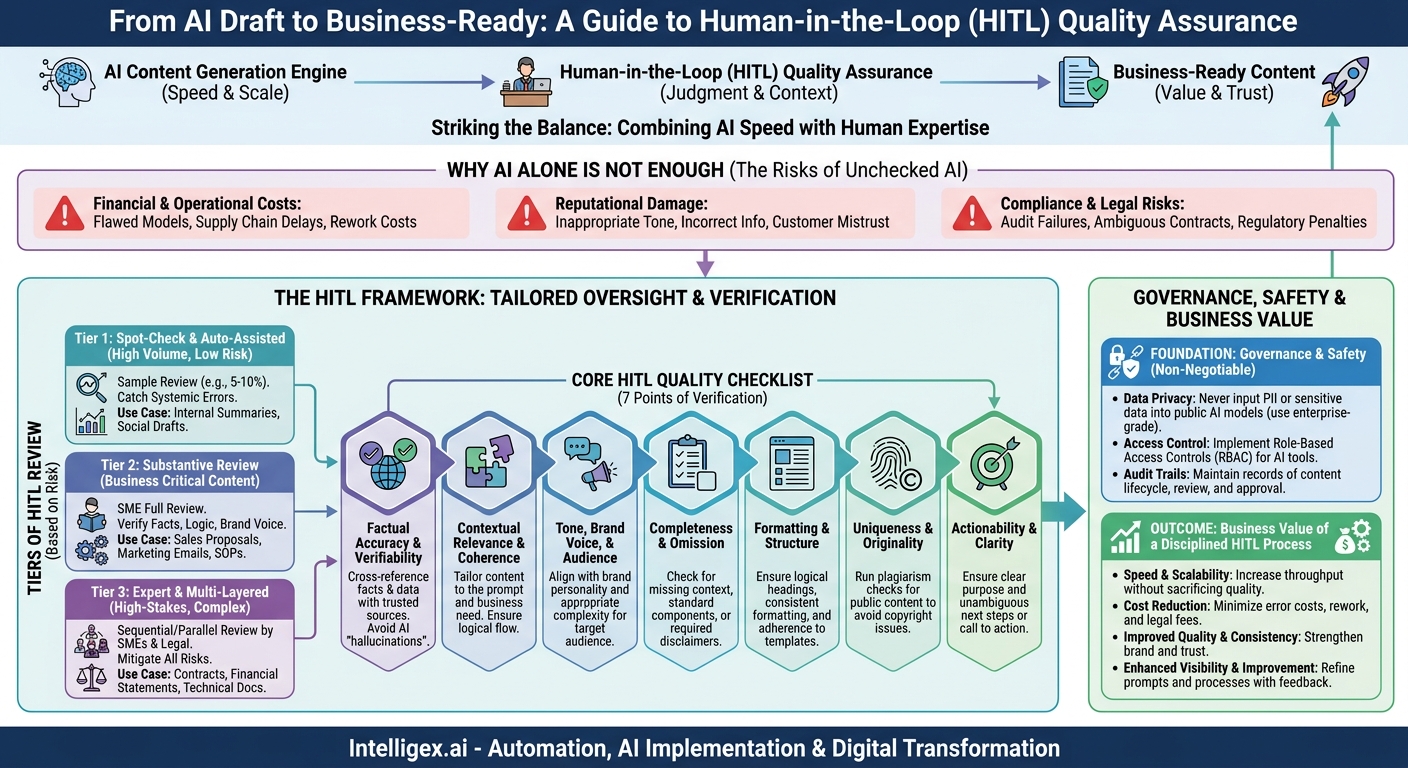
Artificial intelligence is no longer just a tool for analysis; it’s a content-creation engine. Teams across operations, finance, marketing, and HR are using AI to generate everything from project reports and financial summaries to marketing copy and internal communications. This explosion in automated content creation promises unprecedented speed and scale, but it introduces a critical business challenge: how do you ensure the output is accurate, safe, and ready for professional use?
The answer isn’t to slow down or revert to purely manual processes. It’s to implement a structured Human-in-the-Loop (HITL) quality assurance process. A HITL workflow is not a bottleneck. It’s a strategic framework that combines the speed of AI with the judgment of human experts, ensuring that every piece of generated content drives value instead of creating risk.
Why “Good Enough” from an AI is Never Good Enough for Business
Accepting a raw AI draft without review is like shipping a product without quality control. While the output may look polished on the surface, hidden errors can create significant downstream problems. The risks of deploying unchecked AI-generated content are tangible and fall into several key business categories.
Financial and Operational Costs: An AI-generated financial model might misinterpret a data column, leading to flawed projections. A supply chain order summarized by AI could omit a critical line item, causing production delays. These are not trivial mistakes. The cost of correcting them after the fact, both in terms of money and team productivity, far exceeds the time saved by skipping a review. The goal is to reduce the total time-to-value, not just the time-to-first-draft.
Reputational Damage: For customer-facing teams like sales and marketing, brand voice and accuracy are paramount. An AI-generated email campaign that uses an inappropriate tone or presents incorrect product information can erode customer trust instantly. Similarly, a support bot providing inaccurate troubleshooting steps can turn a minor issue into a major customer complaint. Reputation is hard-won and easily lost.
Compliance and Legal Risks: In regulated industries like finance, healthcare, and law, document accuracy is non-negotiable. An AI-generated compliance report that omits required disclosures can lead to audits and severe penalties. A contract drafted with AI assistance might contain ambiguous or incorrect clauses, creating legal vulnerabilities. A robust human review process is an essential component of any compliance framework in the age of AI.
The Three Tiers of HITL Review: Tailoring Oversight to Risk
Not all content carries the same level of risk, so not all content requires the same level of scrutiny. Applying a one-size-fits-all review process is inefficient. A tiered approach allows you to match the intensity of human oversight to the business impact of the content, optimizing for both speed and safety.
Tier 1: Spot-Check and Automation-Assisted Review
This tier is designed for high-volume, low-risk content where the primary goal is to catch systemic AI errors rather than minor individual mistakes. It prioritizes speed and efficiency.
- Appropriate Use Cases: Internal meeting summaries, initial drafts of social media updates, sentiment analysis reports on customer feedback, categorization of internal support tickets.
- The Process: A human reviewer inspects a small, random sample of the AI’s output (e.g., 5-10%). This is often supplemented with automated rules that flag anomalies, such as documents containing specific keywords (like “confidential” or “error”), outputs that fall outside a normal length, or sentiment scores that are extremely negative or positive.
- The Goal: To quickly validate that the AI is performing as expected on a large scale and to identify any recurring patterns of error that require prompt or model adjustments.
Tier 2: Substantive Review
This is the most common tier for professional business content. It requires a full review by a subject matter expert (SME) to ensure the content is accurate, coherent, and fit for its intended audience.
- Appropriate Use Cases: Customer-facing sales proposals, external marketing emails, detailed project plans, HR job descriptions, first drafts of standard operating procedures (SOPs).
- The Process: The SME reads the entire document. They are not just proofreading for grammar; they are verifying facts, checking the logic of arguments, ensuring the tone aligns with the brand voice, and confirming that the content fulfills the original request completely.
- The Goal: To guarantee that a piece of business-critical content is accurate and professional before it is shared with its intended audience, whether internal or external.
Tier 3: Expert and Multi-Layered Verification
This tier is reserved for high-stakes documents where errors can have significant financial, legal, or safety implications. It involves multiple reviewers with different areas of expertise.
- Appropriate Use Cases: Financial statements for auditors, legal contracts, technical documentation for mission-critical systems, submissions to regulatory agencies, and public press releases.
- The Process: The review process is sequential or parallel. For a new sales contract, a sales manager might first review it for business term accuracy. Then, a legal expert reviews it for compliance and risk. For a technical engineering report, one engineer might verify the data while another checks the conclusions and recommendations.
- The Goal: To achieve the highest possible degree of accuracy and mitigate all identifiable risks before a document is finalized and executed.
The Core HITL Quality Checklist: 7 Points of Verification
A standardized checklist is the backbone of an effective HITL workflow. It transforms the review process from a subjective art into a repeatable science, ensuring consistency and completeness. The following seven-point process can be adapted for almost any type of AI-generated content or document.
- Factual Accuracy and Verifiability
This is the most critical check. AI models can “hallucinate” by confidently stating incorrect information. Every verifiable fact, statistic, or data point must be cross-referenced with a trusted source. For an internal report, this might mean checking against a company dashboard. For a marketing whitepaper, it means citing the original research. Never assume the AI’s data is correct.
- Contextual Relevance and Coherence
Does the output actually answer the prompt and address the underlying business need? A common failure mode for AI is producing generic content that is only tangentially related to the specific request. The reviewer must ensure the content is tailored. For example, an AI-generated project update for an executive should be a high-level summary, not a detailed log of every task.
- Tone, Brand Voice, and Audience Appropriateness
Language matters. The content must align with your organization’s established voice and be appropriate for the target audience. A casual, emoji-filled tone might be great for social media but is entirely wrong for a formal proposal to a conservative client. This is where a simple sub-checklist can be invaluable.
- Does the content use approved company and product terminology?
- Is the complexity and reading level suitable for the intended audience?
- Does the tone reflect our brand’s personality (e.g., innovative, authoritative, friendly)?
- Completeness and Omission
Just as important as what is in the document is what is missing. AI models, focused on fulfilling the prompt, can easily omit necessary context or standard components. A human reviewer should check if the document is complete. For instance, a generated business proposal might be missing a section on potential risks, or a new HR policy document might lack a required legal disclaimer.
- Formatting and Structure
A well-structured document is easier to understand and looks more professional. The reviewer should check for logical flow, clear headings, proper use of lists, and consistent formatting. If the content needs to adhere to a company template (like a presentation deck or formal report), ensure the AI-generated text has been correctly placed within that structure.
- Uniqueness and Originality
Large language models learn from vast amounts of text from the internet, and they can sometimes reproduce passages verbatim from their training data. For any public-facing content, it is crucial to run the output through a plagiarism checker. This protects your organization from potential copyright issues and ensures your content is original.
- Actionability and Clarity
Great business content drives action. The final check is to ensure the document has a clear purpose and, if applicable, a clear call to action. Are the next steps in a project plan unambiguous? Is the request in an email easy to understand? Does a marketing page guide the user toward a specific goal? The content should not leave the reader wondering, “What am I supposed to do now?”
Governance and Safety: The Non-Negotiable Foundation
An effective HITL process is built on a foundation of strong data governance and security practices. Speed and quality are meaningless if your process compromises sensitive information or lacks accountability.
Data Privacy: The cardinal rule of using generative AI is to never input personally identifiable information (PII), sensitive customer data, proprietary financial details, or confidential intellectual property into public, consumer-grade AI models. These models may use your inputs for future training. Always use enterprise-grade AI platforms that offer data privacy guarantees or deploy models within your own secure cloud environment. A great resource for understanding risk is the NIST AI Risk Management Framework.
Access Control: Not every employee should be able to generate every type of document. Implement role-based access controls (RBAC) for your AI tools. For example, only HR managers should be able to generate performance reviews, and only the legal team should have access to tools for drafting contracts. This limits the potential for misuse and ensures that sensitive content is handled by authorized personnel.
Audit Trails and Accountability: Maintain a clear record of the content lifecycle. It should be easy to see who generated the initial draft, who reviewed it, what changes were made, and who gave the final approval. This is essential for compliance and accountability. For many teams, the version history and commenting features in platforms like Google Workspace or Microsoft 365 are sufficient. The final human approver is always accountable for the content, regardless of its AI-assisted origin.
The Business Value of a Disciplined HITL Process
Implementing a formal quality checklist for AI-generated content directly translates into measurable business benefits that go far beyond just “better documents.”
- Speed and Scalability: By pairing AI-powered first drafts with efficient human review, teams can dramatically increase their content throughput without sacrificing quality. This allows you to scale operations, from marketing campaigns to financial reporting, without a linear increase in headcount.
- Cost Reduction: A HITL process minimizes the high cost of errors. It reduces the time spent on extensive rework and prevents mistakes that could lead to financial loss, legal fees, or operational disruptions. It also frees up your most valuable SMEs from the tedious task of writing first drafts, allowing them to focus on high-impact strategic work.
- Improved Quality and Consistency: A standardized checklist ensures that all content meets a consistent quality bar, regardless of which team member produced it. This strengthens brand identity, improves clarity in communications, and builds trust with both internal and external stakeholders.
- Enhanced Visibility and Continuous Improvement: The review process creates a powerful feedback loop. By tracking the types of corrections reviewers frequently make, you can identify weaknesses in your AI prompts or models. This data allows you to continuously refine your process, improve your AI’s performance, and reduce the review burden over time.
Your Next Steps: Building Your HITL Framework
Getting started with a structured HITL process doesn’t require a massive, company-wide initiative. You can build momentum and demonstrate value by starting small and iterating.
- Identify One High-Impact Use Case: Choose a single, repetitive content-generation task that is causing a bottleneck. Good candidates include writing weekly project status reports, drafting initial sales outreach emails, or summarizing customer feedback tickets.
- Draft a Simple V1 Checklist: Adapt the 7-point verification list from this post into a short, specific checklist for your chosen use case. Focus on the 5-7 most critical quality checks for that particular type of content.
- Run a Small Pilot Program: Select two or three team members to use the AI tool and the checklist for a defined period, such as one or two weeks. Instruct them to track their time and provide feedback on the process.
- Refine and Expand: Use the feedback from the pilot to improve your checklist and workflow. Once you have demonstrated success with the initial use case, you can use your learnings to confidently roll out the HITL framework to other content types and teams across the organization.
Your Next Read:
Category:
Get a FREE
Proof of Concept
& Consultation
No Cost, No Commitment!