

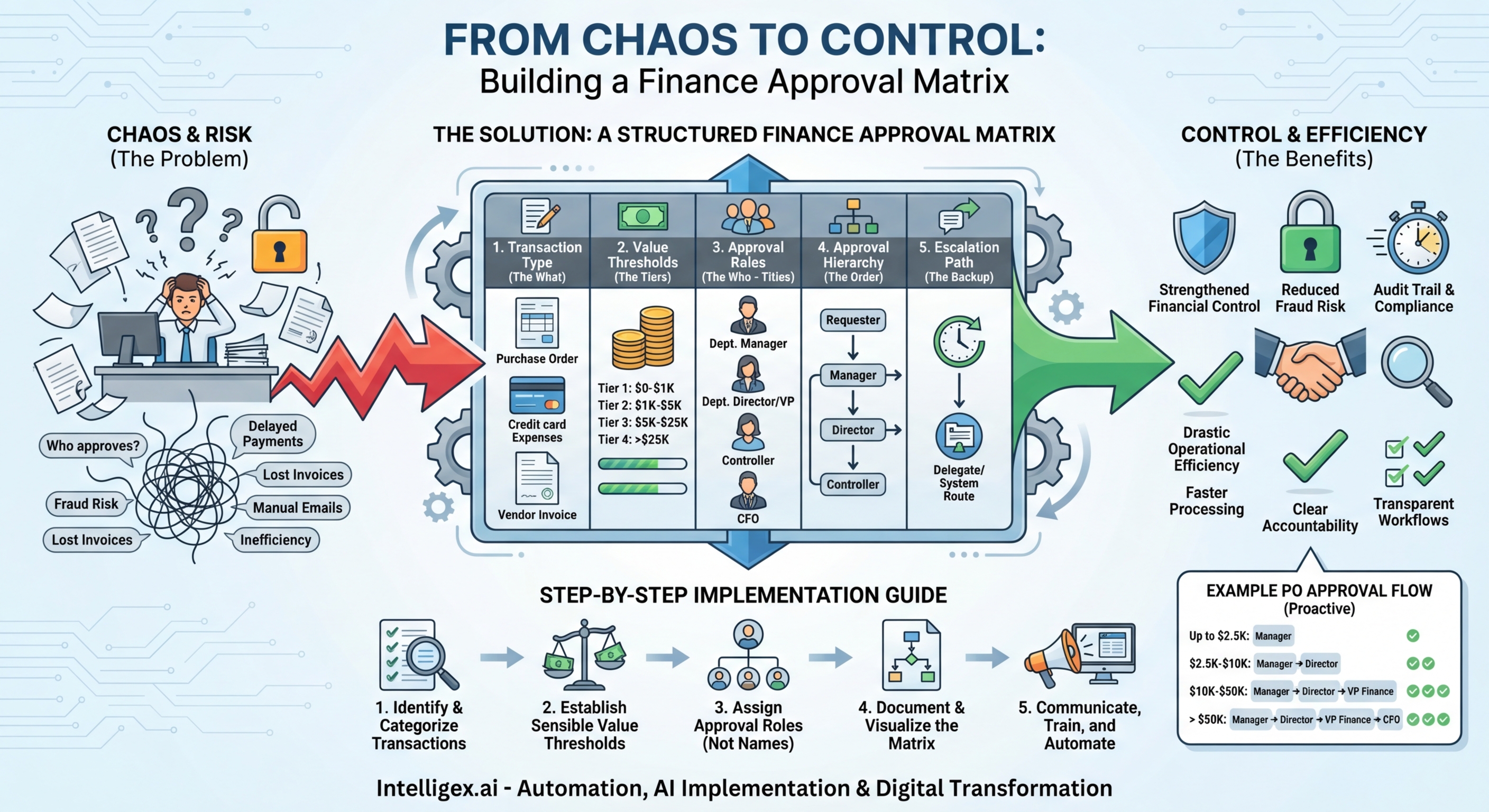
In the fast-paced world of finance, chaos is the enemy. A single misplaced invoice, a questionable expense report, or a delayed purchase order can create a ripple effect of confusion, wasted time, and potential financial risk. If your team spends more time chasing down signatures via email and Slack than they do on strategic financial analysis, you’re not alone. The culprit is often a lack of a clear, standardized process for approvals. This is where a well-structured approval matrix transforms from a simple administrative tool into a cornerstone of financial governance and operational efficiency.
An approval matrix is more than just a flowchart; it’s a formal policy that dictates who must approve specific financial transactions based on a set of predefined criteria, most commonly the transaction’s monetary value. It provides a clear and unambiguous roadmap for every request, eliminating the guesswork and frantic “who needs to sign off on this?” questions. By establishing this framework, you move your finance department from a reactive state of putting out fires to a proactive position of control and oversight.
The Anatomy of an Effective Approval Matrix
Before we dive into building one, it’s essential to understand its core components. A robust approval matrix isn’t just a list of names and numbers; it’s a logical system built on clear principles. Think of it as a grid where every financial request can be precisely plotted to find its correct approval path.
The key elements that form the foundation of any matrix are:
- Transaction Type: This is the “what.” The matrix must differentiate between various types of financial activities, as the approval flow for a $5,000 invoice might differ from a $5,000 employee expense report. Common types include purchase requisitions, purchase orders, vendor invoices, expense reports, new vendor setups, and capital expenditures (CapEx).
- Value Thresholds: This defines the monetary tiers. By setting specific dollar-amount ranges (e.g., $0 – $500, $501 – $2,500, $2,501 – $10,000), you can apply different levels of scrutiny. A small office supply order shouldn’t require the CFO’s time, while a significant software investment absolutely should.
- Approval Levels/Roles: This is the “who.” Crucially, a scalable matrix assigns approvers by their role or title (e.g., “Department Manager,” “VP of Finance,” “Controller”) rather than by their name. This ensures the matrix remains relevant and functional even as personnel changes occur.
- Approval Hierarchy: This dictates the “order.” Does a request need one signature, or does it require a sequence of approvals? For example, a request might first go to the employee’s direct manager and, once approved, automatically route to the department head for final sign-off.
- Escalation Path: A good matrix also implicitly or explicitly defines what happens if an approver is unavailable. Modern automated systems can handle this by setting up delegates or automatically rerouting a request after a certain period of inactivity.
Why Your Finance Team Needs This Now: The Tangible Benefits
Implementing an approval matrix might seem like adding another layer of bureaucracy, but its impact is the exact opposite. It streamlines processes and introduces a level of control that is fundamental to a healthy finance function.
Strengthened Financial Control and Risk Mitigation
This is arguably the most critical benefit. An approval matrix is a powerful internal control mechanism. It ensures that every dollar spent is properly vetted according to company policy. By requiring multiple layers of approval for high-value transactions, you significantly reduce the risk of fraudulent payments, duplicate invoices, and unauthorized spending. For public companies or those adhering to regulations like the Sarbanes-Oxley Act (SOX), a documented and enforced approval matrix is not just a best practice—it’s a compliance necessity. It provides a clear, auditable trail demonstrating that financial controls are in place and being followed.
Drastic Improvements in Operational Efficiency
Consider the typical manual approval process: an employee emails an invoice to their manager, who might be busy and forget about it. After a few follow-up emails, the manager forwards it to someone in finance, who then has to question its validity and budget allocation before seeking final approval from a director. This entire chain is slow, prone to error, and completely opaque.
An approval matrix, especially when integrated into an accounts payable (AP) automation or procurement platform, eradicates these inefficiencies. The moment a request is submitted, the system knows exactly who needs to see it and in what order. Approvers are automatically notified, and the finance team has full visibility into where any request is in the pipeline. This slashes invoice processing times, helps capture early payment discounts, and frees up your team to focus on higher-value activities.
Unwavering Accountability and Transparency
Ambiguity is the enemy of accountability. When no one is quite sure who is responsible for a final sign-off, it’s easy for things to slip through the cracks. An approval matrix eliminates this gray area. It clearly defines ownership at every stage. Every employee knows who to route requests to, and every manager understands their specific approval authority. This creates a culture of responsibility. Furthermore, it generates a digital audit trail for every transaction. If a questionable expense is ever investigated, you can instantly see who approved it and when, providing complete transparency.
Building Your Finance Approval Matrix: A Step-by-Step Guide
Creating an approval matrix requires thoughtful planning and collaboration across departments. It’s a strategic project, not just an administrative task. Here’s a practical approach to building one from the ground up.
Step 1: Identify and Categorize All Transaction Types
Gather stakeholders from finance, procurement, and department heads to brainstorm every type of expenditure that requires an approval. Don’t leave anything out. Your list might include:
- Purchase Requisitions
- Purchase Orders (POs)
- Non-PO Invoices
- Employee Expense Reports
- New Vendor Onboarding
- Capital Expenditure Requests
- Budget Transfers
- Contract Agreements
Step 2: Establish Sensible Value Thresholds
This is where the logic of risk management comes into play. The goal is to balance control with efficiency. You don’t want to create bottlenecks by requiring high-level approval for minor expenses. Analyze your historical spending data to set meaningful tiers. A common structure might look like this:
- Tier 1: $0 – $1,000
- Tier 2: $1,001 – $5,000
- Tier 3: $5,001 – $25,000
- Tier 4: $25,001 – $100,000
- Tier 5: > $100,000
These tiers will vary dramatically based on your company’s size and revenue. A startup’s “high-value” tier might be $10,000, while for a large enterprise, it could be $500,000.
Step 3: Assign Approval Roles (Not People)
Map out your organizational structure and assign approval authority based on roles. This is the most critical step for ensuring the matrix’s longevity. For each transaction type and value threshold, define the required approver(s).
For example, for a Purchase Requisition:
- Tier 1 ($0 – $1,000): Department Manager
- Tier 2 ($1,001 – $5,000): Department Manager → Department Director
- Tier 3 ($5,001 – $25,000): Department Manager → Department Director → VP of Finance
Notice the use of “→” to indicate a sequential workflow. The request must be approved by the first role before it moves to the next.
Step 4: Document and Visualize the Matrix
Consolidate all this information into a clear, easy-to-read document, typically a spreadsheet or a table. This document is your single source of truth. It should be easily accessible to all employees. This is also where a visual infographic becomes incredibly powerful, as it can distill complex workflows into a simple, digestible format that anyone in the organization can understand at a glance.
Let’s visualize a simple example for two common transaction types. A well-designed approval matrix would clearly lay out the paths for each, ensuring no confusion.
Example 1: Purchase Order Approval Workflow
This workflow focuses on pre-approving spend before it happens, a key tenet of proactive financial management.
- Up to $2,500: Requires approval from the requester’s direct Department Manager.
- $2,501 to $10,000: Requires sequential approval, first from the Department Manager, then from the relevant Department Head (Director/VP).
- $10,001 to $50,000: Requires a third level of approval from the VP of Finance after the Manager and Department Head have signed off.
- Over $50,000: All of the above approvals are required, with a final sign-off from the Chief Financial Officer (CFO).
Example 2: Vendor Invoice Approval Workflow
This workflow is for non-PO invoices and often involves coding the expense to the correct general ledger account.
- Up to $1,000: The invoice is coded by an AP team member and requires approval from the relevant Department Manager responsible for that budget.
- $1,001 to $7,500: Requires approval from the Department Manager and the Controller to ensure financial accuracy and compliance.
- Over $7,500: Requires approval from the Department Manager, the Controller, and finally the VP of Finance.
Step 5: Communicate, Train, and Automate
A matrix is useless if nobody knows it exists or how to use it. Formally announce the new policy. Hold training sessions to walk employees through the process. Most importantly, embed this logic directly into your financial software. Modern ERP and AP automation systems are designed to handle complex approval workflows. By programming your matrix into the system, you enforce the policy automatically, making compliance the path of least resistance.
Final Thoughts: From Chaos to Control
An approval matrix is far more than a simple chart. It is a strategic declaration of how your organization manages its financial resources. It’s a framework for accountability, a tool for efficiency, and a shield against risk. By taking the time to design and implement a clear, role-based approval matrix, you empower your finance team to move beyond the tedious task of chasing approvals and into the more strategic role of guiding the company’s financial health. You replace ambiguity with clarity, bottlenecks with streamlined workflows, and unnecessary risk with robust internal controls.
Your Next Read:
Category:
Get a FREE
Proof of Concept
& Consultation
No Cost, No Commitment!