

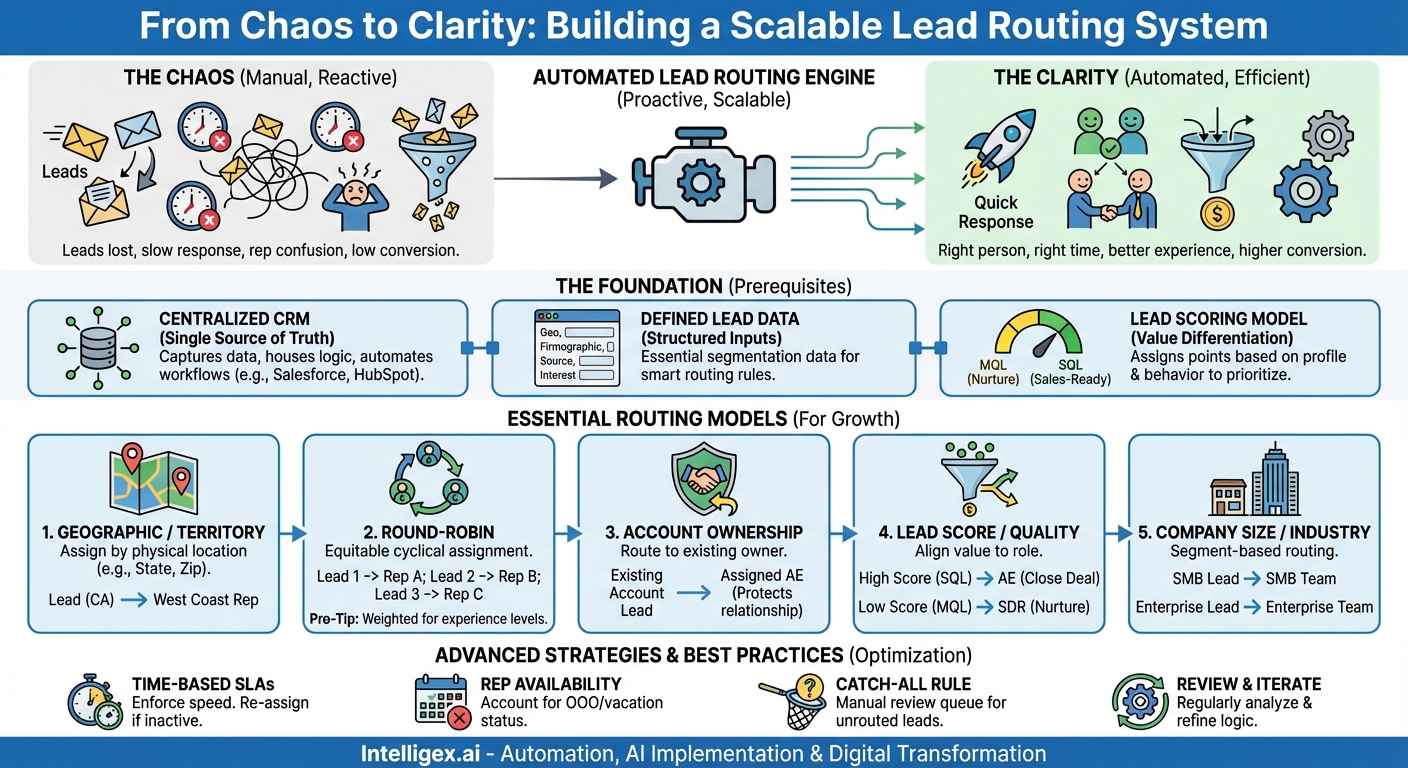
As your business scales, the initial, scrappy methods that once worked for managing new leads begin to crack under the pressure. What was once a manageable trickle of inquiries becomes a flood, and the “whoever gets it first” or “let me assign this one” approach quickly leads to chaos. Leads fall through the cracks, response times plummet, and your best sales reps spend more time figuring out who owns what than actually selling. This is the critical inflection point where a structured, automated lead routing system isn’t just a nice-to-have; it’s the engine of scalable growth. Establishing clear lead routing rules ensures that every single inbound prospect is delivered to the right person, at the right time, every time.
A well-oiled lead routing machine transforms your sales process from reactive to proactive. It eliminates guesswork, prevents cherry-picking, and holds everyone accountable. More importantly, it directly impacts the customer experience. When a hot lead submits a demo request, they expect a quick, relevant response. Automated routing makes that happen in seconds, not hours or days, dramatically increasing your chances of conversion. For a growing sales team, this efficiency is paramount. It allows you to maximize the value of every marketing dollar spent and empowers your reps to focus on what they do best: building relationships and closing deals.
The Foundation of Effective Lead Routing
Before you can build a sophisticated routing system, you need a solid foundation. Jumping straight into complex rules without the necessary prerequisites is like trying to build a house on sand. Ensure these foundational elements are firmly in place first.
A Centralized CRM
Your Customer Relationship Management (CRM) system is the heart of your sales operation. It’s the single source of truth for all lead, contact, and account information. Effective lead routing is almost impossible without a CRM that can capture lead data, house your routing logic, and automate the assignment process. Whether it’s Salesforce, HubSpot, or another platform, make sure it’s fully adopted by your team and capable of handling automated workflows.
Clearly Defined Lead Data
Routing rules rely on data. Your system can only be as smart as the information you feed it. Work with your marketing team to ensure that your lead capture forms are collecting the essential data points needed for segmentation. This includes:
- Geographic Information: Country, state/province, city, postal code.
- Firmographic Data: Company size (employee count or revenue), industry.
- Lead Source: How did they find you? (e.g., Organic Search, Google Ads, Webinar, Trade Show).
- Product/Service Interest: What specific solution are they interested in? This can be captured via a dropdown or inferred from the page they were on when they converted.
An Established Lead Scoring Model
Not all leads are created equal. A Head of Sales at a Fortune 500 company who requests a demo is far more valuable than a student downloading a whitepaper for research. A lead scoring system assigns points to leads based on their demographic information, firmographic data, and online behavior (e.g., pages visited, content downloaded). This score helps you differentiate between Marketing Qualified Leads (MQLs) that need more nurturing and sales-ready Sales Qualified Leads (SQLs) that require immediate follow-up from an Account Executive.
Essential Lead Routing Models for Growth
With your foundation in place, you can begin implementing routing rules that fit your team’s structure and go-to-market strategy. Most sophisticated systems use a combination of these models to create a comprehensive routing flow.
1. Geographic / Territory-Based Routing
This is one of the most common and straightforward routing methods. Leads are assigned to sales reps based on their physical location, such as country, state, or even a set of zip codes. This model is highly effective for teams with field sales reps or when location-specific knowledge (like local market trends, regulations, or language) is a competitive advantage.
Why it’s important: It creates clear lines of ownership, prevents reps from stepping on each other’s toes, and allows reps to become deep experts in their specific region. For customers, it can also lead to a more personalized experience, especially if in-person meetings are part of the sales cycle.
Example: A lead comes in from a company in California. Your CRM automatically checks the “State” field, identifies it as “CA,” and assigns it to your West Coast sales rep, Sarah. A lead from Germany is routed to Klaus, your rep covering the DACH region.
2. Round-Robin Routing
For teams where territory is less important (like many inside sales teams), the round-robin model is a perfect solution for ensuring equitable lead distribution. In its simplest form, it assigns new leads to reps in a cyclical order—the first lead goes to Rep A, the second to Rep B, the third to Rep C, and the fourth back to Rep A.
Why it’s important: It’s the definition of fairness. Round-robin routing prevents “lead hoarding” by top performers and guarantees that every rep, including new hires, gets a steady flow of opportunities to work. This helps with morale, motivation, and forecasting.
Pro-Tip: Consider a weighted round-robin for teams with varying levels of experience. You could assign a senior rep a “weight” of 2 while a junior rep has a “weight” of 1. This means the senior rep would receive two leads for every one lead the junior rep receives, aligning opportunity with closing ability.
3. Account Ownership-Based Routing
This rule is non-negotiable for preventing internal conflict and ensuring a seamless customer experience. If a new lead comes in from a company that is already an existing customer or has an open opportunity, the lead must be routed to the existing account owner. Nothing frustrates a customer—or an Account Executive—more than having a new SDR reach out to a key contact at an account they’re actively trying to close or upsell.
Why it’s important: It protects existing relationships, prevents confusing, disjointed communication, and centralizes all activity related to a single account with one owner. Your CRM should be configured to check for a matching account domain or name before applying any other routing rules.
Example: Jane from Acme Corp. downloads an ebook. Your system sees that Acme Corp. is an existing account owned by your rep, David. Instead of routing the lead into the general queue, it is automatically assigned to David with a notification that a contact at his account has shown new interest.
4. Lead Score / Quality-Based Routing
This model leverages your lead scoring system to align the right type of lead with the right type of sales role. Your most expensive resources—your Account Executives (AEs)—should be spending their time on sales-ready opportunities, not unqualified prospects.
Why it’s important: It creates massive efficiency by structuring a sales funnel. Low-scoring MQLs can be routed to a team of Sales Development Reps (SDRs) or Business Development Reps (BDRs) for qualification and nurturing. Once an SDR qualifies the lead and confirms there’s a real opportunity, they can then convert it and pass the high-scoring SQL to an AE to close the deal.
Example: A lead with a score of 35 (indicating they are a student from a small company) is routed to a marketing nurture sequence. A lead with a score of 95 (a director at a target-sized company who visited the pricing page) is routed directly to the next available AE in a round-robin pool.
5. Company Size or Industry-Based Routing
Just as you might have reps specializing in territories, you may have reps who are experts in specific market segments. This firmographic-based routing assigns leads based on company characteristics like employee count, annual revenue, or industry.
Why it’s important: Selling to a 50-person startup is vastly different from selling to a 50,000-person enterprise. They have different pain points, buying processes, and deal cycles. Routing leads to reps who specialize in these segments (e.g., an SMB team, a Mid-Market team, and an Enterprise team) allows them to develop deep domain expertise and tailor their messaging for maximum impact.
Example: A lead from a company with 200 employees is routed to the “Commercial” sales team. A lead from a company with over 5,000 employees is routed to the “Enterprise” team. Similarly, a lead from a manufacturing company goes to your manufacturing industry expert.
Advanced Strategies and Best Practices
Once you’ve mastered the basics, you can introduce more sophisticated layers to optimize your process further.
Implement Time-Based Rules and SLAs
Speed is everything in sales. A lead’s interest cools with every passing minute. Implement Service Level Agreements (SLAs) that define how quickly a rep must act on a new lead (e.g., within 15 minutes). You can build automation that re-assigns a lead if it hasn’t been actioned within the SLA window. This “shark tank” or “claim it” model moves the lead back into an open queue for the next available rep to grab, creating urgency and accountability.
Account for Rep Availability
Your routing system should be smart enough to know when people are out of the office. There’s no point in sending a hot lead to a rep who is on vacation for a week. Integrate your routing logic with your team’s calendar or have a simple “Out of Office” status in your CRM that temporarily removes reps from all active routing pools. This prevents leads from going cold while waiting for a rep to return.
Always Have a “Catch-All” Rule
What happens when a lead comes in with incomplete or unusual data that doesn’t fit any of your defined rules? Without a default assignment, these leads can end up in a black hole. Create a “catch-all” rule at the very end of your routing logic. This rule should assign any unrouted leads to a specific person (like a sales manager or sales operations specialist) or a designated queue for manual review and assignment. This ensures no lead is ever truly lost.
Review, Analyze, and Iterate
Lead routing is not a “set it and forget it” activity. Your business, team, and market are constantly changing. Set aside time every quarter to review your routing performance. Are leads being distributed evenly? Are there any bottlenecks? Talk to your sales reps—they are on the front lines and will have the best feedback on what’s working and what’s not. Use CRM reports to analyze response times and conversion rates by rule, and don’t be afraid to tweak your logic to optimize for better results.
Investing the time to build a thoughtful, automated lead routing strategy is one of the highest-leverage activities a growing sales organization can undertake. It’s the operational backbone that enables your team to move faster, work smarter, and provide a superior experience for your future customers. By replacing chaos with clarity, you unlock your team’s true potential and build a sales process that can scale with your ambitions.
Your Next Read:
Get a FREE
Proof of Concept
& Consultation
No Cost, No Commitment!
