

A high-performing sales representative is on the cusp of closing a landmark deal. It’s the kind of logo that will open doors, the kind of revenue that will make the quarter. But there’s a catch. The client is demanding a 25% discount and Net 60 payment terms—both outside the standard guidelines. The rep fires off an email to their manager, CCs the VP of Sales, and sends a separate Slack message to someone in finance they think can help. Days tick by. The client gets antsy. The rep is stressed, chasing approvals instead of selling. This chaotic, ad-hoc scramble is where deals go to die.
If this scenario feels painfully familiar, it’s a sign that your organization has outgrown its informal processes. As a business scales, the “wild west” of deal-making—where approvals depend on who you know or who responds to an email first—becomes a significant liability. It creates inconsistency, erodes margins, and slows down sales velocity. The solution is a Deal Desk, and at its heart is a clear, predictable, and efficient approval flow. You don’t need a ten-person team or a million-dollar software suite to get started. A simple, well-defined flow can transform your sales process from a bottleneck into a strategic advantage.
Why a Formal Approval Flow is a Non-Negotiable for Growth
Before diving into the mechanics of a simple flow, it’s crucial to understand why moving away from informal approvals is so critical. The benefits extend far beyond just keeping things organized; they directly impact your bottom line and your ability to scale.
- Increased Sales Velocity: The single biggest killer of a deal is time. When a rep has a clear process and knows exactly what information to provide and who will approve it, the entire cycle accelerates. Instead of days spent chasing signatures, approvals can happen in hours, allowing reps to maintain momentum with the customer.
- Protected Margins and Profitability: Without a standardized process, discounting can become rampant and inconsistent. A Deal Desk flow introduces guardrails. It ensures that every discount is justified and approved by stakeholders who understand its financial impact, protecting your company’s profitability one deal at a time.
- Consistency and Fairness: Ad-hoc approvals often lead to inequity. A rep with a strong relationship with a VP might get a steep discount approved, while another rep with a similar deal gets denied. A formal flow levels the playing field, ensuring all deals are evaluated against the same set of business rules. This builds trust within the sales team and ensures customers receive fair, consistent pricing.
- Enhanced Visibility and Data-Driven Insights: When approvals happen in email threads and private messages, you have zero visibility into your own sales process. A structured flow, even a simple one, captures valuable data. You can start to answer critical questions: What’s our average discount percentage? Which products are most frequently discounted? Where are the bottlenecks in our approval process? This data is gold for refining your sales strategy and pricing models.
- Foundation for Scalability: A process that relies on the tribal knowledge of a few key individuals cannot scale. As your sales team grows from 10 to 50 to 100 reps, you need a system that can handle the increasing volume and complexity of deals without breaking. A simple approval flow is the foundational building block for a scalable and predictable revenue engine.
The Anatomy of a Simple Deal Desk Approval Flow
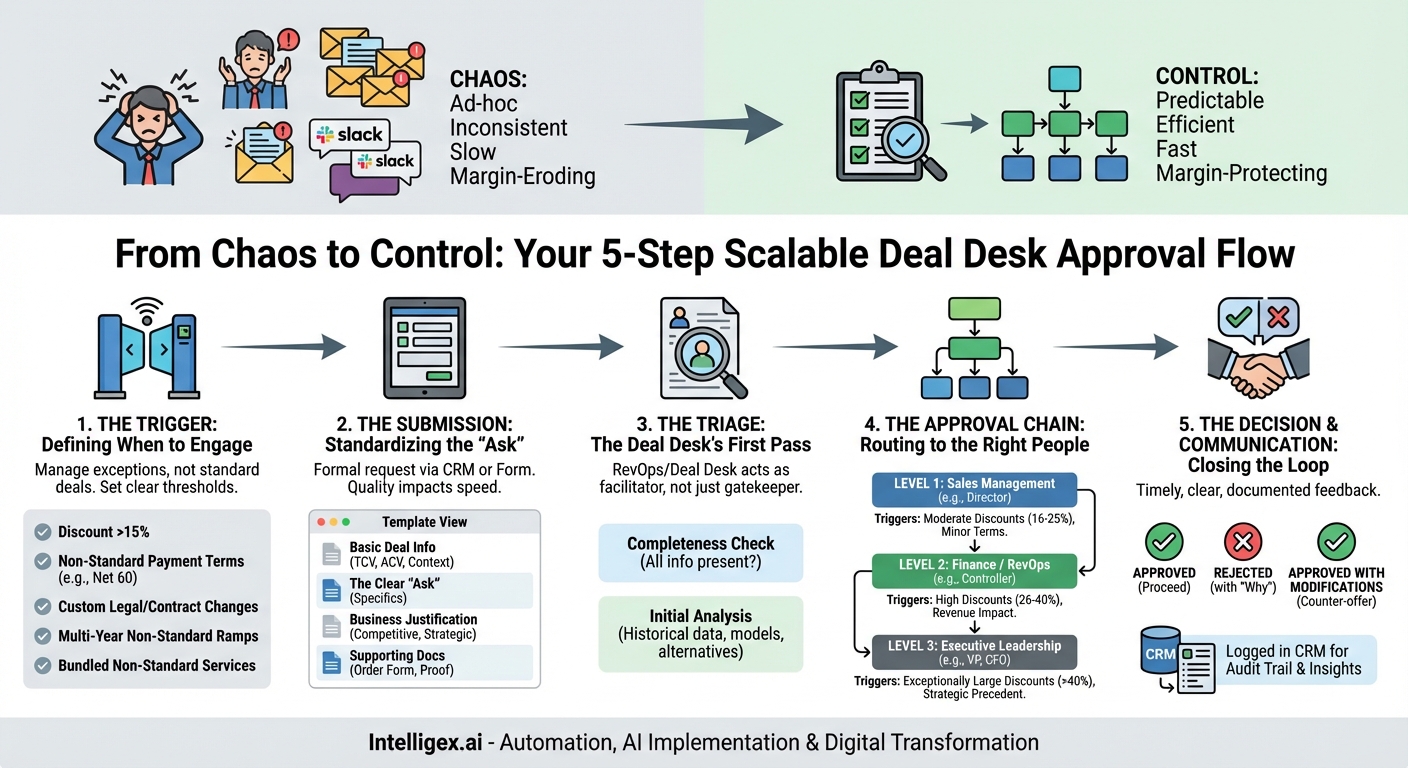
A successful flow is all about clarity and simplicity. Every person involved should know their role, what’s expected of them, and when they need to act. We can break a simple, effective flow down into five distinct steps.
Step 1: The Trigger — Defining When to Engage
The first rule of an efficient Deal Desk is that not every deal needs to go through it. The goal is to manage exceptions, not to micromanage standard business. Therefore, the first step is to establish clear, unambiguous triggers that tell a sales rep when they need to submit a deal for approval. If a deal doesn’t meet any of these criteria, the rep should be empowered to proceed without additional oversight.
Common triggers include:
- Discount Thresholds: This is the most common trigger. For example, a rep may have the authority to offer up to a 15% discount. Anything from 15.1% to 25% requires Deal Desk submission.
- Non-Standard Payment Terms: Your standard terms might be Net 30. Any request for Net 45, Net 60, or anything more complex (like quarterly payments on an annual contract) should trigger the flow.
- Custom Legal or Contractual Changes: If a customer wants to redline your Master Service Agreement (MSA) or requires custom language around liability, security, or data privacy, this must be reviewed.
- Multi-Year Deals with Non-Standard Ramps: A standard multi-year deal might have a 5% price uplift each year. If a client is asking for a flat price for three years or a custom pricing ramp, it requires review to assess the long-term revenue impact.
- Bundling Non-Standard Products or Services: If a deal includes a unique combination of products, a significant amount of professional services, or commitments to future product features, it needs strategic oversight.
The key is to document these triggers and make them easily accessible to the entire sales team. There should be no gray areas.
Step 2: The Submission — Standardizing the “Ask”
Once a trigger is met, the rep needs to formally submit the deal for review. The quality of this submission directly impacts the speed of the approval. A poorly documented request will inevitably lead to back-and-forth questions, delaying the entire process. To avoid this, create a standardized submission template.
This doesn’t need to be complex. It can be a custom object in your CRM (like Salesforce), a dedicated Slack workflow, or even a structured Google Form. The medium is less important than the information it collects. Every submission must include:
- Basic Deal Information: Account Name, Opportunity Link (critical for context), Total Contract Value (TCV), and Annual Contract Value (ACV).
- The Clear “Ask”: What specific non-standard term is being requested? Be precise. Not “a discount,” but “a 22% non-recurring discount on the software subscription for Year 1.”
- The Business Justification: This is the most important part of the submission. Why is this exception necessary to win the deal? A weak justification like “the customer asked for it” is not enough. A strong justification provides context: “We are in a competitive bake-off against Competitor X, who is known to discount aggressively. This is a strategic logo in the enterprise retail vertical, and the customer has confirmed that if we match this price point, they will sign by the end of the week.”
- Supporting Documentation: Attach relevant documents like the draft order form, the customer’s redlined contract, or an email chain that confirms the justification.
Step 3: The Triage — The Deal Desk’s First Pass
The submission is now in the hands of the Deal Desk. In a small but growing company, the “Deal Desk” might be a single person in RevOps or Sales Ops, or even a sales manager who takes on this responsibility. Their first job is not to approve or deny, but to act as a strategic partner and facilitator.
The triage process involves two key actions:
- Completeness Check: Does the submission contain all the necessary information? Is the justification clear and compelling? If not, the Deal Desk’s first action is to go back to the rep for more information. This enforces discipline in the submission process over time.
- Initial Analysis: The Deal Desk provides the first layer of objective analysis. They can check the proposed discount against historical data for similar deals. They can model the impact of non-standard payment terms on cash flow. They may even suggest alternatives to the rep. For example: “Instead of a 25% discount, have you considered offering our Premium Onboarding package at no cost? It has a high perceived value for the customer but a lower margin impact for us.”
This step ensures that by the time the deal reaches the final approvers, it is well-vetted, complete, and presented with a clear business case.
Step 4: The Approval Chain — Routing to the Right People
This is the “flow” itself. The goal is to route the request to the minimum number of people required to make an informed decision. A simple, tiered approval chain is highly effective. The key is to automate this routing based on the submission data if possible.
A common simple approval chain looks like this:
- Level 1: Sales Management (e.g., Sales Director)
- Triggers: Moderate discounts (e.g., 16-25%), minor deviations in standard terms.
- Rationale: The direct sales leader has the best context on their team’s pipeline, the strategic importance of the deal, and the rep’s forecasting. They are the first line of defense for commercial terms.
- Level 2: Finance / RevOps (e.g., Controller or Head of RevOps)
- Triggers: High discounts (e.g., 26-40%), non-standard payment or billing terms, any changes impacting revenue recognition.
- Rationale: Finance must approve anything that materially affects the company’s financials, from cash flow to how revenue is reported. Their sign-off is crucial for financial governance.
- Level 3: Executive Leadership (e.g., VP of Sales, CFO)
- Triggers: Exceptionally large discounts (>40%), significant changes to liability or IP in contracts, deals that set a major strategic precedent.
- Rationale: These are high-risk, high-reward decisions that can have a lasting impact on the business. They require executive-level visibility and approval.
Step 5: The Decision & Communication — Closing the Loop
Once the final approver has made a decision, the loop must be closed quickly and clearly. The Deal Desk is responsible for communicating the final outcome back to the sales rep.
The communication should be:
- Timely: The rep is waiting. A swift response is paramount.
- Clear: State the decision unambiguously: Approved, Rejected, or Approved with Modifications.
- Documented: The final decision and its rationale must be logged in the CRM on the opportunity record. This creates an audit trail and provides valuable data for future analysis.
If a request is rejected, it’s vital to provide the “why.” This turns a rejection into a coaching moment. For instance: “The request for a 35% discount was denied as it brings the deal below our gross margin floor. However, we have approved a counter-offer of a 25% discount combined with a one-year extension of premium support.” This empowers the rep to go back to the customer with a viable alternative.
Putting It All Together: Tools and Best Practices
Implementing this flow doesn’t require a massive investment. Start with the tools you already have and focus on the process.
- Your CRM is Your Best Friend: Whether it’s Salesforce, HubSpot, or another platform, your CRM should be the single source of truth. Build the submission form using custom fields and, if possible, use its native approval process automation to handle the routing.
- Use Communication Tools Wisely: A dedicated Slack or Teams channel (e.g., #deal-desk) is excellent for quick questions and notifications, but it should not be the system of record. Always drive users back to the CRM to log the official submission and decision.
- Document and Train: Create a simple, one-page document outlining the triggers, the submission process, the approval chain, and your target SLAs (Service Level Agreements). For example, a 4-hour initial response time and a 24-hour turnaround for Level 1 approvals. Train your sales team on the process and why it exists.
- Iterate and Improve: Your first version won’t be perfect. After 30-60 days, review the process. Where are the bottlenecks? Are the discount thresholds set correctly? Is the submission form capturing the right information? Solicit feedback from sales reps and approvers and be willing to make adjustments.
Moving from chaotic, ad-hoc deal-making to a structured approval flow is a sign of operational maturity. It’s a shift from simply selling to building a predictable, scalable, and profitable revenue machine. By defining your triggers, standardizing your submissions, and creating a clear, tiered approval chain, you empower your sales team to move faster, protect your margins, and ultimately win more of the right kind of business.
Your Next Read:
Get a FREE
Proof of Concept
& Consultation
No Cost, No Commitment!
