

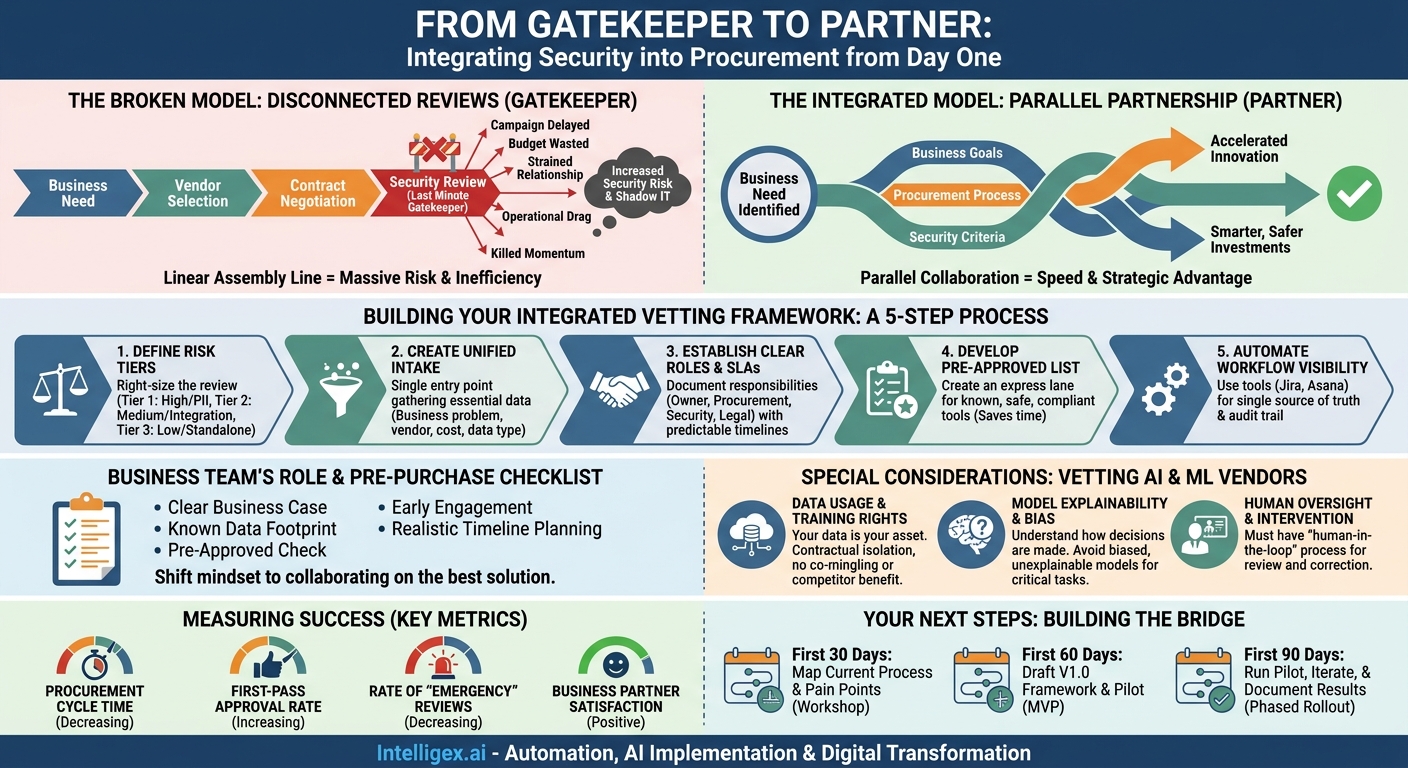
It’s a scenario that plays out in businesses every day. The marketing team is two weeks from launching a major campaign, built entirely around a powerful new customer engagement platform. The contract is ready for signature. Then, the CISO’s office gets wind of it. A frantic, last-minute security review reveals the vendor’s data handling practices violate company policy and multiple privacy regulations. The tool is blocked. The campaign is delayed, the budget is wasted, and the relationship between marketing, procurement, and security is strained. Everyone loses.
This isn’t a failure of security or a reckless business team. It’s a failure of process. When procurement and security operate in separate silos, they create a gauntlet of sequential, often contradictory, reviews that kill business agility. The traditional model, where a tool is selected, negotiated, and then tossed over the wall to security for a final pass-fail judgment, is broken. It treats security as a gatekeeper, not a partner, and it introduces massive risk and inefficiency at the worst possible moment: the finish line.
The solution is to stop thinking of these functions as a linear assembly line. Instead, they must become a parallel, integrated partnership that begins the moment a business need is identified. By weaving security criteria into the procurement process from the very start, you can eliminate last-minute surprises, accelerate innovation, and make smarter, safer technology investments.
The True Cost of Disconnected Reviews
The pain of a last-minute vendor block is felt far beyond the delayed project. This process breakdown creates cascading negative impacts across the organization, affecting everything from budgets and timelines to employee morale and competitive positioning.
Operational Drag and Wasted Resources
When a vendor is rejected late in the game, the hours already spent by the business team, procurement, and legal are lost forever. The team must then restart the entire evaluation process, doubling the workload. This isn’t just about soft costs. It’s about tangible, expensive person-hours being thrown away. Furthermore, rushed reviews, when a project is “too important to fail,” are often superficial. To compensate, security teams may demand expensive mitigating controls or professional services, bloating the total cost of ownership for a tool that was never the right fit to begin with.
Killed Momentum and Competitive Disadvantage
Speed is a currency. In today’s market, the ability to quickly adopt new technology to engage customers, optimize supply chains, or empower employees is a significant competitive advantage. A cumbersome, sequential vetting process acts as a brake on the entire organization. When a sales team can’t deploy a new enablement tool in time for the quarterly push, or when finance has to delay an automation project, the business misses windows of opportunity. The “cost of delay” can be far greater than the cost of the software itself.
Increased Security Risk and Shadow IT
Ironically, a process designed to improve security can often weaken it. When the official procurement channel is perceived as a bureaucratic black hole, business teams will find ways around it. They sign up for “free trials” with company data, use personal credit cards for “minor” software purchases, and create a sprawling, invisible ecosystem of unsanctioned tools known as Shadow IT. This shadow infrastructure has no security oversight, no data governance, and no integration with company identity systems, creating a massive and unmanaged attack surface.
Building Your Integrated Vetting Framework: A 5-Step Process
Shifting from a serial to a parallel vetting process requires a deliberate framework that aligns teams, clarifies responsibilities, and provides transparency. It’s not about adding more red tape. It’s about creating a smarter, more efficient pathway for technology adoption. Here is a practical, step-by-step approach to get started.
- Define Risk Tiers for Vendors and Software
Not all software purchases carry the same level of risk. A graphic design tool that never touches customer data is fundamentally different from a new HR platform that will store employee PII. Create a simple risk-tiering system to right-size the review process. For example:- Tier 1 (High Risk): Systems that process or store sensitive data like PII, financial information (PCI), or protected health information (PHI). These require a full, in-depth security and compliance review.
- Tier 2 (Medium Risk): Applications that integrate with core business systems (like your CRM or ERP) but do not handle highly sensitive data. These need a standard security review focusing on integration points and data access.
- Tier 3 (Low Risk): Standalone tools with no access to sensitive company or customer data. These can often be fast-tracked with a lightweight checklist review.
- Create a Unified Intake and Triage System
The process should start with a single point of entry. A unified intake form, whether it’s in a service desk portal or a simple shared document, is the foundation. This form should gather essential information for all stakeholders at once. It should ask questions that help automatically determine the risk tier. Key fields should include: the business problem being solved, the proposed vendor, the number of users, the estimated cost, and, most importantly, questions about data. For example: “What type of data will this system access or store?” and “Will this system integrate with any of our existing platforms?” - Establish Clear Roles and Service Level Agreements (SLAs)
Ambiguity is the enemy of speed. Clearly document who is responsible for what at each stage of the process. Define the roles of the Business Owner, Procurement Specialist, Security Analyst, and Legal Counsel. Then, attach predictable timelines (SLAs) to each risk tier. For example, a Tier 3 review might have an SLA of 3 business days, while a Tier 1 review for a critical system might be 15 business days. Publishing these SLAs manages expectations and allows business teams to plan their projects realistically. - Develop and Promote a Pre-Approved Vendor List
The fastest review is the one you don’t have to do. For common software categories like project management, video conferencing, or file sharing, create a “preferred” list of vendors that have already passed your security, legal, and procurement checks. This creates an express lane for business teams. It incentivizes them to choose tools that are already known to be safe and compliant, saving everyone time and effort. Make this list easily accessible and promote it internally. - Automate the Workflow for Visibility
You cannot manage what you cannot see. Use a workflow management tool to orchestrate the process. This doesn’t require a complex, expensive platform. A tool like Jira, Asana, or even a SharePoint list can be used to track a request from intake to final approval. This creates a single source of truth where the business owner can see the status of their request at any time, eliminating the need for constant follow-up emails and status meetings. It also provides an audit trail for compliance purposes.
How Business Teams Can Drive Success
An integrated process is a two-way street. While security and procurement must adapt, business teams also play a critical role in making the system work. By approaching technology acquisition as a strategic partner, you can dramatically accelerate the process and get the tools you need faster.
The goal is to shift the mindset from “getting my purchase approved” to “collaborating on the best solution for the company.” When you bring security and procurement into the conversation early, they can act as valuable advisors, helping you spot potential issues and even suggesting better, safer, or more cost-effective alternatives.
Pre-Purchase Checklist for Business Owners
Before you get attached to a specific product, run through this simple checklist. It will help you prepare for a smooth and successful review process.
- Business Case: Have I clearly defined the business problem I am trying to solve and the value this tool will provide?
- Data Footprint: Do I know exactly what kind of company or customer data this tool will need to access, process, or store?
- Pre-Approved Check: Have I checked our company’s list of pre-approved vendors to see if an existing tool can meet my needs?
- Early Engagement: Have I scheduled a brief, exploratory conversation with my contacts in IT security and procurement?
- Timeline Planning: Have I built a realistic timeline for my project that includes time for the procurement and security review process based on the data risk involved?
Thinking through these questions upfront demonstrates that you are a responsible partner and helps the review teams help you. Providing clear, complete information from the start is the single best way to prevent delays down the road.
Special Considerations for Vetting AI and ML Vendors
The rise of artificial intelligence introduces a new layer of complexity to vendor risk management. AI tools are not just static containers for data; they are active systems that learn from it. This requires asking a different, deeper set of questions during the vetting process.
Data Usage and Training Rights
This is the most critical question. Does the AI vendor use your company’s data to train their models for the benefit of other customers? Your proprietary business data is a strategic asset. The contract must be crystal clear that your data will be used only for your benefit and will not be co-mingled or used to improve the service for your competitors. Insist on contractual language that guarantees data isolation.
Model Explainability and Bias
For AI systems that make critical decisions, such as those used in hiring or credit scoring, you need to understand how they work. This is often referred to as “explainability” or “interpretability.” Can the vendor provide a reasonable explanation for why their model reached a particular conclusion? This is not just a technical concern; it’s a legal and ethical one. An unexplainable model could be making biased decisions, exposing your company to significant reputational and regulatory risk.
Human Oversight and Intervention
A fully autonomous AI system can be dangerous. The most robust and responsible AI implementations include a “human-in-the-loop.” This means there must be a clear process for a person to review, override, or correct the decisions made by the AI. When vetting a vendor, ask them to demonstrate how their platform facilitates this human oversight. A system with no off-ramp for human judgment is a system with a critical design flaw.
Measuring the Success of Your Integrated Process
How do you know if your new approach is working? To demonstrate value and justify continued investment in the process, you need to track a few key metrics. These metrics will show the impact on speed, efficiency, and the overall risk posture of the organization.
- Procurement Cycle Time: This is the gold standard. Measure the average time from when a new vendor request is submitted to when the contract is signed and the tool is approved for use. As your integrated process matures, this number should steadily decrease, especially for lower-risk tools.
- First-Pass Approval Rate: Track the percentage of vendors that make it through the entire process without being rejected. A low rate in your old process likely indicated that unsuitable vendors were being selected. A rising rate in your new process shows that you are successfully filtering out poor fits much earlier.
- Rate of “Emergency” Reviews: Log how many requests come in with an “urgent” or “emergency” flag. A key goal of an integrated process is to improve planning and eliminate last-minute fire drills. A significant reduction here proves the process is creating more predictable and manageable workflows.
- Business Partner Satisfaction: The ultimate test is whether the process is working for its primary customers: the business teams. Conduct simple, periodic surveys to gauge their perception of the process. Ask them to rate its clarity, predictability, and speed. Positive feedback is a powerful indicator of success.
Your Next Steps: Building the Bridge
Transforming a deeply ingrained, siloed process can seem daunting, but it can be achieved through an iterative, phased approach. You don’t need to boil the ocean. Start small, demonstrate value, and build momentum.
In the First 30 Days: Schedule a workshop with key leaders from procurement, security, legal, and a business unit that frequently procures new technology. The goal is simple: map the current, as-is process on a whiteboard. Identify the most obvious bottlenecks and points of friction. Gaining a shared understanding of the current pain is the first step toward designing a better future.
In the First 60 Days: Based on your workshop, draft a “version 1.0” of your risk tiers and your unified intake form. Don’t strive for perfection. Create a minimum viable product (MVP) for your process. Select a single, friendly department to pilot the new approach for their next software purchase. This allows you to test your assumptions in a low-risk environment.
In the First 90 Days: Run the pilot. Carefully observe how the process works in practice and solicit detailed feedback from everyone involved. What was confusing? Where did things get stuck? Use this feedback to iterate on your forms and workflows. At the end of the pilot, document the results, highlighting any improvements in cycle time or satisfaction. Share this success story to build support for a broader, phased rollout across the organization.
By taking these deliberate steps, you can begin to dismantle the silos between your teams and build a more agile, secure, and competitive enterprise. You can finally stop blocking innovation at the last minute and start enabling it from day one.
Your Next Read:
Get a FREE
Proof of Concept
& Consultation
No Cost, No Commitment!
