

The moment a candidate says “yes” is a moment of triumph for any HR professional or hiring manager. The search is over, the role is filled, and a promising new talent is about to join the team. But between that celebratory handshake (or email confirmation) and their first day at their desk, lies a critical and often underestimated journey: the document collection workflow. This period, frequently called “pre-boarding,” is far more than just administrative box-ticking. It is your company’s first real opportunity to prove that the organized, efficient, and welcoming culture you described in the interviews is a reality. A clunky, confusing, or paper-heavy process can sow seeds of doubt, while a streamlined, digital-first approach reinforces their decision and sets the stage for a successful start.
Getting this workflow right is a strategic imperative. It directly impacts the new hire experience, mitigates legal and compliance risks, and frees up your HR team from a mountain of manual follow-up. It ensures that Day 1 is about connection, learning, and integration—not about frantically filling out forms. Let’s break down this crucial workflow, phase by phase, to build a process that transforms administrative necessity into a powerful onboarding tool.
The Pre-boarding Bridge: Why This Period is Paramount
Think of the time between offer acceptance and the first day as a bridge. On one side is the candidate, full of excitement and anticipation. On the other is the fully integrated employee. A poorly constructed bridge is wobbly, full of gaps, and makes the journey stressful. A well-constructed one is smooth, secure, and builds confidence with every step. The document collection process is the very foundation of this bridge.
The Impact on the New Hire Experience
First impressions are indelible. A new hire who receives a flood of poorly formatted, difficult-to-understand PDFs attached to a generic email immediately feels like a number. Conversely, receiving a link to a clean, mobile-friendly online portal with a clear checklist and personalized welcome message signals professionalism and care. This initial administrative interaction sets the tone. It can either reduce first-day anxiety by making them feel prepared and organized, or amplify it by creating confusion and frustration before they’ve even started. A smooth process keeps their engagement high and significantly reduces the risk of them “ghosting” or accepting a counteroffer.
The Impact on HR and Operations
For the business, a streamlined workflow is a game-changer. It front-loads the administrative burden, ensuring all necessary legal and payroll information is collected and verified before the employee is on the clock. This is crucial for compliance, especially with time-sensitive documents like the Form I-9. When HR has the required information in advance, they can provision systems, prepare payroll, and coordinate with other departments like IT and Facilities. This means the new hire’s laptop, email address, and security badge are ready and waiting on Day 1, allowing them to be productive and feel like part of the team from the very first hour.
Deconstructing the Workflow: A Step-by-Step Guide
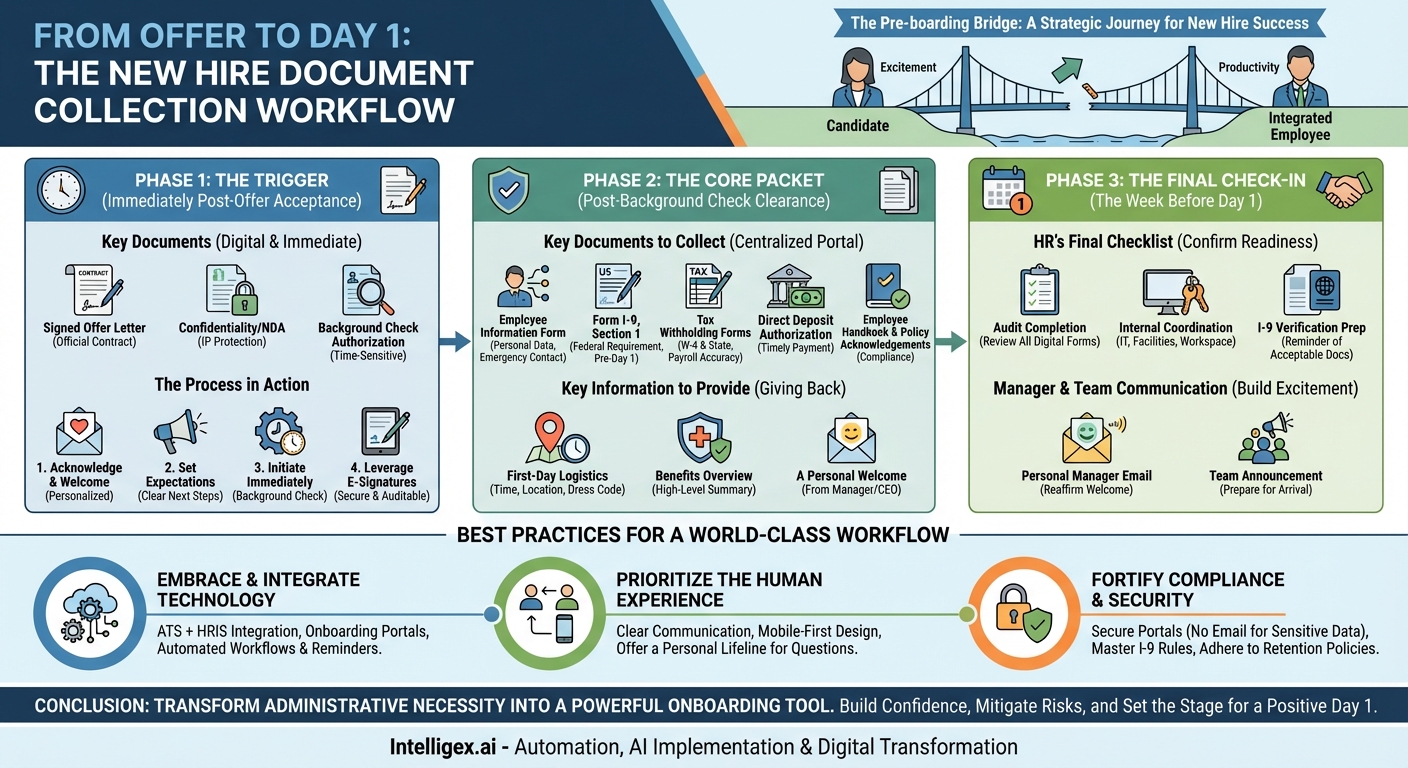
A successful document collection workflow is a logical sequence of events, triggered by specific milestones. While the exact documents may vary by location and industry, the foundational phases remain consistent. To help you visualize this entire process, from the signed offer to the first-day handshake, you can refer to our detailed workflow infographic which maps out each critical step.
Phase 1: The Trigger — Immediately Post-Offer Acceptance
This phase kicks off the second the candidate signs and returns their offer letter. Speed and clarity are your allies here.
- Key Documents: The first wave should be limited to the absolute essentials needed to formalize the agreement and begin necessary checks.
- Signed Offer Letter: This is the official contract and the starting pistol for the entire process.
- Confidentiality/Non-Disclosure Agreement (NDA): Often sent alongside the offer letter, this protects the company’s intellectual property from day zero.
- Background Check Authorization Form: This is time-sensitive. The background check can be the longest lead-time item in the pre-boarding process, so it’s critical to initiate it immediately upon receiving the candidate’s consent.
- The Process in Action:
- Acknowledge and Welcome: As soon as the signed offer lands in your inbox, send a warm, congratulatory email. This shouldn’t be an automated system notification. A personal touch goes a long way.
- Set Expectations: Clearly outline what happens next. A simple sentence like, “We are so excited to have you join us! Over the next few days, our HR team will send you a link to our onboarding portal to complete your new hire paperwork,” manages expectations and prevents confusion.
- Initiate Immediately: Upon receiving the signed authorization, submit the background check to your vendor.
- Leverage E-Signatures: This entire phase should be 100% digital. Using e-signature platforms like DocuSign or Adobe Sign not only expedites the process but also creates a secure, auditable trail.
Phase 2: The Core Packet — Post-Background Check Clearance
Once the background check comes back clear, you can move forward with collecting the core employment, payroll, and policy documents. Bombarding a new hire with these forms before the background check is complete can be premature and create unnecessary work if an issue arises.
- Key Documents to Collect:
- Employee Information Form: This collects basic personal data, legal name, address, and crucial emergency contact information.
- Form I-9, Section 1: Federal law requires the employee to complete Section 1 of the Form I-9 on or before their first day of employment. Providing it in advance gives them ample time to complete it accurately.
- Tax Withholding Forms (W-4 and State Equivalents): Essential for ensuring correct payroll processing from their very first paycheck.
- Direct Deposit Authorization Form: Collecting this now ensures a smooth and timely payment process.
- Employee Handbook & Policy Acknowledgements: Provide a digital copy of the handbook and require a digital signature acknowledging its receipt. This is a critical compliance step.
- Key Information to Provide: This isn’t just about taking; it’s also about giving.
- First-Day Logistics: Provide crystal-clear instructions. Include the start time, address (with parking details) or virtual meeting links, dress code, and who they should ask for upon arrival.
- Benefits Overview: Offer a high-level summary of benefits. Avoid overwhelming them with detailed plan documents, but give them enough information to start thinking about their choices.
- A Personal Welcome: Include a short welcome letter from their direct manager or the CEO.
- The Process in Action: The best practice is to bundle all of these items into a single, secure digital “welcome packet.” An HRIS or a dedicated onboarding portal is the ideal tool. It provides a centralized, user-friendly checklist for the new hire, reducing the cognitive load of tracking multiple email attachments. Provide clear instructions and a point of contact for any questions that arise.
Phase 3: The Final Check-In — The Week Before Day 1
This final phase is about tying up loose ends, confirming readiness, and building excitement for their arrival.
- HR’s Final Checklist:
- Audit Completion: Review the new hire’s file to ensure all digital forms have been submitted. Send friendly, automated reminders for any outstanding items.
- Internal Coordination: Confirm with IT that their laptop is configured and logins are created. Check with Facilities that their workspace is ready. Ensure the hiring manager has a first-week plan in place.
- I-9 Verification Prep: Remind the new hire of the acceptable documents they need to present for I-9 verification within their first three days of employment. This is a crucial, legally mandated step.
- Manager & Team Communication:
- The hiring manager should send a personal email a few days before the start date. This is incredibly impactful. A simple, “Hi [Name], the team and I are really looking forward to you joining us on Monday. We have your first day planned out and are excited to get you started!” makes a world of difference.
- Announce the new hire to the immediate team so they are prepared to welcome their new colleague.
Best Practices for a World-Class Workflow
Building a great process goes beyond just the steps. It’s about the principles and tools you use to execute it.
Embrace and Integrate Technology
Modern HR technology is the engine of an efficient workflow. An Applicant Tracking System (ATS) that integrates seamlessly with your Human Resources Information System (HRIS) is foundational. This integration allows candidate data to flow automatically, eliminating redundant data entry and reducing the risk of errors. Onboarding portals provide a single source of truth for new hires, presenting forms, information, and even introductory videos in a branded, intuitive interface. Finally, using automated workflows and reminders takes the burden of manual follow-up off your HR team, allowing them to focus on more strategic, human-centric aspects of onboarding.
Prioritize the Human Experience
Technology should enable, not replace, the human touch.
- Communicate with Clarity: Avoid HR jargon. Explain why a document is needed (e.g., “We need this W-4 form to ensure we withhold the correct amount of tax from your paycheck”).
- Be Mobile-First: A significant portion of your new hires will complete these forms on a smartphone. Your portal and forms must be responsive and easy to navigate on a small screen.
- Offer a Lifeline: Despite the best technology, questions will arise. Provide the name, email, and phone number of a real person who can help. A quick, friendly answer can turn a moment of frustration into a positive interaction.
Fortify Compliance and Security
The information you are collecting is highly sensitive. Security and compliance must be paramount.
- Never Use Email for Sensitive Data: Collecting Social Security numbers, bank account details, or I-9 documentation via unencrypted email is a major security risk. Always use a secure, encrypted portal.
- Master I-9 Compliance: The Form I-9 has strict timing and verification rules. Understand your obligations for both in-person and remote hires. Failure to comply can result in significant fines.
- Adhere to Retention Policies: Have a clear, legally-vetted policy for how long you must retain these documents and how they should be stored securely, both during and after employment.
Conclusion: From Paperwork to People-First
The HR document collection workflow is the first tangible experience a new employee has with your company’s internal processes. It’s a powerful opportunity to deliver on the promises made during the recruitment cycle. By moving away from disjointed, paper-based systems and embracing a thoughtful, technology-driven, and human-centric approach, you do more than just collect forms. You build confidence, demonstrate respect for the new hire’s time, mitigate critical compliance risks, and lay a solid foundation for a positive and productive Day 1. It’s time to audit your own process. Is it a bridge to success or a path fraught with administrative potholes? Crafting a workflow that truly welcomes your new talent is one of the most valuable investments you can make in their entire employee lifecycle.
Your Next Read:
Get a FREE
Proof of Concept
& Consultation
No Cost, No Commitment!
