

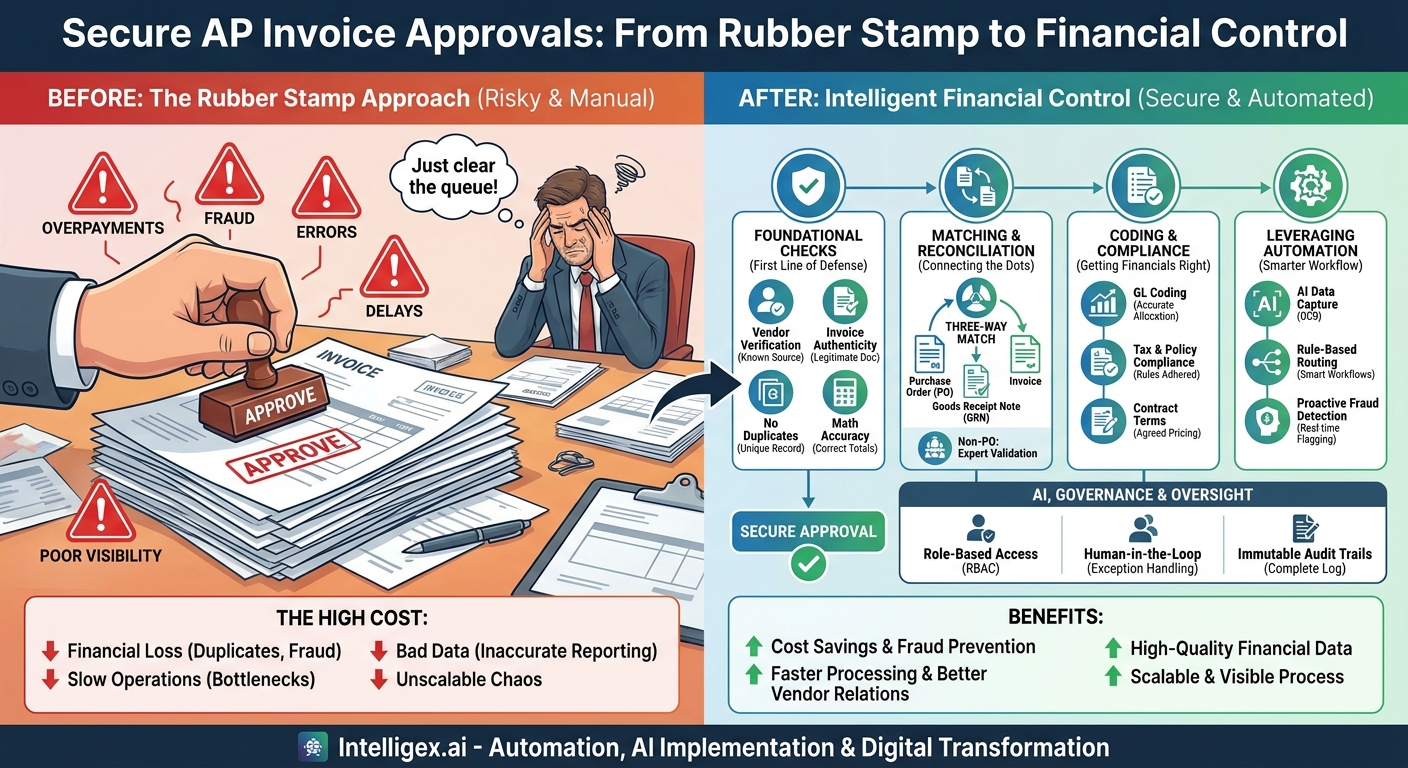
The “Approve” button on an invoice is one of the most powerful, and potentially riskiest, clicks in any business. It’s the final gateway before cash leaves the company. Yet, too often, this crucial step is treated as a rubber-stamp formality, rushed through by a busy manager trying to clear their queue. This seemingly small act, when done without proper diligence, opens the door to overpayments, fraud, and a cascade of financial reconciliation problems.
A robust accounts payable (AP) approval process isn’t about adding bureaucracy. It’s about embedding financial control directly into your daily operations. It’s a system of checks and balances that protects company assets, strengthens vendor relationships, and provides clear visibility into your financial obligations. Moving from a reactive, manual approval culture to a proactive, structured one delivers measurable improvements in speed, cost savings, and data quality. This guide provides a practical checklist to ensure every approval is a confident one.
The High Cost of a Flawed Approval Process
When the AP approval process breaks down, the consequences ripple across the organization. These are not just accounting headaches; they are real business problems with tangible costs. A weak approval framework directly undermines efficiency, visibility, and financial health.
Consider the impact on core business value:
- Cost Control: The most direct impact is financial loss. This includes paying duplicate invoices, paying for services that were never delivered, or falling victim to sophisticated invoice fraud. It also includes missed opportunities, like failing to capture early payment discounts because invoices are stuck in long approval queues.
- Operational Speed: Bottlenecks in the approval chain delay payments to critical suppliers. For a supply chain team, this can mean a delayed shipment of raw materials. For a marketing team, it could put a major campaign on hold. Slow payments strain vendor relationships and can damage your company’s reputation as a reliable partner.
- Data Quality and Accuracy: Every approved invoice feeds into your financial reporting. If an invoice is coded to the wrong department or general ledger (GL) account, your budget-to-actual reports become meaningless. This poor data quality makes accurate financial planning and forecasting nearly impossible.
- Visibility and Scalability: Without a standardized process, it’s difficult to know your true financial liabilities at any given moment. Where is an invoice in the approval process? Who is the current holdup? As the business grows, a manual, ad-hoc process simply cannot scale. The chaos only multiplies, increasing risk and inefficiency with every new hire and vendor.
Foundational Checks: The Non-Negotiables Before You Click ‘Approve’
Before you even begin to analyze the line items, every approver should perform a set of fundamental checks. Think of this as the first line of defense against common errors and fraud. These steps verify the legitimacy of the request itself, ensuring you are paying the right entity the right amount.
Your Initial Verification Checklist
- Vendor Verification: Is this invoice from a known, approved vendor? Cross-reference the vendor name and details against your official master vendor file. Be alert for slight variations in a name or address, which can be a red flag. A sudden, unexpected change in bank account information requires immediate verbal confirmation with a known contact at the vendor company.
- Invoice Authenticity: Does the document look professional and legitimate? Modern invoice fraud can be sophisticated, but many attempts are still caught by spotting inconsistencies. Look for a valid business logo, a sequential invoice number, a clear invoice date, and proper vendor contact information. An invoice that looks hastily assembled or lacks key details warrants extra scrutiny.
- Internal Consistency and Duplicates: Does the invoice number seem logical in sequence with previous invoices from this vendor? More importantly, is it a duplicate? Most modern accounting systems have built-in duplicate checks, but they aren’t foolproof. A manual check of payment history for the same invoice number or amount is a critical backstop.
- Mathematical Accuracy: It sounds basic, but errors happen. Quickly verify the arithmetic on the invoice. Do the quantities multiplied by the unit prices equal the line item totals? Do the subtotals, taxes, and shipping fees add up correctly to the final amount due? A simple spreadsheet error on the vendor’s side could cost you significantly.
Matching and Reconciliation: Connecting the Dots
Once you’ve confirmed an invoice is legitimate, the next step is to verify that your company should actually pay it. This involves matching the invoice against other internal documents to prove that you ordered, and received, the goods or services in question. This is the heart of internal financial control.
The Three-Way Match: The Gold Standard
The most rigorous method for invoice validation is the three-way match. It correlates three separate documents to create a single, verifiable record of a transaction. This process provides a very high degree of confidence that an invoice is valid and accurate.
- The Purchase Order (PO): First, compare the invoice to the original PO. This confirms the purchase was pre-authorized by the appropriate budget holder. You should verify that the item descriptions, quantities, and agreed-upon prices on the invoice match what was approved on the PO. Any discrepancy, such as a price increase, should be investigated immediately.
- The Goods Receipt Note (GRN): Next, confirm that the goods or services were actually delivered. This is done by matching the invoice to a GRN, a packing slip, or a signed proof of service document. For physical goods, this confirms that the quantity listed on the invoice matches the quantity that arrived at your warehouse or office. For services, this might be a project milestone sign-off.
- The Invoice: The invoice is the final piece of the puzzle. When its details align perfectly with both the PO (what you asked for) and the GRN (what you got), you can proceed with the approval. If there are discrepancies, the invoice should be put on hold and sent back to the purchasing department or vendor for clarification.
Handling Invoices Without a PO
Not every purchase will have a PO. Recurring expenses like utility bills, software subscriptions, or legal retainer fees often bypass the standard procurement process. These require a different, but equally disciplined, approval approach.
For these non-PO invoices, the approver’s responsibility is even greater. The key is to verify the legitimacy and business necessity of the charge. For example, when an IT manager receives a monthly cloud services bill from a provider like Amazon Web Services, they are responsible for confirming that the usage charges are in line with the department’s activity for that period. The approval is based on their expert validation of the service rendered, rather than a PO. A clear policy should define who is authorized to approve non-PO invoices up to a certain dollar amount.
Coding and Compliance: Getting the Financials Right
Approval isn’t just about paying the bill. It’s also about telling your financial system how to account for the expense. Proper coding is essential for accurate financial reporting, budgeting, and strategic decision-making. An error here can make departmental budgets inaccurate and obscure the true cost of a project or business unit.
Why GL Coding Matters
When an invoice is approved, it must be coded to the correct General Ledger account, department, and, if applicable, project. This ensures the expense is categorized correctly in your financial statements.
For example, a sales team purchases booth space for a trade show. If the invoice is incorrectly coded to “Travel and Entertainment” instead of “Marketing Events,” it distorts the budgets for both categories. The Marketing VP won’t have a clear picture of event ROI, and the company’s overall financial analysis will be flawed. The approver, who has the most context about the purchase, is in the best position to ensure this coding is correct before the transaction is posted.
Checking for Financial and Policy Compliance
Beyond coding, the approval step is the final check for compliance with both external regulations and internal policies.
- Tax Compliance: Are sales tax, VAT, or other relevant taxes calculated correctly and applied according to local regulations?
- Internal Spending Policies: Does the purchase comply with company policy? For example, does the approver have the necessary authority for an expense of this size? Was the purchase made from a preferred vendor?
- Contractual Terms: Does the invoice align with the terms negotiated in the vendor contract, including pricing, payment terms, and delivery schedules?
Leveraging Automation: A Smarter, Safer Approval Workflow
Performing these checks manually for every invoice is time-consuming, prone to human error, and doesn’t scale with business growth. This is where automation transforms the AP process from a clerical cost center into a streamlined, strategic function. By automating the repetitive, rule-based tasks, you free up your team to focus on exceptions and value-added analysis.
Modern AP automation platforms can execute many of these checklist items instantly and with greater accuracy:
- Automated Data Capture: Intelligent OCR (Optical Character Recognition) technology reads invoices as they arrive, extracting key information like vendor name, invoice number, date, and line-item details. This eliminates manual data entry and its associated errors.
- Automated Matching: The system can automatically perform two-way or three-way matching in seconds. It compares the extracted invoice data against PO and GRN records in your ERP. Invoices that match perfectly can be passed for payment automatically, while only the exceptions are flagged for human review.
- Intelligent, Rule-Based Workflows: You can configure rules to automatically route invoices to the correct approver based on factors like department, GL code, or dollar amount. For instance, invoices under $500 from the IT department can go directly to the IT Manager, while invoices over $10,000 might require sequential approval from the department head and the CFO.
- Proactive Fraud and Duplicate Detection: An automated system can flag potential issues in real-time. It can identify duplicate invoice numbers, amounts from the same vendor in a short period, or invoices from unapproved vendors, stopping fraudulent payments before they happen.
By automating these checks, you can track key performance metrics that demonstrate clear business value, such as a reduction in invoice processing time, an increase in the early payment discount capture rate, and a measurable decrease in payment errors.
AI, Governance, and Human Oversight
While automation and AI offer tremendous power to improve the AP process, they are tools to augment human judgment, not replace it. A successful implementation depends on a strong governance framework that ensures control, security, and accountability.
Role-Based Access Control (RBAC): A fundamental principle is that not everyone should have the same level of access. Your system must enforce a clear separation of duties. The person who enters a vendor into the system should not be the same person who approves their invoices or triggers their payment. RBAC ensures that users only have access to the functions and data necessary to perform their specific roles.
The Human in the Loop: No automated system is perfect. The process must include a “human in the loop” for handling exceptions. When the system cannot perform a match, a data field has a low confidence score, or a rule is violated, it must automatically flag the transaction and route it to a knowledgeable human for review and resolution. This ensures that complex or unusual situations receive the critical thinking they require.
Immutable Audit Trails: One of the most significant benefits of a digital workflow is the creation of a complete, unchangeable audit trail. Every action, from the moment an invoice is received to the moment it is paid, is logged with a user and a timestamp. This provides unparalleled visibility and makes preparing for internal or external audits simple and stress-free.
Your Next Steps: Building a Robust Approval Framework
Improving your AP approval process is an achievable goal that delivers immediate returns. It protects cash, improves efficiency, and provides the reliable financial data needed to run the business effectively. A deliberate, step-by-step approach is the best way to build a framework that lasts.
- Document Your Current Process: The first step is to understand what you do today. Map out the journey of an invoice from mailbox to payment. Identify every touchpoint, every handoff, and every approval. This exercise will quickly reveal the bottlenecks, redundancies, and areas of highest risk.
- Standardize and Formalize Your Policies: Create a clear, written AP approval policy. This document should define approval hierarchies, set spending limits for different roles, and mandate the requirements for POs and three-way matching. Make this policy easily accessible to everyone involved in the process.
- Clean Your Vendor Master Data: Your vendor file is the foundation of your AP process. A project to cleanse this data, by removing duplicate entries, deactivating old vendors, and verifying all contact and banking information, is one of the highest-impact improvements you can make.
- Explore Automation Strategically: You don’t have to automate everything at once. Investigate where technology can provide the biggest lift with the least disruption. Many companies start with automated data capture to eliminate manual entry before moving on to full-scale workflow automation and matching. By taking an incremental approach, you can build momentum and demonstrate value at each stage of your transformation.
Your Next Read:
Category:
Get a FREE
Proof of Concept
& Consultation
No Cost, No Commitment!
