

Returns are not a failure of a sale. They are an inevitable, and even valuable, part of the customer lifecycle. However, many organizations treat returns processing as a purely logistical problem confined to the warehouse. This siloed approach creates friction, inflates costs, and misses a crucial opportunity to gather business intelligence. A truly effective returns workflow is not a single department’s task, it is a cross-functional system that connects your supply chain, finance, customer service, and sales teams. When these teams operate from a shared process and a single source of truth, a return transforms from a costly headache into a driver of efficiency, customer loyalty, and strategic insight.
Breaking down these departmental walls requires a clear understanding of how a single returned product travels not just physically through your warehouse, but digitally through your business systems. It’s a journey that impacts inventory levels, financial statements, sales commissions, and future marketing campaigns. Optimizing this journey unlocks tangible value in speed, cost savings, and data quality across the entire organization.
The Anatomy of a Modern Returns Workflow
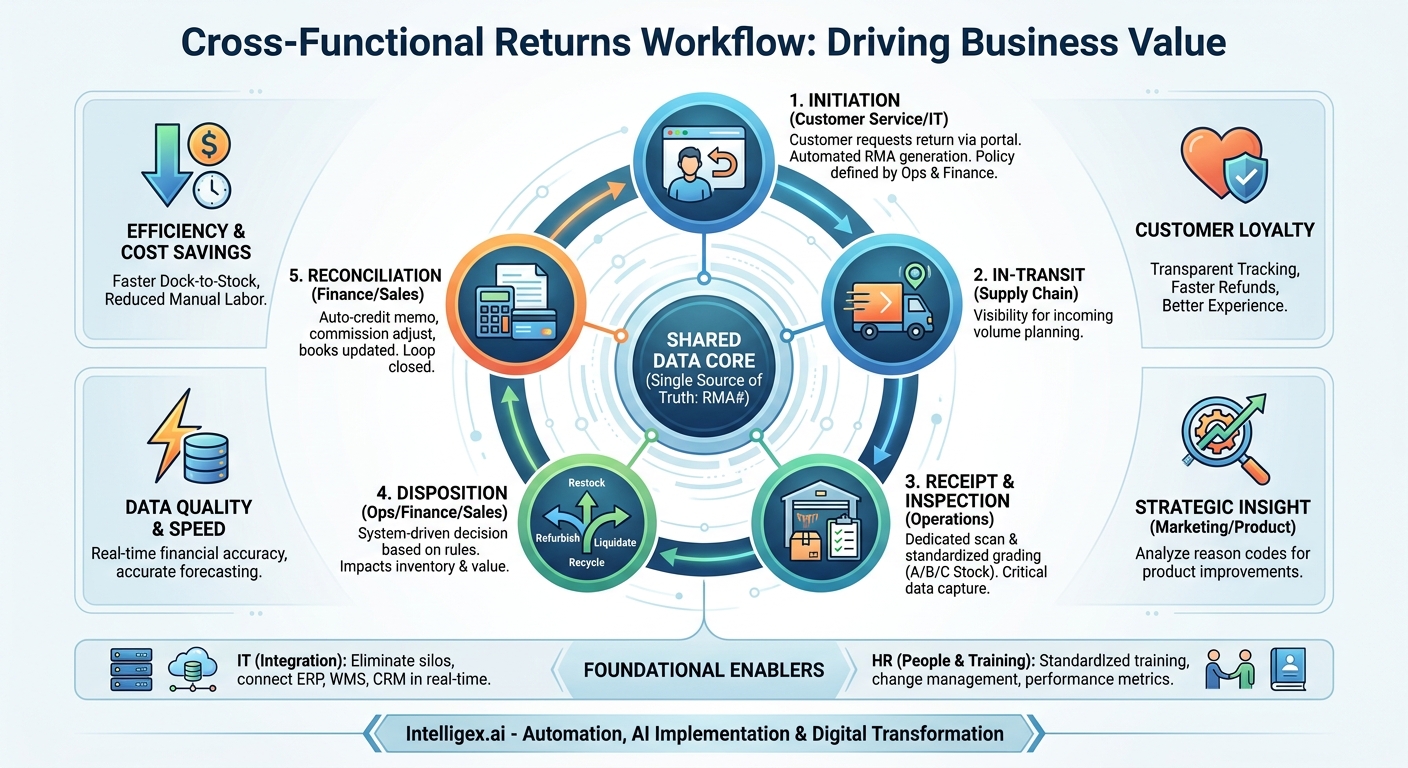
Before optimizing, we must first understand the interconnected stages of a return. Each stage presents a critical handoff between teams, and any delay or error at one point creates downstream problems for everyone else. Thinking of the process as a relay race, where the baton is a piece of data, helps illustrate the dependencies.
The typical journey involves five key phases:
- Initiation: The customer requests a return. This is the first touchpoint, owned by Customer Service but powered by IT’s self-service portals and policies defined by Operations and Finance.
- In-Transit: The product is physically on its way back. Supply Chain and Logistics teams need visibility to plan for incoming volume.
- Receipt and Inspection: The warehouse team receives the package, verifies its contents, and assesses its condition. This is a critical data-creation step that determines the product’s fate.
- Disposition: The decision is made based on the inspection. Will the item be restocked, refurbished, returned to the vendor, liquidated, or recycled? This decision directly impacts inventory and financial value.
- Reconciliation: Finance processes the refund or credit, Sales may adjust commissions, and inventory systems are updated. The loop is closed.
A breakdown in communication between these stages is where value erodes. If a warehouse team fails to accurately record the reason for a return, the marketing team cannot identify a product with a misleading description. If the finance department only receives a credit memo request weeks after a product is back on the shelf, your books are inaccurate. A unified workflow ensures the data baton is passed smoothly and accurately at every step.
Operations and Supply Chain: The Physical Flow
The warehouse floor is where the physical and digital worlds of a return collide. For operations and supply chain leaders, the goal is to process incoming items with speed and accuracy, minimizing the time an asset is in limbo. Every day a restockable item sits in a receiving bin is a day it cannot be sold. This process, often called reverse logistics, must be as disciplined as your outbound fulfillment process.
A well-defined receiving and disposition process is the bedrock of an efficient returns system. It provides the clean data that all other departments depend on.
A Step-by-Step Guide to Inbound Processing
- Automated RMA Generation: The process should begin with a system-generated Return Merchandise Authorization (RMA) number created when the customer initiates the return. This RMA should be the unique identifier for the return across all systems, from the customer service ticket to the warehouse scanner and the final credit memo in the ERP.
- Scanning at a Dedicated Receiving Station: Returned packages should not be mixed with general inbound inventory. A dedicated station where staff can scan the RMA on the shipping label immediately updates the item’s status to “Received.” This simple scan can trigger a notification to the customer, improving their experience, and alert the finance team that the refund process can soon begin.
- Guided Inspection and Grading: The inspection process should be standardized. Instead of relying on subjective judgment, use a system that prompts the inspector with specific questions. For a piece of apparel, it might be: “Is the item in its original packaging?” “Are tags attached?” “Any visible signs of wear?” The answers determine the item’s grade (e.g., A-Stock/New, B-Stock/Refurbish, C-Stock/Liquidate).
- System-Driven Disposition: Based on the grade, product type, and inventory levels, a pre-defined rule engine should recommend the disposition path. A high-demand, A-Stock item should be routed directly for restocking. A damaged electronic item might be routed to a technician for repair assessment. This removes guesswork and ensures business rules are followed consistently.
What to Measure in Operations
To manage it, you must measure it. Key metrics for the operations team include:
- Dock-to-Stock Time: The total time from when a returned item arrives at your facility to when it is available for sale again. A lower number means capital is not tied up in unproductive inventory.
- Inspection Accuracy: The percentage of items that are graded correctly during inspection. Inaccurate grading can lead to a worn item being sent to another customer or a perfectly good item being liquidated at a loss.
- Return Reason Code Accuracy: The consistency and correctness of the reason codes selected during processing. This data is vital for product and marketing teams.
Finance and Sales: Reconciling the Numbers
Once an item has been processed in the warehouse, the financial reconciliation process begins. For the finance team, a return is a reversal of a transaction that impacts revenue, taxes, and payment processing fees. For the sales team, it can affect commissions and forecasts. The speed and accuracy of the information flowing from the warehouse are paramount.
The primary challenge is the time lag. In a disjointed system, the finance team may wait for a weekly report or manual entry from the warehouse to issue a refund. This delay not only frustrates customers but also keeps your financial reporting out of sync with your physical inventory. An integrated system connects the “item received” event in the warehouse directly to the ERP, like those from SAP or Oracle, triggering the workflow for a credit memo automatically.
Real-World Scenarios
Consider the impact on different teams:
- Finance: When a return is processed, the system should automatically calculate the correct refund amount, including or excluding shipping and taxes based on company policy. It then creates a credit memo in the ERP, updates the general ledger, and adjusts the inventory asset value on the balance sheet. This automation reduces manual errors and ensures compliance.
- Sales: For B2B or commissioned sales, returns processing is especially complex. When a large order is returned, a connected system can automatically flag the original sale and place a hold on or reverse the associated commission payment. This prevents overpayments and provides a more accurate view of net sales for forecasting and performance analysis.
The business value of this integration is clear: faster refunds improve customer satisfaction, real-time data provides an accurate financial picture of the company, and automated workflows reduce the manual labor required from your accounting team, freeing them for more strategic tasks.
Customer Service and Marketing: Turning a Negative into a Positive
For customer-facing teams, a return is a critical moment of truth. A difficult or opaque returns process can permanently damage a customer relationship, while a smooth, transparent experience can actually build loyalty. Customer service agents should be empowered with information, not forced to hunt for it.
When a customer calls to ask, “Where is my refund?” the agent should be able to see the full timeline in their CRM, such as Salesforce. They should see the date the RMA was created, when the package was received at the warehouse, that it passed inspection, and that the refund was initiated by finance. This level of visibility turns a potentially negative interaction into a confidence-building one.
A Checklist for a Better Customer Return Experience
Here are key elements that customer service and marketing can champion, all powered by a connected backend process:
- A Self-Service Returns Portal: Allow customers to initiate returns, print labels, and track their status online without needing to contact an agent. This reduces service costs and meets modern customer expectations.
- Proactive Status Notifications: Use automated emails or SMS messages to inform the customer when their return has been received, processed, and when their refund has been issued. Transparency reduces anxiety and lowers inbound support requests.
- Actionable Data for Marketing: Return reason codes are not just operational data; they are direct customer feedback. Marketing and product teams should analyze this data to identify trends. Are many customers returning a new shoe because it “runs small”? That feedback can be used to update the product description online, reducing future returns and improving conversion rates. Is a specific product being returned for “damage in transit”? This can inform a conversation with the packaging and logistics teams.
IT and HR: The Foundational Enablers
A seamless returns workflow is built on a foundation of well-integrated technology and well-trained people. IT and HR are the crucial enablers that make the entire cross-functional process possible.
For the IT team, the primary goal is to eliminate data silos. The returns process touches multiple core systems: the e-commerce platform where the order originated, the Warehouse Management System (WMS) that manages physical inventory, the ERP that handles financials, and the CRM that manages the customer relationship. The role of IT is to ensure these systems can communicate in real time. The key is to establish the RMA number as the universal key that connects the return record across all platforms. This “single source of truth” prevents discrepancies, like an item showing as “in stock” in the e-commerce system when it’s actually sitting in a returns inspection bin.
For the HR team, the focus is on the human element of the process. A new system or workflow is only as good as the people using it. HR, in partnership with department leaders, is responsible for:
- Training and Standardization: Warehouse staff need clear, consistent training on how to inspect and grade products. Customer service agents need to be trained on the returns policy and how to use their new visibility tools to answer customer questions effectively.
- Change Management: Implementing a new cross-functional workflow requires changing old habits. HR can help lead the change management process, communicating the “why” behind the new system and ensuring all teams understand their role and the importance of their contribution.
- Performance Metrics: HR may also help define and track performance metrics tied to the returns process, such as inspection accuracy rates for warehouse staff or resolution times for customer service agents handling returns-related inquiries.
Integrating Intelligence: Where Automation Delivers Value
Once the foundational data flow is established, you can begin layering in more advanced automation and intelligence to further enhance speed and decision-making. This is not about futuristic AI, but about applying practical, rule-based logic to make your process smarter and more scalable.
The most immediate opportunity is in automated dispositioning. Instead of requiring a person to make a judgment call on every single returned item, you can configure a rules engine to handle the majority of cases. For example:
IF Product Category IS “Apparel” AND Return Reason IS “Wrong Size” AND Inspection Grade IS “A-Stock,” THEN Disposition IS “Restock Immediately.”
IF Product Category IS “Electronics” AND Return Reason IS “Defective,” THEN Disposition IS “Route to Technical Repair Bench.”
These rules ensure consistency, reduce the cognitive load on your staff, and dramatically accelerate the dock-to-stock time for eligible products. Another practical application is using historical data to forecast return volumes. By analyzing patterns, you can predict the surge in returns that will follow a major holiday sale, allowing you to proactively schedule staff and allocate warehouse space.
A Note on Safe and Governed Implementation
As you automate decisions and handle customer data, maintaining security and governance is critical. Your implementation plan should include safeguards. First, use role-based access control to ensure that employees can only see the data relevant to their jobs. A finance clerk does not need access to granular warehouse performance data. Second, all customer information must be handled securely to protect privacy. Finally, for any automated decision-making, start small. Implement rules for a single product category first, monitor the accuracy and business impact, and maintain a “human in the loop” to review exceptions or high-value items before scaling the automation across your entire operation.
Next Steps: Building Your Cross-Functional Returns Roadmap
Transforming your returns process from a cost center into a strategic asset is a journey of continuous improvement. It doesn’t require a massive, one-time overhaul. Instead, it starts with building a shared understanding and taking focused, incremental steps. Use this action plan to get started.
- Map Your Current State: Assemble a cross-functional team with representatives from Operations, Finance, Customer Service, IT, and Sales. Together, physically map out your entire returns process as it exists today, from the customer clicking “start a return” to the money being back in their account. Identify every manual step, system gap, and communication delay.
- Define Shared Success Metrics: Agree on a few key performance indicators (KPIs) that the entire team will be accountable for. Instead of each department having its own siloed metric, focus on end-to-end goals like “Total End-to-End Return Cycle Time” (customer shipment to refund complete) or “Net Recovery Value” (the value recovered from returned goods minus processing costs).
- Identify a Pilot Project: Don’t try to fix everything at once. Choose one major pain point from your process map and make it your pilot project. Perhaps it’s automating the generation of shipping labels or implementing a standardized digital inspection process for your highest-volume product. A quick win will build momentum and demonstrate value.
- Prioritize a Centralized Data Hub: Make it a long-term IT goal to work towards a single, unified view of a return that is accessible to all stakeholders. Whether this is in your ERP, a dedicated returns management platform, or a business intelligence dashboard, giving everyone access to the same real-time data is the single most powerful step you can take to eliminate friction and enable smarter, faster decisions.
By treating your returns workflow as the interconnected, cross-functional system it truly is, you can unlock significant efficiencies, reduce costs, and ultimately deliver a better experience for your customers.
Your Next Read:
Get a FREE
Proof of Concept
& Consultation
No Cost, No Commitment!
