

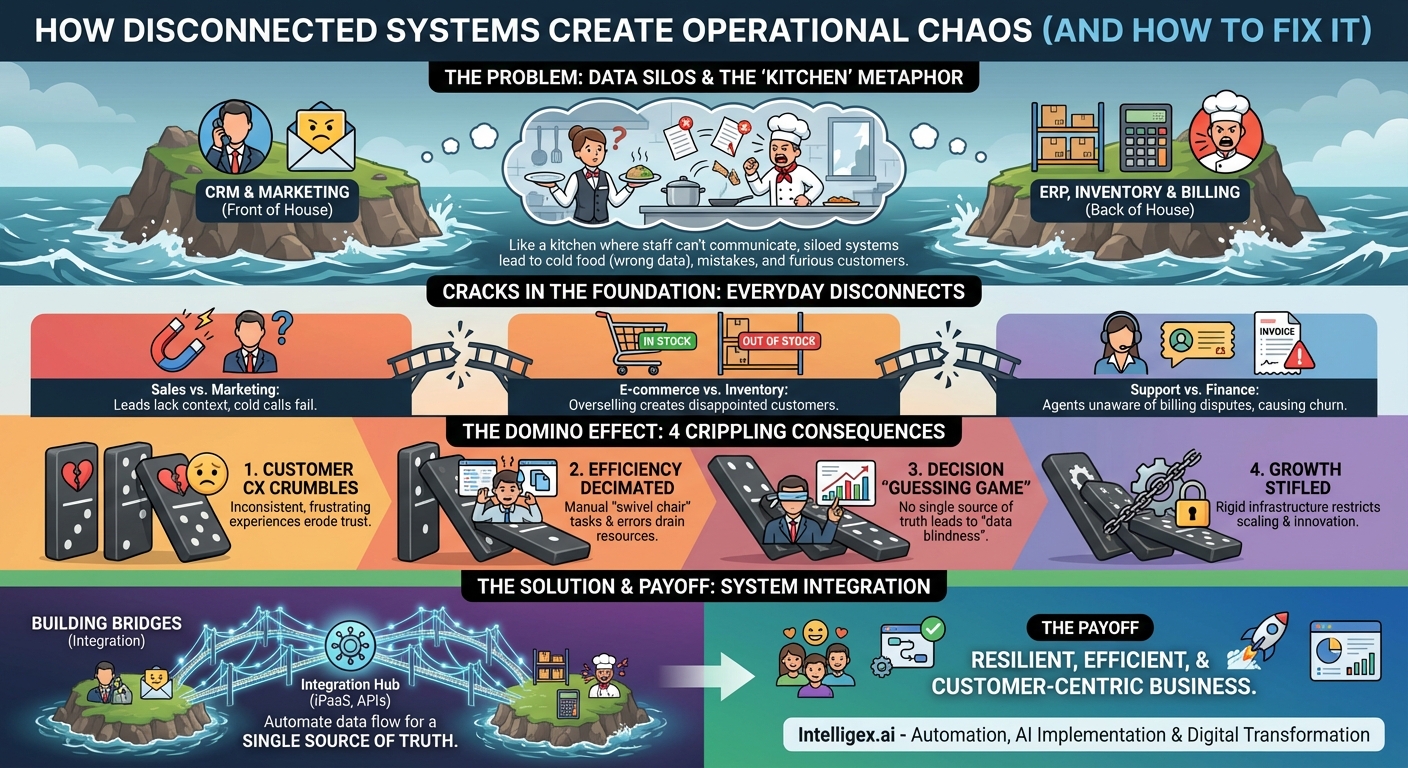
Imagine a world-class restaurant kitchen during the peak of dinner service. The head chef is barking orders, the line cooks are frantically plating, and the servers are rushing between tables. Now, imagine they can’t communicate. The server takes an order but can’t tell the kitchen. The kitchen prepares a dish but has no idea who it’s for. The sommelier recommends a wine pairing for a dish that’s already been 86’d. The result is pure chaos: cold food, wrong orders, and furious customers. This chaotic kitchen is a perfect metaphor for what happens inside many businesses today. Your “chefs,” “cooks,” and “servers” are your software systems—your CRM, your ERP, your marketing platform, your billing software—and when they don’t talk to each other, the result is the same operational chaos, just with data instead of dinner plates.
This breakdown in communication is a silent killer of efficiency, growth, and customer satisfaction. It operates under the surface, creating friction and frustration that many organizations mistake for “the cost of doing business.” But it’s not. It’s the direct result of a fragmented technological landscape, where individual applications operate in isolation. This phenomenon creates what are known as “data silos,” pockets of information that are locked within a single department or system, inaccessible to the rest of the organization. When your business is built on a foundation of these disconnected silos, every process becomes harder, slower, and more prone to error.
The Anatomy of a Disconnected Business
At its core, the problem isn’t that you have too many systems; it’s that these systems operate like independent islands in an archipelago. Each island has its own unique resources and information, but there are no bridges connecting them. To get information from one island to another, you have to send a messenger in a rowboat—a slow, manual, and unreliable process. In the business world, that “rowboat” is often an employee manually exporting a CSV file, copying and pasting data, or re-keying information from one screen to another.
Let’s look at some classic examples of these digital disconnects:
- Sales vs. Marketing: Your marketing automation platform, like HubSpot or Marketo, is a powerhouse for generating leads. It tracks every email open, every webinar attended, and every ebook downloaded. A lead finally reaches a “sales-qualified” score and is passed to the CRM, like Salesforce. But if the systems aren’t integrated, the salesperson just sees a name and an email. They have none of the rich contextual history. They don’t know the lead is a marketing director who has read three case studies about your enterprise solution. Instead, they call and launch into a generic introductory pitch, completely missing the opportunity to have a relevant, informed conversation. The warm lead is instantly cooled.
- E-commerce vs. Inventory: A customer visits your Shopify store and, seeing that a popular item is “in stock,” excitedly makes a purchase. They receive an order confirmation and eagerly await its arrival. What they don’t know is that your e-commerce platform doesn’t have a real-time connection to your warehouse inventory management system (ERP). The last physical unit was sold in a brick-and-mortar store an hour ago. Two days later, the customer receives a dreaded “order cancelled” email. You’ve not only lost a sale but have likely lost a customer for life and earned a negative review in the process.
- Customer Support vs. Finance: A long-time customer is having a technical issue with your product and submits a ticket to your support desk, powered by a tool like Zendesk. They are frustrated and on a deadline. The support agent, focused on resolving the technical issue, is unaware that this same customer has two overdue invoices in the billing system (e.g., QuickBooks). The agent spends 45 minutes troubleshooting, only for the customer to churn a week later over the unresolved billing dispute. A connected system would have flagged the billing issue for the agent, allowing them to bring in the right person or offer a more holistic solution, potentially saving the entire relationship.
These aren’t just minor inconveniences; they are cracks in your operational foundation. And as your business tries to grow, these cracks widen, threatening to destabilize the entire structure.
The Domino Effect: Four Crippling Consequences of System Disconnects
When your systems exist in isolation, the negative impacts cascade throughout the entire organization, creating a domino effect that topples efficiency, angers customers, and blinds leadership. It’s not a single problem but a chain reaction of failures.
1. The Customer Experience Crumbles
In today’s market, customer experience is the ultimate differentiator. Yet, disconnected systems make delivering a seamless experience nearly impossible. Customers don’t see your business as a collection of departments; they see it as a single entity. When they have to repeat their issue to three different agents, or when the marketing team sends them a “special offer” for a product they just bought at full price, it creates a jarring and frustrating experience. This inconsistency erodes trust. It tells the customer, “We don’t know you, and we don’t value your time.” A lack of a unified customer profile means personalization efforts fall flat, support is reactive instead of proactive, and every interaction feels transactional rather than relational. The end result is higher churn, lower lifetime value, and a damaged brand reputation.
2. Operational Efficiency Is Decimated
Perhaps the most immediate and tangible cost of disconnected systems is the immense drain on your internal resources. Your talented, highly-paid employees are forced to spend a significant portion of their day on low-value, manual tasks. Think of the finance team manually reconciling sales data from the CRM with payment data from Stripe, or the HR department re-entering new hire information into five different systems for payroll, benefits, and IT provisioning. This “swivel chair integration”—where an employee literally swivels between two monitors to copy and paste data—is not only mind-numbingly tedious but is also a breeding ground for human error. A single misplaced decimal or transposed digit can lead to costly mistakes in payroll, invoicing, or inventory counts. These manual workarounds create bottlenecks, delay critical processes like order fulfillment and financial reporting, and ultimately sap the morale of your team, who would rather be innovating than acting as human APIs.
3. Decision-Making Becomes a Guessing Game
How can you steer the ship if you can’t see the whole map? When data is scattered across a dozen disconnected systems, you have no single source of truth. The marketing team’s report on “new leads” might not match the sales team’s report on “new opportunities.” The finance team’s revenue numbers might not reconcile with the sales team’s bookings until weeks after the quarter ends. This creates what’s known as “data blindness.” Leaders are forced to make critical strategic decisions based on incomplete, outdated, or outright contradictory information. You can’t accurately calculate your customer acquisition cost if marketing spend and sales conversion data live in separate universes. You can’t forecast inventory needs if your sales pipeline data doesn’t connect to your supply chain data. In a data-driven world, running a business on siloed information is like trying to navigate a maze while blindfolded.
4. Growth and Innovation Are Stifled
Disconnected systems create a technological straitjacket that restricts a company’s ability to scale and adapt. Every new product you launch, every new market you enter, and every new regulation you need to comply with adds another layer of complexity to an already broken process. The manual workarounds that were manageable with 100 customers become completely unsustainable with 10,000. Onboarding a new, innovative piece of technology becomes a Herculean task because it has to be awkwardly bolted onto the existing fragmented infrastructure. Your teams are so busy putting out the fires caused by data inconsistencies and manual errors that they have no time or mental energy left for strategic thinking. Innovation dies in the trenches of operational inefficiency. The business becomes rigid and slow to react, unable to seize new opportunities or respond to competitive threats with the agility the modern market demands.
Building Bridges: The Power of System Integration
The solution to data silos and system fragmentation is, unsurprisingly, to build bridges between them. This process is called system integration. The goal of integration is to create a connected ecosystem where data can flow automatically, seamlessly, and in real-time between all of your critical applications. It’s about transforming your collection of isolated islands into a fully connected continent.
Achieving this doesn’t have to mean a multi-million dollar, multi-year IT project. Modern integration strategies offer a range of flexible options:
- Native Integrations: Many modern SaaS applications come with pre-built connectors for other popular tools. For example, your email marketing tool might have a one-click integration with your CRM. These are often easy to set up and are great for simple, point-to-point connections.
- APIs (Application Programming Interfaces): An API is essentially a set of rules and protocols that allows one piece of software to request and exchange data with another. They are the universal language of the modern web. Using APIs, developers can build custom connections to sync data and trigger workflows between almost any two systems.
- iPaaS (Integration Platform as a Service): For businesses that rely on numerous cloud applications, an iPaaS solution like Zapier, Workato, or MuleSoft is a game-changer. These platforms act as a central hub or “universal translator” that connects hundreds or even thousands of different applications. They provide user-friendly, low-code interfaces that allow even non-technical users to build powerful automated workflows (e.g., “When a customer’s subscription payment fails in our billing system, automatically create a high-priority ticket in our support desk and add the customer to a ‘dunning’ email sequence in our marketing platform.”).
By implementing a thoughtful integration strategy, you establish a “single source of truth” for your most critical data. A customer’s address is updated in one place—the CRM—and that change is automatically pushed to the billing, shipping, and marketing systems. Everyone is working from the same, accurate, up-to-date information.
The Payoff: A Resilient, Efficient, and Customer-Centric Business
When your systems finally start talking to each other, the transformation is profound. The domino effect of failure is replaced by a virtuous cycle of success. The fractured customer experience becomes a cohesive, personalized journey. The crippling operational inefficiencies are replaced by automated, streamlined workflows, freeing your team to focus on high-impact work. The flawed, gut-feel decisions are replaced by sharp, data-driven strategies based on a holistic view of the business. And the stifled, rigid organization becomes an agile, scalable enterprise ready for growth.
Take a moment to look at your own organization’s “kitchen.” Are your systems working together in a symphony of efficiency, or are they creating chaos and confusion? In an increasingly competitive digital landscape, having a connected technology stack is no longer a luxury or a competitive advantage—it is the fundamental price of entry for building a resilient, efficient, and truly customer-centric business.
Your Next Read:
Category:
Get a FREE
Proof of Concept
& Consultation
No Cost, No Commitment!