

In today’s hyper-connected digital landscape, system integration is no longer a luxury—it’s the central nervous system of a modern enterprise. It’s the invisible force that connects your CRM to your marketing automation platform, your ERP to your e-commerce site, and your custom applications to third-party services. When done right, integration creates a seamless flow of data, automates processes, and unlocks powerful business insights. But when done wrong, it can lead to a cascade of problems: data silos, broken workflows, budget overruns, and projects that ultimately fail to deliver on their promise.
The path to integration success is fraught with potential pitfalls. These aren’t just technical hurdles; they often involve strategy, people, and processes. Understanding these common mistakes is the first step toward avoiding them and building a robust, scalable, and resilient integration architecture. Let’s dive into the most frequent integration blunders and, more importantly, how you can sidestep them.
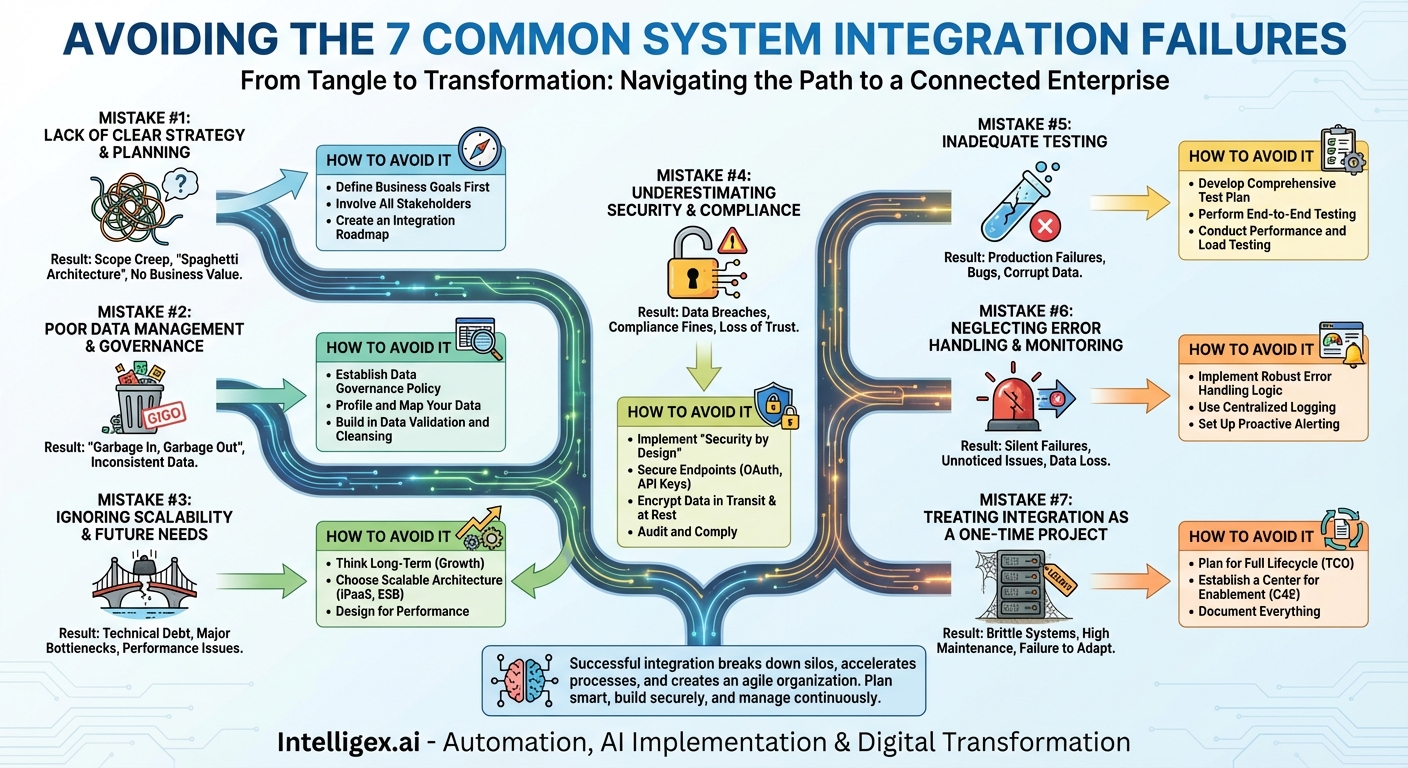
Mistake #1: Lack of a Clear Strategy and Planning
One of the most common reasons integration projects fail is jumping into the technical implementation without a solid strategic foundation. Teams get excited about connecting System A to System B, focusing on the “how” (APIs, connectors, code) before fully defining the “why.” This leads to scope creep, mismatched expectations, and integrations that solve a technical problem but fail to deliver real business value.
An integration is not just a technical task; it’s a business initiative. Without a clear roadmap, you’re navigating without a map. The end result is often a tangled mess of point-to-point connections that are brittle, difficult to maintain, and impossible to scale—a phenomenon often called “spaghetti architecture.”
How to Avoid It:
- Define Business Goals First: Before writing a single line of code, clearly articulate what you want to achieve. Are you trying to create a 360-degree customer view? Shorten the order-to-cash cycle? Improve inventory accuracy? Let the business objective drive the technical solution.
- Involve All Stakeholders: Integration impacts multiple departments. Bring together business users, IT teams, data analysts, and leadership from the very beginning to gather requirements and ensure alignment.
- Create an Integration Roadmap: Don’t try to boil the ocean. Prioritize your integration needs based on business impact and feasibility. Develop a phased roadmap that delivers value incrementally.
Mistake #2: Poor Data Management and Governance
At its core, integration is about moving and transforming data. If you neglect the quality and consistency of that data, you’re simply automating the spread of bad information. The old adage “Garbage In, Garbage Out” (GIGO) is doubly true for integrated systems. A customer record with an incorrect address in your CRM, when integrated, becomes an incorrect address in your shipping, billing, and marketing systems simultaneously.
Common data-related mistakes include inconsistent data formats (e.g., “USA” vs. “United States”), a lack of a “single source of truth” for key entities like customers or products, and failing to perform necessary data cleansing and transformation during the integration process.
How to Avoid It:
- Establish a Data Governance Policy: Define who owns which data, what constitutes “good” data, and which system serves as the master record for specific data entities.
- Profile and Map Your Data: Before you build, thoroughly analyze the data in the source and target systems. Create detailed data maps that specify how fields in one system correspond to fields in another, including any necessary transformations (e.g., converting date formats).
- Build in Data Validation and Cleansing: Your integration logic should include steps to validate data against predefined rules and cleanse it before it’s loaded into the target system. Reject or flag records that don’t meet quality standards.
Mistake #3: Ignoring Scalability and Future Needs
It’s tempting to build a solution that solves today’s problem perfectly. You create a quick, point-to-point integration that handles the current volume of 100 transactions per day. But what happens in six months when your business grows and that volume balloons to 10,000 transactions per day? The integration grinds to a halt, processes break, and the “quick fix” becomes a major bottleneck.
Building for the now without planning for the future is a recipe for technical debt. A solution that isn’t designed for scalability will require a costly and disruptive rewrite down the line, negating any short-term gains.
How to Avoid It:
- Think Long-Term: During the planning phase, consider future business growth, potential increases in data volume, and the possibility of adding more systems to the integration network.
- Choose Scalable Architecture Patterns: Avoid excessive point-to-point connections. Consider more scalable patterns like a hub-and-spoke model, an Enterprise Service Bus (ESB), or a modern Integration Platform as a Service (iPaaS) that can handle growing complexity and load.
- Design for Performance: Implement efficient data processing techniques, such as batching records, asynchronous processing, and proper API usage (e.g., using bulk APIs where available), to ensure the integration can handle increased throughput.
Mistake #4: Underestimating Security and Compliance
Integrations create new pathways for data to flow between systems, and each of these pathways is a potential attack vector. Treating security as an afterthought is one of the most dangerous mistakes you can make. A single unsecured API endpoint can expose sensitive customer data, proprietary business information, and create a backdoor into your corporate network.
Furthermore, many industries are subject to strict data privacy and residency regulations like GDPR, HIPAA, and CCPA. A non-compliant integration can result in hefty fines, reputational damage, and a loss of customer trust.
How to Avoid It:
- Implement a “Security by Design” Approach: Embed security considerations into every phase of the integration lifecycle, from initial design to deployment and maintenance.
- Secure Your Endpoints: Use strong authentication and authorization mechanisms (e.g., OAuth 2.0, API keys) to control who can access your data. Never expose an unprotected endpoint.
- Encrypt Data in Transit and at Rest: Use TLS/SSL to encrypt data as it travels between systems. Ensure sensitive data stored in intermediary databases or logs is also encrypted.
- Audit and Comply: Understand the compliance requirements for your industry and region. Ensure your integration architecture and data handling practices adhere to them, and maintain detailed logs for auditing purposes.
Mistake #5: Inadequate Testing
Development is complete, and the pressure is on to go live. In the rush to meet deadlines, testing is often compressed or, in the worst cases, skimmed over. Teams might perform simple unit tests to ensure a piece of code works in isolation but fail to conduct thorough end-to-end testing that validates the entire business process across multiple systems.
This is a critical error. An integration might work perfectly under ideal conditions in a lab but fail spectacularly in production when faced with unexpected data, network latency, or high transaction volumes. A lack of proper testing means your customers and end-users become your beta testers, discovering bugs that can corrupt data or halt critical business operations.
How to Avoid It:
- Develop a Comprehensive Test Plan: Your plan should cover more than just “happy path” scenarios. Include test cases for edge cases, invalid data, system failures, and connection timeouts.
- Perform End-to-End Testing: Simulate a complete business process from start to finish. For an e-commerce order, this means testing the flow from the web-cart, to the payment gateway, to the ERP, and finally to the shipping system.
- Conduct Performance and Load Testing: Don’t guess how your integration will perform under pressure. Use tools to simulate high volumes of data and concurrent users to identify and fix bottlenecks before you go live.
Mistake #6: Neglecting Error Handling and Monitoring
No system is perfect. APIs go down, networks become congested, and data formats unexpectedly change. An integration built on the assumption that everything will always work perfectly is an integration that is guaranteed to fail. Worse yet is a “silent failure,” where an integration stops working without notifying anyone. Orders stop syncing, customer records aren’t updated, and no one knows there’s a problem until a customer complains or a month-end report is wildly inaccurate.
Robust error handling and proactive monitoring are the immune system of your integration architecture. They allow you to detect, diagnose, and resolve issues before they have a significant business impact.
How to Avoid It:
- Implement Robust Error Handling Logic: Your integration should be ableto gracefully handle transient errors (e.g., network hiccups) with automated retry mechanisms. For permanent errors (e.g., invalid data), it should route the failed transaction to a dedicated queue or “dead letter” file for manual review.
- Use Centralized Logging: Aggregate logs from all components of your integration into a central system. This provides a single place to search and analyze activity, making troubleshooting dramatically faster.
– Set Up Proactive Alerting: Don’t wait for a user to report a problem. Configure alerts that automatically notify your support team via email, Slack, or a ticketing system when error rates exceed a certain threshold or a critical process fails.
Mistake #7: Treating Integration as a One-Time Project
Perhaps the most pervasive mistake is viewing integration as a project with a defined start and end date. The reality is that integration is an ongoing discipline, not a one-and-done task. The systems you connect are not static; they are constantly evolving. Cloud applications release new features and API versions, internal systems are patched and updated, and business requirements change.
An integration that is built and then forgotten will inevitably break. It becomes a piece of fragile, “legacy” technology the moment it’s deployed. This “set it and forget it” mindset leads to an ever-increasing maintenance burden and a system that can’t adapt to business needs.
How to Avoid It:
- Plan for the Full Lifecycle: Factor in the total cost of ownership (TCO), including ongoing maintenance, monitoring, and future updates, into your initial project budget and resource planning.
- Establish a Center for Enablement (C4E): For larger organizations, create a dedicated team or function responsible for setting best practices, providing reusable assets, and governing the integration landscape. This promotes consistency and quality.
– Document Everything: Maintain clear, up-to-date documentation for your integrations, including data maps, endpoint details, error handling procedures, and contact information for the system owners. This is invaluable when it comes time to troubleshoot or upgrade.
Successful integration is a powerful competitive advantage. It breaks down departmental silos, accelerates business processes, and creates a more agile and responsive organization. By understanding and proactively avoiding these common mistakes, you can move beyond simply connecting systems and begin building a truly integrated enterprise that is ready for the future.
Your Next Read:
Category:
Get a FREE
Proof of Concept
& Consultation
No Cost, No Commitment!
