

Automating a business process is easy. Automating it responsibly is hard. When an AI or an automated workflow makes a decision, who is accountable? What happens when it makes a mistake? Without a clear system of oversight, the speed you gain from automation can be quickly erased by the cost of correcting errors, dealing with compliance failures, or losing customer trust.
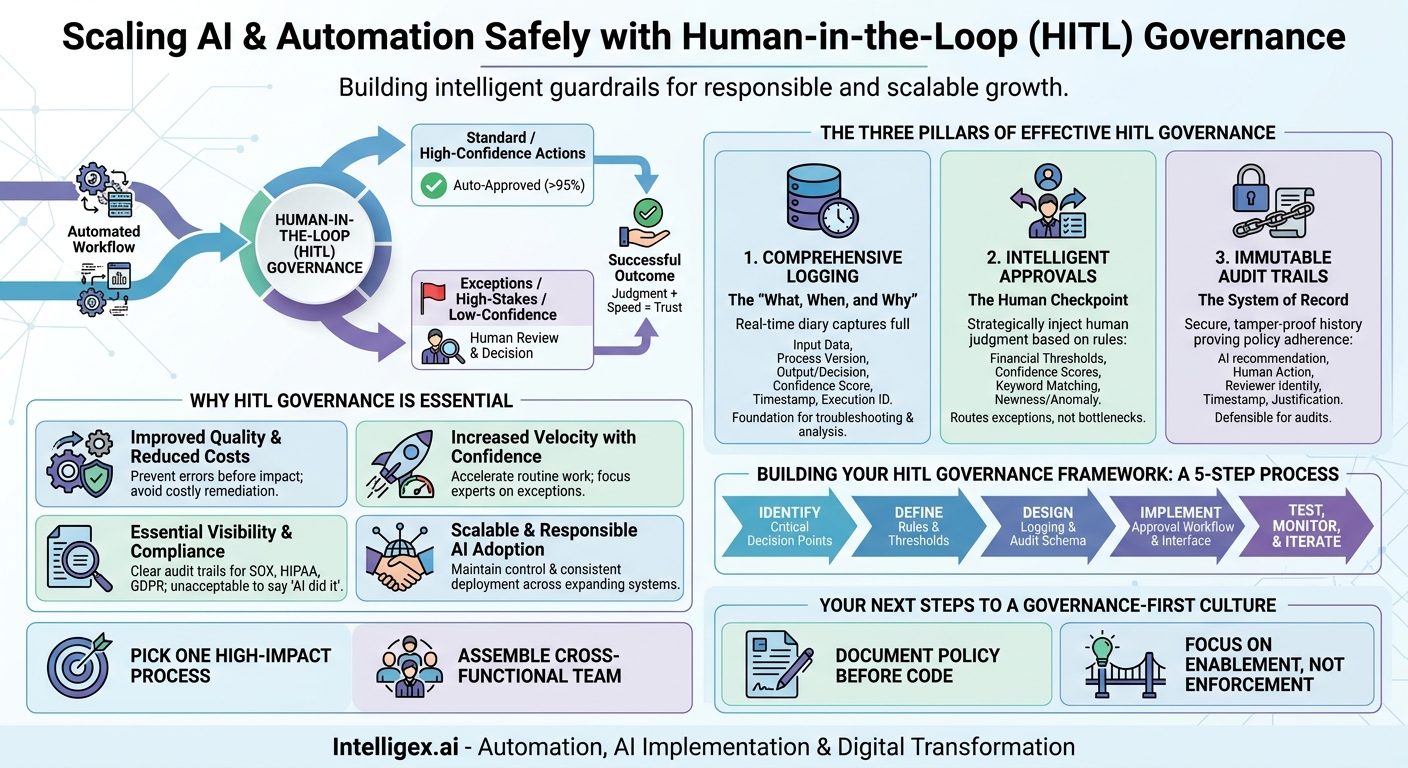
This is where Human-in-the-Loop (HITL) governance becomes essential. It’s not about slowing down automation; it’s about building intelligent guardrails that allow you to scale it safely. By implementing a robust framework of logging, approvals, and audit trails, you create a system that combines the speed of machines with the judgment of humans. This allows your teams to focus their expertise on the exceptions, the high-stakes decisions, and the complex scenarios that truly require their attention, while letting automation handle the rest.
Why HITL Governance Is No Longer a “Nice-to-Have”
Implementing governance might seem like adding bureaucracy, but in reality, it’s a strategic enabler for growth and stability. It directly impacts your bottom line by balancing speed with risk and providing the visibility necessary for modern business operations. The absence of a formal HITL governance structure is a significant, often hidden, source of operational risk.
Here’s the business value broken down:
- Improved Quality and Reduced Costs: It is always cheaper to prevent an error than to fix one. An HITL approval workflow for large financial transactions, for example, can prevent a mistaken automated payment that could take weeks to claw back. By catching deviations before they impact customers or financials, you maintain higher quality standards and avoid costly remediation.
- Increased Velocity with Confidence: When your teams trust the automation, they use it more. Governance provides that trust. It allows you to set clear rules, such as auto-approving 95% of standard requests while flagging the 5% of complex outliers. This lets you accelerate routine work without fearing the consequences of an unmonitored system.
- Essential Visibility and Compliance: When an auditor asks why a specific action was taken, “the AI did it” is not an acceptable answer. A clear audit trail shows exactly what happened, which automated process ran, what data it used, and who (if anyone) reviewed and approved the action. This is non-negotiable for regulations like SOX, HIPAA, or GDPR.
- Scalable and Responsible AI Adoption: You cannot responsibly scale AI and automation without a framework to manage it. HITL governance provides the structure to deploy new automated workflows consistently and safely. As you expand automation to more critical functions, this framework ensures you maintain control and visibility, regardless of scale.
The Three Pillars of Effective HITL Governance
A strong governance framework is built on three interconnected components. Each one serves a distinct purpose, and together they create a comprehensive system of record and control for all your automated processes.
1. Comprehensive Logging: The “What, When, and Why”
Logging is the foundation of visibility. It is the detailed, real-time diary of your automated systems. Effective logging goes far beyond simply recording that a process ran. It must capture the full context of each automated decision to be useful for troubleshooting, auditing, and performance analysis.
What to log for every automated action:
- Input Data: The exact data the AI or rule engine used to make its decision (e.g., the specific invoice data, the customer support ticket text).
- Process & Version: The name and version of the automation or AI model that ran (e.g., “InvoiceProcessor-v2.1”). This is crucial for tracking down issues related to specific model updates.
- Output & Decision: The result of the process (e.g., “Approved,” “Rejected,” “Flagged for Review”) and any generated data (e.g., the extracted invoice amount).
- Confidence Score: If using an AI model, log its confidence in the result. This is a key metric for setting up approval rules.
- Timestamp: An exact, time-zoned timestamp for when the event occurred.
- Execution ID: A unique identifier for that specific transaction, allowing you to trace its journey through the system.
For example, in a marketing automation workflow that uses AI to draft ad copy, a good log entry would contain the initial prompt, the version of the language model used, the generated copy, the AI’s confidence score, and the campaign it was assigned to.
2. Intelligent Approvals: The Human Checkpoint
Not every automated decision needs human oversight. The goal of an approval workflow is not to create a bottleneck, but to strategically inject human judgment where it adds the most value. This is achieved by creating rules and thresholds that automatically route exceptions to the right people.
The logic is simple: if a decision is low-risk and high-confidence, let it proceed automatically. If it’s high-risk or low-confidence, pause and ask a human. This approach is far more efficient than random spot-checks or approving everything.
Examples of intelligent approval triggers:
- Financial Thresholds: Auto-approve expense reports under $100, but require manager approval for anything over $1,000.
- Confidence Scores: In an AI-powered document processing system, automatically process documents where the AI’s data extraction confidence is above 95%. Flag any document below that threshold for a human to validate.
- Keyword Matching: In a contract review system, automatically approve contracts that use a standard template. Flag any document containing non-standard terms like “indemnity” or “exclusivity” for legal review.
- Newness or Anomaly: Auto-process payments to known vendors, but require manual verification for the first payment to any new vendor.
3. Immutable Audit Trails: The System of Record
While logs record what the system did, the audit trail records the complete lifecycle of a transaction, including the human interactions. It is the authoritative, chronological history that proves you are following your own governance policies. For compliance purposes, this trail must be secure and tamper-proof.
An audit trail answers key questions:
- What was the AI’s initial recommendation?
- Was it flagged for human review?
- Who was assigned the review?
- What action did they take (e.g., Approve, Reject, Edit)?
- When did they take that action?
- Did they provide a justification or comment for their decision?
For example, if an AI flags a potential duplicate invoice but an Accounts Payable clerk investigates and manually approves it as valid, the audit trail must record the AI’s initial flag, the clerk’s identity, the approval action, the timestamp, and the clerk’s note explaining why it wasn’t a duplicate. This creates a defensible record for financial audits.
Building Your HITL Governance Framework: A 5-Step Process
Putting a framework in place doesn’t require a massive, multi-year project. You can start with a single, high-value process and expand from there. By following a structured approach, you ensure that your governance model is practical, effective, and aligned with business needs.
- Identify Critical Decision Points: Start by mapping out one of your key automated workflows. Look for the specific points where a wrong decision could have a significant financial, operational, or reputational impact. Don’t try to govern everything at once. Focus on processes like payment approvals, customer data updates, or legal contract generation.
- Define Your Rules and Thresholds: For each critical decision point you identified, work with the business stakeholders to define the triggers for human review. What constitutes a “large” transaction? What is an acceptable AI confidence score? What keywords are considered high-risk? Document these rules clearly. This is the logic that will power your intelligent approval system.
- Design the Logging and Audit Schema: Determine exactly what data fields you need to capture. A good starting point is: UserID, Timestamp, ProcessName, ProcessVersion, ActionTaken, InputData, OutputData, ConfidenceScore, ReviewerID, ReviewerAction, and ReviewerJustification. Standardizing this schema allows you to build a consistent governance layer across multiple automated systems.
- Implement the Approval Workflow and Interface: Decide how exceptions will be managed. For simple cases, this could be an email or a Slack notification with approval buttons. For more complex needs, it could involve routing tickets in a system like ServiceNow or Jira, or building a simple review dashboard. The key is to make it easy for reviewers to see the context and take action quickly. I recommend exploring workflow tools like Microsoft Power Automate or enterprise platforms like ServiceNow to manage this routing.
- Test, Monitor, and Iterate: Your first set of rules won’t be perfect. Deploy your governance framework in a pilot phase and monitor the results. Are you flagging too many transactions, creating a bottleneck? Or are you flagging too few, letting errors slip through? Use the data you’re logging to analyze the performance and fine-tune your thresholds over time.
Putting Governance into Practice: Scenarios by Department
HITL governance isn’t just an IT or compliance concept. It has practical applications that deliver value to every part of the business.
Finance and Accounting
In automated invoice processing, an AI can extract data like vendor name, date, and amount. A governance rule could automatically pay invoices under $5,000 from known vendors. However, it would flag any invoice over that amount, or any invoice from a new vendor, for review by an AP clerk. This prevents both overpayments and fraudulent vendor payments.
Metric to measure: First-pass automation rate (percentage of invoices processed without human touch).
Human Resources
When using an AI tool for resume screening, the system can automatically shortlist candidates who meet the basic qualifications for a role. However, a HITL policy is crucial to mitigate bias. The rule should be that a human recruiter must review the AI-generated shortlist before any candidates are contacted. The audit trail would log which candidates the AI recommended and which ones the recruiter ultimately advanced, providing a record of the human oversight.
Metric to measure: Correlation between AI ranking and hiring manager satisfaction.
Sales and Legal
An automated system can generate a standard sales contract based on deal parameters from a CRM like Salesforce. A governance wrapper can then scan the document for any manual edits or non-standard clauses. If the document is 100% standard, it can be sent to the customer. If any deviations are detected, it is automatically routed to the legal team for approval, with the changes highlighted.
Metric to measure: Average contract approval time.
A Quick Checklist for Safe and Secure Implementation
As you build your governance framework, keep these critical security and privacy considerations in mind. A failure in these areas can undermine the entire system.
- Role-Based Access Control (RBAC): Who can see the logs? Who has the authority to approve a $50,000 payment versus a $500 one? Implement strict RBAC to ensure users can only see and act on the data relevant to their role.
- Data Privacy and Anonymization: Be mindful of logging sensitive data like Personally Identifiable Information (PII) or Protected Health Information (PHI). Ensure logs are stored securely, encrypted, and anonymized where possible to comply with regulations like GDPR.
- Immutability of Audit Trails: For an audit trail to be trustworthy, it must be tamper-proof. Use technologies like write-once storage or secure, append-only databases to ensure that log and audit entries cannot be altered or deleted after they are created.
- Alerting and SLAs: A flagged transaction is useless if no one acts on it. Set up automated alerts for pending approvals and define Service Level Agreements (SLAs) for review times to prevent bottlenecks.
- Data Retention Policies: Define how long you need to store logs and audit trails. This will be guided by both operational needs (e.g., troubleshooting) and legal requirements (e.g., financial record-keeping laws).
–
For organizations looking for a comprehensive methodology, the NIST AI Risk Management Framework provides an excellent, vendor-neutral guide for governing AI systems.
Your Next Steps to Building a Governance-First Culture
Implementing HITL governance is a journey, not a destination. The goal is to embed this thinking into how you design and deploy all automated systems. It’s a shift from “how can we automate this?” to “how can we automate this safely and transparently?”
Here’s how to get started:
- Pick One Process: Choose a single, high-impact workflow to be your pilot. A process involving financial transactions or customer data is often a great place to start.
- Assemble a Cross-Functional Team: Bring together the process owners from the business, a developer or IT lead, and a representative from your compliance or legal team. Governance is a team sport.
- Document the Policy: Before you write a single line of code, write the governance policy. Clearly document the rules, thresholds, roles, and escalation procedures.
- Focus on Enablement, Not Enforcement: Frame the initiative as a way to help the business move faster with confidence. Strong governance is what enables you to unlock the full potential of AI and automation, turning a powerful tool into a reliable, scalable, and trustworthy business asset.
Your Next Read:
Category:
Get a FREE
Proof of Concept
& Consultation
No Cost, No Commitment!