

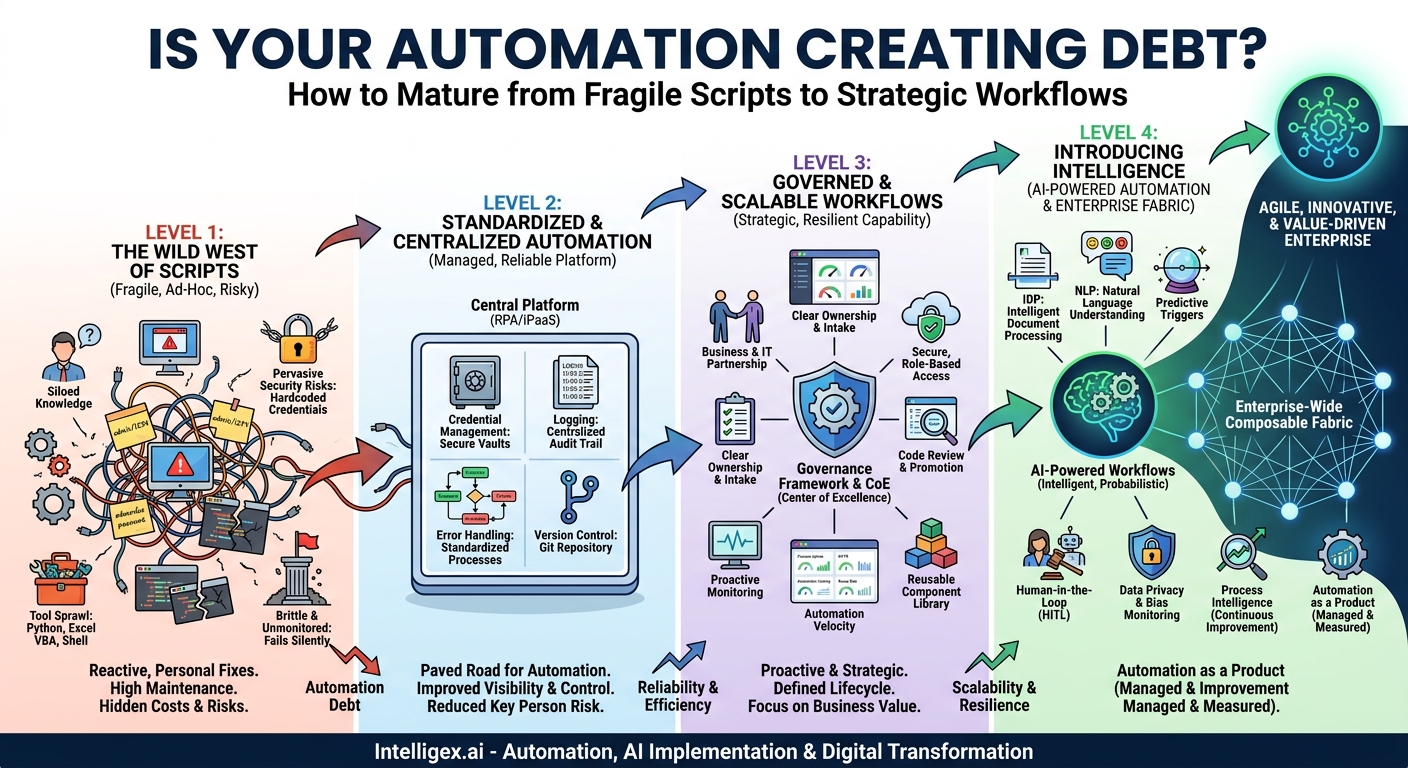
Your organization is probably already automating. The question is, are you doing it effectively? For many, automation looks like a patchwork of personal scripts, brittle macros, and disconnected tools. It’s a short-term fix that creates long-term “automation debt.” A finance analyst’s Excel macro breaks after a software update, an IT admin’s personal script is lost when they leave the company, and a marketing tool runs with hardcoded credentials, creating a security risk no one even knows about. This is the chaotic, reactive state of immature automation.
Moving beyond this stage isn’t about simply buying more tools. It’s about maturing your approach. It means transforming isolated, fragile scripts into a managed, reliable, and scalable system of governed workflows. This journey unlocks significant business value: not just cost savings, but improved speed, higher quality, end-to-end visibility, and the agility to adapt to change. This is the path from ad-hoc tasks to strategic, enterprise-wide capability.
Recognizing Level 1: The Wild West of Scripts
The first stage of automation maturity is often decentralized and invisible. It’s born out of necessity, with skilled individuals solving their own immediate problems. While their initiative is commendable, the result is a fragile ecosystem that cannot scale and introduces hidden risks.
Characteristics of Level 1 Automation
If you see the following signs, you are likely in the “Wild West” phase:
- Tool Sprawl: Automation happens in whatever tool is at hand. This could be Python scripts on a local machine, complex Excel VBA macros, or shell scripts for server tasks. There is no standard.
- Siloed Knowledge: The person who wrote the automation is the only one who understands it. There is no documentation, version control, or shared repository. If that person is on vacation or leaves the company, the process grinds to a halt.
- Brittle and Unmonitored: These scripts often lack basic error handling. They fail silently or produce incorrect outputs, and no one knows until a downstream process breaks. They are highly sensitive to small changes in user interfaces, file formats, or API calls.
- Pervasive Security Risks: Credentials, API keys, and passwords are often hardcoded directly into scripts and stored in plain text, making them a prime target for security breaches. There are no formal access controls or audit trails.
Real-World Examples
This level of automation is happening in every department:
- Finance: An analyst’s personal macro consolidates data from ten different spreadsheets for a weekly report. It works perfectly for them, but no one else can run it, and it breaks if a single column name changes.
- Marketing: A team member has a script that scrapes competitor pricing from a few websites and emails a summary. When a website redesigns its layout, the script fails without warning.
- IT Operations: A system administrator uses a set of personal shell scripts to restart services or clear logs. These scripts are not version-controlled and differ slightly from server to server, leading to inconsistent outcomes.
The hidden cost of this stage is significant. Teams spend more time firefighting and debugging broken scripts than they save from the automation itself. It creates a false sense of efficiency while accumulating technical and operational risk.
Moving to Level 2: Standardized and Centralized Automation
The first major leap in maturity is about bringing order to the chaos. The goal is not to stifle innovation but to provide a stable foundation that allows teams to automate more effectively and reliably. This phase is about creating a “paved road” for automation, guiding developers and citizen automators toward best practices.
The core principle is centralization. By moving from dozens of individual, unmanaged tools to a single, managed platform, you gain immediate visibility and control. This could be an enterprise-grade Robotic Process Automation (RPA) tool, an integration Platform as a Service (iPaaS), or a dedicated workflow orchestrator.
A Practical Plan to Reach Level 2
Transitioning from Level 1 to Level 2 requires a deliberate, step-by-step approach. You don’t need to do everything at once. Focus on building momentum with a few high-impact wins.
- Inventory Your Existing Automations: You can’t manage what you can’t see. Conduct a survey across departments to identify all existing scripts and macros. Ask teams what they are running, what it does, how often it runs, and how critical it is.
- Prioritize Based on Impact and Risk: Analyze your inventory. Identify automations that are business-critical, prone to failure, or pose a security risk. These are your top candidates for migration. A script that handles sensitive financial data is a higher priority than one that formats a weekly internal newsletter.
- Select a Central Automation Platform: Choose a platform that fits your needs. Consider factors like ease of use for your teams, integration capabilities with your core systems (like SAP or Salesforce), security features, and scalability.
- Establish Basic Standards: Define the “rules of the road.” This doesn’t need to be a 100-page document. Start with simple, essential standards:
- Credential Management: All secrets, keys, and passwords must be stored in a secure vault, not in code.
- Logging: Every automation must log its start, end, and any errors to a central location.
- Error Handling: Every automation must have a clear process for what to do when it fails (e.g., retry three times, then send a notification to a specific support channel).
- Version Control: All automation code must be stored in a central repository like Git.
- Migrate and Prove Value: Choose one or two high-priority automations for a pilot project. Rebuild them on the new platform according to your new standards. Document the improvements in reliability and the time saved on manual fixes. This success story will be your key to getting broader buy-in.
By achieving this level, you begin to realize tangible business value. Reliability increases because you have standardized error handling. Visibility improves because all workflows are running on a single platform with a central dashboard. And you dramatically reduce the “key person” risk that plagues Level 1 organizations.
Reaching Level 3: Governed and Scalable Workflows
This is the target state for most organizations. At this level, automation is no longer an ad-hoc activity but a well-defined, managed, and scalable business capability. Workflows are treated like first-class software assets, with clear ownership, a defined lifecycle, and robust governance that enables, rather than hinders, development.
The key shift is from a reactive, technical focus (fixing broken scripts) to a proactive, strategic one (building resilient, high-value processes). Automation is now a partnership between business and IT. A small, central team, often called a Center of Excellence (CoE), provides the platform, standards, and expertise, while business teams are empowered to identify opportunities and participate in the development process.
The Pillars of Strong Governance
Governance is not about bureaucracy. It’s about establishing a framework that ensures automations are built correctly, securely, and in alignment with business goals. It provides the guardrails that allow for distributed, “citizen-led” development without reintroducing chaos.
Use this short checklist to assess your governance model:
- Clear Ownership: Is there a named business owner and a technical owner for every automated process?
- Formal Intake Process: Is there a simple, documented way for business units to request a new automation and for the CoE to evaluate its feasibility and business value?
- Secure Credential Management: Are all secrets managed centrally through an enterprise-grade vault with role-based access?
- Code Review and Promotion: Is there a mandatory peer review process before any automation is deployed to production? Are there separate development, testing, and production environments?
- Monitoring and Maintenance Plan: Is there a proactive plan for monitoring the health of automations and a defined process for updates and maintenance?
- Reusable Components: Are you building a library of reusable components (e.g., a “Log In to SAP” module or a “Read from Google Sheet” function) to accelerate future development?
What to Measure at This Level
Once you have a governed system, you can start measuring what matters. Your metrics should shift from simple activity (number of bots) to business outcomes and operational excellence.
- Process Uptime/Success Rate: What percentage of automated workflow runs complete successfully without manual intervention?
- Mean Time to Resolution (MTTR): When an automation fails, how long does it take to identify, diagnose, and resolve the issue?
- Automation Velocity: How long does it take to move a new automation request from idea to production deployment?
- Reuse Rate: What percentage of new automations leverage pre-built, certified components from your library?
Introducing Intelligence: AI-Powered Automation
With a stable and governed foundation, you can begin to incorporate Artificial Intelligence (AI) to tackle a new class of problems. Mature automation is not just about moving data from A to B faster. It’s about making smarter decisions within those processes. This is the shift from purely deterministic, rules-based automation to probabilistic, AI-driven workflows.
Where AI Enhances Automation
AI is not a replacement for rules-based automation; it is a powerful extension of it. It excels at handling the variability and ambiguity of unstructured data and complex decision-making that would paralyze a traditional script.
- Intelligent Document Processing (IDP): While a traditional bot might fail if a field on an invoice moves by a few pixels, an IDP model can read and understand invoices, purchase orders, and contracts in various formats. Example: Accounts Payable can automate the entire invoice lifecycle, from ingestion and data extraction to three-way matching and payment approval, flagging only the exceptions for human review.
- Natural Language Processing (NLP): AI can understand the intent and sentiment within emails, support tickets, or survey responses. Example: A customer service workflow can use NLP to automatically read incoming support emails, categorize the issue (e.g., “Billing Inquiry,” “Technical Problem”), and route it to the correct team with the right priority.
- Predictive Triggers: Workflows can be initiated not by a fixed schedule, but by an AI model’s prediction. Example: A supply chain process can automatically trigger a purchase order when a predictive model forecasts that inventory for a critical part will fall below a safety threshold next week, preventing a stockout before it happens.
Safe and Responsible AI Implementation
Introducing AI adds a new layer of complexity and responsibility. Because AI models make predictions, not certainties, your governance framework must evolve to manage this. The goal is to build trust in the outcomes.
- Human-in-the-Loop (HITL): For high-stakes decisions, never allow a fully autonomous process. The AI should handle the clear-cut cases and flag ambiguous or low-confidence results for a human expert to review and approve. This combines the scale of AI with the judgment of a person.
- Data Privacy and Access Control: Ensure that AI models are trained and operated with strict adherence to data privacy principles. Use anonymized data for training whenever possible, and ensure the production workflow only has access to the minimum data required to function (the principle of least privilege).
- Monitoring for Drift and Bias: AI models are not static. Their performance can degrade over time as real-world data patterns change (a concept known as “model drift”). Implement continuous monitoring to track model accuracy and check for unintended bias in its decisions.
The Ultimate Goal: A Composable, Enterprise-Wide Fabric
The highest level of automation maturity is when automation ceases to be a separate, specialized discipline and becomes an integral part of how the organization operates. It is a composable fabric of technology, skills, and governance that enables rapid and resilient process innovation across the entire enterprise.
At this stage, the focus shifts from automating individual tasks to orchestrating complex, end-to-end value streams. The CoE’s role evolves from being the central “builder” to being the “enabler” of a federated ecosystem. They maintain the core platform, provide secure and pre-approved building blocks (like API connectors and reusable sub-processes), and empower business teams to assemble their own solutions within established guardrails.
Characteristics of a Mature Automation Fabric
- API-First Integration: Automation relies on stable, well-documented APIs instead of fragile UI-based screen scraping. This is a core principle supported by robust infrastructure, perhaps managed via a service like AWS or other cloud providers.
- Low-Code Empowerment: Business users and process owners can use visual, drag-and-drop tools to assemble their own workflows from a palette of governed, pre-built components. They can solve their own problems without waiting in a long IT queue.
- Process Intelligence is Standard: Tools like process mining are used proactively to analyze system logs, identify bottlenecks, and discover new opportunities for automation, creating a virtuous cycle of continuous improvement.
- Automation as a Product: Each automated workflow is managed like a product, with a dedicated owner, a roadmap for enhancements, and metrics that tie directly back to business KPIs.
Example: A sales operations manager needs to create a new process for handling high-value leads. Using a low-code platform, they assemble a workflow that: (1) receives a new lead from the marketing automation tool, (2) enriches the lead data using a pre-approved third-party service via a secure API connector, (3) scores the lead based on a central business rule engine, and (4) automatically assigns it to the right sales representative in the CRM and schedules a follow-up task. They built and deployed this in a single afternoon, all within the security and governance framework provided by IT.
Your Next Steps on the Maturity Journey
Advancing your organization’s automation maturity is a marathon, not a sprint. It’s a continuous journey of improvement that requires a clear vision and a practical, incremental approach. Wherever you are today, you can take deliberate steps to move forward.
1. Assess Your Current State
Be honest about where you are. Are you in the “Wild West,” with scripts scattered across the organization? Or have you started centralizing, but lack formal governance? Use the levels described here as a guide to identify your biggest gaps and opportunities. Interview teams and document the pain points caused by your current approach, such as time spent fixing broken processes or the risks of unmanaged scripts.
2. Build a Value-Driven Business Case
Don’t focus on technology. Focus on business value. Frame the initiative around solving tangible problems. Calculate the “cost of inaction,” including hours wasted on manual rework, the compliance risk of unaudited processes, and the opportunity cost of slow execution. A compelling business case connects maturation efforts to strategic goals like improving customer experience, increasing operational agility, or strengthening your risk posture.
3. Start Small, Prove Value, and Scale
Don’t try to boil the ocean by creating a massive, all-encompassing governance committee from day one. Select one high-impact, problematic business process. Re-engineer and automate it the “right way” on a modern platform with proper governance. Measure the before-and-after results in terms of speed, accuracy, and resilience. This initial success story will be your most powerful tool for securing the resources and buy-in needed to scale your efforts across the organization.
By taking these steps, you can begin the transformation from a chaotic collection of scripts to a strategic automation capability that delivers real, sustainable value to your business.
Your Next Read:
Category:
Get a FREE
Proof of Concept
& Consultation
No Cost, No Commitment!
