

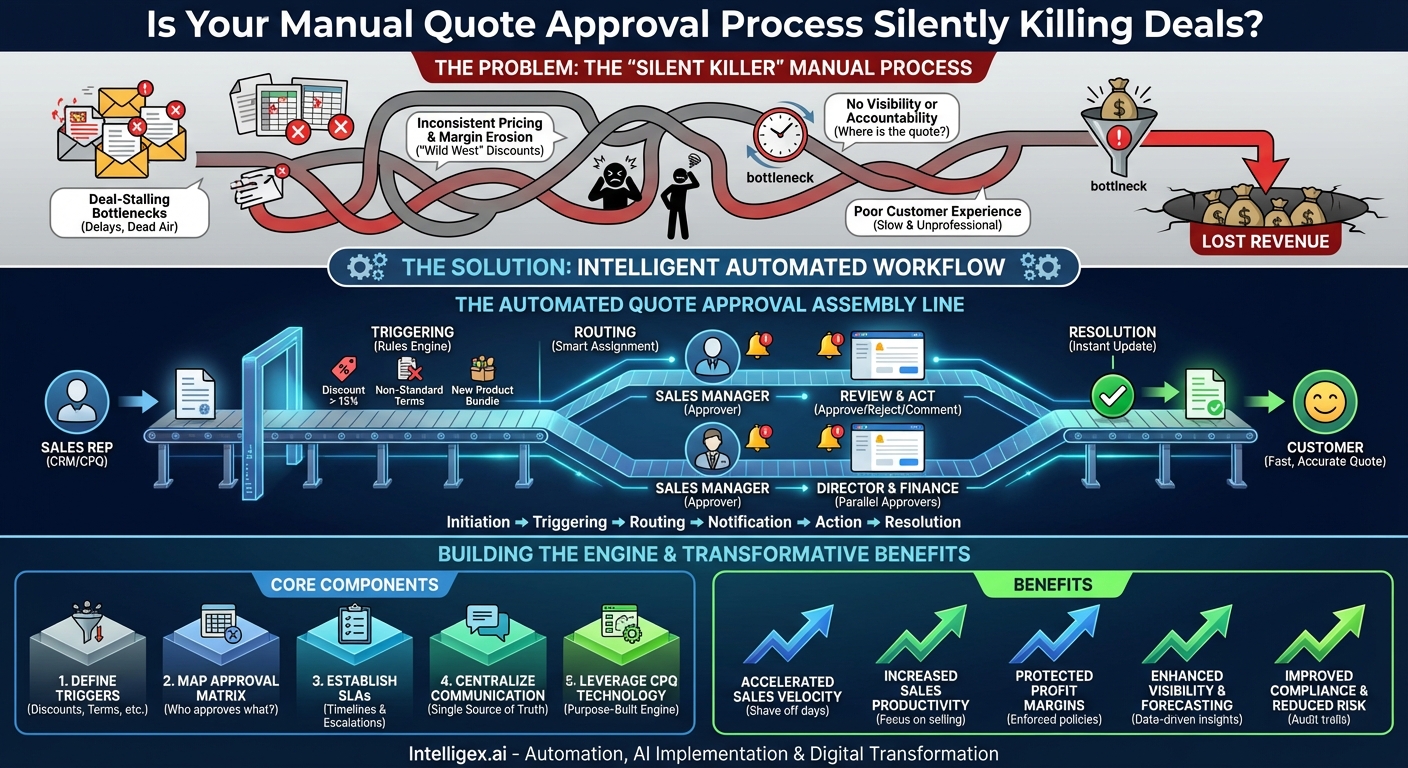
The final yard of the sales process can often feel like the longest. Your sales team has done the hard work: they’ve identified a prospect, nurtured the lead, demonstrated value, and built a compelling solution. The deal is on the verge of closing. All that’s left is sending the final quote. And then… silence. The deal grinds to a halt, stuck in an internal labyrinth of email chains, spreadsheet approvals, and follow-up requests. This final-mile friction, caused by a clunky and inefficient quote approval process, is one of the most significant—and preventable—bottlenecks in the modern sales cycle.
For too many organizations, the quote-to-cash process is a tangled web of manual handoffs. A sales rep creates a quote, often with a special discount to seal the deal, and emails it to their manager. The manager, buried in their inbox, might take a day to review it. If the discount exceeds their authority, they forward it to a regional director or a finance manager. Legal might need to weigh in on non-standard terms. Each step adds another layer of delay, another opportunity for miscommunication, and another point of failure. While your internal gears are slowly turning, your competitor is sending a polished, approved quote and winning the business. To accelerate revenue and empower your sales team, you must move beyond this manual chaos. The solution is a structured, automated quote approval workflow.
What Exactly is a Quote Approval Workflow?
A quote approval workflow is a predefined, automated set of rules and steps that a sales quote must pass through before it can be sent to a customer. It’s the digital equivalent of an assembly line for your pricing and proposals. Instead of relying on ad-hoc emails and manual tracking, a workflow system automatically routes a quote to the correct stakeholders based on specific criteria. Think of it as the central nervous system for your sales process, ensuring that every quote is accurate, profitable, and compliant without sacrificing speed.
This isn’t just about getting a “yes” or “no.” A robust workflow governs the entire process:
- Initiation: A sales rep generates a quote in a centralized system, like a CRM or a Configure, Price, Quote (CPQ) platform.
- Triggering: The system automatically analyzes the quote. Does it contain a discount over 15%? Does it include non-standard payment terms? Does it bundle products in a new way? These conditions act as triggers.
- Routing: Based on the triggers, the workflow automatically sends the quote to the designated approver(s). A 10% discount might go to the sales manager, while a 30% discount might require approval from both the sales director and the finance department simultaneously.
- Notification: Approvers are instantly notified via email, Slack, or within their primary work platform, with a direct link to review and act on the quote.
- Action: The approver can approve, reject, or request changes with comments, all within the same system. This entire history is logged against the deal record.
- Resolution: Once all approvals are secured, the sales rep is immediately notified, and the quote is unlocked, ready to be sent to the customer.
Why Your Manual Approval Process is a Silent Revenue Killer
If you’re still relying on email threads and shoulder taps for approvals, you’re likely bleeding revenue and efficiency in ways you may not even realize. The “way we’ve always done it” is actively harming your ability to compete and grow.
It Creates Deal-Stalling Bottlenecks
The single biggest killer of manual approvals is delay. A quote sitting in a manager’s inbox is a deal in limbo. The customer, who was excited and ready to buy, starts to cool off. This “dead air” creates uncertainty and opens the door for competitors to swoop in. When approvals require multiple people in a sequence, the problem is magnified. If one person is out of office or busy, the entire process grinds to a halt with no visibility for the anxious sales rep.
It Leads to Inconsistent Pricing and Margin Erosion
Without a structured system, discount governance becomes the “wild west.” Some managers are lenient, others are strict. Reps may “shop around” for the approver most likely to say yes. This leads to inconsistent pricing for customers and a steady erosion of your profit margins. A formal workflow enforces your business rules universally, ensuring that discounts are strategic tools, not just a default closing tactic.
It Lacks Visibility and Accountability
Where is the quote for the Acme Corp deal? Who has it? How long have they had it? With manual processes, these questions are nearly impossible to answer without a flurry of emails and messages. Sales reps are in the dark, and leadership has no way to identify systemic bottlenecks. An automated workflow provides a clear audit trail. You can see exactly where every quote is, who the current approver is, and how long each stage is taking, creating accountability across the board.
It Delivers a Poor Customer Experience
Imagine telling an eager customer, “I’ll get that quote over to you as soon as I can get it approved,” and then following up two days later. This projects an image of disorganization and inefficiency. Customers today expect speed and professionalism. A swift, accurate quote shows that you are organized, responsive, and easy to do business with, building trust from the very first transaction.
Building an Effective Quote Approval Workflow: The Core Components
Transitioning from a manual process to an automated workflow requires thoughtful design. It’s not just about buying software; it’s about defining the logic that governs your business. A well-built workflow is clear, logical, and designed for speed.
Step 1: Define Your Approval Triggers
First, determine what actually requires an approval. Not every quote needs to go through a multi-step process. The goal is to manage by exception. Common triggers include:
- Discount Thresholds: The most common trigger. You might have tiers, e.g., >10% requires a manager, >20% requires a director, >30% requires a VP and Finance.
- Non-Standard Terms: Any deviation from your standard legal T&Cs, payment terms (e.g., Net 90 instead of Net 30), or service level agreements (SLAs).
- Product-Specific Rules: High-value capital equipment or low-margin services might have stricter approval rules than standard software licenses.
- Geographical or Segment Rules: Quotes for new markets or specific industry verticals might require special oversight.
Step 2: Map Your Approval Matrix
Once you have your triggers, you need to map out who approves what. This is your approval matrix. It should be as simple as possible but as complex as necessary. Avoid long, sequential chains whenever possible. Instead, use parallel approvals where multiple people (e.g., Sales and Legal) can review and approve a quote simultaneously. Modern systems also allow for dynamic approvers, such as routing to the current deal owner’s direct manager, rather than a hard-coded name.
Step 3: Establish and Enforce SLAs
A workflow without a timeline is just a digital waiting room. For each step in the approval process, define a Service Level Agreement (SLA). How long does a manager have to respond? 2 hours? 8 business hours? A good workflow system will do more than just wait. It will automatically send reminders to the approver as the SLA deadline approaches and can even escalate the approval to their superior if the SLA is breached, ensuring no quote is ever forgotten.
Step 4: Centralize All Communication
Get the conversation out of email. When an approver requests a change, that comment and the subsequent discussion should happen directly within the quote record in your CRM or CPQ tool. This creates a single source of truth. Anyone looking at the deal can see the entire history of the negotiation and approval process, eliminating confusion and providing valuable context for the future.
Step 5: Leverage Technology—Especially CPQ
While you can build rudimentary workflows in some CRMs, this is the native territory of Configure, Price, Quote (CPQ) software. CPQ solutions are purpose-built to handle complex pricing rules, product configurations, and, most importantly, sophisticated approval workflows. They integrate seamlessly with your CRM, acting as the engine that powers a fast, accurate, and controlled quoting process.
The Transformative Benefits of an Optimized Workflow
Implementing a robust quote approval workflow isn’t just an operational tweak; it’s a strategic investment that pays dividends across the entire business.
Accelerated Sales Velocity: This is the headline benefit. By automating routing, notifications, and escalations, you can shave days, not just hours, off your sales cycle. Faster quotes mean faster revenue recognition and a more agile sales motion.
Increased Sales Productivity: Your sales reps are your most expensive resource. An automated workflow frees them from the administrative burden of chasing down approvals. Instead of playing internal project manager, they can spend their time on what they do best: selling. This not only makes them more productive but also significantly boosts morale.
Protected Profit Margins: By systematically enforcing discount policies, you regain control over your pricing strategy. The workflow acts as a guardrail, preventing unauthorized discounts and ensuring that profitability is considered in every single deal.
Enhanced Visibility and Forecasting: With a structured process, you gain invaluable data. You can identify which managers are approval bottlenecks, which products require the most discounting, and how long your average quote-to-approval cycle is. This data allows for continuous process improvement and more accurate sales forecasting.
Improved Compliance and Reduced Risk: For industries with strict regulatory requirements, a documented and enforceable approval workflow is essential. It ensures that all quotes are compliant with company policy and legal standards, providing a clear audit trail for every transaction.
In today’s competitive landscape, speed is a decisive advantage. The gap between a generated quote and a customer’s signature is where deals are won or lost. By untangling the knot of manual approvals and implementing a smart, automated workflow, you’re not just making an internal process more efficient. You are fundamentally re-engineering your sales cycle for speed, accuracy, and growth. You are empowering your reps to close deals faster, protecting your bottom line, and delivering the modern, professional experience your customers demand.
Your Next Read:
Get a FREE
Proof of Concept
& Consultation
No Cost, No Commitment!
