

Rapid growth is the dream for any ambitious company. The sales chart points up and to the right, new talent is walking through the door, and the market is buzzing about your brand. It’s an exhilarating, chaotic, and utterly transformative period. Yet, lurking just beneath the surface of this success is a silent threat that can stifle momentum, burn out your team, and frustrate your customers: the workflow bottleneck. What starts as a minor hiccup when you’re a team of five can quickly become a full-blown organizational crisis when you’re a team of fifty. These points of congestion in your business processes are the invisible friction holding your company back from its true potential. Understanding where they come from and, more importantly, how to systematically dismantle them is not just a matter of efficiency—it’s a matter of survival for a scaling company. This is about transforming growing pains into a sustainable competitive advantage.
The Silent Killer of Productivity: Understanding the Bottleneck
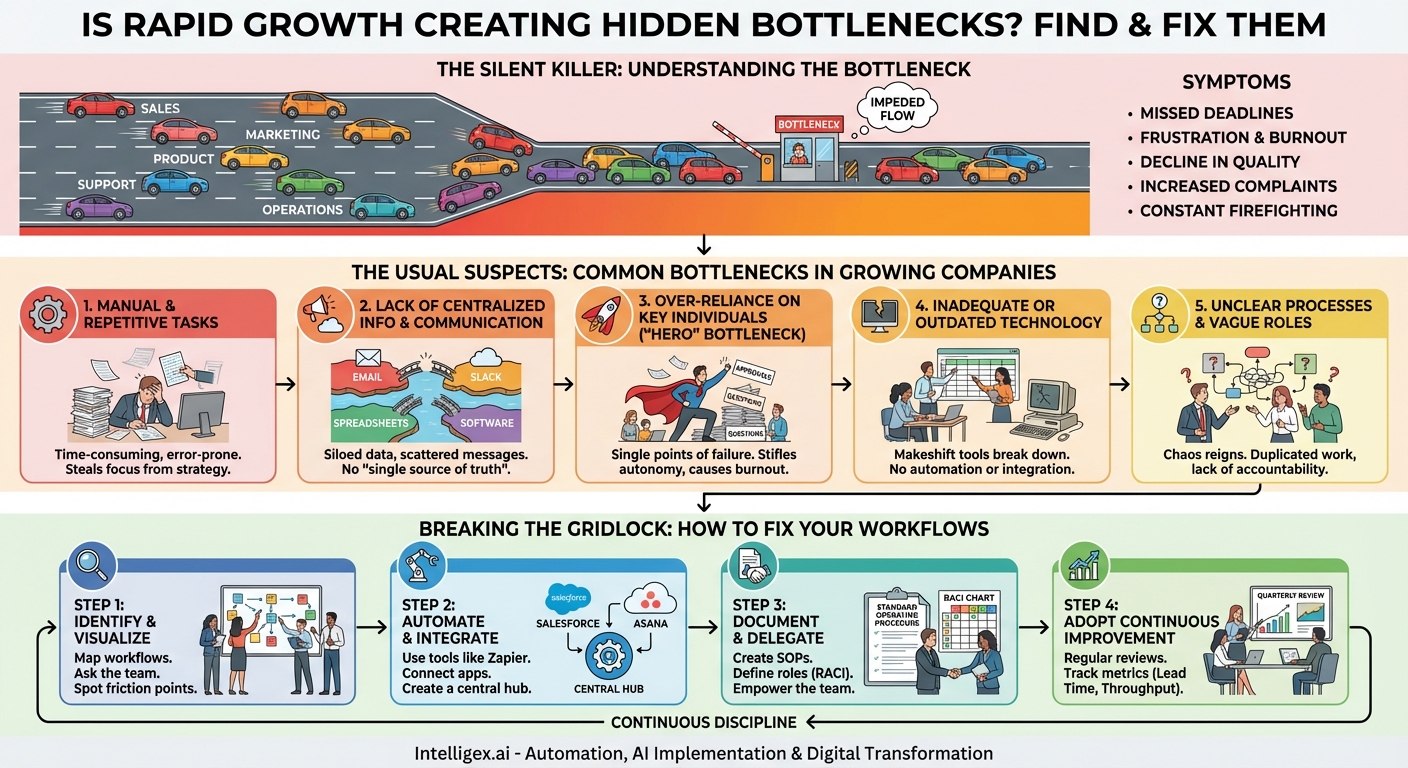
In its simplest form, a workflow bottleneck is a stage in a process where the flow of work is impeded, causing a backlog to build up behind it. Think of it like a five-lane highway suddenly merging into a single lane for a toll booth. No matter how fast cars travel before or after the booth, the overall speed of traffic is dictated by that single, constrained point. In a business context, this “toll booth” can be a person, a team, a piece of software, or an inefficient step in a process.
The symptoms are often mistaken for other problems. You might notice:
- Consistently missed deadlines, even with the team working overtime.
- A palpable sense of frustration and burnout among employees.
- A decline in the quality of work as people rush to keep up.
- Increasing client complaints about slow turnaround times.
- A feeling that the business is constantly “firefighting” rather than making strategic progress.
This isn’t just a temporary bad week; it’s a systemic issue. The concept is perfectly captured by the Theory of Constraints (TOC), which posits that any complex system has at least one constraint that limits its performance. In other words, your entire company’s output is limited by the capacity of its most significant bottleneck. To increase the output of the entire system, you must identify and improve that single “weakest link.” For a growing business, these links are constantly being tested, stretched, and broken under the increasing load.
The Usual Suspects: Common Bottlenecks in Growing Companies
While bottlenecks can be unique to each business, several common culprits emerge time and again as companies scale. These are the processes and habits that worked in the “scrappy startup” phase but become liabilities during the “scale-up” phase.
1. Manual and Repetitive Tasks
When a company is small, manual processes are manageable. The founder might personally draft every invoice, or the first marketing hire might manually post to social media channels. It’s quick, requires no investment in new tools, and it works. However, as the volume of work multiplies, these manual tasks become a crushing burden. The time spent on repetitive, low-value work grows exponentially, stealing focus from strategic initiatives that actually drive growth. This bottleneck isn’t just slow; it’s also incredibly prone to human error. A typo in an invoice, a missed data entry field, or a misconfigured report can have cascading consequences, leading to wasted time on corrections and potential damage to client relationships.
Example: A new e-commerce business experiences a surge in orders. The operations manager, who used to manually copy and paste shipping information from their online store into a courier’s portal, is now spending six hours a day just processing orders. They can’t keep up, shipments are delayed, and they have no time to negotiate better rates with new shipping partners.
2. Lack of Centralized Information and Communication
In the early days, communication is organic. Everyone sits in the same room, and information is shared freely. As the company expands—adding new departments, remote employees, and specialized roles—this informal system shatters. Information becomes siloed, trapped in different email inboxes, scattered across various Slack channels, buried in personal spreadsheets, and locked within departmental software that doesn’t talk to anything else. The search for a “single source of truth” becomes a time-consuming and often fruitless quest. Team members waste precious hours trying to find the latest version of a document or asking colleagues for information they should be able to access themselves. This leads to decisions being made on incomplete or outdated data, creating misalignment and rework across the entire organization.
Example: A sales team closes a complex deal and logs the details in their CRM. The implementation team, which uses a separate project management tool, receives an incomplete handover via email. They spend the first week of the project chasing the sales rep for crucial details, frustrating the new client and delaying the project kickoff.
3. Over-reliance on Key Individuals (The “Hero” Bottleneck)
Every company has its heroes—the go-to experts who hold a vast amount of institutional knowledge or have the sole authority to make certain decisions. While valuable, these individuals can easily become bottlenecks. When every marketing proposal has to be approved by the founder, or when only one senior engineer understands how to deploy code to the production server, the entire process grinds to a halt whenever that person is busy, sick, or on vacation. This “hero” model creates single points of failure that are simply not scalable. It stifles the growth and autonomy of other team members, who are forced to wait for approvals or answers instead of moving forward. It also puts immense pressure on the hero, leading to inevitable burnout.
Example: A creative agency has a highly talented Art Director who must personally review and approve every single design asset before it goes to a client. As the agency’s client roster grows, a massive backlog of unapproved work piles up on the Art Director’s desk, causing project delays and stressing out the entire design team.
4. Inadequate or Outdated Technology
The tech stack that served you well as a startup can quickly become a liability. Using a shared spreadsheet to manage a complex product roadmap or relying on a free version of a tool that lacks essential collaboration features creates immense friction. As complexity and volume increase, these makeshift solutions break down. They lack the ability to automate, provide clear visibility, integrate with other critical systems, or ensure data security. Teams spend more time fighting their tools than doing their actual work. The reluctance to invest in a scalable, professional-grade tech stack is often a false economy, as the hidden costs in lost productivity and inefficiency far outweigh the subscription fees for proper software.
Example: A customer support team is using a shared Gmail inbox to manage all incoming inquiries. As ticket volume explodes, emails get missed, two agents accidentally reply to the same customer, and there’s no way to track metrics like response time or resolution rate. The lack of a proper helpdesk system is leading to poor customer service and a chaotic support experience.
5. Unclear Processes and Vague Roles
The “all hands on deck” mentality is a hallmark of early-stage startups. Roles are fluid, and processes are invented on the fly. This flexibility is an asset initially, but it becomes a major bottleneck during growth. Without clearly defined processes and responsibilities, chaos reigns. How does a new feature idea go from concept to launch? Who is ultimately responsible for a project’s budget? What is the official review and approval cycle for a blog post? When these questions don’t have clear answers, work gets duplicated, tasks fall through the cracks, accountability is nonexistent, and teams spin their wheels in a cycle of confusion and frustration.
Example: A software company kicks off a new project. The product manager, designer, and lead engineer all have different ideas about the project scope and their respective responsibilities. Without a documented project kickoff process or a RACI (Responsible, Accountable, Consulted, Informed) chart, they spend the first two sprints debating the plan instead of building the product.
Breaking the Gridlock: How to Fix Your Workflows
Identifying bottlenecks is the first step, but the real work lies in systematically unclogging them. This isn’t about a single, magic-bullet solution but rather a continuous process of observation, adjustment, and improvement.
Step 1: Identify and Visualize
You cannot fix what you cannot see. The first action is to map your core workflows from start to finish. Use digital whiteboarding tools like Miro or Lucidchart, or even just sticky notes on a wall. Get the team involved in this process—they are on the front lines and know exactly where the friction points are. Ask them powerful questions: “What is the most frustrating part of your day?” or “If you could wave a magic wand and fix one step in this process, what would it be?” Visualizing the flow of work will make the bottlenecks glaringly obvious. Look for the places where work piles up or where handoffs are consistently fumbled.
Step 2: Automate and Integrate
Once you’ve identified manual, repetitive tasks, make it your mission to automate them. This is the solution for the “Manual Tasks” and “Outdated Tech” bottlenecks. Use integration platforms like Zapier or Make to connect the apps your team already uses, creating seamless data flows. For instance, automatically create a project in Asana when a deal is marked “Closed-Won” in Salesforce. Invest in a scalable tech stack that can serve as a central source of truth. A robust CRM, a dedicated project management platform, or a company-wide knowledge base like Notion or Confluence can eliminate information silos and provide a single, reliable hub for everyone in the company.
Step 3: Document and Delegate
To combat the “Hero” bottleneck and “Unclear Processes,” you must prioritize documentation and delegation. Create Standard Operating Procedures (SOPs) for all critical and recurring tasks. This democratizes knowledge, ensuring that processes are not dependent on a single person. Clearly define roles and responsibilities for projects using a framework like a RACI chart to eliminate confusion and establish clear ownership. Most importantly, empower your team. Delegate decision-making authority to the lowest possible level. Trust your people to do their jobs without needing constant oversight. Cross-train employees on essential functions to build redundancy and resilience into your operations.
Step 4: Adopt a Mindset of Continuous Improvement
Eliminating bottlenecks is not a one-time project; it’s an ongoing discipline. The constraints in your business will shift as you continue to grow. The bottleneck you fix today may be replaced by a new one tomorrow. Foster a culture of continuous improvement where everyone feels empowered to point out inefficiencies and suggest better ways of working. Hold regular process review meetings (e.g., quarterly) to assess what’s working and what isn’t. Use data to monitor performance. Track key metrics like lead time (time from request to delivery), cycle time (time spent actively working on a task), and throughput (the number of work items completed per unit of time). This data will help you spot new clogs before they become major organizational blockages.
Growth is a fantastic problem to have, but it demands a shift from an informal, personality-driven operation to an intentional, process-driven one. By proactively identifying and addressing these common workflow bottlenecks, you do more than just improve efficiency. You create a calmer, more productive work environment, empower your team to do their best work, and build a scalable foundation that can support your company’s ambitions for years to come. The goal is to make your operations as smooth and powerful as your vision.
Your Next Read:
Get a FREE
Proof of Concept
& Consultation
No Cost, No Commitment!