

How long does it take for your team to buy a new software license? To order critical equipment? To get a proposal approved? For many organizations, the answer is a frustrating mix of “too long” and “I don’t know.” The path from a simple request to an approved purchase is often a tangled web of emails, spreadsheets, and manual follow-ups. This isn’t just an administrative headache; it’s a hidden drag on productivity, a source of uncontrolled spending, and a significant operational risk.
A poorly defined procurement process creates friction at every turn. It forces your most valuable employees to spend time chasing signatures instead of driving results. It leaves your finance team in the dark, reacting to expenses instead of proactively managing them. But when you treat the request-to-approval flow as a strategic business process, you transform it from a bureaucratic hurdle into a powerful engine for agility, cost control, and scalable growth.
Deconstructing the “Simple” Purchase Request
At its surface, a purchase request seems straightforward. An employee needs something, so they ask for permission to buy it. Yet, the underlying data required to make a sound business decision is far more complex. A robust process doesn’t just ask “what,” but also “why,” “how much,” and “what’s the impact.” Ignoring these details upfront is what leads to the endless back-and-forth that grinds operations to a halt.
Every well-formed request, whether for a $50 software subscription or a $50,000 piece of machinery, should capture a core set of information. Think of it as the foundation upon which all approvals, financial tracking, and analysis are built. The goal is to collect everything needed for a decision in a single, standardized package.
A complete request typically includes:
- Requester & Department: Who needs this and which budget will it affect? This is crucial for routing and financial allocation.
- Vendor Information: The proposed supplier. Is it a new vendor or an existing one? This can trigger different workflows, like a new vendor security review.
- Detailed Item/Service Description: This includes the exact product, service, subscription tier, quantity, and service term. Vague requests like “new marketing software” are a primary source of delays. A better request is “Loom Business subscription, 10 seats, annual plan.”
- Cost Breakdown: The total cost, including any one-time fees, recurring charges, taxes, and shipping. Attaching a formal quote is best practice.
- Business Justification: This is the most critical and often-missed component. Why is this purchase necessary? How does it support team or company objectives? What is the expected return on investment or the risk of not making the purchase?
- Supporting Documentation: This can include quotes, statements of work (SOWs), security questionnaires, or master service agreements (MSAs). Centralizing these documents with the request prevents them from getting lost in inboxes.
By standardizing this intake, you eliminate the initial ambiguity that stalls most requests. Approvers get the full context they need to make a fast, informed decision, and requesters know exactly what information they need to provide, reducing friction from the very first step.
The Anatomy of a Broken Procurement Flow
Many businesses operate with a procurement process that evolved organically rather than by design. It often relies on institutional knowledge and the goodwill of individuals to function. This fragility becomes painfully obvious as the company scales. What worked for 20 people becomes a chaotic bottleneck for 200.
How can you tell if your process is broken? It often exhibits a clear set of symptoms that create drag on the entire organization. If several of these sound familiar, it’s a sign that your request-to-approval workflow needs a strategic overhaul.
Common Symptoms of a Failing Process:
- The Black Hole of Email: Requests are sent via email, where they are easily missed, buried, or forgotten. There is no central dashboard to see the status of all pending requests.
- Ambiguous Approval Chains: No one is quite sure who needs to approve what. A $500 request might go through the same five-person approval chain as a $50,000 one, while another large purchase gets approved with a single manager’s nod.
- Constant Status Chasing: Requesters have zero visibility after they hit “send.” They resort to sending follow-up emails or messages, interrupting their managers and the finance team to ask, “Has this been approved yet?”
- Maverick Spend Surprises: Finance discovers purchases long after they’ve been made, often when an unapproved invoice arrives. This “maverick spend” bypasses all financial controls and vendor vetting.
- Duplicate Purchases: The marketing team in North America buys a subscription to a project management tool, unaware that the European operations team already has a company-wide license for the same software. Without a centralized view of purchasing, this waste is nearly impossible to spot.
- Painful Audits: When it’s time for a financial audit, tracking down the approval history for a specific purchase requires digging through years of old emails and disconnected spreadsheets, a time-consuming and error-prone task.
These symptoms are not just minor annoyances. They translate directly into wasted money, lost productivity, and increased security and compliance risks. Each lost request or delayed approval is a productivity blocker for your team, preventing them from getting the tools they need to do their jobs effectively.
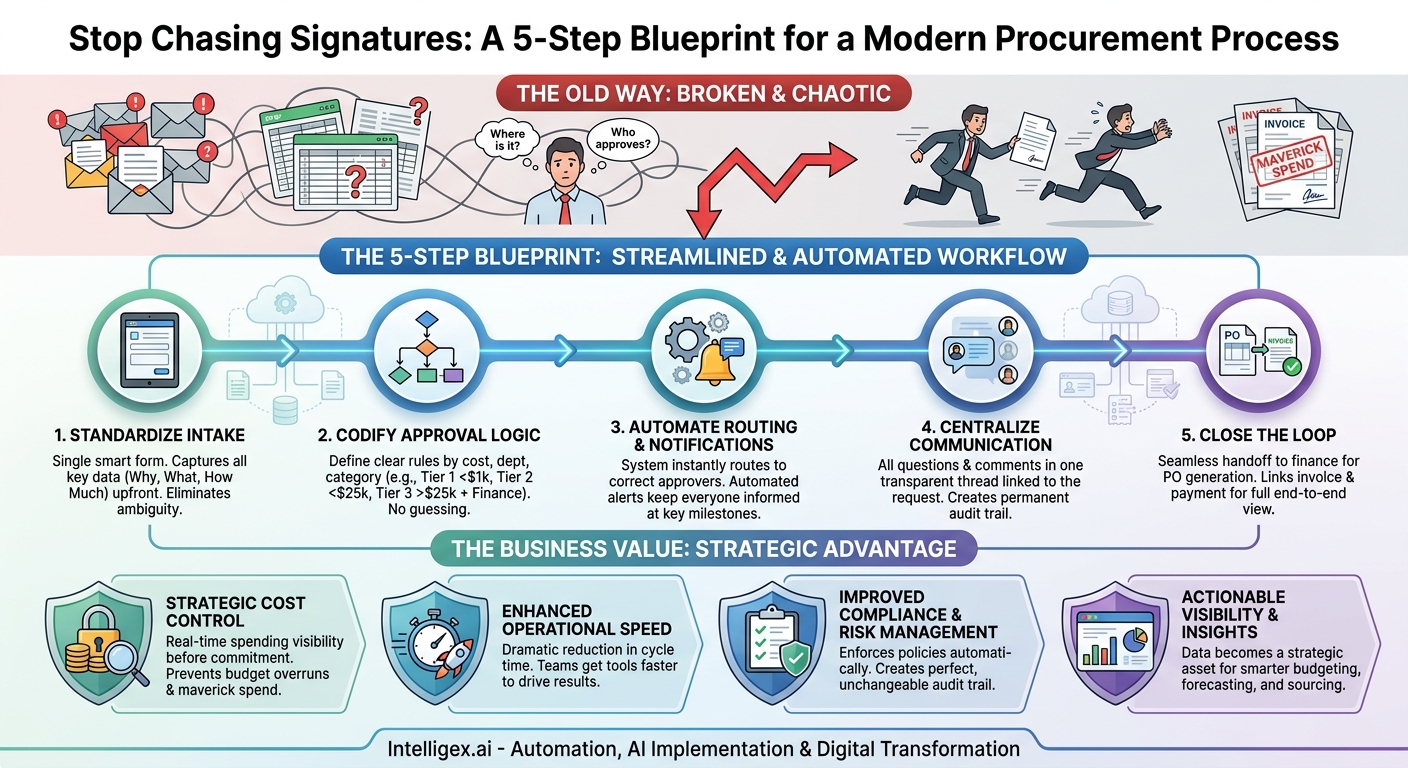
A 5-Step Blueprint for a Modern Procurement Workflow
Fixing a broken process requires moving from an informal, manual system to a structured, automated workflow. This doesn’t need to be an intimidating, multi-year project. By focusing on a clear, logical progression, you can build a scalable system that serves the business now and in the future. The goal is to make the right way to make a purchase the easiest way.
Here is a step-by-step blueprint for designing a workflow that delivers speed, control, and visibility.
- Standardize the Intake Point.
The first step is to eliminate email and spreadsheets as request channels. Create a single, smart intake form for all purchase requests. This form is your gateway to the entire process. It should be dynamic, asking for more information based on the request type or value. For instance, a request for new software over $10,000 might automatically trigger questions about data security and IT integration that a request for office supplies would not.
- Define and Codify Approval Logic.
Document clear, unambiguous rules for who needs to approve what. This logic is typically based on factors like cost, department, and purchase category. A common tiered structure might look like this:
- Tier 1 (e.g., up to $1,000): Direct Manager approval only.
- Tier 2 (e.g., $1,001 – $25,000): Manager and Department Head approval.
- Tier 3 (e.g., above $25,000): Manager, Department Head, and a VP of Finance.
Beyond cost, incorporate conditional rules. For example, any request categorized as “Software” must also be routed to the Head of IT for a security review, regardless of its cost.
- Automate Routing and Notifications.
This is where the process transforms. Once a request is submitted, the system should automatically enforce the logic you defined in the previous step. The request is instantly routed to the first approver’s queue without any manual intervention. When they approve it, it automatically moves to the next person in the chain. The system should also send automated notifications to keep everyone informed: approvers get a message when their action is required, and the original requester receives updates as their request hits key milestones (e.g., “Approved by Manager,” “Approved by Finance,” “Purchase Order Created”).
- Create a Centralized Hub for Communication.
Move all conversations about a request out of siloed channels and into a single, transparent thread attached to the request itself. If an approver has a question about a quote, they can post a comment directly on the request. The requester is notified, can respond, and the entire exchange is logged permanently as part of the audit trail. This eliminates any “he said, she said” confusion and provides complete context for anyone who reviews the request later.
- Close the Loop from Approval to Fulfillment.
The workflow doesn’t end at the final approval. The system should seamlessly hand off the approved request to the procurement or finance team to generate a purchase order (PO). The PO number should be automatically logged against the original request. Finally, when the invoice is received and paid, that information should also be linked back, providing a complete, end-to-end view of the entire lifecycle from need to payment.
The Business Value: More Than Just Moving Faster
A streamlined request-to-approval process delivers benefits that ripple across the entire organization. It’s a foundational element of operational excellence that strengthens financial controls, accelerates business velocity, and provides the data needed for smarter strategic decisions.
Strategic Cost Control
By channeling all spending requests through a single system, you gain real-time visibility into spending commitments before money leaves the bank. This proactive view allows finance teams to manage cash flow more effectively and prevent budget overruns. It virtually eliminates maverick spend, ensuring every dollar is accounted for and approved. Furthermore, with a centralized record of all purchases, you can easily identify opportunities to consolidate spend with key vendors, giving you greater leverage for negotiating better prices and terms.
Enhanced Operational Speed
The most immediate benefit is a dramatic reduction in the procurement cycle time. What once took weeks of manual follow-up can now be completed in days or even hours. When employees and teams get the tools and resources they need faster, they can execute on their projects and goals without delay. This isn’t just a matter of convenience; it’s a competitive advantage. A key metric to track here is the Average Request-to-Approval Time, which you should see decrease significantly after implementation.
Improved Compliance and Risk Management
An automated workflow is also a powerful compliance tool. It ensures that every purchase adheres to internal policies and passes through the necessary reviews, whether for security, legal, or data privacy. The system creates a perfect, unchangeable audit trail for every request, detailing who requested it, who approved it, when they approved it, and why. This makes internal and external audits simpler and less stressful, as all the required documentation is organized and easily accessible.
Actionable Visibility and Insights
When all your procurement data lives in one structured system, it becomes a strategic asset. Leaders can generate reports and dashboards to analyze spending patterns with ease. You can answer critical business questions like:
- How much are we spending per month by department?
- Who are our top 10 vendors by total spend?
- Are we seeing a spike in software subscription costs?
This data is invaluable for budgeting, forecasting, and strategic sourcing initiatives. Tracking metrics like Spend by Category and Spend by Vendor moves procurement from a reactive, transactional function to a proactive, strategic one.
Department-Specific Scenarios: Making It Real
A well-designed procurement workflow is not a one-size-fits-all solution. Its true power lies in its flexibility to meet the unique needs of different departments while maintaining a consistent, compliant framework for the entire organization.
For IT Teams: The IT department is a hub for requests for new hardware, software licenses, and cloud infrastructure. A structured flow ensures that every request for a new application automatically triggers a security and integration review. This prevents the proliferation of “shadow IT,” where departments purchase and use unvetted software that can pose a security risk. It also allows IT to manage licenses effectively, reallocating unused seats and preventing duplicate purchases.
For Marketing Teams: Marketers move fast, with needs ranging from new martech tools and creative agency retainers to ad campaign budgets and event sponsorships. An agile approval process allows them to seize opportunities quickly. For instance, a request for a campaign budget can be routed simultaneously to the CMO for strategic approval and to Finance for budget verification. This parallel processing means marketing can launch campaigns faster, capitalizing on market trends.
For Operations & Supply Chain: In manufacturing or logistics, speed and accuracy are paramount. A delay in ordering raw materials or critical replacement parts can shut down a production line, costing thousands of dollars per hour. An automated workflow ensures these urgent requests are immediately routed to the right approvers, even on their mobile devices, minimizing delays. Integration with an ERP system like Oracle NetSuite can automatically convert an approved request into a purchase order sent directly to the supplier, shaving critical time off the process.
For HR Teams: HR manages a wide range of procurement needs, from engaging recruiting firms and purchasing benefits packages to booking employee training programs. A defined workflow ensures these expenses align with company policies and budgets. It provides a clear, confidential channel for approvals that may involve sensitive information, ensuring the right leaders have oversight without exposing details to the entire organization.
The Role of Integration and AI
Building a modern procurement workflow is not just about creating a better form or a prettier dashboard. It’s about creating an intelligent, connected system that automates manual work and provides insights to help people make better decisions. This is where thoughtful integration and practical applications of AI become game-changers.
The goal is to meet your team where they already work. Integration with communication platforms like Slack or Microsoft Teams allows an approver to receive a notification and approve or deny a request with a single click, directly within the chat interface. They don’t have to switch contexts or log into another system. Similarly, connecting your procurement system to your finance or ERP platform enables a seamless flow of data, automatically creating POs and syncing vendor information without error-prone manual data entry.
AI can further reduce friction in the process. Instead of forcing employees to navigate complex category lists, an intelligent intake system can use natural language processing to understand a free-text request like “I need a new standing desk for our new hire in marketing” and automatically categorize it as “Office Furniture,” assign it to the Facilities department, and route it to the correct approver.
AI can also act as a proactive policy engine. The system can be configured to automatically flag requests that fall outside of policy, such as selecting a non-preferred vendor when a preferred, pre-negotiated option exists. It can then alert the requester with a helpful note, guiding them toward a compliant choice before the request ever consumes an approver’s time.
A Note on Governance and Safe Implementation
As you introduce more automation and intelligence, maintaining strong governance is critical. A well-designed system should enhance, not compromise, your controls. This means implementing role-based access so that employees can only see and act on requests relevant to them. Financial data and contract details should be restricted to authorized personnel. Furthermore, it’s essential to maintain a “human in the loop” for critical decisions. Automation should handle the routing, validation, and notifications, but the final sign-off for a high-value, strategic purchase should always rest with an accountable human leader.
Your Next Steps: From Chaos to Control
Transforming your procurement process is an achievable goal that delivers immediate and lasting value. You don’t need to boil the ocean. Start with a focused, iterative approach to build momentum and demonstrate success.
Here is a simple action plan to get started:
- Map Your Current State. Get the key stakeholders in a room (or a virtual whiteboard) and map the journey of a typical purchase request today. Follow it from the initial need to the final payment. Identify every person, tool, communication channel, and delay involved.
- Identify the Biggest Bottleneck. Look at your map and pinpoint the single biggest source of friction. Is it that requests are hard to submit? Is it an unclear approval chain? Is it the manual handoff to the purchasing team? This is your ideal starting point for improvement.
- Design Your Pilot Workflow. Don’t try to fix everything at once. Choose one common, high-volume request type, such as software under $5,000, and design the ideal, automated workflow for it. Define the form, the approval logic, and the notifications.
- Implement and Iterate. Use your existing tools or a dedicated procurement platform to build and launch your pilot workflow. Gather feedback from users, measure the improvement in cycle time, and use those learnings to refine the process before expanding it to other request types across the organization.
By taking these deliberate steps, you can move your organization from a state of reactive chaos to one of proactive control, turning your procurement process into a true strategic advantage.
Your Next Read:
Get a FREE
Proof of Concept
& Consultation
No Cost, No Commitment!
