

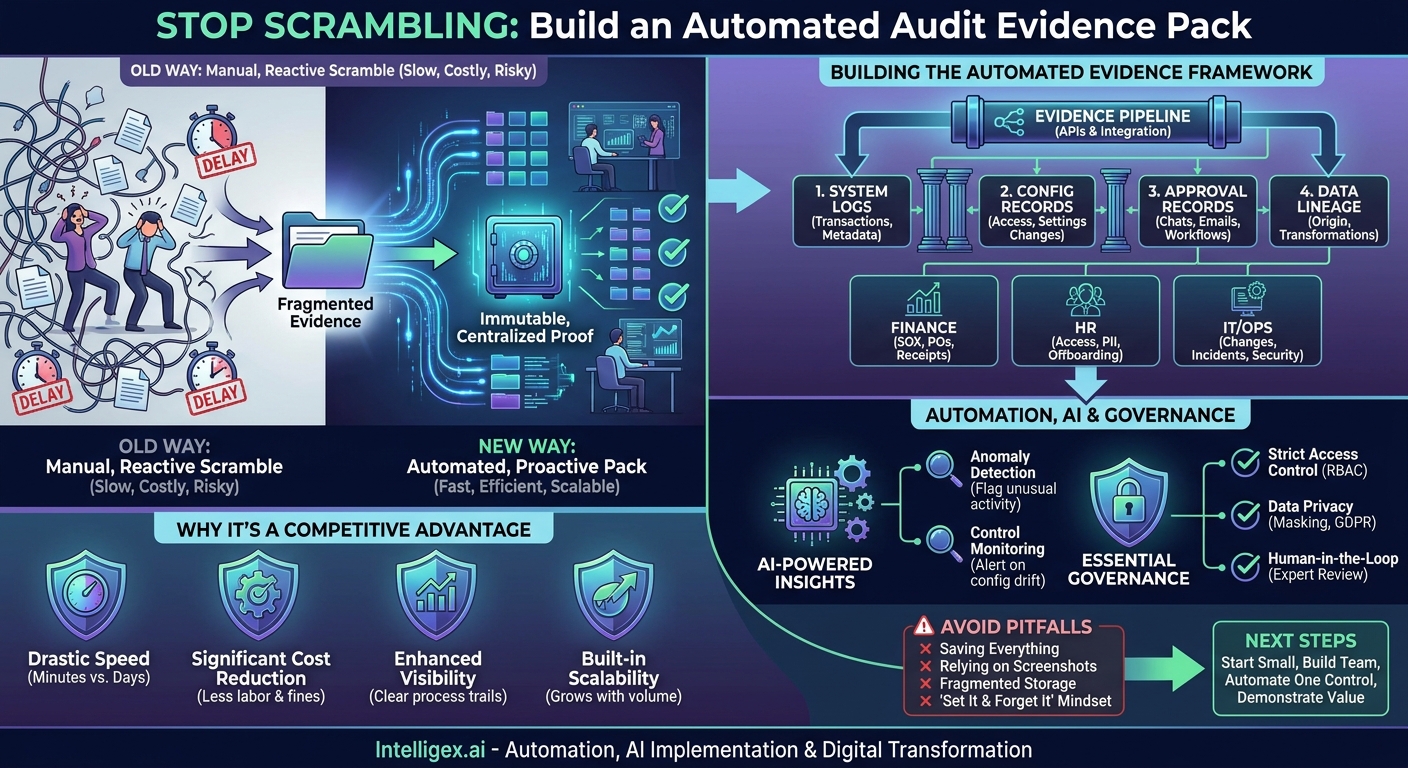
The dreaded audit request. It arrives in an email, and suddenly, teams scramble to pull records from a dozen different systems. Finance hunts for invoices in the ERP, HR searches for onboarding forms on a shared drive, and IT digs through server logs. This reactive, manual process is not just stressful; it’s expensive, slow, and prone to human error. In a world of increasing regulatory scrutiny and digital complexity, relying on last-minute evidence gathering is a significant business risk.
A modern audit evidence pack is the solution. It is not a static folder of PDFs but a dynamic, automated collection of digital proof that demonstrates your processes are operating as designed. Building this capability is a core part of digital transformation. It turns compliance from a painful, periodic event into a continuous, automated function that delivers tangible business value in speed, cost savings, and operational visibility.
Why a Proactive Audit Pack Is a Competitive Advantage
Treating audit readiness as an ongoing discipline rather than a fire drill fundamentally changes its impact on your organization. The goal is to move from “proving it happened” to “showing how it works,” with immutable, system-generated evidence. This shift provides clear business benefits far beyond simply satisfying an auditor.
- Drastic Speed Improvements: When an auditor requests evidence for a specific transaction or user action, the ideal response time should be minutes, not days. An automated system can pull pre-collected, indexed evidence instantly, dramatically shortening audit cycles and freeing up your team for value-added work.
- Significant Cost Reduction: The primary cost of an audit is often the internal labor spent finding, organizing, and explaining evidence. By automating collection, you reduce these manual hours significantly. This also lowers the risk of costly fines or remediation projects resulting from failed audits.
- Enhanced Visibility and Quality: A well-designed evidence pack provides a clear, time-stamped trail of your key business processes. This visibility isn’t just for auditors. It helps operations managers identify process bottlenecks, quality control issues, and training opportunities, leading to better business outcomes.
- Built-in Scalability: A manual evidence gathering process breaks under pressure. As your transaction volume grows, you cannot hire people fast enough to keep up. An automated framework scales effortlessly, ensuring that your compliance posture remains strong as your business expands.
The Core Components of a Modern Evidence Pack
An effective evidence pack goes far beyond a simple transaction receipt. It tells the complete story of a process, including the who, what, when, where, and why of every critical step. Your goal is to collect evidence that is complete, accurate, and immutable. This means prioritizing system-generated records over manual documentation like screenshots, which can be easily edited or lack crucial context.
A robust evidence pack should contain a mix of the following digital artifacts:
1. System-Generated Transaction Logs
This is the gold standard. These are records created automatically by your core business applications. They are difficult to tamper with and contain rich metadata.
Example: The full transaction history for a purchase order in your ERP system, including the initial creation, every approval step with user IDs and timestamps, and the final payment record.
2. Configuration Change Records
Auditors need to know who has access to what and who can change critical settings. This includes changes to user permissions, system configurations, and administrative settings.
Example: A log from your CRM like Salesforce showing that a user’s profile was changed from “Sales Rep” to “Sales Manager,” including which administrator made the change and when.
3. Communication and Approval Records
Many decisions happen in communication tools. While not as ideal as a structured log, capturing these conversations can be critical evidence for processes that are not yet fully automated.
Example: An email thread or a specific Slack channel conversation where a manager provides explicit approval for a budget exception, saved in a searchable archive.
4. Process and Data Lineage
For data-intensive processes, especially in finance or analytics, you must prove where the data came from and how it was transformed. This ensures data integrity.
Example: A record from your data integration tool showing that customer data was pulled from the production database, anonymized according to a specific rule, and then loaded into a testing environment.
Tailoring Evidence for Key Business Functions
The specific evidence you need to collect varies by department. The key is to map your high-risk processes and identify the “key controls” where you need indisputable proof of proper execution. Here are a few examples across the business.
Finance and Procurement (SOX, Internal Controls)
Finance is the traditional home of the audit, with a heavy focus on financial reporting and fraud prevention. The goal is to prove segregation of duties and approval authority.
- What to Save: Purchase order approval workflows, expense report submissions with attached digital receipts, user access reviews for financial systems, and records of journal entry approvals.
- Scenario: An auditor questions a large payment to a new vendor. Your evidence pack should contain not just the invoice, but the vendor setup and approval record, the purchase order with its multi-level digital approval stamps, and the goods receipt confirmation from the warehouse system, all linked to the transaction.
Human Resources (Hiring, Offboarding, PII)
HR audits often focus on access control and data privacy. The process of an employee joining, changing roles, and leaving the company creates a long trail of critical evidence.
- What to Save: Records of new hire background checks, signed policy acknowledgments, system access provisioning requests and approvals, and a complete log of the de-provisioning process upon termination.
- Scenario: To prove compliance with offboarding procedures, you need more than a checklist. Your evidence pack should include a ticket from your IT service management (ITSM) system, linked to logs from Active Directory, your HRIS, and core applications showing the exact time each account was disabled.
IT and Operations (Change Management, Incident Response)
For IT, audits center on system stability, security, and data integrity. Proving that changes to production systems are properly tested and approved is paramount.
- What to Save: Change management tickets (e.g., from Jira or ServiceNow) with linked test plans, peer review sign-offs, and deployment approvals. Also, save incident response logs and vendor security assessment reports.
- Scenario: An auditor is reviewing a recent system outage. Your evidence pack should include the incident timeline, communication records, the root cause analysis report, and the subsequent change ticket created to deploy a fix, showing that the solution went through the proper testing and approval cycle before being released.
Building Your Evidence Collection Process: A Step-by-Step Guide
Transitioning to an automated evidence framework is a methodical process. It requires collaboration between business process owners, IT, and your compliance or internal audit teams. Rushing the process or failing to define requirements clearly will lead to collecting the wrong evidence or building an unsustainable system.
- Identify and Prioritize High-Risk Processes: You cannot automate everything at once. Start with the processes that carry the most significant financial or regulatory risk. Common starting points include procure-to-pay, order-to-cash, and employee lifecycle management.
- Map the Process and Pinpoint Key Controls: For each selected process, create a detailed flowchart. Work with the process owners to identify the specific steps that serve as “controls.” A control is any action that ensures the process operates correctly, such as a manager’s approval, a system validation rule, or a three-way match between an invoice, PO, and receipt.
- Define “Sufficient Evidence” for Each Control: This is the most critical step. For each control, ask: “What digital record would provide indisputable proof that this control was executed correctly?” Be specific. Instead of “save the approval,” define it as “capture the system log of the approval event, including the approver’s user ID, the exact timestamp, the item being approved, and the data values at the time of approval.”
- Automate the Evidence Capture Mechanism: This is the technical implementation. Use APIs to connect directly to your source systems (ERP, CRM, HRIS). When a control event occurs, the API should trigger a workflow that pulls the defined evidence, packages it with relevant metadata (like the process name and date), and sends it to a secure, central repository.
- Establish a Secure and Searchable Repository: Evidence must not be scattered. Store it in a centralized location with strict access controls, such as a dedicated cloud storage bucket, a data warehouse, or a specialized GRC (Governance, Risk, and Compliance) platform. The repository must be indexed and easily searchable.
- Implement and Enforce Retention Policies: Work with your legal and compliance teams to define how long different types of evidence must be stored (e.g., 7 years for financial records). Automate the archival and eventual deletion of evidence to manage storage costs and comply with data retention rules.
- Test and Refine Continuously: Your business processes and systems will change. Regularly conduct internal mini-audits to test your evidence pack. Pick a random sample of transactions and try to retrieve the full evidence package. Use these tests to identify gaps and refine your collection process.
The Role of Automation and AI in Evidence Management
Modern compliance is a data problem, and that is where automation and AI provide immense leverage. The goal is not to replace human auditors but to empower them with perfect, complete data so they can focus on judgment and analysis rather than manual data collection.
Automation is the foundation. By using integration platforms and APIs to connect systems, you create an “evidence pipeline.” For example, you can automatically capture infrastructure change logs from services like AWS CloudTrail, which documents every API call within your cloud environment. This provides a rich, unfiltered source of evidence for IT auditors. This documentation, which can be found at https://docs.aws.amazon.com/, serves as a blueprint for what’s possible.
AI can then be applied on top of this automated data flow to add a layer of proactive intelligence. Instead of just collecting evidence for past events, AI can help identify potential compliance failures in near real-time.
- Anomaly Detection: A machine learning model can be trained on your historical transaction data to learn what “normal” looks like. It can then flag unusual activity, such as an employee approving an unusually high number of invoices in a short period or a payment being sent to a vendor from a high-risk country for the first time.
- Control Monitoring: AI can continuously check configurations to ensure controls haven’t been disabled. For example, it could alert you if a rule requiring dual-approval for payments over $10,000 is suddenly turned off in your financial system.
Safe Implementation and Governance
When you centralize sensitive audit data and apply AI, governance becomes critical. This is not a “set it and forget it” system. Strong guardrails are essential to maintain trust and security.
Access Control: The evidence repository must be protected with strict, role-based access control (RBAC). Only named individuals from compliance, internal audit, and authorized external auditors should have access. All access must be logged and monitored.
Data Privacy: Your evidence may contain Personally Identifiable Information (PII). Ensure your system has capabilities to mask or tokenize sensitive data where appropriate, and that your collection and storage practices align with regulations like GDPR and CCPA.
Human-in-the-Loop Review: An AI-generated alert is an indicator, not a verdict. All anomalies or flagged exceptions must be routed to a human expert for investigation and validation. The system’s purpose is to augment human oversight by finding the needle in the haystack, not to make automated compliance decisions.
Common Pitfalls to Avoid
As you build your automated evidence framework, be mindful of these common traps that can undermine its effectiveness.
- Saving Everything: The goal is not to create a complete backup of all your company’s data. This is costly and creates noise, making it harder to find relevant evidence. Focus exclusively on the specific data points that prove a key control was executed.
- Relying on Screenshots: While sometimes unavoidable for legacy systems, screenshots should be a last resort. They lack metadata, are not machine-readable, and can be easily altered. Always prioritize structured, system-generated logs.
- Fragmented Storage: Storing evidence in email, shared drives, or local desktops defeats the purpose of the system. A centralized, indexed repository is non-negotiable for achieving the speed and efficiency gains you seek.
- “Set It and Forget It” Mindset: Your business is dynamic. When a process is updated or a new system is implemented, the evidence collection workflow must be updated as well. Build a process for regularly reviewing and updating your evidence definitions.
Your Next Steps: Building a Resilient Compliance Framework
Creating a comprehensive, automated audit evidence pack is a journey, but the return on investment in terms of risk reduction, cost savings, and operational efficiency is substantial. It transforms compliance from a source of friction into a well-oiled machine that supports the business.
To get started, focus on taking small, deliberate steps:
- Pick a single, high-impact process. Don’t try to boil the ocean. Select one critical process, like vendor invoice processing or employee offboarding, and use it as your pilot project.
- Assemble a cross-functional team. Bring together the process owner from the business, a representative from IT who understands the systems, and someone from your internal audit or compliance team. This collaboration is key to defining the right requirements.
- Document and automate one control. Start with one critical control within that process. Define the “sufficient evidence” and build the technical workflow to capture and store it automatically.
- Demonstrate the value. Once you can instantly pull a complete, perfect evidence package for that one control, show it to stakeholders. The “wow” moment of turning a two-day manual scramble into a ten-second query is the best way to get the buy-in you need to scale your efforts across the organization.
By taking this incremental, value-driven approach, you can build a compliance framework that is not only effective but also a true enabler of business agility and growth.
Your Next Read:
Category:
Get a FREE
Proof of Concept
& Consultation
No Cost, No Commitment!