

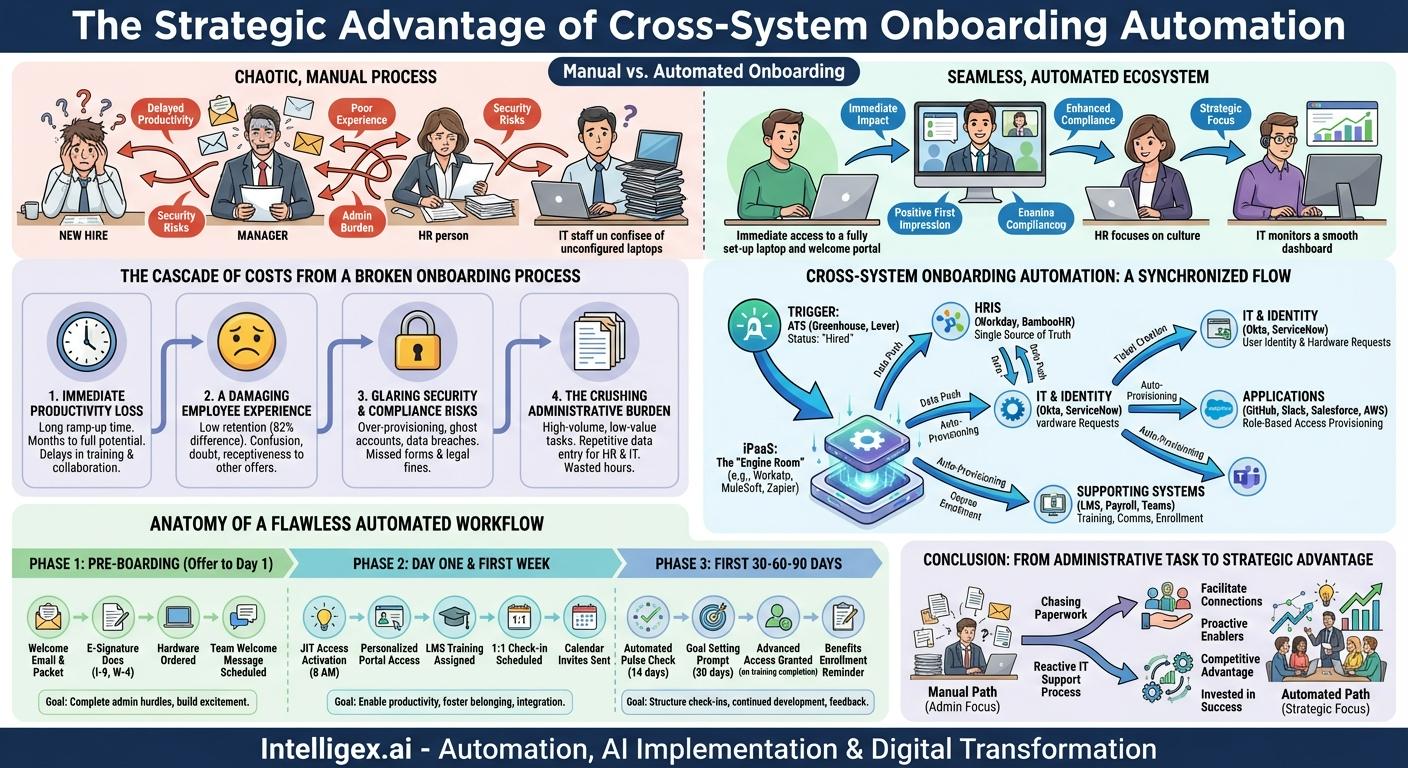
The scene is all too familiar in many organizations. A new hire arrives on their first day, bright-eyed and eager, only to find their laptop isn’t ready, they can’t access their email, and their manager is frantically trying to figure out which systems they need access to. HR is buried under a mountain of paperwork, IT is playing catch-up on provisioning requests, and the new employee’s initial excitement begins to curdle into a feeling of disorganization and regret. This chaotic, manual approach to onboarding is more than just a bad first impression; it’s a significant drain on resources, a security risk, and a direct threat to employee retention. In today’s competitive talent market, a disjointed onboarding experience is a luxury no company can afford. The solution lies in moving beyond simple digital checklists and embracing true, end-to-end employee onboarding automation that flows seamlessly across every critical business system.
The Cascade of Costs from a Broken Onboarding Process
A manual or fragmented onboarding process creates a domino effect of negative consequences that ripple throughout the organization. These costs aren’t just line items on a budget; they are hidden drains on productivity, morale, and security that compound over time.
Immediate Productivity Loss
Every hour a new employee spends waiting for a laptop, a password, or access to a critical application is an hour of lost productivity. Studies have shown it can take eight to twelve months for a new hire to reach their full performance potential, and a clunky onboarding process significantly extends this ramp-up period. When IT, HR, and hiring managers are manually coordinating tasks via email chains and spreadsheets, delays are inevitable. The new hire is left in limbo, unable to begin training, collaborate with their team, or contribute meaningful work, starting their tenure on a frustratingly passive note.
A Damaging Employee Experience
The first few days at a new job set the tone for the entire employee lifecycle. A smooth, welcoming, and organized experience signals that the company is competent, values its employees, and has invested in their success. Conversely, a chaotic process suggests disorganization and a lack of care. According to research by Glassdoor, organizations with a strong onboarding process improve new hire retention by a staggering 82%. When a new hire’s first impression is one of confusion and inefficiency, it can sow seeds of doubt and lead them to question their decision, making them more receptive to other opportunities.
Glaring Security and Compliance Risks
Manual user provisioning is a minefield of security vulnerabilities. When an IT administrator is rushing to create a dozen accounts across different platforms, human error is almost guaranteed. This can lead to over-provisioning—granting an employee more access than their role requires, a major security risk known as the principle of least privilege violation. Furthermore, without an automated system, there’s no reliable way to track who has access to what. This becomes a critical liability during offboarding, where lingering “ghost accounts” can become backdoors for data breaches. On the compliance side, manually tracking the completion of essential paperwork like I-9 forms, tax documents, and policy acknowledgements is fraught with risk. A single missed form can result in significant fines and legal trouble.
The Crushing Administrative Burden
Consider the sheer volume of repetitive tasks involved in onboarding one employee: data entry into the HRIS, creating email accounts, setting up payroll, adding them to communication channels, assigning training modules, and ordering equipment. Now multiply that by the number of hires your company makes each year. HR professionals, IT staff, and even hiring managers spend countless hours on this low-value, high-volume administrative work. This is time that could be spent on strategic initiatives like talent development, improving company culture, or providing personalized support to the new hire.
What Exactly is Cross-System Onboarding Automation?
True onboarding automation is far more than just a digital to-do list or an e-signature tool. It is the creation of a cohesive, event-driven ecosystem where different software platforms communicate and act in concert, without human intervention. The process is orchestrated by a central workflow that connects disparate systems, ensuring data flows accurately and tasks are executed at precisely the right moment.
The entire journey begins with a single trigger event. Typically, this is when a recruiter changes a candidate’s status to “Hired” in the company’s Applicant Tracking System (ATS), such as Greenhouse, Lever, or Taleo. This one click sets off a sophisticated, automated chain reaction:
- ATS to HRIS: The ATS instantly and securely pushes the new hire’s data—name, title, department, start date, salary—to the Human Resource Information System (HRIS) like Workday, BambooHR, or Rippling. This action creates the official employee record, which becomes the single source of truth for all employee data.
- HRIS to IT & Identity: The creation of the HRIS record then triggers the next set of actions. It signals the IT Service Management (ITSM) platform, like ServiceNow or Jira, to automatically generate tickets for hardware procurement and setup. Simultaneously, it instructs the Identity and Access Management (IAM) system, such as Okta, Azure Active Directory, or Google Workspace, to create the user’s core digital identity.
- Identity to Applications: This is where the magic of role-based access control happens. Based on the data inherited from the HRIS (e.g., role: “Software Engineer,” department: “Platform”), the IAM system automatically provisions access to the correct applications. The engineer gets accounts in GitHub, Jira, and AWS, while a new salesperson would be granted access to Salesforce, Outreach, and a commission-tracking tool. This ensures employees get exactly what they need—no more, no less—from day one.
- HRIS to Supporting Systems: The workflow continues, branching out to other essential platforms. The new hire is automatically enrolled in mandatory “Day One” courses in the Learning Management System (LMS). Their details are pushed to the payroll system, and they are added to the correct communication channels in Slack or Microsoft Teams.
The key takeaway is that this is not a linear series of independent automations. It is a deeply interconnected web where systems are constantly talking to each other, using the new hire’s data as the common thread to orchestrate a complex but perfectly synchronized series of events.
The Anatomy of a Flawless Automated Workflow
A truly effective automated onboarding process is best understood by breaking it down into distinct phases, each with its own set of triggers and automated actions that guide the new hire from the moment they accept the offer through their first critical 90 days.
Phase 1: The “Pre-boarding” Period (Offer Acceptance to Day 1)
The goal of this phase is to complete all administrative hurdles and build excitement before the employee even sets foot in the office. This ensures their first day is focused on culture and connection, not paperwork.
- Trigger: Candidate status changes to “Hired” in the ATS.
- Automated Actions:
- An HRIS profile is automatically created using data from the ATS.
- A personalized welcome email is sent from the hiring manager’s account, perhaps with a link to a “welcome packet” or a team video.
- A package of digital documents (I-9, W-4, direct deposit form, employee handbook) is sent for electronic signature via a platform like DocuSign or HelloSign. Completion status is tracked automatically.
- ITSM tickets are generated to provision a laptop, monitor, and any other necessary hardware, with the delivery address pulled directly from the HRIS.
- A “Welcome to the Team!” message is scheduled to post in the relevant team Slack or Microsoft Teams channel at 9:00 AM on the new hire’s start date.
Phase 2: Day One and the First Week
This phase is all about enabling productivity and fostering a sense of belonging. The focus shifts from administrative tasks to integration and learning.
- Trigger: The employee’s start date arrives.
- Automated Actions:
- At a pre-set time (e.g., 8:00 AM on their start date), the IAM system automatically activates all user accounts and permissions. This is a critical security practice known as Just-in-Time (JIT) access.
- The new hire receives an automated welcome message with their temporary password and a link to a personalized onboarding portal or checklist.
- The LMS automatically assigns the “First Week” training curriculum, covering topics like company policies, security protocols, and benefits overview.
- The hiring manager receives an automated reminder to schedule a 1:1 check-in meeting for the end of the day.
- The new hire is automatically added to all relevant calendar invites for recurring team meetings and department all-hands.
Phase 3: The First 30-60-90 Days
Onboarding doesn’t end after the first week. Automation can help structure the crucial first three months, ensuring consistent check-ins and continued development.
- Trigger: Time-based milestones (e.g., 14 days, 30 days, 60 days post-start date).
- Automated Actions:
- At the 14-day mark, an automated pulse-check survey is sent to the new hire to privately gather feedback on their experience so far.
- At 30 days, both the manager and the employee receive an automated notification to collaborate on setting their 30-60-90 day goals.
- As required training modules in the LMS are completed, access to more advanced systems or higher permission levels can be automatically granted.
- Reminders are automatically sent to the employee before the benefits enrollment deadline.
The Engine Room: Integration Platforms as a Service (iPaaS)
The obvious question is: how do you get all these different systems—Workday, Okta, ServiceNow, Slack—to talk to each other? They weren’t built by the same companies and don’t speak the same language. The answer lies in a category of technology known as Integration Platform as a Service (iPaaS).
Think of an iPaaS solution like Workato, MuleSoft, or Zapier as the central nervous system of your company’s tech stack. It acts as the digital glue, connecting disparate applications and enabling the creation of complex, automated workflows. These platforms use Application Programming Interfaces (APIs)—the standardized communication protocols that modern software uses to interact—to pull data from one system and push actions to another.
The power of a modern iPaaS is that it often provides a low-code or no-code visual interface. This means that HR and IT operations professionals, not just specialist developers, can build, manage, and modify these onboarding workflows. They can drag-and-drop connectors for common applications and define the logic for the workflow, such as: “WHEN a new user is created in Workday with the department ‘Sales’, THEN create a user in Salesforce with the ‘Sales Development Rep’ profile AND add them to the #sales-team channel in Slack.” This democratizes automation, allowing the teams who own the onboarding process to also own its automation.
Conclusion: From Administrative Task to Strategic Advantage
Implementing cross-system onboarding automation is about so much more than efficiency. Yes, it dramatically reduces manual work, eliminates human error, and strengthens security. But its true impact is strategic. It transforms onboarding from a disjointed administrative checklist into a seamless, unified experience that reflects a modern, organized, and employee-centric culture.
By automating the mundane, you free your HR and IT teams to focus on the human element. HR can spend less time chasing paperwork and more time facilitating meaningful connections and checking in on the new hire’s well-being. IT can shift from reactive ticket-takers to strategic enablers of productivity. Most importantly, a flawless automated onboarding process delivers a powerful message to your new employee from the very first interaction: we are prepared for you, we value your time, and we are invested in your success. In the ongoing war for talent, that first impression isn’t just a nicety—it’s a decisive competitive advantage.
Your Next Read:
Get a FREE
Proof of Concept
& Consultation
No Cost, No Commitment!