

The promise of automation is compelling: streamlined operations, lower costs, and faster execution. Many leaders envision a future of “lights-out” processes, where tasks run seamlessly from start to finish without any human touch. While this is achievable for certain workflows, the rush to full automation often overlooks a more powerful and practical strategy: Human-in-the-Loop (HITL) automation.
Deciding between full automation and keeping a human step is not just a technical choice. It is a strategic business decision with significant implications for quality, risk, and scalability. Getting it right means creating efficient, resilient systems. Getting it wrong can lead to costly errors, frustrated employees, and broken processes. The key is knowing when a human’s judgment, intuition, and context-awareness are your most valuable assets.
Understanding the Automation Spectrum
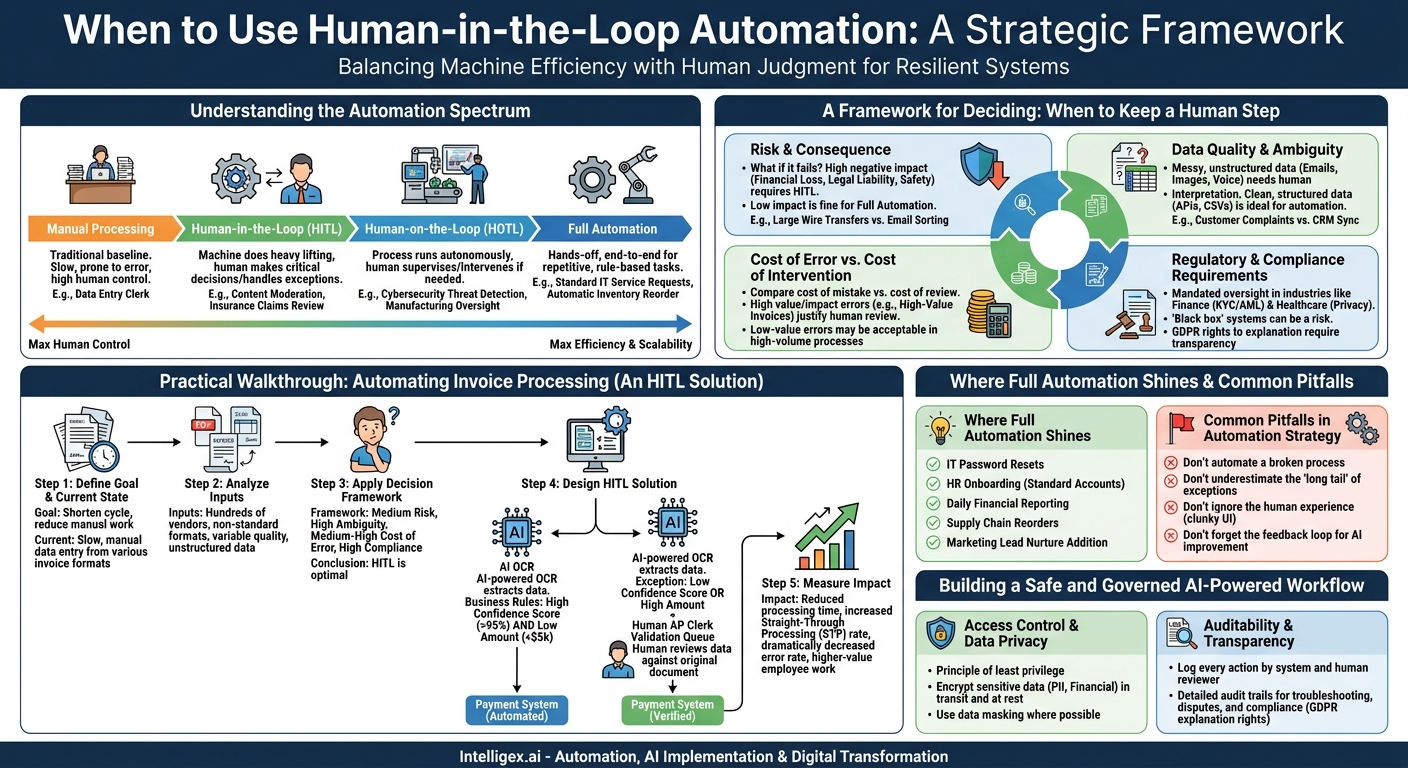
Automation isn’t a simple on-or-off switch. It exists on a spectrum, and choosing the right point on that spectrum for each process is critical. Understanding the main models helps clarify the options.
Manual Processing
This is the traditional baseline where people perform nearly every step of a task. Think of an accounts payable clerk manually keying in invoice data from a scanned PDF into an accounting system. It is slow, prone to error, and does not scale well, but it provides maximum human control.
Human-in-the-Loop (HITL) Automation
In an HITL system, the machine does the heavy lifting, but a human is required to make a critical decision, handle an exception, or validate the output. The process cannot be completed without this human touchpoint. This model is designed to combine the speed of machines with the judgment of humans.
- Example: Content Moderation. An AI can flag potentially inappropriate content, but a human moderator makes the final call on whether to remove it, applying community guidelines and cultural nuance.
- Example: Insurance Claims Processing. An AI can extract data from a claim form and photos, but a human adjuster reviews the package, assesses the context of the claim, and approves the final payout amount.
Human-on-the-Loop (HOTL) Automation
In a HOTL system, the process runs autonomously, but a human supervises it and can intervene if necessary. The system does not stop to wait for human approval. Instead, the human acts as an overseer, monitoring for performance issues or anomalies. This is common in high-stakes monitoring environments.
- Example: Cybersecurity Threat Detection. An automated system monitors network traffic for suspicious activity and can block known threats automatically. A security analyst reviews alerts and dashboards, investigating complex anomalies or new types of attacks that the system flags but cannot resolve on its own.
- Example: Manufacturing Plant Operations. A factory line runs automatically, but a human supervisor monitors production dashboards and can step in to recalibrate a machine or address a supply issue.
Full Automation
This is the “hands-off” model where a process runs end-to-end without any planned human intervention. These are typically tasks that are highly repetitive, rule-based, and deal with structured data. The goal is maximum efficiency and scalability for simple, predictable workflows.
A Framework for Deciding: When to Keep a Human Step
Choosing the right automation model requires a clear-eyed assessment of the process itself. Instead of asking “Can we automate this?”, ask “Should we automate this, and to what degree?”. Use these four factors to guide your decision.
1. Risk and Consequence
What happens if the automated process makes a mistake? The higher the potential negative impact, the stronger the case for human oversight. A simple framework is to classify the consequences of failure as low, medium, or high.
- Low Consequence: An error is easily reversible and has minimal business impact. (Good for full automation). Example: Sorting internal support emails into folders. If one is miscategorized, it can be found with a quick search.
- Medium Consequence: An error causes financial loss, customer frustration, or requires significant manual effort to fix. (Good for HITL or HOTL). Example: Automatically generating a complex sales quote. An error could lead to a lost deal or unprofitable pricing. An HITL step for a sales rep to review the quote is essential.
- High Consequence: An error could result in major financial loss, legal liability, reputational damage, or safety issues. (Requires HITL). Example: A system for approving large financial wire transfers or an AI used in medical diagnostics. Human validation is non-negotiable.
2. Data Quality and Ambiguity
Automation thrives on clean, structured, and predictable data. The messier and more ambiguous the input, the more you need human interpretation.
- Structured Data: Data from APIs, standardized web forms, or structured files like CSVs are ideal for full automation. The rules are clear and the format is consistent. Example: Syncing customer data between a marketing platform and a CRM like Salesforce.
- Unstructured or Ambiguous Data: Data from emails, PDFs, images, voice recordings, or handwritten notes is challenging for machines. While AI has made huge strides, it can still miss context. Example: Interpreting the intent of a long, emotional customer complaint email. An AI can summarize it and suggest a category, but a human agent is needed to understand the nuance and craft an empathetic response.
3. Cost of Error vs. Cost of Intervention
This is a practical financial calculation. Compare the cost of an automated system making a mistake against the cost of paying a person to review the work. Sometimes, a small error rate in a high-volume, low-value process is acceptable. For an invoice processing system handling thousands of small invoices per day, a 99% accuracy rate from full automation might be more cost-effective than paying a team to review every single one. However, for a system handling a few high-value invoices, the cost of a single error (e.g., paying $500,000 instead of $50,000) far outweighs the cost of a human review step.
What to measure: Track the “straight-through processing” (STP) rate. This is the percentage of transactions that are processed without any human intervention. Aiming for an 80% STP rate with HITL for the remaining 20% is often a much more realistic and valuable goal than a costly and brittle 100% full automation solution.
4. Regulatory and Compliance Requirements
In many industries, the decision is made for you. Regulations often mandate human oversight for specific processes. For example, financial services have strict Know Your Customer (KYC) and Anti-Money Laundering (AML) rules that require human verification of identities and investigation of suspicious transactions. In healthcare, patient data privacy laws govern how information can be handled and shared. Additionally, regulations like GDPR give individuals the right to an explanation for automated decisions made about them, making a “black box” full automation system a compliance risk.
Practical Walkthrough: Automating Invoice Processing
Let’s apply this framework to a common business process: accounts payable (AP) invoice processing. The goal is to move away from manual data entry to reduce costs and speed up vendor payments.
- Define the Goal and Current State
The objective is to shorten the invoice-to-pay cycle and reduce the manual workload on the AP team. Currently, AP clerks receive PDF invoices via email, open each one, and manually type the vendor name, invoice number, date, line items, and total amount into the accounting system. The process is slow and prone to typos. - Analyze the Inputs
The invoices come from hundreds of different vendors. There is no standard format. Some are clean, digitally generated PDFs. Others are low-quality scans of paper documents. A few even contain handwritten notes or approval stamps. The data is highly unstructured and variable. - Apply the Decision Framework
- Risk and Consequence: Medium. Paying a fraudulent invoice, paying the wrong amount, or paying a duplicate invoice can lead to direct financial loss and damage vendor relationships.
- Data Ambiguity: High. The variety of formats and quality of scans makes 100% accurate data extraction very difficult for an automated system.
- Cost of Error: Medium to high. Overpayments are lost money, while underpayments or late payments can result in supply chain disruptions and late fees.
- Compliance: High. Financial records must be accurate for audits and tax purposes. A clear audit trail is required.
- Design the HITL Solution
Based on the analysis, full automation is too risky and unreliable. An HITL approach is the optimal solution.- An AI-powered Optical Character Recognition (OCR) tool reads the invoice and attempts to extract all the key fields.
- The system assigns a confidence score to each extracted field.
- Business Rules are applied: If all fields have a confidence score above 95% AND the total invoice amount is below a set threshold (e.g., $5,000), the invoice is automatically passed to the payment system. This is the “straight-through” path.
- The Human-in-the-Loop step: If any confidence score is low, or if the invoice total exceeds the threshold, the invoice is routed to a human AP clerk’s validation queue. The clerk sees the original invoice alongside the AI-extracted data. Their job is not to re-type everything, but to quickly verify and correct the few fields the AI was unsure about.
- Measure the Impact
This hybrid approach delivers significant business value. The AP team is freed from tedious data entry and can focus on being strategic reviewers. Key metrics to track include:- Processing time per invoice: Reduced from minutes to seconds for most invoices.
- Straight-through processing (STP) rate: The percentage of invoices handled with zero human touch.
- Error rate: The number of incorrect payments made, which should decrease dramatically.
- Employee satisfaction: AP clerks are now performing higher-value work.
Where Full Automation Shines
While HITL is powerful for complex processes, full automation remains the right choice for many tasks. It excels in high-volume, low-risk scenarios where the rules are clear and the data is clean. Its business value lies in its sheer speed and scalability.
Consider these scenarios, which are ideal candidates for full automation:
- IT Service Desk: Automatically fulfilling a user-submitted request to reset a password for a known application.
- HR Onboarding: Provisioning standard accounts (email, messaging, project management tools) for a new employee once their profile is created in the central HR system.
- Financial Reporting: Generating and emailing a standard daily sales report by pulling data from the CRM and finance systems at a scheduled time.
- Supply Chain: Sending an automatic reorder request to a supplier when inventory for a specific part drops below a predefined threshold.
- Marketing Operations: Adding a new lead to a specific email nurture campaign after they fill out a “request a demo” form on the website.
Common Pitfalls in Automation Strategy
As you plan your automation initiatives, be aware of common traps that can derail projects and diminish returns.
Don’t automate a broken process. Automation will not fix a flawed, inefficient, or illogical workflow. It will just make a bad process run faster, leading to bigger and faster problems. Always map, analyze, and simplify your process before you attempt to automate it.
Don’t underestimate the “long tail” of exceptions. It is often said that the first 80% of a process is easy to automate, but the last 20% (the exceptions, special cases, and edge cases) can take 80% of the effort. Chasing 100% automation for a complex process can lead to a brittle, over-engineered system that is expensive to build and maintain. This is precisely where HITL provides a pragmatic escape hatch.
Don’t ignore the human experience. An HITL system should empower your employees, not frustrate them. If the user interface for validation is clunky, slow, or unclear, people will find workarounds or reject the system entirely. The goal is to make the human’s job faster and easier, so design the system with their experience as a top priority.
Don’t forget the feedback loop. The most valuable part of an HITL system is the data it generates. Every time a human corrects a mistake made by the AI, that correction is a valuable training signal. A well-designed system feeds this information back to continuously improve the underlying AI model. This creates a virtuous cycle where the system gets smarter over time, increasing its straight-through processing rate and reducing the need for human intervention.
Building a Safe and Governed AI-Powered Workflow
Introducing automation, especially AI-driven systems, into core business processes requires a focus on governance and safety from day one. You are accountable for the decisions your automated systems make.
Access Control and Data Privacy
Apply the principle of least privilege. An automation tool should only have access to the specific data and systems it absolutely needs to perform its task. When processing sensitive information like customer Personally Identifiable Information (PII) or financial records, ensure that data is encrypted both in transit and at rest. Use data masking or anonymization techniques wherever possible to limit exposure.
Auditability and Transparency
Every action taken by an automated system should be logged. For an HITL process, the log should be even more detailed. It should capture not only what the system did, but also which human reviewed the action, when they reviewed it, and what changes (if any) they made. This creates an immutable audit trail that is essential for troubleshooting, resolving disputes, and satisfying compliance requirements. You must be able to answer the question: “Why did the system do that?”
Your Next Steps: Building an Automation Roadmap
Moving from theory to practice can feel daunting. The key is to start small, prove value, and build momentum. Follow these steps to begin your journey.
- Identify a Candidate Process. Don’t try to automate everything at once. Look for a process that is a known pain point. Good candidates are often repetitive, high-volume, and create bottlenecks for other teams. The AP invoice processing example is a classic starting point.
- Map the Current State. Before you can improve a process, you must understand it. Document the existing workflow from start to finish. Talk to the people who do the work every day. They know where the real problems and exceptions are.
- Apply the Decision Framework. Using the criteria of risk, data ambiguity, cost of error, and compliance, determine where your process should fall on the automation spectrum. Decide if you are aiming for full automation or a more robust HITL or HOTL model.
- Define Success Metrics. How will you measure success? Be specific. Is your goal to reduce the average cycle time by 50%? To decrease the error rate to less than 0.1%? To increase the straight-through processing rate to 75%? Clear metrics are essential for building a business case and proving ROI.
- Launch a Pilot Project. Select a trusted partner or internal team to pilot the new, automated process. Test it with a limited set of data or transactions. Use this pilot phase to work out the kinks, gather feedback from users, and refine the workflow before a full-scale rollout.
By taking a deliberate and strategic approach, you can move beyond the hype and use automation to create real, sustainable business value. The right choice is rarely about replacing humans, but about empowering them to do their best work.
Your Next Read:
Category:
Get a FREE
Proof of Concept
& Consultation
No Cost, No Commitment!
