

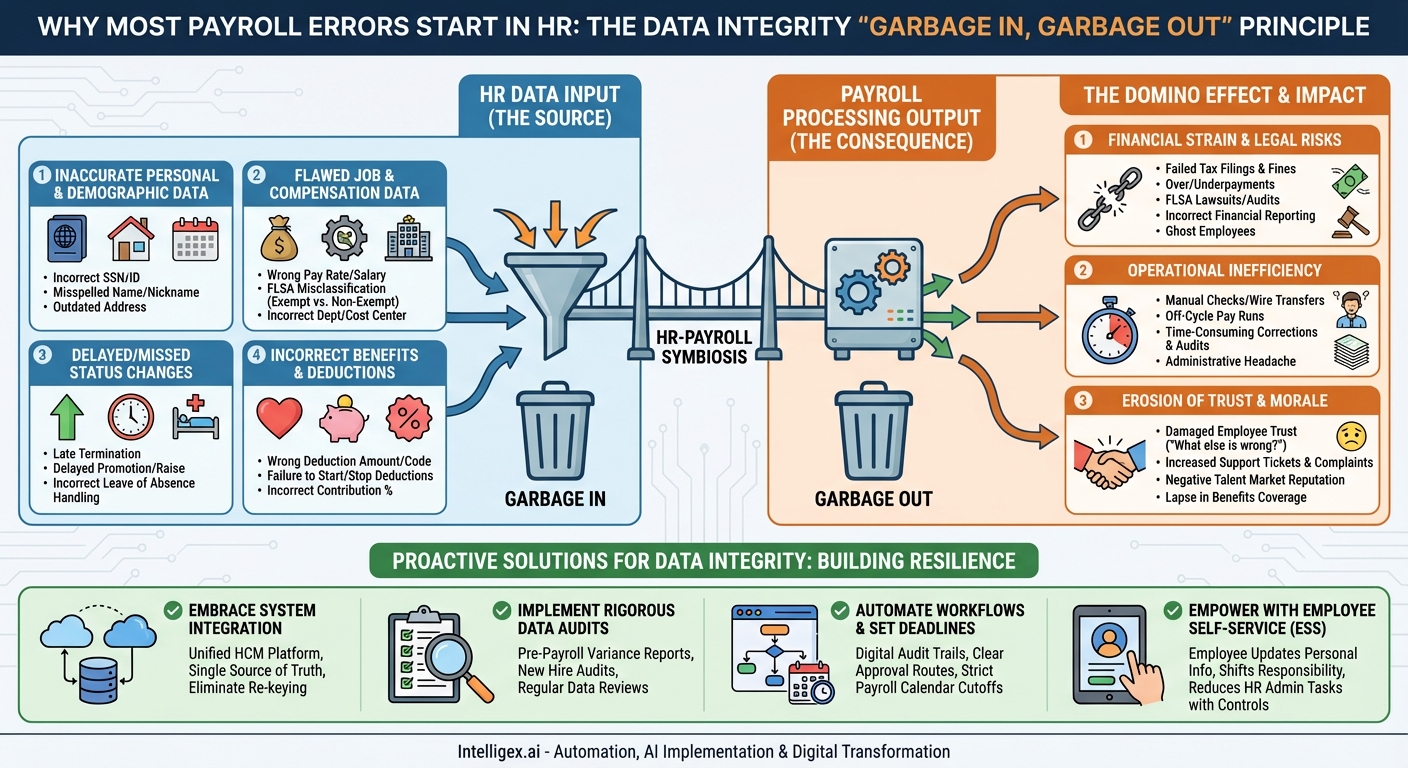
Payroll processing is often seen as a precise, numbers-driven function, a world of decimals, tax codes, and deadlines. Yet, the accuracy of every single paycheck hinges on something that happens long before calculations begin: the quality of data provided by Human Resources. The relationship between HR and Payroll is symbiotic; one cannot function effectively without the other. When HR data is flawed, the payroll process, no matter how sophisticated, will inevitably produce errors. This is the classic principle of “garbage in, garbage out,” and its consequences can ripple through an organization, causing financial strain, legal exposure, and a significant blow to employee morale.
A single mistake—a mistyped digit in a bank account, a delayed termination entry, or an incorrect pay rate—is never just a single mistake. It’s the start of a domino effect. Correcting the initial error requires time from both HR and payroll staff, pulling them away from strategic tasks to perform forensic accounting on a single employee’s pay stub. It may require off-cycle pay runs, which can incur extra processing fees. It damages the trust between the employee and the company, leaving them to wonder, “If they can’t get my pay right, what else are they getting wrong?” In a competitive talent market, that erosion of trust is a liability no company can afford. Let’s delve into the most common HR data errors that wreak havoc on payroll and explore how to build a more resilient and accurate system.
Inaccurate Personal and Demographic Data
At the most basic level, payroll needs to know who to pay, where they live, and their legal identifiers. Errors in this foundational data set create immediate and often serious problems.
The Errors:
- Incorrect Social Security Numbers (SSNs) or National Identifiers: A simple transposition of two digits during onboarding can cause chaos.
- Misspelled Names or Use of Nicknames: Using “Mike” instead of “Michael” on official documents can cause mismatches with bank and tax authorities.
- Outdated Home Addresses: An employee moves and forgets to update their address in the HR system.
The Payroll Impact:
The consequences of these seemingly minor errors are significant. An incorrect SSN will cause a mismatch with the Social Security Administration, leading to failed tax filings and potential fines from the IRS or other tax agencies. It means year-end tax forms like W-2s are rejected, creating a frantic scramble to correct and re-issue documents. A misspelled name or an incorrect bank account number will cause a direct deposit to fail. This leaves an employee without their expected pay, forcing the payroll team to rush a manual check or wire transfer. An old address means physical paychecks, and more importantly, year-end tax documents are mailed to the wrong location, creating a security risk and delaying the employee’s ability to file their personal taxes.
Flawed Job and Compensation Data
This category is arguably the source of the most frequent and financially impactful payroll errors. It all comes down to what an employee does and how much they are paid for it.
The Errors:
- Incorrect Pay Rate or Salary: A manager agrees to a salary of $65,000, but HR mistakenly enters $60,500 into the system.
- Wrong FLSA (Fair Labor Standards Act) Classification: An employee is incorrectly classified as “exempt” (salaried) when their job duties legally qualify them as “non-exempt” (hourly), or vice-versa.
- Incorrect Department or Cost Center Codes: An employee is assigned to the “Marketing” G/L code when they actually work in “Sales.”
The Payroll Impact:
An incorrect pay rate is the most direct cause of overpayments or underpayments, leading to frustrated employees and complex correction processes. Recovering an overpayment can be a delicate legal and interpersonal issue, while underpayments require immediate correction and can damage an employee’s financial stability. The most dangerous error here is FLSA misclassification. If a non-exempt employee is wrongly classified as exempt, the company is failing to pay them legally required overtime. This can lead to Department of Labor audits, back-pay awards for months or even years of unpaid overtime, and costly class-action lawsuits. Finally, incorrect cost center codes corrupt financial reporting. The company’s leadership is making budget decisions based on inaccurate labor cost data, which can lead to poor strategic planning and misallocation of resources.
Delayed or Missed Employee Status Changes
An employee’s journey within a company is dynamic. They get promoted, take leaves of absence, transfer departments, and eventually, they leave. If HR does not record these changes in a timely manner, payroll will continue to operate on outdated information.
The Errors:
- Late Termination Processing: A manager fails to submit the termination paperwork until days or weeks after an employee’s last day.
- Delayed Promotion or Pay Raise Entry: A pay increase is effective on the 1st of the month, but it isn’t entered into the HR system until the 15th, after the payroll cutoff.
- Incorrect Handling of Leaves of Absence: An employee goes on FMLA leave, but their status is not updated, causing regular pay and deductions to continue incorrectly.
The Payroll Impact:
Paying a terminated employee is one of the most glaring and costly payroll errors. These “ghost employees” represent a significant financial drain and a fraud risk. Attempting to claw back these funds is a difficult and often unsuccessful process. For promotions, a delayed entry results in retroactive pay calculations, which are complex and prone to further error. The employee is underpaid, and the payroll team has to perform manual adjustments in a subsequent pay period. For leaves of absence, failing to update an employee’s status can mean the company continues to pay its portion of health insurance premiums for an employee who should be paying the full amount, or it can lead to incorrect pay calculations if the leave is partially paid. It creates a compliance nightmare and an administrative headache to reconcile.
Incorrect Benefits Enrollment and Deductions
Benefits are a core part of an employee’s total compensation, and the deductions associated with them are a critical component of every payroll run. Errors here directly impact an employee’s take-home pay and their access to vital services like healthcare.
The Errors:
- Wrong Deduction Amount or Code: An employee elects the “Family” health plan, but HR mistakenly assigns them the “Employee + Spouse” deduction amount.
- Failure to Start or Stop Deductions: A new hire’s 401(k) election is not entered in time for their first eligible payroll, or a terminated employee’s health insurance deduction isn’t stopped on their final check.
- Incorrect Contribution Percentages: A 4% 401(k) contribution is keyed in as 0.4% or, worse, 40%.
The Payroll Impact:
Incorrect deductions are immediately noticeable to employees and are a major source of support tickets and complaints. Under-deducting means the employee owes more money later, creating a future financial burden. Over-deducting reduces their take-home pay unfairly. For retirement plans, failing to make timely deductions can cause an employee to miss out on investment gains and, more seriously, can jeopardize the qualified status of the company’s 401(k) plan if employer-matching contributions are also missed. The most severe consequence is when a deduction error leads to a lapse in coverage. If a company fails to remit an employee’s health insurance premium, that employee could be denied medical care, creating a massive liability and ethical crisis for the employer.
Proactive Solutions for Data Integrity
Recognizing the sources of error is the first step. The next is to build a resilient framework that prevents them from occurring in the first place. This requires a multi-faceted approach involving technology, process, and people.
1. Embrace System Integration
The root of many errors is the manual transfer of data between disconnected systems. An organization might have one system for applicant tracking, another for core HR, a separate one for timekeeping, and a fourth for payroll. Every time data is re-keyed, the risk of error multiplies. The solution is to invest in a unified Human Capital Management (HCM) platform where a single data entry—a new hire, a pay change, a termination—flows automatically and seamlessly from the HR module to the payroll module. This creates a “single source of truth” and eliminates the risk of data falling out of sync.
2. Implement Rigorous Data Audits
Do not wait for an employee to report an error. Proactive auditing is essential. Before each payroll run, generate reports that flag potential issues. A variance report, for example, can compare the current payroll to the previous one and highlight any employee with a significant change in gross or net pay, prompting a closer look. An audit report for new hires should be reviewed to ensure their name, SSN, pay rate, and bank details are all correct before their first paycheck is ever processed. Regular audits of employee addresses, benefit elections, and job data can catch errors before they fester.
3. Automate Workflows and Establish Clear Deadlines
Relying on emails and paper forms to communicate critical changes is a recipe for disaster. Modern HR systems allow for the creation of automated workflows. When a manager wants to promote an employee, they initiate a digital form. The form is automatically routed for necessary approvals (e.g., to department head, then to HR) before the data is committed to the system. This creates a digital audit trail and ensures all stakeholders have signed off. Couple this with a strictly enforced payroll calendar. Communicate clear deadlines for submitting all changes and make it clear that anything submitted after the cutoff will have to wait for the next pay cycle, ensuring the payroll team has adequate time to process accurately.
4. Empower with Employee Self-Service (ESS)
Who knows an employee’s personal information best? The employee. Providing them with a self-service portal to update their own address, emergency contacts, and direct deposit information shifts the responsibility for accuracy to the source. This not only improves data quality but also frees up HR staff from administrative tasks. However, ESS must be implemented with controls. While an address change can be instant, a change to bank details might trigger a notification to HR for review to prevent fraud.
Ultimately, clean HR data is the bedrock of a reliable payroll system. It is a shared responsibility that extends from the employee entering their information, to the manager approving a change, to the HR professional overseeing the system. By closing the gaps with integrated technology, disciplined processes, and a culture of accountability, organizations can transform payroll from a source of anxiety and risk into what it should be: a seamless, accurate, and positive reflection of the value placed on every employee.
Your Next Read:
Category:
Get a FREE
Proof of Concept
& Consultation
No Cost, No Commitment!