

A new salesperson joins your team on Monday. By Wednesday, they still lack access to the CRM. A manager gets a promotion, but their new title doesn’t appear in the company directory for a week, and their first paycheck reflects their old salary. These are not isolated IT or HR issues. They are symptoms of a disconnected data backbone, where critical employee information is trapped in separate, unsynchronized systems. The result is a cascade of manual corrections, security risks, and operational friction that quietly drains productivity.
The solution lies in creating a seamless, automated flow of information from the system where employee data originates (the HRIS) to the systems that depend on it for payroll and access. This synchronization isn’t just about technical efficiency. It’s a strategic imperative that directly impacts business speed, cost, and security. By establishing the Human Resources Information System (HRIS) as the single source of truth, you can build a reliable foundation for employee lifecycle management that scales with your organization.
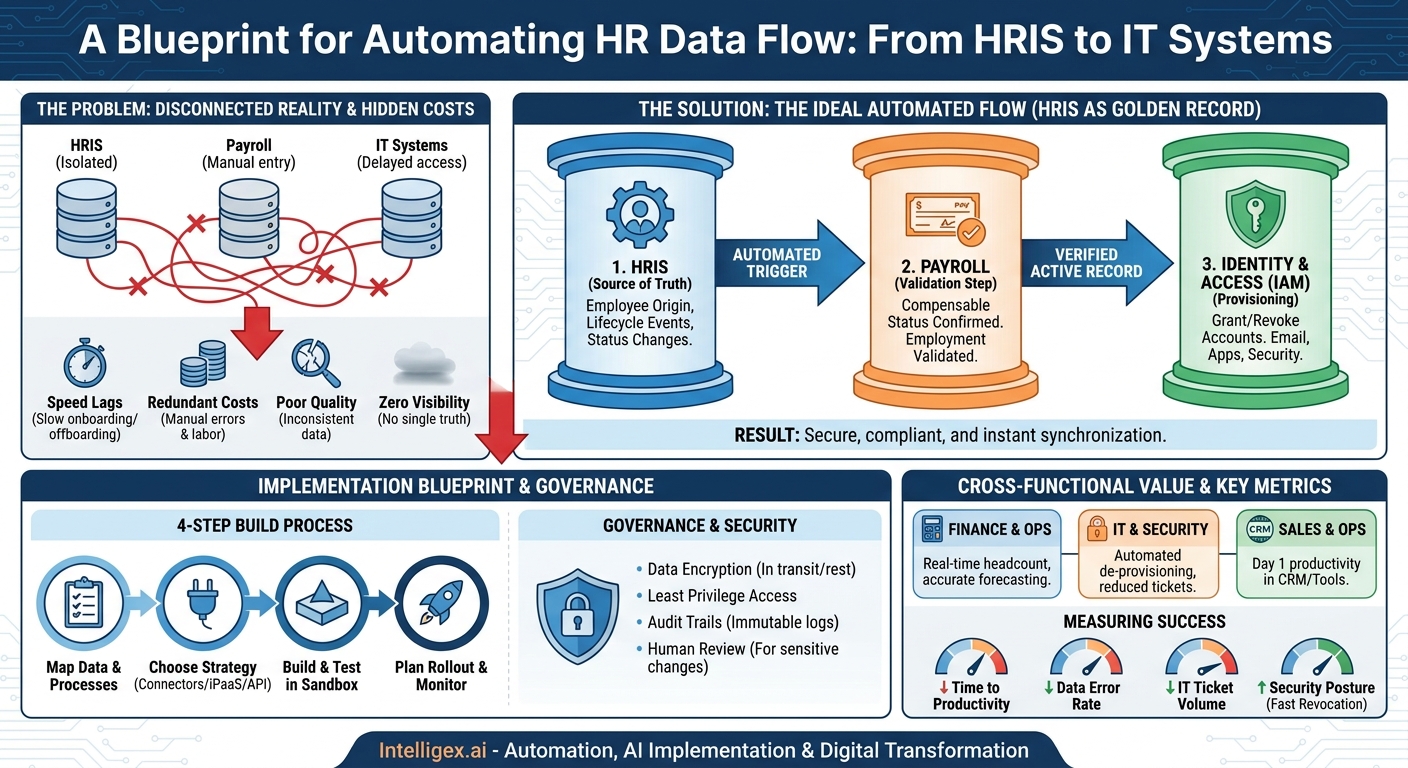
The Hidden Costs of Disconnected HR Systems
When your HRIS, payroll, and identity management systems don’t talk to each other, the consequences ripple across the entire organization. These costs are often hidden within departmental budgets, appearing as excess administrative overhead, reactive IT support, and avoidable compliance risks. Understanding these specific impacts is the first step toward building a business case for integration.
The primary costs fall into four business-critical categories:
- Speed: Manual processes are inherently slow. Onboarding becomes a multi-day ordeal of emails and support tickets, delaying a new hire’s time to productivity. Offboarding is even more critical. A delay in revoking system access after an employee leaves creates a significant security vulnerability. Organizational changes, like promotions or departmental moves, get stuck in limbo, causing confusion and frustration.
- Cost: Every time an HR administrator manually enters new hire data into three different systems, you are paying for redundant labor. Worse, you are paying to fix the inevitable human errors. A typo in a bank account number can delay payroll, while an incorrect department code can wreck budget forecasts. Over time, the cost of manual data reconciliation and error correction far exceeds the investment in automation.
- Quality: Inconsistent data leads to poor decision-making. If your finance team pulls a headcount report from the payroll system while a department head uses a report from the HRIS, the numbers will not match. This data divergence erodes trust and makes strategic workforce planning nearly impossible. Low-quality data also degrades the employee experience, sending a message that the organization is disorganized.
- Visibility: Without a single source of truth, no one has a clear, real-time view of the organization. Leaders cannot confidently answer basic questions like “How many people are in the engineering department today?” or “What is our current total salary expenditure?” This lack of visibility hampers agility and makes it difficult to respond to market changes or internal needs.
The Ideal Flow: HRIS as the Single Source of Truth
To solve these challenges, you must establish a clear, logical, and automated data flow. The most resilient model uses the HRIS as the “golden record” for all employee information. This is the system where an employee’s journey begins and where all status changes, such as promotions, transfers, or terminations, are officially recorded. From there, data flows downstream in a specific sequence: HRIS to Payroll, and then to Identity and Access Management (IAM).
Here’s why this order is so effective:
HRIS → Payroll: The HRIS (like Workday or BambooHR) holds the core identity and organizational data: name, title, department, manager, and start date. This information is the trigger. When a new hire is finalized in the HRIS, that event should automatically create a corresponding record in the payroll system (like ADP). This first leg of the journey ensures that the employee exists officially for compensation purposes. It validates their employment status before any access is granted.
Payroll → Identity: Once the employee record is active in payroll, the flow continues to the identity management system (like Okta or Microsoft Entra ID). This step is critical. The IAM system provisions accounts and grants access to applications like email, messaging platforms, and core business software. By making this step dependent on a verified payroll record, you create a powerful control. It prevents the creation of “ghost” accounts for individuals who are not officially on the payroll, strengthening both security and compliance.
This directional flow, from HRIS to Payroll to Identity, creates a chain of validation. An employee cannot be paid without being in the HRIS, and they cannot gain access to sensitive systems without being an active, payable employee. This structure transforms routine HR events into automated, reliable, and secure business processes.
A Practical Blueprint for Implementation
Connecting these systems requires a methodical approach. A successful project moves beyond simply connecting APIs; it involves a deep understanding of your business processes and data. Rushing the implementation can lead to propagating bad data faster, so careful planning is essential.
Follow these steps to build a robust and scalable integration:
- Map Your Core HR Processes and Data Fields: Before writing any code or configuring any connector, document every step of your key employee lifecycle events. Focus on the most frequent and critical ones first: new hire onboarding, promotion or transfer, and termination. For each process, identify every data field that needs to move between systems. Create a simple data dictionary that lists the field name in the source system (HRIS) and its corresponding name in the target systems (Payroll, IAM). Be precise. “Job Title” in the HRIS might map to “Position” in the payroll system.
- Choose Your Integration Strategy: You have several options for technically connecting the systems. The right choice depends on your existing technology stack, budget, and in-house expertise.
- Native Connectors: Many modern SaaS applications offer pre-built integrations with other popular platforms. These are often the fastest to set up but may lack flexibility for custom business rules.
- Integration Platforms (iPaaS): Tools like MuleSoft, Workato, or Celigo provide a middle layer to build, manage, and monitor integrations. They offer a balance of speed and customizability, with visual workflows and pre-built connectors.
- Custom API Development: For highly unique requirements, you can use the systems’ APIs (Application Programming Interfaces) to build a completely custom solution. This offers maximum flexibility but requires significant development and maintenance resources.
- Build and Test in a Sandbox Environment: Never build or test an integration using live employee data. All major HRIS, payroll, and IAM providers offer sandbox or development environments. Use these to build the integration and run a comprehensive set of test cases. Test for common scenarios like a new hire, but also for edge cases like a re-hire, a name change, or an international transfer. Verify that data flows correctly and that errors are handled gracefully.
- Plan for Rollout and Monitoring: Start with a phased rollout. You might begin by enabling the integration for a single department or location. This allows you to identify and fix any unforeseen issues before impacting the entire organization. Once live, implement robust monitoring and alerting. You need to know immediately if an integration fails, so you can intervene manually and prevent data from falling out of sync.
Beyond Onboarding: Cross-Functional Business Value
While automated onboarding and offboarding are the most obvious benefits, a synchronized HR data flow delivers value to nearly every department. When employee data is reliable and current across all platforms, it becomes a strategic asset that unlocks new efficiencies.
Finance and Operations
For the finance team, accurate, real-time headcount and compensation data is foundational. With a direct link from the HRIS, they can trust the numbers used for budgeting, forecasting, and financial reporting. This eliminates the tedious process of manually reconciling headcount reports between HR and Finance at the end of each month. During an audit, demonstrating a systematic, automated flow of data from the source system provides a clear and defensible control.
IT and Security
IT departments are often buried in manual ticket requests for user account creation and permission changes. Automating user provisioning based on HRIS data frees up the IT team to focus on more strategic initiatives. The security benefits are even more significant. Automated de-provisioning, triggered by a termination event in the HRIS, is one of the most effective security controls an organization can implement. It ensures that access to sensitive data is revoked the moment an employee leaves, drastically reducing the risk of data exfiltration or unauthorized access.
Sales, Marketing, and Supply Chain
The impact extends to revenue-generating and operational teams as well. When a new sales representative is hired, the automated flow can ensure their immediate creation in the CRM (like Salesforce), with the correct territory and permissions assigned from day one. In marketing, new team members get instant access to content management and analytics platforms. For a logistics company, a new warehouse operator or driver can be automatically provisioned with access to inventory and routing systems, ensuring they are productive immediately.
Key Metrics: How to Measure Success
To justify the investment and demonstrate ongoing value, it is crucial to measure the impact of your HR data synchronization project. Instead of relying on anecdotal evidence, track specific, quantifiable metrics that connect the integration to business outcomes. Focus on metrics that reflect improvements in speed, cost, and quality.
Consider tracking the following:
- Time to Productivity: Measure the average time from a new hire’s official start date to the moment they have access to all their essential systems (email, core business apps, etc.). A successful integration should reduce this from days to hours, or even minutes.
- Data Error Rate: Before implementation, baseline the number of monthly manual corrections required in your payroll and IT systems due to incorrect employee data. After the integration is live, track the reduction in these errors.
- IT Ticket Volume: Monitor the number of help desk tickets related to user account creation, password resets for new hires, and access permission requests. A sharp decline is a direct indicator of automation success.
- De-provisioning Time: This is a critical security metric. Measure the average time between an employee’s termination being processed in the HRIS and the revocation of their access to key systems. The goal should be to get this as close to real-time as possible.
Navigating Data Privacy and Governance
Automating the flow of sensitive employee data carries significant responsibility. A poorly designed integration can expose Personally Identifiable Information (PII) or grant incorrect permissions, creating serious privacy and security risks. Building a strong governance framework around your integration is not optional.
Your implementation plan must include a focus on safe and compliant data handling. Adhere to core principles like the principle of least privilege, where the integration service accounts have only the minimum permissions necessary to perform their tasks. For example, the service account reading from the HRIS should have read-only access to most fields.
Use this checklist to guide your governance strategy:
- Data Ownership: Is there a clear business owner for the data in each system (HR for HRIS, Finance for Payroll, IT for IAM)?
- Data Encryption: Is all employee data encrypted both in transit (using protocols like TLS) and at rest within each system’s database?
- Access Control: Does the integration logic strictly follow the principle of least privilege? Have the permissions of the integration’s service accounts been audited?
- Audit Trails: Does the integration platform create an immutable log of every record it creates, updates, or deletes? This is essential for troubleshooting and for demonstrating compliance.
- Human Review: For highly sensitive changes, such as executive-level role changes or significant compensation adjustments, consider building a “human-in-the-loop” step. The automation can flag the event and route it to a designated manager for approval before the change is finalized in downstream systems. To learn more about building secure cloud applications, official documentation from providers like Microsoft Azure is an invaluable resource.
Your Next Steps to a Synchronized HR Ecosystem
Creating a seamless flow of HR data is a foundational step in digital transformation. It replaces slow, error-prone manual tasks with a fast, reliable, and secure automated process. The benefits are clear: faster onboarding, lower administrative costs, a stronger security posture, and more reliable data for decision-making across the business.
Getting started does not require a massive, multi-year project. You can achieve significant value by taking a deliberate, incremental approach.
- Audit Your Current State: Begin by identifying your biggest pain points. Where do data discrepancies cause the most rework? Which manual processes are slowing down your teams? Talk to HR, IT, and Finance to pinpoint the bottlenecks.
- Identify a Pilot Project: Don’t try to automate everything at once. The new hire onboarding process is often the ideal starting point. It’s a high-frequency, high-value process where the benefits of automation are immediately visible.
- Engage Key Stakeholders: Bring together leaders from HR, IT, and Finance for a workshop. Map out the current process and collaboratively design the desired future state. Gaining alignment on goals and data definitions early is critical for success.
- Explore Your Technical Options: Investigate the capabilities of your existing systems. Do your HRIS and IAM platforms have pre-built connectors? If so, a pilot project could be simpler than you think. If not, begin evaluating which integration strategy best fits your long-term goals and technical resources.
By transforming your HR data flow from a series of manual handoffs into an automated, trustworthy system, you build a more agile, secure, and efficient organization ready for future growth.
Your Next Read:
Category:
Get a FREE
Proof of Concept
& Consultation
No Cost, No Commitment!
