

The age of artificial intelligence is no longer on the horizon; it’s here. Businesses across every industry are scrambling to integrate AI into their operations, hoping to unlock new efficiencies, create smarter products, and gain a decisive edge over the competition. Yet, for every story of an AI-driven breakthrough, there are countless others of stalled projects, budget overruns, and initiatives that, despite being technologically impressive, deliver little to no tangible business value. The “build it and they will come” approach simply doesn’t work for AI. The critical difference between success and failure often lies in the very first step: choosing where to focus your efforts.
Without a rigorous framework for prioritization, organizations risk falling into common traps. They might pursue “AI for AI’s sake,” chasing trendy applications without a clear problem to solve. Or they might get bogged down in a highly complex, long-term project that drains resources before ever showing a return. The key to avoiding these pitfalls is to move from a technology-first mindset to a value-first strategy. This means systematically identifying, evaluating, and prioritizing AI use cases based on one primary criterion: their potential business impact. This guide will walk you through a practical framework to do just that, helping you build an AI roadmap that delivers real, measurable results.
Why Strategic Alignment is Non-Negotiable
Before you can even think about algorithms or data sets, your AI strategy must be firmly anchored to your overarching business strategy. AI should never be a solution in search of a problem; it must be a powerful tool aimed directly at your most significant challenges and opportunities. The first step is to look away from the technology and look toward your company’s core objectives.
What are your organization’s primary goals for the next one to three years? Are you focused on aggressive revenue growth, significant cost reduction, market share expansion, or enhancing customer loyalty? Your C-suite has likely defined these goals. Your job is to make them the foundation of your AI exploration. Every potential AI use case must be held up against these objectives and answer a simple question: “How will this project help us achieve one of our core strategic goals?”
Connecting the Dots: From Goals to Use Cases
Once your strategic goals are clear, you can begin brainstorming potential AI applications that directly support them. This process transforms abstract business aims into concrete, actionable ideas.
- If your goal is to reduce operational costs, potential AI use cases might include:
- Predictive Maintenance: Using sensor data to predict equipment failure in a manufacturing plant, reducing downtime and costly emergency repairs.
- Automated Invoice Processing: Deploying natural language processing (NLP) to read, categorize, and process invoices, freeing up your finance team for more strategic work.
- Supply Chain Optimization: Implementing AI models to forecast demand more accurately and optimize logistics and inventory levels, cutting down on waste and carrying costs.
- If your goal is to increase revenue, you might explore:
- Personalized Recommendations: Developing a recommendation engine for your e-commerce site that increases average order value and conversion rates.
- Dynamic Pricing: Using an AI model to adjust prices in real-time based on demand, competitor pricing, and inventory levels.
- AI-Powered Lead Scoring: Building a system that analyzes customer data to identify and prioritize leads most likely to convert, allowing your sales team to focus their efforts effectively.
This initial step of aligning AI initiatives with business goals serves as a powerful first filter. It immediately weeds out projects that are technologically interesting but strategically irrelevant, ensuring that your valuable resources are directed where they can make the most difference.
The Prioritization Matrix: Balancing Impact and Feasibility
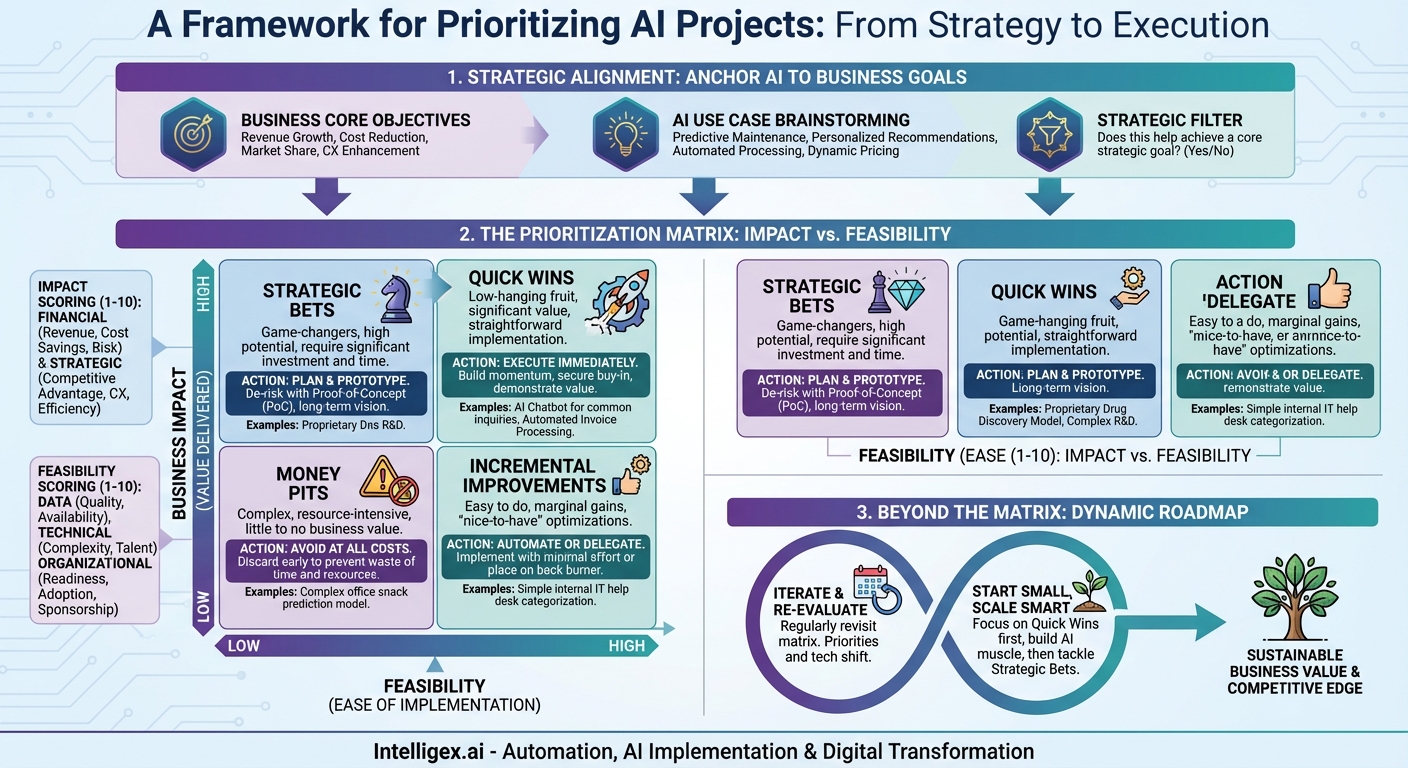
After brainstorming a list of strategically aligned use cases, the next challenge is to decide which ones to tackle first. A highly effective method for this is a two-axis prioritization matrix. This simple yet powerful tool forces you to evaluate each potential project along two critical dimensions: Business Impact and Feasibility. By plotting your use cases on this matrix, you can visually categorize them and make data-driven decisions about your AI roadmap.
Axis 1: Quantifying Business Impact
Business impact is the measure of the value a use case could deliver if successfully implemented. To assess this accurately, you need to move beyond gut feelings and use concrete metrics. A good approach is to create a scoring system (e.g., on a scale of 1 to 10) that considers a blend of financial and strategic factors.
Financial Metrics:
- Revenue Generation: How much new revenue could this project create? This could be through increased sales, higher conversion rates, or the creation of entirely new AI-enabled products or services.
- Cost Savings: How much money could this project save the company? Calculate potential savings from reduced labor hours, lower material waste, decreased error rates, or improved process efficiency.
- Risk Reduction: What is the financial value of mitigating a specific risk? This could involve preventing fraud, avoiding regulatory fines, or reducing the likelihood of a costly operational failure.
Strategic Metrics:
- Competitive Advantage: Will this project create a sustainable competitive moat? Does it leverage proprietary data or create a capability that is difficult for competitors to replicate?
- Customer Experience (CX): How significantly will this improve customer satisfaction, loyalty, or Net Promoter Score (NPS)? A superior customer experience can be a powerful long-term value driver.
- Operational Efficiency: Beyond direct cost savings, how much faster, more reliable, or more streamlined will our core processes become?
By assigning a score to each of these categories for every use case, you can calculate a weighted average to determine a final, objective Impact Score.
Axis 2: Assessing Feasibility
A high-impact idea is worthless if you can’t actually build it. The feasibility axis measures the likelihood of successfully implementing the use case, considering technical, data, and organizational hurdles. Like the impact score, this should be quantified using a 1-10 scale.
Data Availability and Quality:
- This is often the single biggest barrier to AI success. Do you have the necessary data to train the model? Is it accessible, clean, labeled, and sufficient in volume? A project with perfect potential but no data is a non-starter.
Technical Complexity:
- What level of technical expertise is required? Can this be solved with a relatively simple, off-the-shelf API or does it require a team of PhD-level data scientists to build a novel algorithm from scratch? Do you have the necessary talent in-house, or will you need to hire or outsource?
Organizational Readiness:
- Successful AI implementation is as much about people as it is about technology. Is there a strong executive sponsor for the project? How significant is the change management required? Will employees embrace and adopt the new AI-driven process, or will they resist it? You must also consider the ethical, legal, and regulatory implications.
Combine these factors into a final Feasibility Score for each use case. Now you have two numbers for every idea: one representing its potential value and another representing the ease of achieving that value.
Putting It All Together: The Four Quadrants of AI Opportunity
With your use cases scored on both impact and feasibility, you can plot them on a 2×2 matrix. This visualization will clearly group your projects into four distinct categories, each with a clear course of action.
Quadrant 1: Quick Wins (High Impact, High Feasibility)
These are your top priorities. The projects that land in this quadrant are the low-hanging fruit of your AI strategy. They promise to deliver significant business value and are relatively straightforward to implement given your current data, technology, and talent.
Action: Execute immediately. These projects are perfect for building momentum, demonstrating the value of AI to skeptical stakeholders, and securing buy-in and funding for more ambitious future initiatives. Success here creates a virtuous cycle of trust and investment.
Example: Implementing a well-established AI-powered chatbot service to handle the top 20% of common customer service inquiries, freeing up human agents for more complex issues.
Quadrant 2: Strategic Bets (High Impact, Low Feasibility)
This quadrant contains your game-changers. These are the highly ambitious, transformational projects that could redefine your business or even your entire industry. However, they come with significant challenges—they may require massive data collection efforts, groundbreaking research, or substantial organizational change.
Action: Plan and Prototype. Do not commit to a full-scale rollout immediately. Instead, treat these as long-term strategic investments. Break them down into manageable phases, starting with a small-scale proof-of-concept (PoC) or pilot program. The goal is to de-risk the project by testing your core assumptions, validating the technology, and demonstrating potential value on a smaller scale before seeking a major investment. These projects require long-term vision and unwavering executive sponsorship.
Example: Developing a proprietary deep learning model to discover new pharmaceutical compounds, a project with immense potential but high technical and scientific uncertainty.
Quadrant 3: Incremental Improvements (Low Impact, High Feasibility)
Projects in this quadrant are easy to do but don’t move the needle in a meaningful way. They might be “nice-to-have” features or small optimizations that offer marginal gains. While tempting because of their simplicity, they can become a dangerous distraction.
Action: Automate or Delegate. If these can be implemented with minimal effort using off-the-shelf tools or by a junior team member, they might be worth pursuing. However, be wary of letting these “trivial tasks” consume resources that could be dedicated to a genuine Quick Win. Often, the best course of action is to place them on the back burner.
Example: Building a simple AI script to automatically categorize internal IT help desk tickets for a team of five.
Quadrant 4: Money Pits (Low Impact, Low Feasibility)
This is the danger zone. These projects are difficult, complex, and resource-intensive to implement, and even if you succeed, they offer little to no business value. These ideas are often born from a desire to use a specific technology (e.g., “we should be doing something with generative AI”) without any connection to a real business problem.
Action: Avoid at all costs. Your prioritization framework should make these projects easy to identify. It is crucial to discard these ideas early and decisively to prevent a catastrophic waste of time, money, and your team’s morale.
Example: A complex project to predict office snack preferences using machine learning, requiring significant data collection for a negligible return.
Beyond the Matrix: Building a Dynamic AI Roadmap
Your prioritization matrix is not a one-time exercise etched in stone. It is a living document that should guide the creation of a dynamic, adaptable AI roadmap.
Iterate and Re-evaluate
The world of AI moves at lightning speed. A technology that is a “Strategic Bet” today might become a highly feasible “Quick Win” in eighteen months as tools mature and become more accessible. Similarly, your business priorities may shift. It’s essential to revisit and re-evaluate your use case matrix on a regular basis—at least quarterly or semi-annually. This ensures your AI roadmap remains aligned with both technological reality and business strategy.
Start Small, Scale Smart
Resist the urge to tackle everything at once. The most successful AI strategies often start with a laser focus on one or two high-priority Quick Wins. Use these initial projects to not only deliver value but also to build your organization’s “AI muscle.” The lessons learned, infrastructure built, and skills developed during these early projects will dramatically improve your ability to assess and execute on your more complex Strategic Bets down the line. A healthy AI portfolio is a balanced one, containing a mix of projects that deliver immediate value while paving the way for future transformation.
Ultimately, the organizations that will lead in the age of AI won’t be the ones with the most data scientists or the most complex algorithms. They will be the ones with the clearest vision and the most disciplined strategy. By systematically evaluating every potential initiative through the dual lenses of business impact and feasibility, you can cut through the hype, focus your resources where they matter most, and build an AI roadmap that truly drives your business forward.
Your Next Read:
Category:
Get a FREE
Proof of Concept
& Consultation
No Cost, No Commitment!