

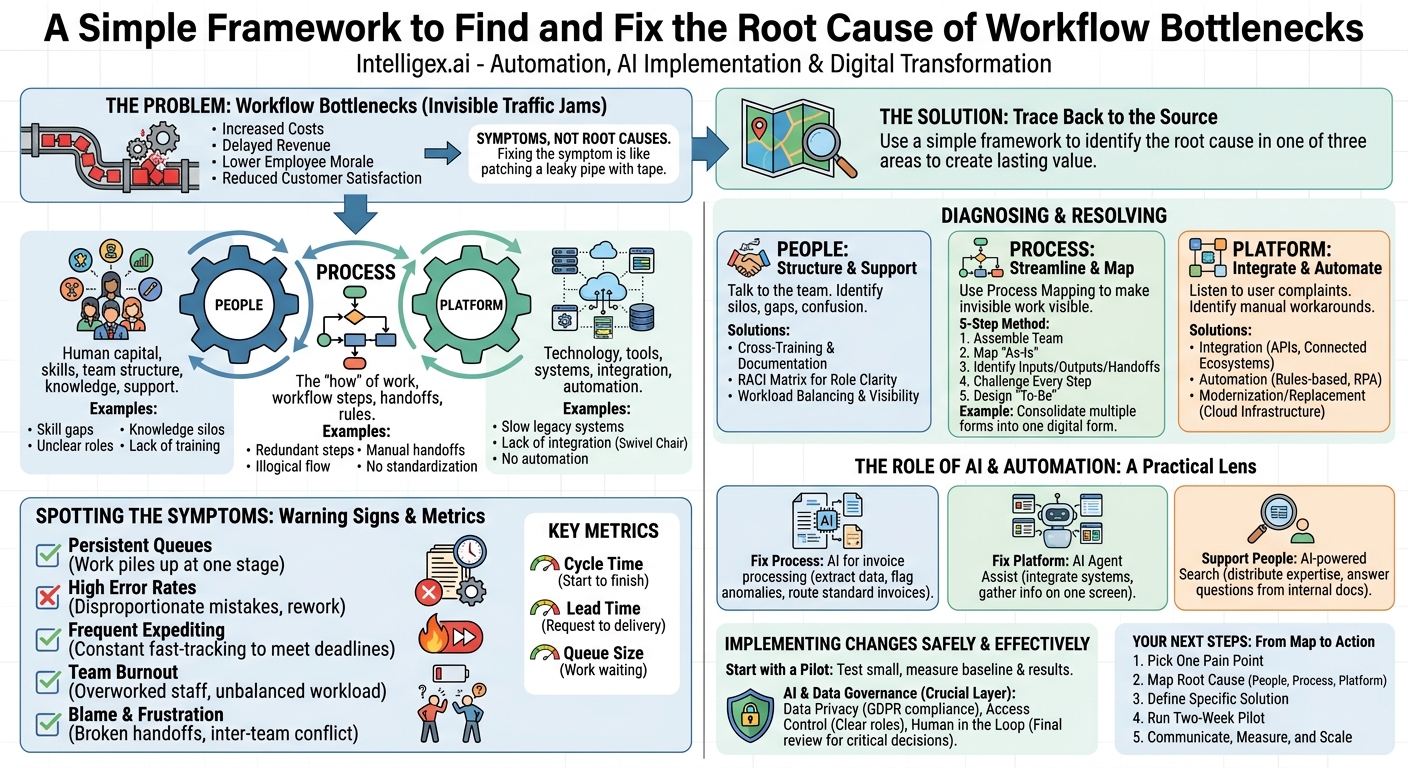
Every business has them. They are the invisible traffic jams in your operations, the points where progress slows to a crawl, and work piles up. These are workflow bottlenecks, and they do more than just cause frustration. They directly impact your bottom line by increasing costs, delaying revenue, and hurting both employee morale and customer satisfaction. The problem is that bottlenecks are often symptoms of a deeper issue, and fixing the symptom without understanding the root cause is like patching a leaky pipe with tape. The leak will always find a new place to break through.
To truly solve these constraints, you need a simple but effective map to trace the problem back to its source. Most workflow bottlenecks, regardless of the department or industry, originate from one of three areas: People, Process, or Platform. By using this framework, you can move beyond quick fixes and begin implementing changes that create lasting value, improving speed, quality, and scalability across your organization.
Spotting the Symptoms: Where to Look for Bottlenecks
Before you can diagnose the cause, you must first recognize the symptoms. Bottlenecks are not always obvious. They can hide within a single team’s daily tasks or in the handoffs between major departments. The key is to learn how to spot the warning signs that a process is under strain. These signs often appear long before a major project fails or a client complains.
Look for recurring patterns of inefficiency. A single missed deadline might be an anomaly, but if the finance team is always late closing the books at month-end, you have a systemic issue. If one senior developer is the only person who can deploy code to production, you have a critical dependency that is slowing everyone else down. These patterns are your starting point.
To make this more concrete, here is a checklist of common symptoms to watch for in your own teams:
- Persistent Queues: Work consistently piles up at one specific stage. For example, a pile of contracts waiting for legal review or a backlog of support tickets assigned to a single agent.
- High Error Rates: A particular step in a process generates a disproportionate number of mistakes, requiring rework that consumes time and resources.
- Frequent Expediting: Teams constantly have to “fast track” or escalate work to meet deadlines, indicating the standard process is too slow.
- Team Burnout: Specific individuals or teams are consistently overworked and stressed, while others have available capacity. This often points to an unbalanced workload caused by a bottleneck.
- Blame and Frustration: When teams blame each other for delays (e.g., “Sales is submitting incomplete forms,” “IT is too slow to provision servers”), it often highlights a broken handoff in the process.
To quantify these observations, focus on a few key metrics. You do not need a complex dashboard to get started. Track simple, powerful indicators like Cycle Time (the time it takes to complete one task from start to finish), Lead Time (the total time from a customer request to delivery), and Queue Size (how much work is waiting at a specific step). A rising cycle time for a specific task is a clear signal that a constraint is getting worse.
The Root-Cause Map: People, Process, or Platform?
Once you have identified a bottleneck’s symptoms, you can use our simple framework to find the source. Nearly every operational constraint can be traced back to a root cause in one of three fundamental categories. Understanding which category your problem falls into is the most critical step, as the solution for a people-related issue is vastly different from the solution for a technology-related one.
1. People
This category covers issues related to human capital, skills, and team structure. The work itself might be well-defined, but the people performing it are constrained. This is not about blaming individuals; it is about identifying systemic issues in how your teams are structured, trained, and supported.
Examples include skill gaps where no one is trained to use a new software, knowledge silos where one person holds all the critical information, or unclear roles and responsibilities leading to dropped tasks and confusion.
2. Process
Process-related bottlenecks stem from the “how” of the work. The steps in your workflow may be redundant, illogical, or simply outdated. You might have a team of highly skilled people using great technology, but if the process they are forced to follow is inefficient, they will never achieve their full potential.
Common examples are excessive approval steps, manual handoffs between teams that cause delays, a lack of standardization leading to inconsistent work quality, or redundant data entry that serves no real purpose.
3. Platform
This category includes all the technology, tools, and systems your teams use to get work done. A platform bottleneck occurs when your technology hinders your people and processes instead of enabling them. This is an increasingly common issue as businesses adopt more software without a clear integration strategy.
Think of slow, outdated legacy systems, a lack of integration between critical applications (like your CRM and your accounting software), or a complete absence of automation for highly repetitive, manual tasks.
In the following sections, we will explore how to diagnose and solve bottlenecks within each of these three areas.
Diagnosing and Resolving People-Related Bottlenecks
When a workflow is constrained by a “people” problem, simply adding more headcount or buying new software will not fix it. In fact, it can make things worse by adding more complexity and cost. The solution lies in understanding the dynamics of your team and providing them with the structure, knowledge, and support they need to succeed.
The first step is to talk to the people doing the work. They almost always know where the problems are. Ask open-ended questions like, “What is the most frustrating part of your day?” or “If you could change one thing about how we do this, what would it be?” Their answers will point you directly toward knowledge silos, skill gaps, or role confusion.
Consider a sales operations team where every custom quote has to be approved by a single sales director. That director becomes a bottleneck. The root cause could be a lack of trust in the team (a cultural issue), or it could be that the team lacks the training to create complex quotes accurately (a skill gap). The solution for the former involves delegation and clear approval guidelines, while the solution for the latter is targeted training. One problem, two very different people-centric solutions.
Common resolutions for people-related bottlenecks include:
- Cross-Training and Documentation: Eliminate single points of failure by training multiple team members on critical tasks. Document these processes in a central knowledge base so information is not held by one person.
- Defining Roles with a RACI Matrix: For complex processes involving multiple stakeholders, a RACI chart clarifies who is Responsible, Accountable, Consulted, and Informed. This prevents tasks from being dropped during handoffs.
- Workload Balancing: Use project management tools to gain visibility into who is working on what. This allows managers to redistribute tasks from overburdened team members to those with more capacity, preventing burnout and improving flow.
Untangling Process-Related Bottlenecks with a Simple Exercise
Process bottlenecks are often the most common and the most rewarding to fix. They represent the established “rules” of how work gets done, and these rules often go unquestioned for years. Streamlining a broken process can deliver immediate gains in speed and quality without significant investment in new technology or hiring.
The most powerful tool for diagnosing a process bottleneck is process mapping. This exercise involves visually laying out every single step of a workflow, from its trigger to its completion. The goal is to make the invisible work visible, so you can challenge assumptions and identify waste.
Here is a simple, five-step method to map your process and find the friction:
- Assemble the Right Team: Gather a small group of people who are actually involved in the process every day. Do not just include managers. You need the front-line perspective to understand what really happens.
- Map the “As-Is” Process: Using a whiteboard or a digital collaboration tool, map out the current process step-by-step. Be brutally honest. If a step involves exporting a CSV, emailing it to someone, and having them manually upload it, map it exactly that way.
- Identify Inputs, Outputs, and Handoffs: For each step, note what information is needed to start it (inputs) and what it produces (outputs). Pay special attention to handoffs, which are any time work moves from one person or team to another. Handoffs are a primary source of delays and miscommunication.
- Challenge Every Step: Go through the map and ask critical questions for each box you have drawn. Is this step truly necessary? Does it add value for the customer? Can it be simplified? Why are we doing it this way? This is where you uncover redundant approvals or unnecessary reports.
- Design the “To-Be” Process: Based on your analysis, design a new, streamlined version of the process. Eliminate wasteful steps, clarify handoffs, and simplify decision points. This new map becomes your blueprint for implementation.
For example, an HR onboarding process might involve three different forms that ask for the same employee information. A process map would immediately highlight this redundancy. The “to-be” process would consolidate this into a single digital form, saving time for both the new hire and the HR team, and reducing the risk of data entry errors.
Overcoming Platform and Technology Bottlenecks
In today’s digital workplace, your technology stack can be your greatest asset or your biggest liability. Platform bottlenecks arise when your tools are slow, disconnected, or simply not fit for the purpose they are being used for. This forces your team to create manual workarounds, which are inefficient and prone to error.
A classic platform bottleneck is the “swivel chair” problem. An employee takes information from one system (like an email), swivels their chair, and manually types the same information into another system (like a CRM). This is a direct result of a lack of integration. Every minute spent on this kind of manual data transfer is a minute not spent on high-value work.
Diagnosing these issues often involves listening to user complaints. When teams say, “the system is too slow” or “I have to export everything to Excel to get my work done,” they are pointing you toward a platform bottleneck. You can also look at system performance logs or conduct user surveys to pinpoint specific pain points.
Solving technology bottlenecks often involves one of three approaches:
- Integration: Connecting siloed systems so that data can flow automatically between them. Modern applications often have APIs (Application Programming Interfaces) that allow for this. For example, integrating your e-commerce platform with your inventory system ensures your website always shows accurate stock levels. Major platforms like Salesforce are built around this principle of a connected ecosystem.
- Automation: Using software to handle repetitive, rules-based tasks. This can be as simple as an automated email response or as complex as using Robotic Process Automation (RPA) to mimic human actions across multiple legacy applications.
- Modernization or Replacement: In some cases, a legacy system is so outdated that it cannot be effectively integrated or automated. While replacing a core system is a significant undertaking, the long-term benefits in speed, security, and scalability can be immense. Using modern cloud infrastructure, for example through providers like Amazon Web Services, can provide a flexible foundation for growth.
The Role of AI and Automation: A Practical Lens
While artificial intelligence is often surrounded by hype, it is also a powerful and practical tool for solving specific types of bottlenecks when applied correctly. Instead of thinking of AI as a magical solution, think of it as a way to enhance your team’s capabilities and automate complex, judgment-based tasks that traditional automation cannot handle.
Let’s look at how AI can address issues from our framework:
- Fixing a Process Bottleneck: Consider an accounts payable team that manually reviews thousands of invoices. An AI-powered tool can be trained to read and extract key information (like vendor name, date, and amount), flag any anomalies or potential duplicates, and route standard invoices for automatic payment. This frees up the human team to focus only on the exceptions, turning a multi-day process into a matter of hours.
- Fixing a Platform Bottleneck: Imagine a customer service team that has to look up information in three different systems to answer a single customer query. An AI-powered agent assist tool can integrate with those systems on the back end. When a query comes in, the tool can automatically gather all the relevant information and present it to the human agent in a single screen, dramatically reducing handling time and improving customer satisfaction.
- Supporting a People Bottleneck: When you have a knowledge silo, an AI-powered search tool can help distribute that expertise. By indexing internal documentation, past project files, and chat logs, these tools allow any employee to ask a question in natural language and get a direct, relevant answer. This reduces dependence on a single expert and accelerates learning for the entire team. A popular platform for team collaboration and project management that helps centralize this information is Jira.
The key is to start with the problem, not the technology. First identify the bottleneck using the People, Process, Platform map. Then, and only then, evaluate whether AI or automation is the right tool to solve it.
Implementing Changes Safely and Effectively
Identifying a bottleneck and designing a solution is only half the battle. The final, crucial step is implementing the change in a way that your team embraces and that does not introduce new risks to the business. A poorly managed rollout can create more problems than it solves.
First, always start with a pilot program. Choose a small, contained part of the process or a single receptive team to test your new solution. This allows you to work out the kinks on a small scale, gather feedback, and build a success story. Before you begin the pilot, be sure to measure your baseline metrics (like cycle time or error rate). After the pilot, measure them again. This data is your proof that the change is working and will be essential for getting buy-in to roll it out more broadly.
A Note on AI and Data Governance
When your solution involves automation or AI, you must add an extra layer of diligence around governance and security. These powerful tools require clear rules to operate safely.
- Data Privacy: Be certain that any AI tool you use complies with relevant data privacy laws like GDPR. Never feed sensitive personal or customer data into a public, third-party AI model unless you have a clear data processing agreement that protects that information.
- Access Control: Not everyone in the company should be able to build or deploy an automation. Establish clear roles for who can create, test, and run automated processes to prevent a “wild west” environment of uncontrolled bots.
- Human in the Loop: For any critical decision, especially those involving finance, compliance, or customer relationships, AI should be used to assist, not replace, human judgment. Always design your workflow so that a human expert has the final review and approval on high-stakes decisions.
Your Next Steps: From Map to Action
Understanding the theory behind workflow bottlenecks is valuable, but creating real change requires action. The goal is not to launch a massive, company-wide transformation project overnight. The goal is to build momentum by making one small, measurable improvement at a time. The cumulative effect of these small wins is what drives true digital transformation.
Here is your action plan to get started:
- Pick One Pain Point: Choose a single, well-understood bottleneck that causes significant frustration. Do not try to boil the ocean. A good starting point is a process where the symptoms (like long queues or frequent complaints) are already obvious.
- Map the Root Cause: Gather the team involved and use the People, Process, Platform framework to have an honest discussion about the source of the problem. Is it a skill gap? A redundant step? A slow system?
- Define a Specific Solution: Propose a clear, simple change. Instead of “improve marketing,” try “reduce the content approval cycle time from 10 days to 3 days by implementing parallel approvals in our project management tool.”
- Run a Two-Week Pilot: Test your proposed solution with a small group. Measure the “before” and “after” to gather concrete data on its impact.
- Communicate, Measure, and Scale: Share the results of your successful pilot with stakeholders. Use the data to make the case for a broader rollout. Then, move on to the next bottleneck and repeat the process.
By consistently applying this simple cycle of identifying, diagnosing, and solving bottlenecks, you will steadily increase the efficiency, speed, and resilience of your entire organization.
Your Next Read:
Category:
Get a FREE
Proof of Concept
& Consultation
No Cost, No Commitment!
