

Imagine this scenario: you’re in a critical board meeting, presenting the quarterly performance review. A board member points to a key metric on your slide—a 15% increase in customer lifetime value—and asks a simple, yet terrifying question: “Where did that number come from? Can we be certain it’s accurate?” In that moment, your confidence hinges not on the beautiful chart, but on your ability to trace that number back to its source. If you can’t, the entire presentation, and the strategy it supports, is built on a foundation of sand. This is the exact problem that data lineage solves.
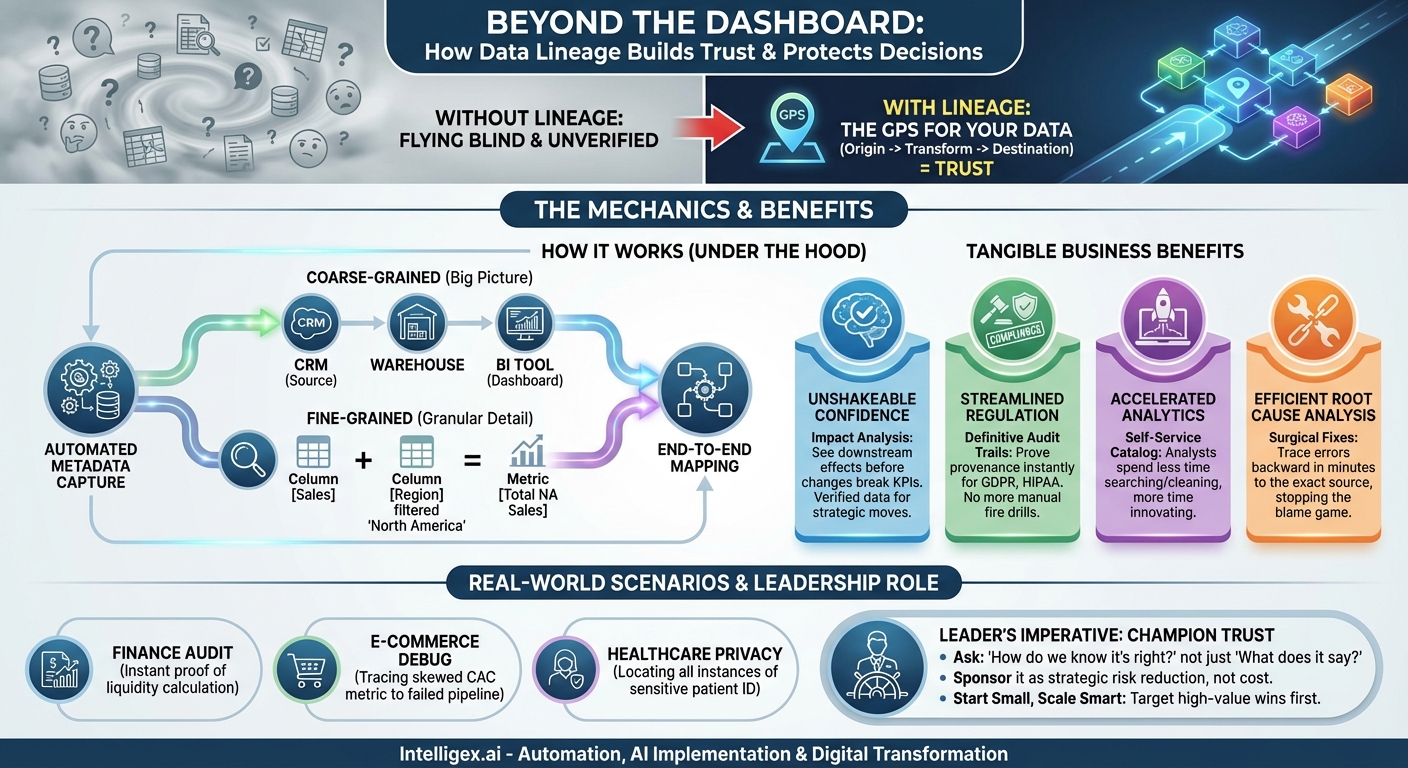
At its core, data lineage is the GPS for your data. It provides a detailed, end-to-end map of your data’s journey through your organization. It documents its origin, every stop it makes, every transformation it undergoes, and its final destination in a report or dashboard. It’s not just a technical concept for the IT department; it’s a fundamental business capability that builds the single most important currency in a data-driven organization: trust. Without lineage, you’re flying blind, making high-stakes decisions based on data you can’t fully verify. With it, you have a clear, auditable trail that turns data from a potential liability into your most powerful strategic asset.
The Tangible Business Benefits of Knowing Your Data’s Story
Understanding data lineage isn’t an academic exercise. It translates directly into competitive advantages, risk mitigation, and operational efficiency. For a leader, embracing data lineage means unlocking tangible value across the entire enterprise.
Unshakeable Confidence in Decision-Making
Every strategic decision, from market expansion to product development, relies on data. Data lineage provides an “impact analysis” lens. Before making a change to a data source, you can see exactly which downstream reports, dashboards, and critical KPIs will be affected. This prevents the all-too-common scenario where a small change in one system unexpectedly breaks a crucial executive dashboard. More importantly, it provides the verification needed to stand behind your numbers with absolute certainty, fostering a culture where data is not just present, but truly trusted.
Streamlined and Bulletproof Regulatory Compliance
In an era of GDPR, CCPA, HIPAA, and countless other data privacy and financial regulations, “I don’t know” is no longer an acceptable answer for auditors. Regulators demand that you know where your sensitive data is, how it’s being used, and how it was derived. Data lineage is the definitive audit trail. When an auditor asks you to prove the provenance of a figure in a financial report or demonstrate how you’re managing personally identifiable information (PII), a data lineage map provides an immediate, verifiable answer. This drastically reduces the time and cost of audits and minimizes the risk of multi-million dollar fines for non-compliance.
Data lineage transforms regulatory compliance from a frantic, manual fire drill into a routine, automated process. It’s the difference between panicked searching and confident reporting.
Accelerated Analytics and Innovation
Your data scientists and business analysts are some of your most expensive and valuable resources. Yet, industry studies consistently show they spend up to 80% of their time simply finding, cleaning, and trying to understand data rather than deriving insights from it. This is a massive drain on productivity and innovation. Data lineage acts as a self-service catalog for these teams. They can quickly discover the most reliable data sources, understand the business logic applied to them, and trust the data they are using. This frees them from the drudgery of data archeology and empowers them to focus on what you hired them to do: uncover the next big opportunity for your business.
Efficient Root Cause Analysis
When a report is wrong, the clock starts ticking. The traditional approach is a painful, cross-departmental blame game. The finance team questions IT, who points to the data engineering team, who suspects a source system issue. This can take days or weeks to resolve, eroding trust in the data infrastructure with every passing hour. With data lineage, the process is surgical. You can trace the incorrect metric backward through its journey, step-by-step, to pinpoint the exact transformation or source that introduced the error. A process that once took weeks of manual investigation can now be resolved in minutes, saving countless hours and restoring faith in your data analytics.
A Peek Under the Hood: How Data Lineage Works
While you don’t need to be a data engineer to benefit from data lineage, understanding its basic mechanics is helpful. Lineage is built by capturing and interpreting metadata—the “data about the data”—from all the systems in your data ecosystem.
Think of it in two levels of detail:
- Coarse-Grained Lineage: This is the high-level, “big picture” view. It shows you that data flows from System A (like a Salesforce CRM) to System B (a data warehouse) and then into System C (a business intelligence tool like Tableau). This is useful for understanding the overall data architecture and dependencies between major platforms.
- Fine-Grained Lineage: This is the granular, detailed view that provides the most business value. It doesn’t just show that Tableau gets data from the warehouse; it shows that a specific column, `[Sales_Amount]` in the `[Orders_Table]`, was joined with the `[Customer_Region]` column, filtered for “North America,” and then used to calculate the “Total NA Sales” metric in your executive dashboard. This level of detail is essential for root cause analysis and impact analysis.
Achieving this manually is impossible in any modern organization. The process relies on sophisticated, automated tools that connect to your various data sources, databases, ETL (Extract, Transform, Load) pipelines, and BI platforms. These tools automatically scan the metadata and code to stitch together the end-to-end lineage map, creating a living, breathing view of your data flows that updates as your systems change.
Data Lineage in the Wild: Three Scenarios
Let’s move from theory to practice. Here’s how data lineage plays out in real-world business contexts.
Scenario 1: The Financial Services Firm Facing an Audit
A banking regulator requests proof for a specific number in a liquidity risk report. They need to see the entire calculation trail, from the source transaction systems to the final aggregated figure. Without data lineage, this would trigger a massive, manual effort involving dozens of people digging through code and spreadsheets. With a data lineage solution, the compliance officer simply clicks on the metric in the report, and the entire flow is visualized instantly—showing every source table, every filter, and every calculation. The audit request is satisfied in hours, not weeks.
Scenario 2: The E-commerce Retailer Debugging a Marketing Dashboard
The Chief Marketing Officer notices that the “Customer Acquisition Cost” (CAC) metric on her dashboard has suddenly spiked, but campaign spending hasn’t changed. Panic ensues. Is the ad platform data wrong? Is the website analytics integration broken? Using data lineage, an analyst traces the CAC metric back. They quickly see that a data pipeline responsible for bringing in website session data failed to run the previous night. The “number of new customers” was artificially low, which skewed the calculation. The problem is identified and fixed before the CMO makes a flawed decision to cut ad spend.
Scenario 3: The Healthcare Provider Managing Sensitive Data
A new internal policy requires that all patient data used in research must be de-identified. The Chief Data Officer is tasked with ensuring compliance. Instead of conducting a massive manual survey of every database and application, they use their data lineage tool to search for all instances of sensitive patient information (like `Patient_ID` or `Diagnosis_Code`). The tool generates a map showing every single report, dataset, and analytical model that touches this sensitive data, allowing them to systematically check each one for compliance and identify potential risks.
Your Role as a Leader: Championing a Culture of Trust
Data lineage is not merely a technology to be implemented by IT; it is a business strategy that must be championed from the top. Its success depends as much on culture as it does on code.
Ask the Right Questions
Shift the conversation in your meetings. Instead of just asking, “What does the data say?” start asking, “How do we know this data is right?” and “Can we see the journey of this number?” This signals to your entire organization that transparency and verifiability are non-negotiable. It encourages teams to think critically about their data sources and builds accountability into the analytics process.
Sponsor the Initiative
Implementing a robust data lineage program requires investment in both tools and people. As a leader, you must recognize it not as a cost center, but as a strategic investment in risk reduction, efficiency, and decision quality. Provide the executive sponsorship and resources necessary to get the project off the ground and ensure it’s focused on solving a critical business problem first, like regulatory reporting or a key sales dashboard.
Start Small, Scale Smart
Don’t try to map your entire data universe at once. This “boil the ocean” approach is a common cause of failure. Identify one or two high-value, high-visibility business areas to start with. Demonstrate a clear win—like cutting audit preparation time by 90%—and use that success to build momentum and secure buy-in for broader expansion.
In the end, data is the lifeblood of the modern enterprise, but its value is directly proportional to how much you can trust it. Data lineage is the circulatory system that makes that trust possible. It provides the clarity, context, and confidence needed to navigate an increasingly complex business landscape. By embracing it, you are not just investing in better data; you are investing in better decisions, a more agile organization, and a more secure and prosperous future.
Your Next Read:
Category:
Get a FREE
Proof of Concept
& Consultation
No Cost, No Commitment!