

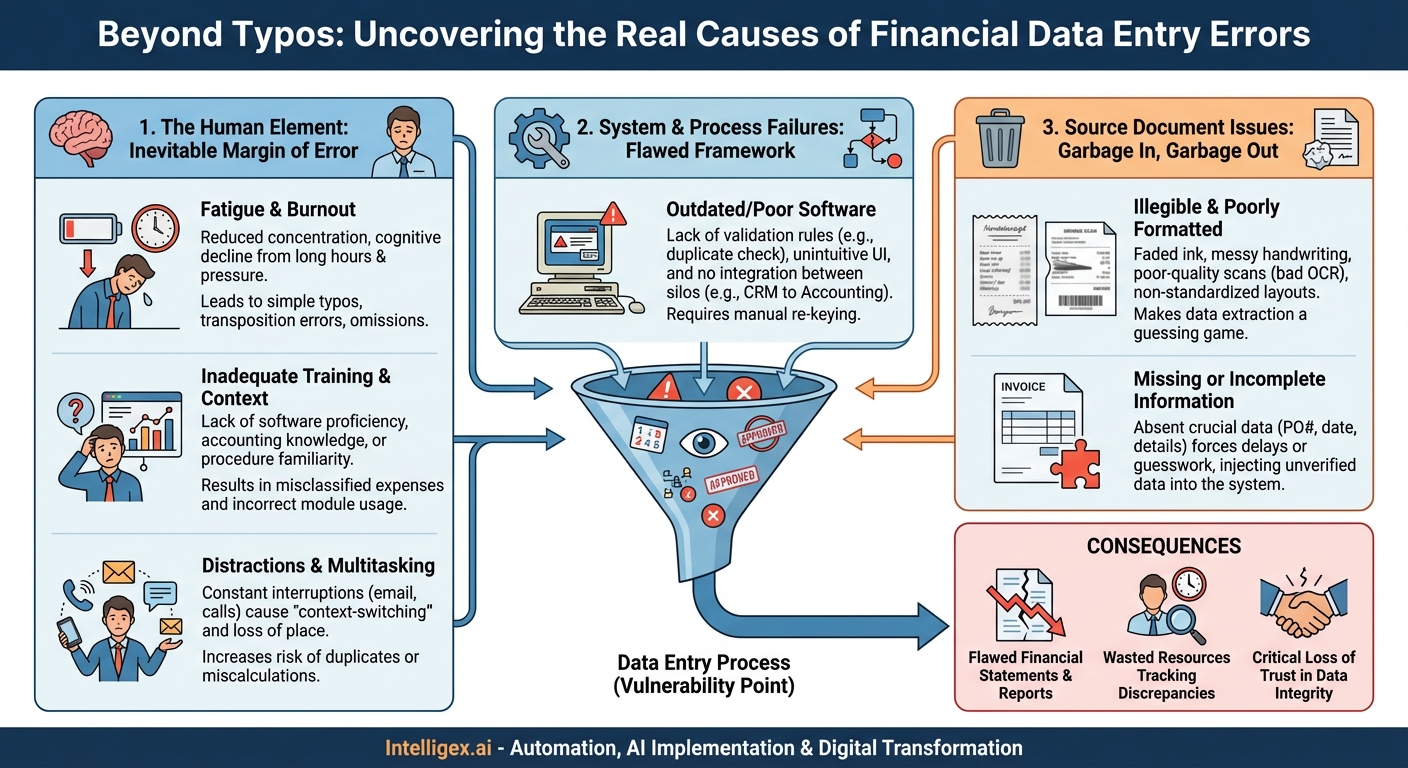
In the world of finance, data is king. Accurate financial data forms the bedrock of sound business decisions, regulatory compliance, and strategic planning. Every forecast, budget, and performance report relies on the integrity of the numbers flowing into the system. Yet, a persistent and costly vulnerability exists at the most fundamental level: data entry. While it may seem like a straightforward administrative task, the process of transcribing information from source documents into financial systems is fraught with potential for error. A single misplaced decimal, a transposed digit, or a misclassified expense can cascade through an organization, leading to flawed financial statements, wasted resources tracking down discrepancies, and a critical loss of trust in the data itself. Understanding the root causes of these errors is the first, most crucial step toward mitigating them and safeguarding the financial health of your business. These causes are rarely isolated; they often intertwine, creating a complex web of risk that can be traced back to three core areas: the human element, systemic process failures, and the quality of the source data itself.
The Human Element: The Inevitable Margin of Error
At the heart of most data entry processes is a person. And to be human is to be fallible. No matter how skilled or diligent an employee is, a combination of psychological, physiological, and environmental factors can pave the way for mistakes. Recognizing these human-centric causes is not about placing blame, but about designing more resilient systems and supportive work environments.
Fatigue and Burnout
Financial data entry is often a repetitive, high-volume task that requires sustained concentration. When employees work long hours, face tight deadlines, or are simply overworked, mental and physical fatigue inevitably sets in. Think of concentration as a muscle; with overuse and without rest, it weakens. As fatigue grows, the brain’s executive functions—responsible for attention, error-checking, and decision-making—begin to decline. This can manifest in several ways:
- Simple typos: Hitting an adjacent key or mistyping a number becomes more frequent.
- Transposition errors: Accidentally swapping digits (e.g., entering “81” instead of “18”). This is a particularly insidious error, as the individual digits are correct, making it harder for a casual review to spot.
- Omissions: Skipping a line item on an invoice or forgetting to enter a transaction altogether.
The monotonous nature of the work can lead to a state of “cognitive autopilot,” where the employee is performing the task without full conscious engagement. This is when the risk of an error slipping through unnoticed is at its highest. A culture that glorifies long hours and “pushing through” can, paradoxically, be a breeding ground for costly financial inaccuracies.
Inadequate Training and Contextual Understanding
Effective data entry is more than just typing numbers into boxes. It requires a foundational understanding of the financial context. An employee who hasn’t been properly trained is not just a less efficient worker; they are a significant liability. This lack of training can take several forms:
- Software Proficiency: A new team member unfamiliar with the specific accounting software or ERP system may struggle to navigate its interface, entering data into incorrect fields or using the wrong modules.
- Accounting Principles: A clerk who doesn’t understand the chart of accounts is likely to misclassify expenses. Is a new software subscription a “Software Expense,” an “IT Cost,” or a “General & Administrative Expense”? The wrong choice can distort departmental budgets and profitability analysis.
- Company-Specific Procedures: Every organization has its own nuances for handling certain transactions, such as coding inter-company transfers, processing employee reimbursements, or applying vendor-specific payment terms. Without clear documentation and training on these internal policies, inconsistency and errors are guaranteed.
Distractions and Multitasking
The modern workplace is a minefield of distractions. Constant email notifications, instant messages, phone calls, and colleagues asking “just a quick question” shatter the deep focus required for accurate data entry. Research has consistently shown that multitasking is a myth; what we are actually doing is “context-switching”—rapidly toggling our attention between tasks. Each switch carries a cognitive cost, draining mental energy and increasing the likelihood of error. A data entry professional might be halfway through inputting a complex, multi-line invoice when an urgent email arrives. After addressing the email, they return to the invoice, but their place is lost. Did they enter line five already? Was that tax amount inclusive or exclusive? This momentary lapse can easily lead to a duplicated entry or a miscalculation.
System and Process Failures: When the Framework is Flawed
While human error is a significant factor, it often occurs within a flawed framework. Poorly designed systems and inefficient processes can create an environment where mistakes are not just possible, but probable. Blaming an individual for an error that the system facilitated is a failure to see the bigger picture.
Outdated or Poorly Configured Software
The tools used for data entry play a massive role in accuracy. Legacy accounting systems or poorly implemented modern software can be a primary source of errors.
- Lack of Validation Rules: Modern systems can be configured to prevent common mistakes. For example, a system can flag an invoice number that has already been entered to prevent duplicate payments, or reject a date entered in an invalid format. Outdated software often lacks these basic guardrails, placing the entire burden of accuracy on the human user.
- Clunky User Interface (UI): A confusing, cluttered, or unintuitive interface makes the job harder. If fields are poorly labeled or the workflow is illogical, users are more likely to make mistakes or develop inefficient workarounds that introduce new risks.
- Absence of Integration: In many companies, financial data exists in silos. Customer information is in a CRM, sales orders are in an e-commerce platform, and payables are in the accounting system. If these systems are not integrated, data must be manually re-keyed from one to the other. This manual duplication of effort is a massive source of risk, as it doubles the opportunity for a typo or omission to occur with every transaction.
Weak Processes and Non-Existent Workflows
Even the best software is ineffective if the processes governing its use are weak. A lack of standardized procedures creates a chaotic environment where consistency is impossible.
- No “Four-Eyes Principle”: A fundamental control in finance is the principle of review and approval, sometimes called the “four-eyes principle.” One person enters the data, and a second person reviews and approves it before it’s finalized. Many organizations, especially smaller businesses or teams under pressure, skip this critical step, allowing a single individual’s mistake to go directly into the financial records unchecked.
- Inconsistent Procedures: If one accounts payable clerk codes a certain vendor’s invoices one way, and another clerk codes them differently, the result is fragmented and unreliable data. Without a documented, standardized operating procedure (SOP) for all common tasks, consistency relies on tribal knowledge, which is easily lost or misinterpreted.
- Ambiguous Data Formats: A simple yet pervasive problem is the lack of a standard for data formats. One person might enter a date as “01/12/2023” (January 12th) while another from a different region enters it as “12/01/2023” (December 1st). Similar issues arise with currency symbols, abbreviations, and naming conventions (e.g., “Corp.” vs. “Corporation”), leading to duplicate vendor records and chaotic data that is nearly impossible to analyze accurately.
Source Document Issues: Garbage In, Garbage Out
The principle of “garbage in, garbage out” is acutely true in financial data entry. The accuracy of the final record can be no better than the quality of the source document from which it was derived. No amount of diligence or system controls can fully compensate for information that is unclear, incomplete, or incorrect from the start.
Illegible and Poorly Formatted Documents
Despite the digital age, businesses still contend with a flood of problematic source documents. These can include:
- Handwritten Receipts: Faded ink, messy handwriting, and cramped spacing on small receipts make deciphering amounts, dates, and vendor names a guessing game. Is that a “1” or a “7”? Is that a “0” or a “6”? Each guess is a potential error.
- Poor-Quality Scans: Scanned invoices or PDFs that are blurry, skewed, or have low resolution can make optical character recognition (OCR) software ineffective and force manual entry from a barely readable document.
- Non-Standardized Layouts: Every vendor has a different invoice layout. The total might be at the top right for one, the bottom left for another. Tax, shipping, and discount information can be located in a dozen different places. The mental effort required to constantly re-orient and find the correct information on these varied documents increases the cognitive load on the data entry clerk, raising the probability of error.
Missing or Incomplete Information
Often, the problem isn’t that the information is illegible, but that it simply isn’t there. An invoice might arrive from a vendor without a crucial piece of data, such as a purchase order (PO) number, an invoice date, or a detailed breakdown of services rendered. This forces the data entry professional into a difficult position. They must either halt the process to track down the missing information—a time-consuming task that kills productivity—or make an educated guess. Guessing at a GL code or assuming a default date to keep the workflow moving is a common practice born of necessity, but it is one that directly injects inaccurate or unverified data into the financial system.
Ultimately, finance data entry errors are a multifaceted problem that cannot be solved with a single solution. They are a symptom of deeper issues within a company’s people, processes, and technology. By understanding these common causes—from the tired employee and the confusing software to the illegible invoice—organizations can begin to move from a reactive mode of constantly fixing errors to a proactive one of preventing them. This involves investing in automation, refining workflows to include vital checks and balances, and, most importantly, empowering employees with the training, tools, and supportive environment they need to succeed. Tackling these root causes is not just about clean data; it’s about building a foundation of financial integrity that supports a healthier, more resilient business.
Your Next Read:
Category:
Get a FREE
Proof of Concept
& Consultation
No Cost, No Commitment!
