

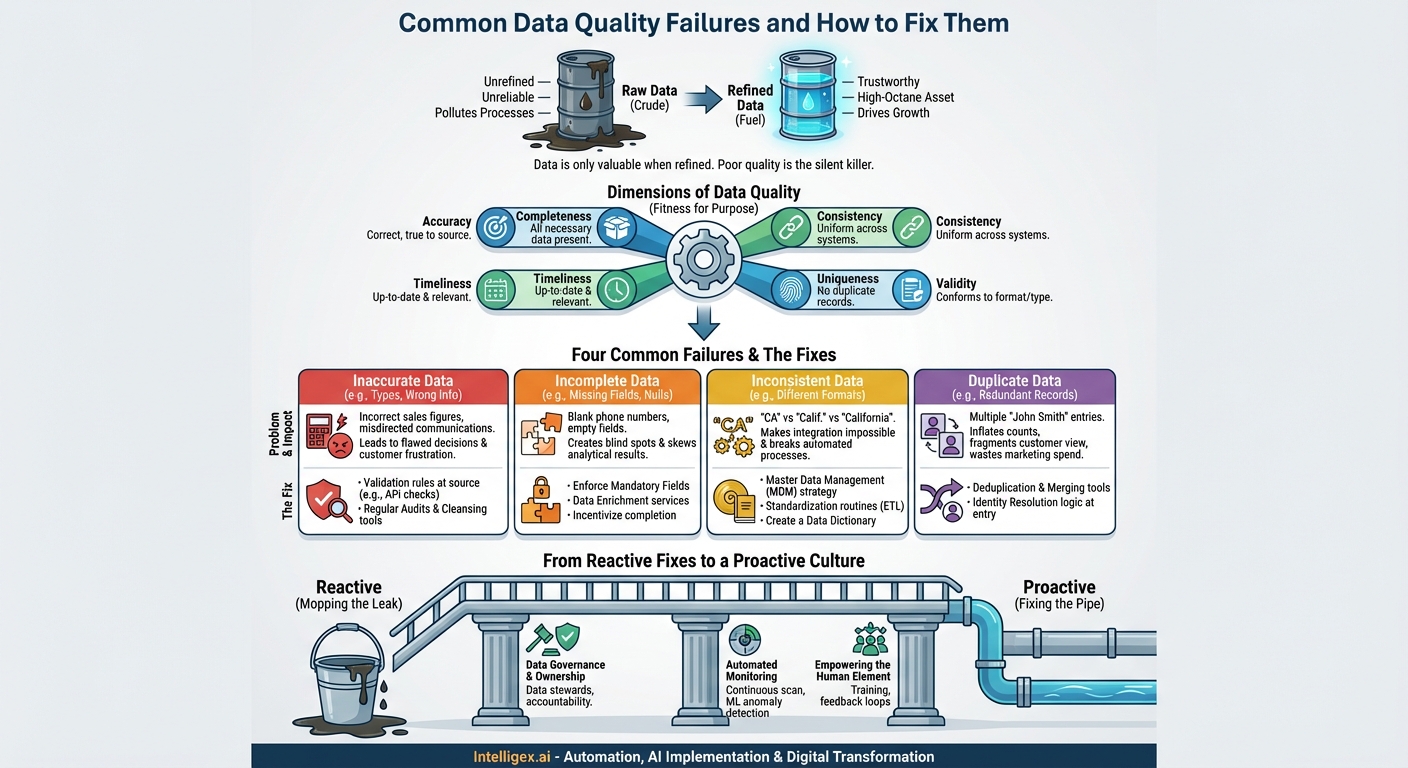
In today’s business landscape, data is the lifeblood of the organization. It fuels everything from strategic decision-making and operational efficiency to customer personalization and machine learning models. We often hear the phrase “data is the new oil,” but this analogy is only half-right. Like crude oil, raw data is of little value until it’s refined. Poor-quality data—the unrefined, sludge-filled version—doesn’t just sit idly in your systems. It actively pollutes your processes, erodes trust, and leads to costly, misguided decisions. It’s the silent killer of digital transformation initiatives.
The challenge is that data quality issues are often insidious. They creep in through countless entry points, from a fat-fingered typo in a CRM to a flawed data migration script. Before you know it, your reports are unreliable, your marketing campaigns are missing the mark, and your executives are questioning the very foundation of their dashboards. Recognizing and rectifying these data quality failures is not merely a technical task for the IT department; it’s a strategic imperative for the entire business. It’s about transforming raw, unreliable information into a trustworthy, high-octane asset that drives growth and innovation.
Understanding the Dimensions of Data Quality
Before diving into the common failures, it’s crucial to understand that “data quality” is a multi-faceted concept. It’s not a simple binary of “good” or “bad.” High-quality data is data that is fit for its intended purpose. This fitness is typically measured across several key dimensions. While there are many frameworks, most agree on a core set of attributes that define the health of your data:
- Accuracy: Is the data correct and true to the source? Does it accurately represent the real-world entity it describes?
- Completeness: Is all the necessary data present? Are there empty fields or missing records that could compromise analysis or operations?
- Consistency: Is the data consistent across different systems and datasets? Is “United States” represented as “US,” “U.S.A.,” and “United States” in different tables?
- Timeliness: Is the data available when needed? Is it up-to-date and relevant to the current business context?
- Uniqueness: Is each entity (like a customer or product) represented only once? Or are there duplicate records cluttering your database?
- Validity: Does the data conform to the required format, type, and range? For example, is a date stored in a standard YYYY-MM-DD format, and is an email address field actually an email address?
A failure in any one of these dimensions can have a cascading effect, undermining the integrity of your entire data ecosystem. Let’s explore the most common failures that arise from these dimensions and, more importantly, how to fix them.
Common Failure #1: Inaccurate Data
The Problem
Inaccuracy is the most classic data quality failure. It means the data stored in your system is factually wrong. This can range from a simple typo in a customer’s name to an incorrect sales figure that throws off an entire quarterly report. Inaccuracies often stem from human error during data entry, data decay (information becoming outdated over time, like a customer’s address), or flawed data collection processes.
Example: A sales representative manually enters a new client’s address as “123 Main St” when it’s actually “132 Main St.” The initial invoice is sent to the wrong location, delaying payment and causing frustration for the new customer right at the start of the relationship.
The Impact
The consequences of inaccurate data are direct and tangible. It leads to shipping errors, misdirected marketing communications, failed customer support interactions, and fundamentally flawed business intelligence. Decisions made on inaccurate data are, at best, guesses and, at worst, actively harmful to the business.
The Fix
- Prevent at the Source: The best cure is prevention. Implement strict data validation rules at the point of entry. Use tools like address verification APIs to check and standardize addresses in real-time. Where possible, replace free-text fields with dropdowns, radio buttons, or standardized picklists to minimize typos.
- Regular Audits and Cleansing: For existing data, you cannot assume it’s correct. Implement regular data auditing processes. Use data cleansing tools that can identify and flag potential inaccuracies. For critical data points, consider third-party data enrichment services to verify and append correct information.
Common Failure #2: Incomplete Data
The Problem
Incomplete data, characterized by missing values or null fields, is another pervasive issue. A customer record might be missing a phone number, a product record might lack a weight dimension, or a transaction log might have a blank timestamp. This often happens when fields are not made mandatory during data capture, during a data migration where schemas don’t perfectly align, or when users simply don’t have the information at hand and skip the field.
Example: A marketing team wants to run a targeted SMS campaign, but they discover that 40% of the customer records in their CRM are missing a valid mobile phone number. The potential reach and effectiveness of the campaign are immediately crippled.
The Impact
Incomplete data creates blind spots. It prevents a 360-degree view of the customer, skews analytical results (e.g., calculating an average purchase value is meaningless if many transaction amounts are missing), and hinders operational processes that rely on that data. It can also lead to compliance issues if legally required information is absent.
The Fix
- Enforce Mandatory Fields: Identify the truly critical data points for your business processes and make those fields mandatory in all data entry forms and systems. Use clear UI/UX cues to guide users on what information is essential.
- Data Enrichment and Imputation: For existing gaps, use data enrichment services to find and fill in missing information from external, reputable sources. For analytical purposes, data imputation techniques (like replacing a missing value with the mean or median) can be used, but this must be done with extreme caution and full transparency, as it introduces assumptions into your dataset.
- Incentivize Completion: Run campaigns that encourage customers to complete their profiles. Offering a small discount or access to exclusive content in exchange for updated information can be a highly effective way to fill in the blanks.
Common Failure #3: Inconsistent Data
The Problem
Inconsistency occurs when the same piece of information is stored in different formats across your organization. This is a common byproduct of data silos, where different departments or applications have their own standards for data entry. The state of “California” might be stored as “CA” in the billing system, “Calif.” in a legacy spreadsheet, and “California” in the CRM.
Example: A company wants to analyze its total sales for a specific product. However, the product is named “SuperWidget Model A” in the sales system, “Super Widget A-Series” in the inventory system, and “SW-A” in the marketing database. Aggregating this data to get a single, accurate view is a nightmare of manual mapping and guesswork.
The Impact
Inconsistency makes data integration and aggregation nearly impossible. It breaks automated processes and leads to wildly inaccurate reporting. You can’t get a single source of truth if everyone is speaking a different data language. It’s a major roadblock to achieving a unified view of customers, products, or operations.
The Fix
- Establish a Master Data Management (MDM) Strategy: MDM is the definitive solution for inconsistency. It involves creating a single, authoritative “golden record” for key data entities (like customers, products, suppliers) and ensuring all systems refer to this master record.
- Standardize and Normalize: Implement data standardization routines, often within an ETL (Extract, Transform, Load) process. These routines automatically convert different data variations into a single, predefined format (e.g., all state abbreviations are converted to the standard two-letter code).
- Create a Data Dictionary: Develop and enforce a company-wide data dictionary that defines what each data field means, what its format should be, and what are the acceptable values. This serves as a rulebook for anyone creating or handling data.
Common Failure #4: Duplicate Data
The Problem
Duplicates, or redundant records for the same entity, are a plague on databases everywhere. A customer, “John Smith,” might exist as “Jon Smith,” “J. Smith,” and “John A. Smith,” each with slightly different information. Duplicates are created when there’s no robust check for existing records before a new one is created, or when data is imported from multiple lists without proper matching logic.
Example: A customer service agent pulls up a record for “Cathy Jones” to discuss a recent order. Unbeknownst to them, another record exists for “Catherine Jones” at the same address, which holds the history of a long-standing support ticket. The agent, lacking the full context, gives incomplete advice, frustrating the customer.
The Impact
Duplicates have a severe impact across the board. They inflate customer counts and skew analytics. They lead to wasted marketing spend by targeting the same individual multiple times. Most critically, they fragment the customer view, leading to disjointed and frustrating customer experiences and increasing compliance risks under regulations like GDPR.
The Fix
- Implement Deduplication and Merging: Use specialized data quality tools that employ fuzzy matching and sophisticated algorithms to identify potential duplicates. These tools can then merge the redundant records into a single, comprehensive “golden record,” preserving the best information from each source.
- Identity Resolution at Entry: The best long-term fix is to prevent duplicates from being created in the first place. Implement robust identity resolution logic in your data entry forms. When a user tries to create a new contact, the system should automatically search for potential matches and prompt the user to update an existing record instead of creating a new one.
From Reactive Fixes to a Proactive Culture
Fixing individual data errors is a necessary but ultimately insufficient strategy. It’s like constantly mopping up a leak without fixing the pipe. To truly solve the data quality problem, you must shift from a reactive to a proactive approach, embedding data quality into the very culture of your organization.
This cultural shift is built on three pillars:
- Data Governance and Ownership: Data quality is not an IT problem; it’s a business problem. A strong data governance framework establishes clear ownership and accountability for data assets. Appointing “data stewards” within business departments who are responsible for the quality of their data domain ensures that the people who know the data best are empowered to maintain its integrity.
- Automated Monitoring: You can’t fix what you can’t see. Move away from manual spot-checks and implement automated data quality monitoring tools. These solutions can continuously scan your data pipelines and databases, applying predefined rules and using machine learning to detect anomalies. They can flag issues in real-time, allowing you to fix a problem before it contaminates downstream reports and applications.
- Empowering the Human Element: Ultimately, most data is created or touched by people. It’s crucial to train employees on the importance of data quality and provide them with the tools and knowledge to enter data correctly. Create a positive feedback loop where users can easily report data issues they find, making them active participants in the quality control process.
Investing in data quality is not an expense; it’s a foundational investment in the reliability of your entire business. By systematically identifying common failures, implementing robust technical and procedural fixes, and fostering a culture of data accountability, you can transform your data from a potential liability into your most powerful strategic asset. Trustworthy data is the bedrock upon which sound decisions, exceptional customer experiences, and sustainable growth are built.
Your Next Read:
Category:
Get a FREE
Proof of Concept
& Consultation
No Cost, No Commitment!
