

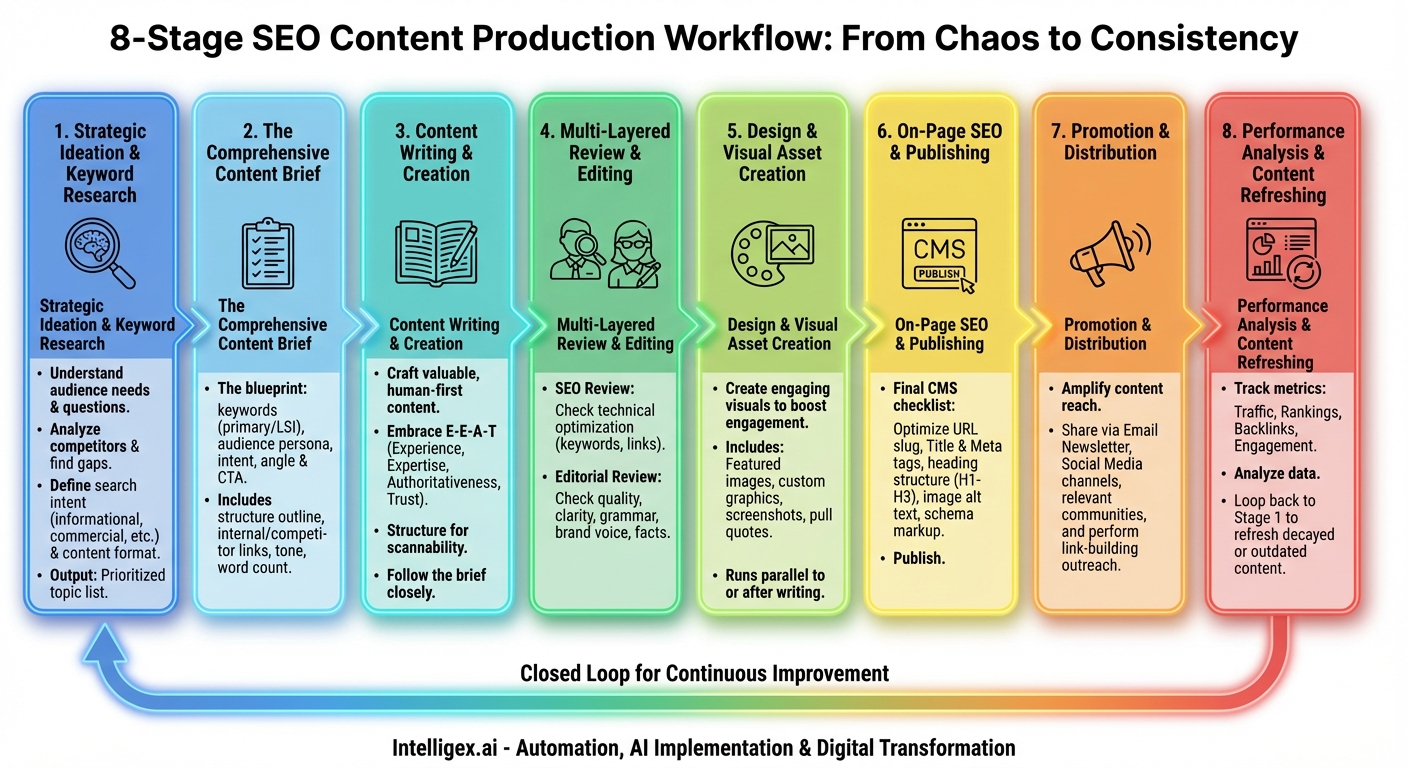
In the world of SEO, content is the fuel that powers the engine. But without a well-defined process, that fuel can be wasted, leading to sputtering results, missed deadlines, and frustrated teams. Many organizations operate in a state of organized chaos, where content ideas are thrown around, writers are given vague instructions, and the final product is a gamble. A structured, repeatable content production workflow is the antidote to this chaos. It transforms content creation from an unpredictable art into a scalable science, ensuring every piece of content is strategically planned, expertly executed, and optimized for maximum search visibility from the very beginning.
A robust workflow doesn’t just make life easier; it builds a foundation for long-term SEO success. It ensures consistency in quality and brand voice, clarifies roles and responsibilities, and creates a feedback loop for continuous improvement. It’s the assembly line that allows you to produce high-quality, high-ranking content at scale. Let’s break down an eight-stage workflow that can be adapted to fit any SEO team, from a nimble startup to a large enterprise.
Stage 1: Strategic Ideation and Keyword Research
This is the starting block where strategy dictates direction. Content creation without rigorous ideation and keyword research is like setting sail without a map or a destination. The goal here is to build a backlog of content ideas that are not just interesting, but are also tied directly to business objectives and user search intent.
Key Activities:
- Topic Brainstorming: This goes beyond just “what should we write about?” It involves analyzing customer pain points, talking to sales and support teams, and identifying questions your audience is actively asking.
- Keyword Research: This is the core of the stage. Identify a primary target keyword and a cluster of related secondary and long-tail keywords. Critically, you must analyze the search intent behind these keywords. Is the user looking for information (informational), comparing products (commercial investigation), or ready to buy (transactional)? The intent will dictate the entire angle and format of the content.
- SERP Analysis: Don’t just look at keyword volume. Manually search for your target keywords and analyze the Search Engine Results Page (SERP). What kind of content is ranking? Are they blog posts, videos, product pages, or listicles? Are there Featured Snippets, People Also Ask boxes, or image packs? This analysis provides a clear picture of what Google deems relevant for that query.
*Competitor Analysis: Use tools like Ahrefs or Semrush to see what content is driving traffic for your competitors. Look for their top pages, identify content formats that perform well, and search for “content gaps”—valuable keywords they rank for that you don’t.
The output of this stage should be a prioritized list of content topics, each with a designated primary keyword, a set of secondary keywords, a clearly defined search intent, and notes on the required content format.
Stage 2: The Comprehensive Content Brief
The content brief is the single most important document in the entire workflow. It is the blueprint that translates the SEO strategy from Stage 1 into actionable instructions for the writer. A weak or incomplete brief is the number one cause of miscommunication, extensive rewrites, and content that misses the mark. A great brief ensures that the writer, editor, and SEO specialist are all perfectly aligned before a single word is written.
Essential Components of a Content Brief:
- Primary and Secondary Keywords: Clearly list the main target keyword and the semantic LSI keywords to be included.
- Target Audience: Who is this piece for? Define the persona, their level of expertise, and their primary pain points.
- Search Intent: Reiterate the intent (e.g., “User is a beginner marketer looking for a step-by-step guide on how to set up a Google Analytics account”).
- Title and Meta Description: Provide a proposed, optimized title tag and meta description.
- Core Angle & CTA: What is the unique perspective of this piece? What action do you want the reader to take after reading?
- Structural Outline: This is critical. Provide a suggested H2 and H3 structure based on your SERP analysis. This guides the writer on the logical flow and ensures all key subtopics are covered.
- Internal Linking Suggestions: List 3-5 relevant existing pages on your site to link to. This is crucial for building topic clusters and passing link equity.
- Competitor Links: Include links to the top 3-5 ranking articles for the target keyword so the writer can understand the competitive landscape.
- Word Count Target: Provide a realistic range based on the average length of the top-ranking content.
- Tone of Voice: Specify whether the tone should be formal, conversational, technical, witty, etc., to align with your brand guidelines.
Stage 3: Content Writing and Creation
With a detailed brief in hand, the writer can now focus on what they do best: creating compelling, valuable, and well-written content. This stage is about crafting a narrative that satisfies the user’s query while seamlessly integrating the SEO elements outlined in the brief. The writer’s primary focus should always be on the reader. Content that is genuinely helpful, engaging, and authoritative is what ultimately wins in SEO.
Best Practices for Writers:
- Write for Humans First: The content should flow naturally and be easy to read. Avoid “keyword stuffing” at all costs. Use keywords where they make sense, especially in headings and early in the copy, but never sacrifice readability.
- Structure for Scannability: Online readers scan. Use short paragraphs, bullet points, numbered lists, and bolded text to break up the content and make key information easy to digest.
- Incorporate the Brief: The writer should methodically work through the brief, ensuring the specified structure, keywords, and internal links are included in the draft.
*Embrace E-E-A-T: Google’s quality guidelines emphasize Experience, Expertise, Authoritativeness, and Trustworthiness. Writers should demonstrate this by citing credible sources, including original data or insights, and writing with a confident, knowledgeable voice.
Stage 4: Multi-Layered Review and Editing
A first draft is never a final draft. This stage involves a crucial quality control check from two different but equally important perspectives: SEO and editorial. Separating these reviews ensures that both technical optimization and content quality are given the attention they deserve.
The SEO Review:
An SEO specialist or strategist reviews the draft specifically for search engine optimization. They are not primarily looking for grammar or style but are checking against a technical list:
- Is the primary keyword used effectively in the title, H1, and within the first 100 words?
- Are secondary keywords naturally integrated throughout the text and in subheadings?
- Are the internal links implemented correctly with appropriate anchor text?
- Does the content structure logically address the search intent?
- Is there any risk of keyword cannibalization with other existing content?
The Editorial Review:
An editor then reviews the draft for quality, clarity, and consistency. Their focus is on the reader’s experience:
- Clarity and Flow: Is the writing clear, concise, and easy to understand? Does the argument flow logically from one point to the next?
- Grammar and Spelling: A basic but essential check for professionalism and credibility.
- Brand Voice and Tone: Does the content align with the established brand voice?
- Fact-Checking: Are all claims, stats, and quotes accurate and properly attributed?
This stage often involves a feedback loop where the draft is passed back to the writer for revisions based on the feedback from both reviews.
Stage 5: Design and Visual Asset Creation
Content is more than just words on a page. Visual elements play a massive role in user engagement, comprehension, and shareability. This stage runs parallel to the writing and review stages or immediately follows them. It involves creating all the non-textual elements that will accompany the post.
Types of Visual Assets:
- Featured Image: A high-quality, on-brand hero image for the top of the post and for social sharing.
- In-Content Graphics: Custom charts, diagrams, or illustrations that help explain complex concepts.
- Screenshots and Annotations: Essential for tutorials and how-to guides to show users exactly what to do.
- Pull Quotes: Visually distinct text boxes that highlight key quotes or statistics, making the content more scannable and shareable.
Investing in good design elevates the perceived value of your content and can significantly improve metrics like time on page and reduce bounce rates.
Stage 6: On-Page SEO and Publishing
This is the final pre-launch checklist. Once the text is finalized and the visual assets are ready, the content is loaded into the Content Management System (CMS), like WordPress. Before hitting “publish,” a final on-page SEO check is performed directly within the CMS.
The Final Publishing Checklist:
- URL Slug: Ensure the URL is short, clean, and contains the primary keyword (e.g., `yourdomain.com/content-production-workflow`).
- Title Tag and Meta Description: Copy in the final, optimized versions. Check their length to ensure they won’t be truncated in search results.
- Heading Structure: Double-check that the post uses a proper hierarchy (one H1, followed by H2s, H3s, etc.).
- Image Optimization: Make sure all images are compressed for fast loading and have descriptive alt text for accessibility and image SEO.
- Internal and External Links: Verify that all links work correctly and open in a new tab where appropriate.
- Schema Markup: Add relevant structured data, such as FAQ schema or How-to schema, to help Google understand your content and potentially earn rich snippets.
Once this checklist is complete, the content can be scheduled or published.
Stage 7: Promotion and Distribution
The “if you build it, they will come” mentality does not work in content marketing. Hitting “publish” is not the end of the workflow; it’s the beginning of the promotion phase. The goal is to get initial traction, send positive signals to Google, and get your content in front of your target audience.
Effective Distribution Channels:
- Email Newsletter: Share the new content with your most engaged audience—your subscribers.
- Social Media: Promote the piece across all relevant company and personal social channels, tailoring the message for each platform.
- Community Engagement: Share the content in relevant Slack communities, forums, or on Reddit, but only where it adds genuine value to the conversation.
- Link Building Outreach: If the content is a significant “linkable asset,” reach out to other websites or individuals mentioned in the piece to let them know and encourage sharing.
Stage 8: Performance Analysis and Content Refreshing
A content workflow is a closed loop, not a straight line. The final stage is to monitor performance and use that data to inform future decisions and improve existing assets. Set a reminder to check the performance of a new piece after 30-90 days.
Key Metrics to Track:
- Organic Traffic: How many users is the page attracting from search engines? (Google Analytics)
- Keyword Rankings: Where does the page rank for its target keywords? (Google Search Console, Ahrefs)
- Backlinks: Is the content naturally acquiring links from other websites?
- Engagement Metrics: What is the average time on page and bounce rate?
- Conversions: Is the content driving leads, sign-ups, or sales?
This data reveals what’s working and what isn’t. Furthermore, schedule periodic “content refresh” initiatives. Identify content that has seen its rankings decay or is becoming outdated. Go back through this entire workflow—updating research, rewriting sections, adding new visuals, and promoting it again—to give it a new lease on life. This is one of the most effective and efficient ways to maintain and improve your SEO performance over time.
Your Next Read:
Get a FREE
Proof of Concept
& Consultation
No Cost, No Commitment!
