

The promise of artificial intelligence is transforming industries, but with great power comes great risk. Deploying a new AI model into a live production environment can feel like swapping out a jet engine mid-flight. What if the new model, despite stellar performance in the lab, behaves unexpectedly with real-world, messy data? The consequences can range from frustrated users and minor revenue dips to catastrophic system failures and severe reputational damage. This is the deployment dilemma that keeps engineering leads and product managers awake at night. How can we innovate confidently and unleash the power of AI without introducing unacceptable risk? The answer lies in a powerful, risk-averse strategy known as Shadow Mode testing.
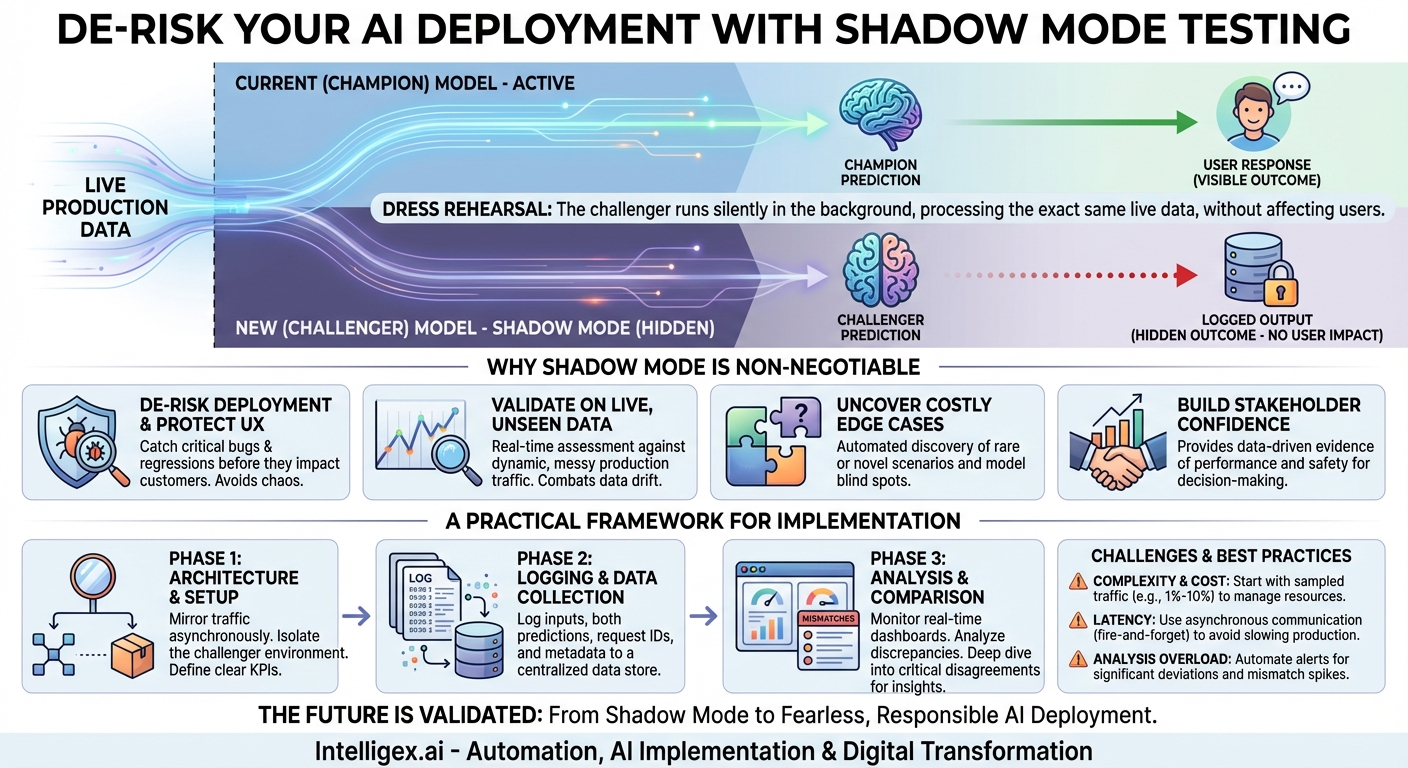
At its core, Shadow Mode is a dress rehearsal for your AI system. It’s a deployment strategy where a new model (the “challenger”) runs silently in the background of a production environment, processing the exact same live data as the current, trusted system (the “champion”). The challenger model makes its predictions, recommends actions, and classifies data, but its outputs are never shown to the user or used to trigger any real-world actions. Instead, they are meticulously logged and stored for later analysis. Think of it as a student pilot flying a simulator connected to the real plane’s controls; they experience real flight conditions, but the experienced instructor (the champion system) is the one actually flying the plane. The student’s actions are recorded, allowing the instructor to review their performance and identify areas for improvement without ever jeopardizing the passengers.
Why Shadow Mode is Non-Negotiable for High-Stakes AI
Offline evaluation metrics like accuracy, precision, and F1-score are essential, but they only tell part of the story. They are calculated on curated, historical datasets that may not fully represent the dynamic and often chaotic nature of live production traffic. Shadow Mode bridges this critical gap between the laboratory and the real world, offering a suite of benefits that are essential for responsible AI deployment.
De-Risking Deployment and Protecting User Experience
This is the primary and most compelling reason to adopt a shadow testing framework. By running a model in a non-interfering mode, you can catch critical bugs, performance regressions, or unintended biases before they ever impact a single customer. Imagine a new fraud detection model that, due to a subtle data shift, starts incorrectly flagging a huge volume of legitimate transactions. In a direct deployment, this would cause chaos, blocking valid payments and infuriating customers. In Shadow Mode, this behavior would be identified as a massive spike in mismatches between the champion and challenger, allowing the team to diagnose and fix the issue with zero customer impact.
Validating Performance on Live, Unseen Data
The real world is unpredictable. Data distributions shift, user behaviors evolve, and external factors introduce noise that was never present in your training set. This phenomenon, known as “data drift,” can silently degrade a model’s performance over time. Shadow Mode is your frontline defense against this. It provides a continuous, real-time assessment of how your model performs on the data it will actually encounter. You can directly compare the challenger’s predictions against the champion’s, providing a concrete, quantitative measure of its real-world performance and robustness.
Uncovering Costly Edge Cases
No matter how comprehensive your test suite is, it’s nearly impossible to anticipate every single edge case. Users will always find creative ways to input data you never expected. Shadow Mode acts as an automated edge case discovery engine. When the challenger model produces a wildly different output from the champion, it often points to a rare or novel input scenario. Analyzing these discrepancies allows you to understand the model’s blind spots and either retrain it with more diverse data or implement specific guardrails to handle such cases gracefully.
Building Stakeholder Confidence
Deploying a new AI system is often a significant business decision. Stakeholders from product, finance, and leadership need assurance that the new system is not only better but also safe and reliable. A comprehensive Shadow Mode report, complete with comparative metrics, mismatch analysis, and performance dashboards, is the ultimate tool for building that confidence. It replaces “we think it will work” with “we have data showing it works on a week’s worth of live production traffic with a 15% improvement and an error profile we understand and accept.”
A Practical Framework for Implementing Shadow Mode
Successfully implementing a Shadow Mode framework requires a thoughtful approach to architecture, logging, and analysis. It’s more than just running a second model; it’s about building a system for rigorous, continuous validation.
Phase 1: Architecture and Setup
The first step is to design the infrastructure to support parallel execution. Your system needs to be able to take a single incoming production request and fan it out to both the champion and the challenger models simultaneously.
- Data Mirroring: This is a common pattern where production traffic is duplicated. Technologies like service mesh sidecars (e.g., Istio), event streaming platforms (e.g., Apache Kafka), or specialized proxy layers can be used to mirror requests to the shadow service without impacting the primary service’s latency.
- Isolating the Challenger: The shadow environment must be completely isolated. It should have no “write” access to production databases or external services. Its sole purpose is to receive data, make a prediction, and log the result. This prevents any accidental side effects.
- Defining Success Metrics: Before you begin, clearly define what “better” means. Is it higher accuracy? Lower false positive rate? Faster inference time? These key performance indicators (KPIs) will be the basis for your final decision.
Phase 2: Logging and Data Collection
The data you collect during the shadow run is the most valuable asset of the entire process. Your logging must be comprehensive and structured.
For every single request, you should log a payload that includes:
- A unique request ID for easy correlation.
- The full input data/features sent to the models.
- The champion model’s prediction/output.
- The challenger model’s prediction/output (and confidence score, if applicable).
- Timestamps for the request and each response.
- Relevant metadata (e.g., user ID, region, device type).
This structured log data should be streamed to a centralized data store, such as a data lake or a log analytics platform (e.g., Elasticsearch, Datadog), where it can be queried and visualized.
Phase 3: Analysis and Comparison
Once data starts flowing, the analysis begins. This is where you turn raw logs into actionable insights.
- Aggregate Performance Dashboards: Create dashboards that track your predefined success metrics in real-time. You should be able to see, at a glance, a side-by-side comparison of the champion and challenger across KPIs like error rate, latency, and prediction distribution.
- Mismatch Analysis: This is the most critical part. Filter for all the instances where the challenger’s prediction differed from the champion’s. These disagreements are your primary learning opportunities. Categorize them: Where are the disagreements concentrated? Are they happening for a specific user segment? A particular type of input?
- Deep Dive on Critical Discrepancies: For high-impact mismatches (e.g., a fraud model disagreement on a large transaction), perform a root cause analysis. Examine the input features that led to the different outcomes. This often reveals insights about the challenger’s strengths and weaknesses, or perhaps a flaw in the champion that you never knew existed.
Challenges and Best Practices
While incredibly powerful, implementing a Shadow Mode framework is not without its challenges. Awareness of these potential hurdles is key to a smooth execution.
Infrastructure Complexity and Cost
Running a duplicate production stack, even a partial one, incurs costs for compute, networking, and storage. It also adds architectural complexity.
Best Practice: Start with a sampled percentage of traffic. You don’t need to shadow 100% of requests from day one. Shadowing just 1% or 10% of traffic can often provide enough data to validate the model’s behavior. Additionally, leverage serverless or auto-scaling infrastructure for the shadow environment to manage costs effectively.
Latency Considerations
You must ensure that the process of mirroring traffic and running the shadow model does not add any latency to the user-facing production path. The fanning out of requests should happen asynchronously.
Best Practice: Use asynchronous communication patterns. The production service should send the request to the shadow service and “fire and forget,” not waiting for a response. An event bus or message queue is an ideal architecture for this decoupling.
Analysis Overload
A high-traffic system can generate terabytes of log data, and analyzing it manually is impossible. The risk is collecting a mountain of data that no one has time to interpret.
Best Practice: Automate your analysis. Set up automated alerts for significant deviations in your core metrics or for spikes in the mismatch rate. Build tools and dashboards that allow you to easily slice and dice the data, drilling down from a high-level overview to individual request logs.
The Future is Validated: From Shadow Mode to Full Deployment
Shadow Mode is not the final step, but it is the most critical preparatory one. After a successful shadow period where the challenger has proven its stability, performance, and superiority, you can proceed with confidence to other phased rollout strategies like canary releases (releasing the model to a small percentage of users) or A/B testing (directly comparing its business impact against the champion). Without the safety net of Shadow Mode, these subsequent steps are far riskier propositions.
In the rapidly evolving landscape of artificial intelligence, speed and innovation are paramount. But agility cannot come at the expense of reliability and trust. A Shadow Mode testing framework provides the perfect synthesis, enabling teams to deploy cutting-edge AI fearlessly and responsibly. It transforms the deployment process from a high-stakes gamble into a data-driven, evidence-based decision, ensuring that when your new AI model finally steps out of the shadows, it is more than ready for the spotlight.
Your Next Read:
Category:
Get a FREE
Proof of Concept
& Consultation
No Cost, No Commitment!
