

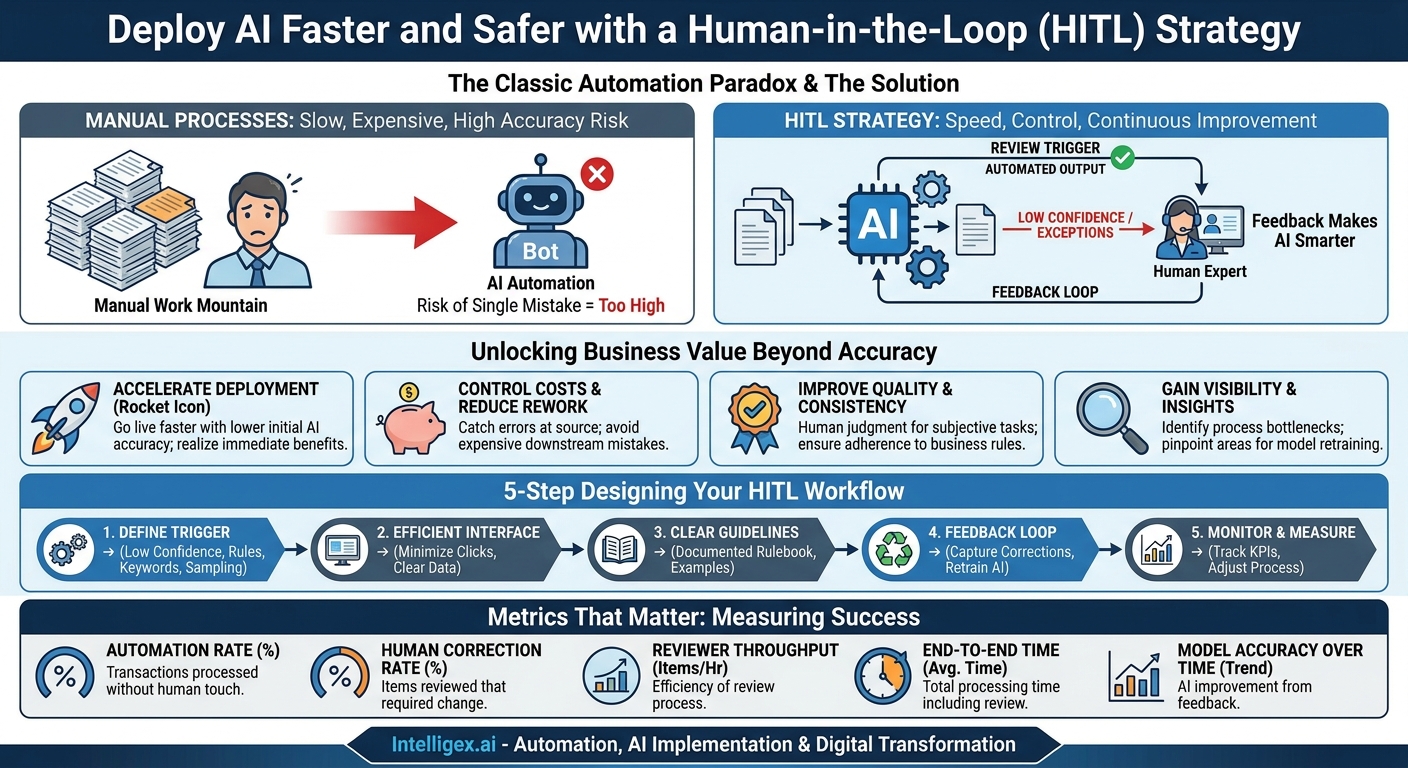
Your team is staring down a mountain of manual work. You know automation is the answer, but the risk of a single mistake is too high. A misclassified invoice could lead to a duplicate payment. An incorrectly processed customer request could damage a relationship. This is the classic automation paradox: the processes that would benefit most from speed are often the ones that require perfect accuracy, forcing us to keep them manual, slow, and expensive.
But what if you could have both speed and control? What if you could deploy an AI-powered solution to handle 80% of the work automatically, while intelligently routing the remaining 20% of complex or uncertain cases to a human expert for a quick review? This strategic partnership between people and AI is called a Human-in-the-Loop (HITL) review. It isn’t a technical workaround; it’s a business strategy for deploying AI safely, building trust in new systems, and creating a powerful feedback cycle that makes your automation smarter over time.
What is Human-in-the-Loop Review? (And What It Isn’t)
At its core, a Human-in-the-Loop system is a process where a machine learning model and a human being work as a team. The AI performs the bulk of a repetitive task, like extracting data from documents or categorizing support tickets. However, the system is designed to recognize when it has low confidence in its own result. Instead of making a potential mistake or stopping the entire process, it flags the item and routes it to a person for a final decision.
Think of it like a senior manager training a new hire. The manager doesn’t re-do all of the new hire’s work. Instead, they assign tasks, review the outputs they are less certain about, provide corrections, and offer guidance. Over time, the new hire requires less and less oversight. A HITL system works the same way. The human expert validates, corrects, or enriches the AI’s work, and those corrections are fed back to improve the underlying model.
It’s important to understand what HITL is not:
- It is not 100% manual review. The goal is to focus human attention only where it’s most needed, on the exceptions and edge cases, freeing up your team from the high-volume, easy work.
- It is not a sign of AI failure. It’s a sign of intelligent system design. Building a system that knows its own limits is a feature, not a bug. It provides a safety net that enables you to automate high-stakes processes with confidence.
- It is not just for data labeling. While HITL is famous for training AI models, its real business value comes from applying it to live, operational workflows in finance, HR, and operations to ensure quality and compliance every day.
The Business Case: Unlocking Value Beyond Accuracy
Implementing a human review step might sound like it slows down automation, but in reality, it unlocks significant business value across several dimensions. It allows you to move faster, control costs, and build more resilient systems.
Accelerate Deployment, Not Just Processes
Waiting for an AI model to reach 99% accuracy before deploying it can take months, if it’s even possible. A HITL approach lets you go live when the model is 80% or 85% accurate. You can start realizing the benefits of automation immediately while your human experts handle the remaining percentage. This pragmatic approach drastically shortens the time-to-value for new AI initiatives.
Control Costs and Reduce Rework
The cost of a mistake grows exponentially the further it travels through a process. An incorrect data point extracted from an invoice is easy for a human to fix in a 10-second review. If that same error goes unnoticed and results in an overpayment, it could take hours of work from your finance team and supplier communications to resolve. HITL is a form of proactive quality control that catches errors at the source, which is always cheaper and more efficient than fixing them downstream.
Improve Quality and Consistency
For tasks that involve subjective judgment, like categorizing customer sentiment or assessing the severity of a compliance risk, AI can struggle with nuance. Human reviewers, guided by a clear set of business rules, can ensure that these subjective decisions are made consistently and in line with your company’s standards. This consistency improves service quality and provides reliable data for business intelligence.
Gain Visibility into AI Performance
A well-designed HITL process does more than just fix errors. It generates a rich dataset about your AI’s performance. Every time a human makes a correction, you learn something new. Are there specific vendors whose invoices always confuse the model? Does the AI struggle with a particular type of customer request? This visibility is invaluable for identifying process bottlenecks and pinpointing exactly where the AI model needs further training.
Where to Apply HITL: Common Business Scenarios
The applications for Human-in-the-Loop review span nearly every department. It is most valuable in workflows that are high-volume, require high accuracy, and involve interpreting unstructured data like documents, images, or text.
Here are a few concrete examples:
- Finance and Accounting: In accounts payable automation, an AI can extract data like invoice numbers, dates, and line items. A HITL workflow can flag invoices for human review if the confidence score is low, if the total amount exceeds a certain threshold, or if the extracted vendor doesn’t match a record in your ERP system. This prevents duplicate payments and ensures data accuracy before it enters your financial records.
- Human Resources: When screening thousands of resumes, an AI can quickly identify candidates who meet the basic qualifications for a role. A human recruiter then reviews this qualified shortlist, focusing their time on engaging the best candidates rather than sifting through unqualified applicants.
- Operations and Supply Chain: An AI can analyze images from a production line to flag potential product defects. A human operator then reviews the flagged images to confirm if it’s a true defect or just a shadow, preventing false positives from stopping the line and ensuring only quality products are shipped. Similarly, it can be used to classify and extract data from shipping documents like bills of lading or proof of delivery.
- Marketing and Sales: After a trade show, you may have a list of hundreds of new leads. An AI can enrich this data with company information from sources like LinkedIn. A HITL step allows a sales development representative to quickly verify the enriched data for key accounts, ensuring they have accurate information before making the first call. Another use case is categorizing incoming customer support emails so they are routed to the right agent. A human can review any messages the AI is unsure how to categorize.
- Legal and Compliance: When performing contract review, an AI can scan thousands of agreements to identify non-standard clauses or specific types of risk. A paralegal or lawyer then reviews only these flagged clauses, dramatically reducing the time required for due diligence or compliance checks.
Designing Your HITL Workflow: A 5-Step Process
Putting a successful Human-in-the-Loop system in place is more about process design than complex technology. It requires a thoughtful approach to integrating human expertise with automated tasks. Following a structured process ensures your review workflow is efficient, effective, and scalable.
- Define the Trigger for Human Review. The first step is to decide exactly when a human needs to intervene. Sending too much for review defeats the purpose of automation, while sending too little introduces risk. Common triggers include:
- Low Confidence Score: The AI model outputs a probability score for its prediction. You can set a rule to send anything below a certain threshold (e.g., 90% confidence) to a human.
- Business Rule Validation: The system can check the AI’s output against a known rule. For example, in invoice processing, if the line-item totals do not add up to the invoice subtotal, trigger a review.
- Specific Keywords or Patterns: For text-based tasks, you can flag items containing certain words like “urgent,” “complaint,” or “legal” for immediate human attention.
- Random Sampling: To perform ongoing quality audits, you can send a small, random percentage of even high-confidence items for review. This helps you spot model drift or systemic issues over time.
- Create an Efficient Review Interface. The environment where your experts review the data is critical. A poorly designed interface will create a new bottleneck. The key is to minimize clicks and cognitive load. A good review UI should present:
- The original source data (e.g., the document image or the customer email).
- The AI’s extracted or classified data, clearly highlighted.
- Simple, intuitive controls to Accept, Reject, or Correct the AI’s output. For corrections, fields should be easily editable.
The goal is to make the decision-making process for the human as fast as possible.
- Establish Clear Guidelines and Documentation. Your reviewers must be consistent. Two different people reviewing the same item should arrive at the same conclusion. This requires clear, written guidelines. This “rulebook” should define what “correct” looks like and provide examples for ambiguous cases. For instance, when classifying customer feedback, what is the exact definition of “Negative Sentiment” versus “Product Question”? These guidelines are essential for training new reviewers and ensuring high-quality data.
- Implement the Feedback Loop. This is the most important step for long-term success. The corrections made by your human reviewers are incredibly valuable data. They represent the ground truth of where the AI model made a mistake. Your system must be designed to capture these corrections and use them to retrain and improve the AI model. This creates a virtuous cycle: the AI handles more volume, the humans handle more challenging exceptions, and their corrections make the AI smarter, further increasing the automation rate over time.
- Monitor and Measure the Process. You cannot improve what you do not measure. Track key performance indicators (KPIs) to understand the health and efficiency of your HITL workflow. This allows you to justify the investment and make data-driven decisions about when to adjust confidence thresholds or retrain your model.
Metrics That Matter: How to Measure Success
To demonstrate the value of your Human-in-the-Loop implementation and manage it effectively, you need to track the right metrics. These metrics tell a story about your efficiency, quality, and the improving capability of your AI.
- Automation Rate: This is the most important business metric. It represents the percentage of all transactions that are processed end-to-end without any human touch. Your primary goal is to increase this rate over time as the AI learns from human feedback.
- Human Correction Rate: Of the items sent for review, what percentage did the human actually have to change? If this number is very high, your AI model may need more training. If it’s very low, your confidence threshold for triggering a review might be too conservative, and you could automate more.
- Reviewer Throughput: How many items can one person review per hour? This measures the efficiency of your review interface and the clarity of your guidelines. If throughput is low, it might point to a bottleneck in the UI design.
- End-to-End Processing Time: What is the average time it takes for an item to be fully processed, including any time spent waiting in the human review queue? This helps you understand bottlenecks and manage staffing for your review team.
- Model Accuracy Over Time: By periodically testing your AI model against a “golden set” of data, you can track its accuracy improvement. As the model is retrained with data from the feedback loop, its baseline accuracy on new, unseen items should increase.
Building a Safe and Effective Review Process
When humans are involved in reviewing business data, especially information related to customers, employees, or finances, governance and security are paramount. A safe HITL process protects sensitive data and ensures that human judgment is applied consistently and without bias.
Privacy and Access Control
Not everyone on your team should be able to see every piece of data. Use role-based access control (RBAC) to ensure that only authorized individuals can review sensitive information. For example, only members of the HR team should be able to review employee-related documents, and only the finance team should see full invoice details. Where possible, consider techniques like data masking or redaction to hide personally identifiable information (PII) from reviewers who do not need to see it to complete their task.
Consistency and Bias Mitigation
Humans have their own biases, and these can inadvertently influence their review decisions, potentially re-introducing the very inconsistency you’re trying to eliminate. The best way to mitigate this is through rigorous training and excellent documentation. Reviewers must be trained not only on the software interface but also on the business rules and guidelines they are expected to follow. Regular calibration sessions, where reviewers discuss ambiguous cases as a group, can help ensure everyone is aligned.
Here is a short checklist to guide the design of a safe HITL process:
- Role-Based Access: Are user roles clearly defined to restrict access to sensitive data?
- Data Masking: Is PII or other confidential data masked or redacted whenever possible?
- Clear Guidelines: Do reviewers have a written “rulebook” with clear definitions and examples?
- Audit Trails: Does the system log every action taken by a reviewer (e.g., who reviewed what, when, and what change was made)? This is critical for compliance and accountability.
- Feedback Mechanism: Is there a formal process for reviewers to ask questions or suggest improvements to the guidelines?
Your Next Steps to Implementing Human-in-the-Loop
Getting started with Human-in-the-Loop doesn’t require a massive, enterprise-wide project. The most successful implementations start small, prove their value on a single, well-defined problem, and then scale from there. If you’re ready to move beyond the limitations of 100% manual work or 100% blind automation, here is a practical path forward.
First, identify a high-value, repetitive process that is currently a bottleneck. Look for workflows where your team spends a significant amount of time on tasks that are mostly straightforward but have a high cost of error. Good candidates are often found in accounts payable, customer onboarding, or claims processing.
Next, focus on the business problem, not the technology. Sit down with the team that performs the work today. They are the subject matter experts. Ask them: What is the most common type of error? What takes the most time? What information do you need to make a decision? Their answers will help you define the rules for your review triggers and design an effective interface.
Finally, define what “good enough” looks like for the first version of your automated system. Don’t aim for perfection on day one. Aim for progress. By launching an AI solution with a robust Human-in-the-Loop safety net, you can start automating safely, learn from your exceptions, and build a system that gets smarter every single day.
Your Next Read:
Category:
Get a FREE
Proof of Concept
& Consultation
No Cost, No Commitment!